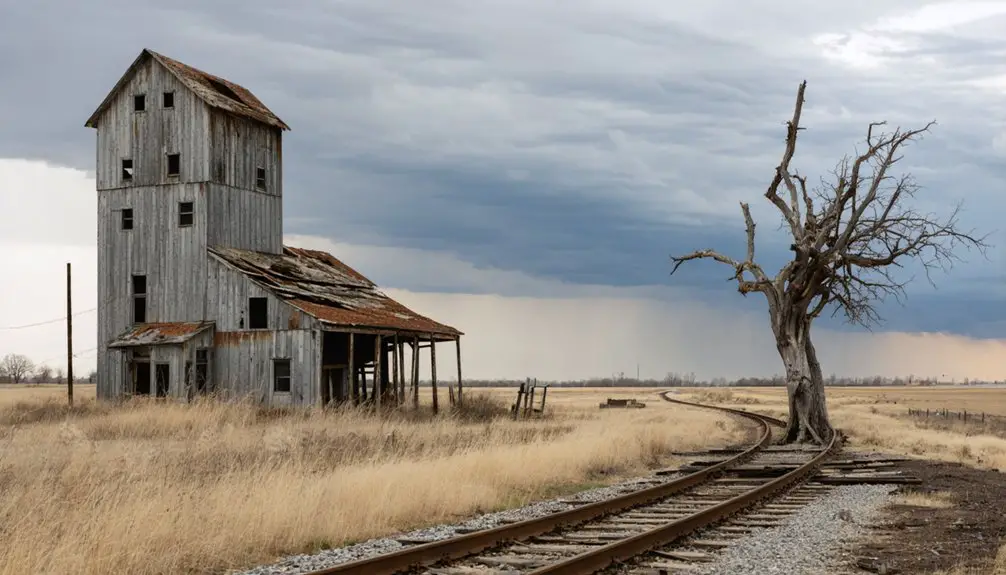
You’ll find Bodum’s ghost town site in a quiet corner of Isanti County’s section 16, accessible via I-35W north to MN-65. Navigate using coordinates 45°31’18″N 93°12’16″W through unmarked gravel roads branching east near Isanti Township. What awaits you is prairie-reclaimed land where only concrete house outlines, scattered debris, and one weathered white house remain as proof of this vanished settlement. Respect private property boundaries as you explore, and prepare for foot travel beyond where vehicles can venture into this forgotten landscape that holds deeper stories.
Key Takeaways
- Bodum sits in section 16, Isanti Township, at coordinates 45°31’18″N 93°12’16″W in east-central Minnesota’s Isanti County.
- Drive I-35W north 30 miles, merge onto MN-65 for 15 miles, then locate unmarked gravel roads near the coordinates.
- Only one white house and concrete foundations of twelve homes remain; the prairie reclaimed most of the settlement.
- Respect private property boundaries and prepare for foot travel where roads end in this rural, remote area.
- GPS navigation is essential for traversing Isanti County’s patchwork of fields and locating the unmarked ghost town site.
The Lost Settlement of Bodum: A Brief History
In the waning decades of the nineteenth century, when Minnesota’s prairie stretched endless and promising before land-hungry settlers, a small community called Bodum took root in soil that would never quite sustain it. You’ll find this settlement emerged during the state’s explosive growth phase, joining countless other hopeful towns platted across the territory.
Yet Bodum’s founders made one critical miscalculation: they chose land far from railroad lines and main roads. These key economic factors sealed the town’s fate before it truly began. Without transportation access, businesses couldn’t thrive and commerce stagnated. Cultural influences of the era valued progress and connectivity—things Bodum couldn’t offer.
The population remained sparse, unable to support municipal services. Eventually, the prairie reclaimed what ambition had briefly carved from its expanse.
Why Bodum Became a Ghost Town
Though Bodum experienced a brief moment of significance during the 1862 Dakota Conflict—when it housed a major fort and attracted settlers seeking safety—this wartime boom proved unsustainable. By the late 1880s, you’d have witnessed the town’s rapid unraveling.
The lack of infrastructure sealed Bodum’s fate: no railroad came through, and major roads bypassed the settlement entirely. Meanwhile, nearby Kimball offered what Bodum couldn’t—connections to the wider world and real opportunity.
Economic decline followed swiftly. Businesses packed up and relocated to Kimball, taking jobs and commerce with them. Without industry anchors or transportation networks, residents drifted away, chasing prosperity elsewhere.
The churches stood empty, the post office closed, and the cheese factory fell silent. Bodum simply faded, another casualty of progress choosing different paths.
What Remains at the Bodum Site Today
When you arrive at Bodum’s coordinates, you’ll find nothing but open farmland stretching toward the horizon—no weathered storefronts, no crumbling foundations, no trace of the settlement that once thrived here. The prairie has completely reclaimed what little the town left behind, erasing nearly all physical evidence of its brief existence.
You’ll need GPS to confirm you’ve even reached the right spot, as the landscape offers no visual clues that a community ever called this place home.
Empty Fields and Farmland
As you approach the coordinates 45°31′18″N 93°12′16″W in section 16 of Isanti Township, you’ll find yourself scanning empty fields that stretch toward distant tree lines, searching for something—anything—that whispers of a town called Bodum. The scenic vistas reveal only agricultural expanses where a community once thrived.
The landscape tells its story through absence of development:
- Endless cropland replaces what were once streets and gathering places
- Windswept acreage shows no trace of the creamery or ice house
- Solitary farmsteads dot horizons where neighbors once lived closer
- Unmarked ground conceals foundations beneath decades of plowing
- Open sky dominates where modest buildings once broke the prairie
You’re witnessing nature’s reclamation—a memorial to settlements that couldn’t overcome isolation.
Lost Structural Evidence
Unlike the completely vanished settlements that leave visitors guessing at their precise locations, Bodum offers tangible proof of its existence—though you’ll need to look carefully to find it. You’ll discover foundations of twelve houses lining what was once the main street, their concrete outlines mapping a community that’s been reclaimed by prairie grass.
Scattered industrial debris tells stories of resourceful lives—twisted metal fragments, rusted equipment, and eerie machinery patterns that hint at thriving operations. The decaying architectural remains include traces of a fire hall, school, and recreation area. A solitary street light post stands like a sentinel over empty lots where three-bedroom houses with garages once sheltered families.
Only one white house survives, a weathered witness to Bodum’s bustling past.
Today’s Bodum exists as a whisper in Minnesota’s farmland, demanding GPS coordinates to find what little remains. You’ll face routing challenges traversing Isanti Township’s rural roads, where coordinate-based navigation becomes essential. Punch in 45°31′18″N 93°12′16″W and trust your device—no highway signs point the way.
What awaits your discovery:
- Single repurposed store building serving as someone’s private residence
- Endless farmland stretching where creamery and ice house once stood
- Unmarked section 16 location requiring precise coordinates
- No historical markers or preserved structures
- Private property boundaries limiting exploration opportunities
The vanished community offers no grand revelations, just authenticity. You’re venturing beyond tourist trails into genuine abandonment, where Minnesota’s agricultural present has absorbed its mercantile past. Respect property lines while witnessing history’s quiet erasure.
Pinpointing Bodum’s Location in Isanti County

Nestled within the rolling farmlands of east-central Minnesota, Bodum occupies a quiet corner of section 16 in Isanti Township, where the prairie gradually surrenders to the woods. You’ll find this ghost town at precise coordinates 45°31′18″N 93°12′16″W—a designation that proves invaluable when you’re traversing roads that don’t acknowledge its existence on modern signs.
Your GPS becomes essential here, directing you through Isanti County’s patchwork of fields and forgotten homesteads. The site lies roughly within the broader Minneapolis-St. Paul metropolitan orbit, yet feels worlds removed from suburban sprawl.
When coordinating land surveys or examining property records, you’ll discover Bodum listed among fellow vanished communities like Athens and Blomford—names that once meant something to settlers who claimed this territory, their ambitions now reduced to archival footnotes and weathered foundations.
Driving Directions to the Bodum Ghost Town Site
- Launch northbound on I-35W for 30 miles, then merge onto MN-65 for the final 15-mile stretch
- Watch for Isanti High School—your five-mile warning marker before township entry
- Identify unmarked gravel roads branching eastward near coordinates 45.5°N, 93.3°W
- Respect private property boundaries amid residential pockets scattered through wilderness
- Prepare for foot travel where navigational challenges intensify beyond vehicle limits
- Summer (June-August): Comfortable 75-85°F highs with dry conditions perfect for wandering abandoned structures
- Fall (September-October): Peak foliage mid-October creates stunning photography backdrops, though first frosts arrive late September
- Winter (December-February): Extreme -30°F lows and 40-50 inches of snow make rural roads impassable
- Spring (April-May): Lingering snowmelt and frost risks through mid-May complicate access
- Optimal window: Late summer through early fall balances mild temperatures with clear visibility
- Sturdy footwear and weather-resistant layers protect you from Minnesota’s temperamental climate
- First-aid kit and emergency toolkit guarantee you’re prepared when isolation becomes real
- Portable charger and offline maps keep you maneuvering without signal dependency
- Water bottles and non-perishable snacks fuel your exploration through abandoned structures
- Multi-tool and duct tape solve unexpected challenges in forgotten territory
- Purple Hawk Country Club for golf rounds beneath wide-open skies
- Isanti County Historical Society where archival photographs reveal what those ghost towns once were
- K & A Mini Golf and Ice combining retro fun with seasonal activities
- Cambridge Union Cemetery (rated 5.0) connecting you to pioneer stories
- Winter Fest on February 28, 2026 featuring free rides, bonfires, and downhill sledding at Central Green
Fuel up in Isanti or Braham, as services vanish approaching the ghost town. Power lines and abandoned farmsteads become your compass, guiding you toward Bodum’s skeletal remains.
Best Time to Visit Bodum

Summer and early fall offer your best window for exploring Bodum, when dry conditions transform muddy forest roads into passable routes for your vehicle.
Spring’s snowmelt and frequent rains turn access roads into treacherous mud pits that’ll strand even experienced drivers, while Minnesota’s shifting weather patterns make reaching the site a gamble you’ll likely lose.
Plan your visit between late June and September when the ground firms up and you can safely navigate the backroads without worrying about getting stuck miles from help.
Seasonal Weather Considerations
When planning your ghost town exploration of Bodum, timing can mean the difference between an enriching adventure and a frustrating battle with Minnesota’s elements. Understanding weather variables helps you navigate Isanti County’s dramatic seasonal shifts, while smart travel logistics guarantee accessible backroads.
Key seasonal considerations for your journey:
Avoiding Muddy Conditions
Minnesota’s backroads transform into muddy quagmires during spring thaw and after heavy rains, turning your Bodum exploration into a tire-spinning ordeal. You’ll face serious road accessibility challenges when the ground’s saturated, especially since this ghost town sits off main routes where maintenance is minimal.
Plan your visit between late June and early October when muddy ground conditions are least likely. Summer’s dry stretches give you firm footing around the old store-turned-house and surrounding farmland. Fall offers crisp air and solid paths before winter locks everything down.
Check recent weather patterns before heading out. If it’s rained within three days, postpone your trip. These rural roads don’t drain quickly, and getting stuck means you’re truly isolated. Bring boots regardless—the freedom to explore shouldn’t end at a puddle.
What to Bring on Your Ghost Town Adventure
Before you set off into the weathered remnants of Bodum, you’ll want to pack strategically for both the expected and the unpredictable. Your packing checklist essentials should prioritize self-reliance since civilization feels miles away out here.
For off the grid photography tips, pack extra batteries—ghost towns don’t offer charging stations. Bring cash for any access fees, and trust your instincts with a personal alarm for complete peace of mind.
Other Abandoned Towns to Explore Near Bodum

Beyond Bodum’s crumbling foundations, Minnesota harbors dozens of ghost towns waiting to pull you deeper into the state’s forgotten corners. Head to Elcor near Gilbert, where an active mine pit swallowed an entire community—you’ll find a rusted fire hydrant and porcelain toilet marking where 1,000 souls once lived.
Forestville offers preserved buildings frozen in time, while Nininger’s ambitious dreams dissolved into farmland marked only by roadside plaques. Wasioja’s seminary ruins tell Civil War stories through crumbling barn foundations, and Radium’s faded farmhouse remnants dot western Minnesota’s agricultural expanse.
Each site demands your curiosity and respect—bring sturdy boots, water, and your sense of adventure. These vanished communities don’t advertise themselves; they reward those willing to wander off-grid.
Extending Your Trip: Cambridge and Isanti County Attractions
After wandering through abandoned settlements and crumbling foundations, you’ll find Cambridge offers a living counterpoint—a thriving hub where Isanti County’s past and present collide in the best possible way.
Base yourself at nearby lodging near Peterson Park, then chart your own course through:
Cap exploration days at Pine Brook Inn’s bar or grab pizza at Pizza Pub. This isn’t manufactured entertainment—it’s authentic small-town energy surrounding your ghost town quest.
Frequently Asked Questions
Is Permission Required to Access Private Farmland Where Bodum Once Stood?
Yes, landowner permission required before exploring Bodum’s farmland remnants. You’ll need to contact property owners directly or consult local historical society archives to identify current landholders and secure access to this vanished settlement’s private grounds.
Are There Any Historical Photographs or Maps of Bodum Available Online?
You won’t find Bodum in historical archives—the 2011 fire destroyed most records, and it’s too obscure for digitized collections. Your best hope lies in aerial photography from county assessors or requesting vintage plat maps from surviving records.
Can Metal Detectors Be Used to Find Artifacts at the Site?
You’ll need written landowner permission before detecting historical items at Bodum, as it’s private farmland. Traversing abandoned sites requires respecting property rights and Minnesota’s artifact protection laws, which prohibit unauthorized digging even in forgotten places.
Were Any Notable Events or Crimes Recorded During Bodum’s Brief Existence?
No notable crimes or mysterious disappearances marked Bodum’s quiet existence. You’ll find zero criminal records from this peaceful farming settlement—just hardworking families who simply drifted away when better opportunities called them elsewhere, leaving only whispers behind.
Are Guided Tours Available for Isanti County Ghost Town Sites?
No guided tours exist for Isanti County’s ghost towns—you’ll explore independently. Visitor experiences rely on self-discovery rather than interpretive signage. You’re free to roam Bodum’s remnants at your own pace, creating your own haunted narrative.