You’ll find Boonville’s ghost town remnants just two miles northeast of Bryan via FM 158, where coordinates 30°40’15″N 96°19’29″W lead to Texas’s original Brazos County seat. The 11.29-acre heritage park preserves an 1856 dogtrot cabin, replica courthouse, and cemetery where frontier surveyor Harvey Mitchell rests among weathered headstones. Visit during October’s Boonville Days festival for Civil War reenactments and chuck wagon lunches, or explore year-round when spring bluebonnets blanket the grounds where Mordecai Boon’s settlement once thrived.
Key Takeaways
- Boonville is located 2 miles northeast of Bryan at coordinates 30°40’15″N 96°19’29″W via State Highway 6 and FM 158.
- The 11.29-acre Heritage Park features an 1856 dogtrot cabin, replica courthouse, and bronze statues of Texas pioneers.
- Visit the historic cemetery to see graves of early settlers including surveyor Harvey Mitchell, who donated land for Texas A&M.
- Spring visits offer bluebonnet displays, while October’s Boonville Days festival features reenactors, crafts, and authentic frontier demonstrations.
- The site marks Texas’s colonial history from 1821-1831 when Mordecai Boon established Brazos County’s original government seat.
The Rise and Fall of Mordecai Boon’s Settlement
While Daniel Boone blazed trails through Kentucky’s wilderness, his nephew Mordecai charted a different frontier in Mexican Texas.
Between 1821 and 1831, you’ll find Mordecai Boon arriving with Stephen F. Austin’s second colony, claiming plantation land along the Brazos River. He joined fellow pioneers like Elliot McNeil Millican and Richard Carter, establishing what would become Boonville’s agricultural economy on John Austin’s league.
Finding Boonville: Directions and Coordinates
Today, pinpointing Boonville’s exact location requires traversing to coordinates 30°40′15″N 96°19′29″W, though you won’t find a bustling town square waiting for you. You’ll head two miles northeast of Bryan via Farm Road 158—locally known as Boonville Road—where a cemetery and Texas Centennial monument mark what historic land surveying once designated as Brazos County’s first seat.
Those original surveyors, working in 1841, could scarcely imagine modern GPS guiding visitors to their carefully platted townsite. Back then, early transportation methods meant dusty wagon trails connecting scattered settlements. Now you’ll cruise State Highway 6 before turning onto FM 158, trading horses for horsepower while hunting remnants of Mordecai Boon’s vanished community within Bryan’s current city limits.
Walking Through Boonville Heritage Park
Upon arrival at Boonville Heritage Park, you’ll step onto 11.29 acres that serve as the last preserved fragment of Brazos County’s original seat of government. The 1856 Turner-Peters dogtrot log cabin stands as authentic frontier architecture, its hand-hewn logs and 19th-century furnishings telling stories of Texas independence.
You’ll discover replica structures including the old courthouse, smokehouse, and Masonic Lodge, each detailed with informative panels explaining their historical significance.
Bronze statues of Sam Houston, Harvey Mitchell, and early Texas Rangers punctuate your exploration, creating exceptional historic photo opportunities against weathered wood and stone. Spring transforms the grounds into a wildflower spectacle, where bluebonnets carpet the earth beneath towering oaks.
Whether you’re walking solo or joining a docent-led tour, this peaceful remnant offers unscripted encounters with Texas’s pioneering past.
Stories From the Cemetery: Harvey Mitchell and Early Settlers
The weathered headstones of Boonville Cemetery hold the stories of Texas’s frontier builders, none more significant than Harvey Mitchell‘s final resting place. Born in 1821, Mitchell arrived in Texas at eighteen when his family couldn’t afford college. He transformed that setback into legendary success.
You’ll find his grave among the settlers he served from 1842 until his death in 1901. Mitchell’s pioneer land surveying efforts shaped Brazos County’s boundaries, while his work as chief justice, surveyor, and clerk established the region’s governmental foundation. Mitchell’s role in county education extended beyond serving as superintendent—he personally taught frontier children.
His greatest achievement came in 1871 when he led the committee that donated 2,500 acres to secure Texas A&M‘s location, outmaneuvering San Antonio itself.
Annual Events and Festivals at the Ghost Town Site
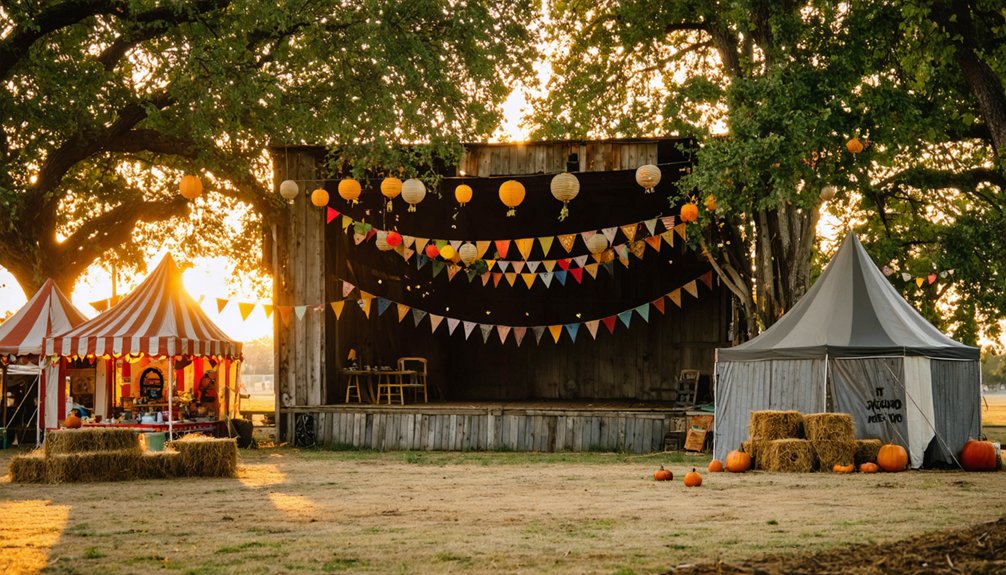
Every October, Boonville’s frontier spirit roars back to life during Boonville Days: Texas Heritage Festival, transforming the grounds of Brazos Valley Museum of Natural History into a living embodiment of 19th-century pioneer culture. You’ll encounter cowboys, Civil War reenactors, and costumed settlers demonstrating blacksmithing, flint-knapping, and traditional weaving from 9 am to 4 pm.
The festival features immersive pioneer activities including hands-on craft workshops, period games, and exploration of historical replicas like dogtrot cabins.
Your day can begin with the Buffalo Stampede 5K at 7:30 am—a fitting tribute to bison conservation efforts in Texas. Admission remains free, letting you experience pony rides, live period music, and authentic chuck wagon lunches without constraint. It’s frontier freedom without the hardship, celebrating Brazos County’s untamed heritage every third Saturday in October.
Frequently Asked Questions
What Are the Best Nearby Accommodations for Visiting Boonville, Texas?
You’ll find excellent budget-friendly lodging options near Boonville, from Motel 6 and Days Inn to charming local bed and breakfasts throughout Bryan’s historic district. These accommodations put you minutes from your ghost town adventure while keeping costs reasonable.
Are There Restroom Facilities Available at Boonville Heritage Park?
Yes, you’ll find restroom facilities at Boonville Heritage Park, though portable restrooms are available during peak seasons. The park’s hours of operation run dawn to dusk daily, but facility access can vary, so plan accordingly.
Can Visitors Bring Pets to the Ghost Town Site?
You’ll find pet friendly policies aren’t centrally documented for Boonville’s ghost town site. Research beforehand, respect leash requirements if visiting, and prepare for potential restrictions. Individual property owners establish their own rules, so you’ll need advance confirmation.
What Other Ghost Towns Are Within Driving Distance of Boonville?
You’ll find Bradshaw in Taylor County and Locker in San Saba County within driving distance. While these aren’t abandoned mining sites, you can explore local historical museums in Bryan to discover more about the region’s vanished communities and frontier heritage.
Is Photography Permitted Inside the Historic Buildings at the Park?
You’ll find photography freely welcomed throughout Boonville’s outdoor spaces, though the site contains no active historic buildings to enter. You can capture weathered monuments and cemetery stones, adjusting camera settings for Texas’s bright lighting conditions without restrictions.