Drive five miles southwest from Waxahachie on rural country roads to discover Boz, a ghost town where scattered foundations and a weathered cemetery tell stories of broken railroad promises and faded agricultural dreams. You’ll need your own vehicle since there’s no public transit, and you should download offline maps before venturing into areas with spotty cell service. Pack water and prepare for minimal amenities as you explore the raw landscape where Congress’s abandoned supercollider nearly erased this vanished community, and where Bethel Methodist Church still stands from its Hollywood moment in “Places in the Heart.”
Key Takeaways
- Boz is located 5 miles southwest of Waxahachie in Ellis County, accessible only by personal vehicle on rural country roads.
- Download offline maps before visiting due to spotty cell service in this remote area with no public transit options.
- The historic cemetery is the sole remaining landmark, with scattered ruins and a historical marker detailing the town’s history.
- Bring water and supplies as Boz offers no amenities, restoration efforts, or interpretive signs during exploration.
- Visit nearby Bethel Methodist Church, featured in “Places in the Heart,” which preserves its authentic 1800s character and sanctuary.
The Rise and Fall of a Texas Farming Community
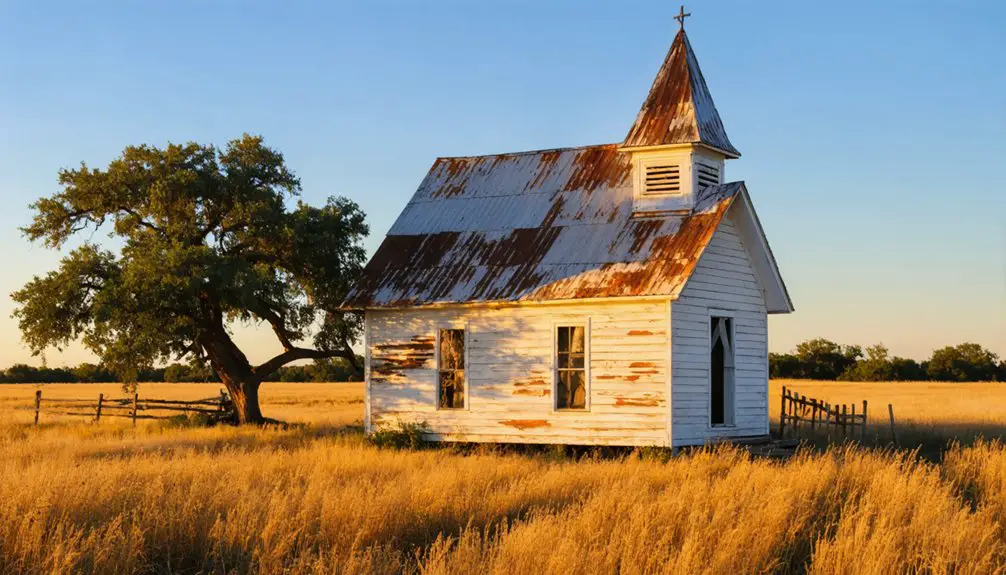
In the late 1880s, settlers carved out a farming community on what would become Farm Road 1493, five miles southwest of Waxahachie in the rich agricultural heartland of Ellis County. You’ll find lingering memories of when this place thrived—a post office from 1891 to 1906, Bethel Methodist Church standing as the community’s soul, and a schoolhouse educating farm children until 1943.
By the mid-1930s, seventy-five residents called Boz home, supporting three businesses that catered to their agricultural needs.
But agricultural decline hit hard. Population plummeted to fifteen by 1986. Then came the 1989 supercollider threat—federal plans that would’ve obliterated what remained. By 1992, only eighty-four-year-old Monnie Bratcher stayed behind. Though the project died, so had the town.
Getting to Boz From Waxahachie
Today’s ghost town explorers will find Boz much easier to reach than Monnie Bratcher found it to leave. Your journey begins in Waxahachie, where route planning tools like Google Maps and Waxe offer real-time directions to this Ellis County hamlet. The drive’s a short rural jaunt—neighboring communities like Forreston and Midlothian sit just miles away, suggesting you’ll cover minimal distance on country roads.
For navigation resources, MapQuest provides step-by-step guidance while satellite views reveal the terrain you’ll traverse. Since public transit doesn’t serve these backroads, you’ll need your own vehicle. Download offline maps before departing—cell service gets spotty in remote areas.
Interactive mapping tools let you zoom into obscure turnoffs where Boz’s remnants await your discovery along dusty Texas lanes.
What Remains: Exploring the Ghost Town Today
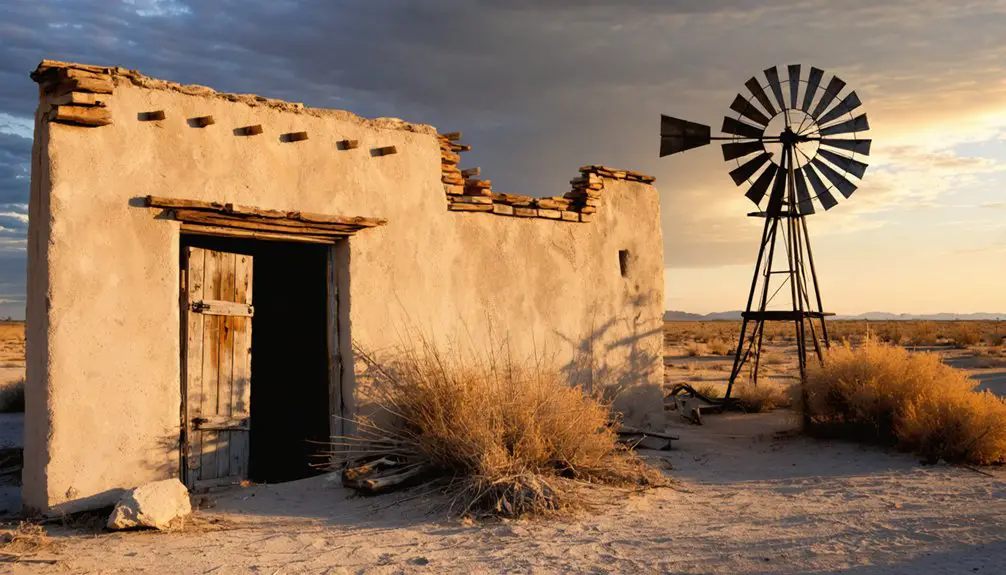
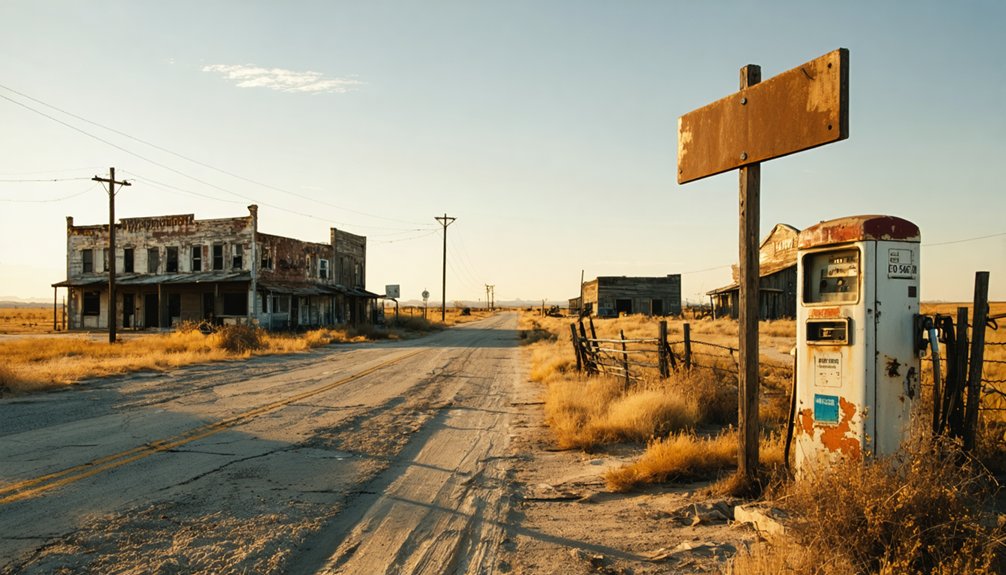
Little survives where Boz once thrived—a cemetery stands sentinel over vanished dreams, its weathered headstones the town’s most enduring testimony. You’ll discover scattered ruins claimed by creeping vegetation, their original purposes obscured by time’s relentless march. Agricultural relics peek through sandy soil, remnants of farming ambitions that couldn’t sustain a community.
The historical marker reveals what your eyes can’t see—railroad promises broken, a county seat lost, prosperity redirected elsewhere. There’s no cemetery restoration project here, no manicured grounds or interpretive signs. This ghost town exists in raw authenticity.
You’re free to roam these empty acres, piecing together fragments of frontier optimism. Pack water and prepare for minimal amenities. This isn’t curated history—it’s Texas unvarnished, where abandonment teaches harder lessons than preservation ever could.
Bethel Methodist Church and Its Hollywood Fame
While Boz itself crumbled into obscurity, Bethel Methodist Church—four miles from the ghost town’s skeletal remains—carved an unexpected path to cinematic immortality. In 1984, director Robert Benton’s film crew transformed this 1924 sanctuary into the emotional heart of “Places in the Heart.”
You’ll recognize the church’s opening and closing scenes, where forgiveness unfolds across its original wood pews and floors.
The film crew’s impressions clearly resonated—they left the structure virtually untouched, preserving its authentic character. Adjacent to the cemetery, God’s Acres pavilion hosted the film’s second dance scene, cementing the local church legacy beyond Ellis County.
Today, you can visit this active congregation where Hollywood and hardscrabble Texas history intersect. The sanctuary remains remarkably unchanged, though air conditioning now tempers the summer heat.
The Supercollider That Almost Erased History
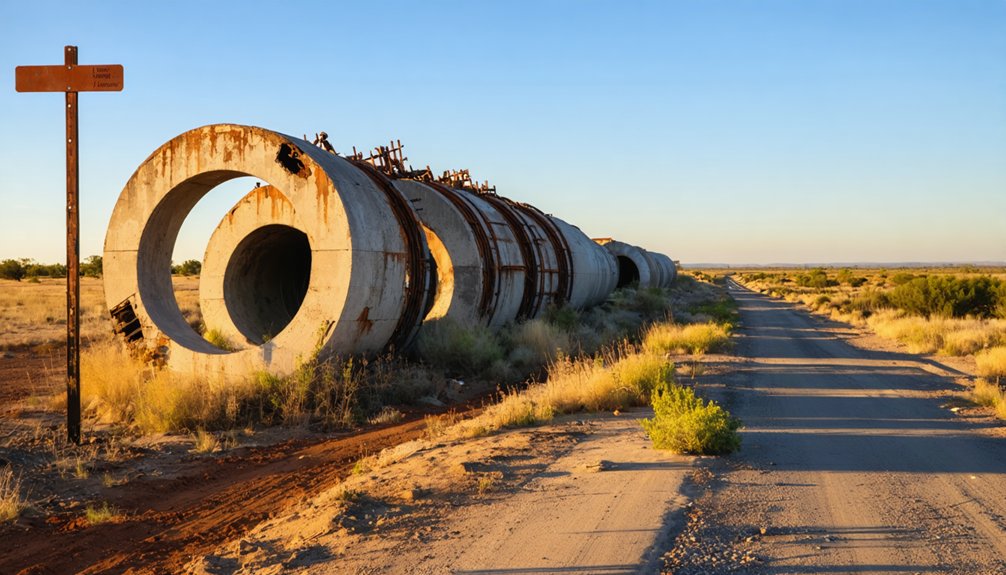
Just as Bethel Methodist Church found salvation through cinema, Boz itself nearly met annihilation at the hands of atomic science. In 1988, Ellis County won the prize nobody anticipated: hosting the world’s largest particle accelerator. The “Desertron” would’ve carved a 54-mile ring beneath Waxahachie, with abandoned underground tunnels snaking directly through Boz’s historic footprint.
Construction crews sank seventeen shafts and bored sixteen miles before Congress pulled the plug in 1993, killing the $10 billion project. Rural community impacts proved devastating—$2 billion spent, dreams shattered, and 14-foot-diameter tunnels left to flood and decay.
Today, those concrete shells stand as monuments to scientific ambition gone sideways, while Boz survived to remain beautifully, defiantly untouched.
Best Time to Visit and What to Bring
Spring and fall offer the most comfortable conditions for exploring Boz’s remnants, when Texas heat won’t drain your energy and golden-hour light transforms weathered structures into photographic treasures. Pack a DSLR or mirrorless camera with multiple lenses, sturdy boots for traversing overgrown paths, and plenty of water since you’ll find no services in this forgotten settlement.
You’ll also need a first-aid kit, fully charged phone, and someone who knows your route—cell service is unreliable in Ellis County’s remote corners.
Ideal Seasons for Exploring
Timing your visit to Boz can transform a mediocre ghost town experience into an unforgettable adventure. October through November delivers prime conditions—temperatures cool dramatically after summer’s brutal 90°F-113°F range, while fall foliage patterns paint West Texas landscapes in amber hues.
Spring weather trends bring spectacular April wildflowers, though you’ll need to dodge unpredictable thunderstorms and tornadoes. Summer’s extended daylight offers exploration time, but relentless heat drives most adventurers indoors.
Winter presents unpredictable swings between perfect 70°F hiking days and frigid bluster. Your best bet? Late autumn’s clear skies and mild temperatures create ideal rambling conditions without summer’s oppressive heat or spring’s violent storms. November particularly shines—fewer tourists, comfortable temperatures, and crystal-clear visibility for photographing crumbling structures against endless Texas horizons.
Essential Photography Equipment
Once you’ve locked in your November travel dates, the right photography gear transforms Boz’s weathered facades and collapsed interiors into powerful visual stories. Your camera body preferences should lean toward mirrorless or DSLR models with high-resolution sensors that excel in low-light conditions—essential for capturing the ghost town’s shadowy corners and twilight atmospheres.
Lens selection prioritization matters equally. Pack a wide-angle lens for sweeping abandonment vistas, a prime lens for intimate detail work on rusted artifacts, and a versatile zoom for compositional flexibility. Don’t forget your tripod for long-exposure shots that reveal star trails over silent structures, plus powerful LED lights to illuminate forgotten spaces. These tools guarantee you’ll capture Boz’s haunting beauty without constraints, freezing decay’s poetic moments exactly as you envision them.
Rural Safety Preparations
When planning your Boz expedition, you’ll find March through May delivers the sweet spot for rural exploration—mild 70-80°F temperatures blanket Ellis County’s open fields, eliminating the brutal heat stress that turns summer ghost town visits into survival ordeals.
Fall’s 60-75°F days offer equally comfortable conditions with crisp, low-humidity air perfect for traversing FM 1493’s narrow pavement.
Essential Safety Gear:
- Vehicle Readiness: Pack spare tires and full fuel tanks—Waxahachie’s stations sit 10-15 minutes away, and debris-strewn roads guarantee flats
- Communication Backup: Carry satellite communicators since cell coverage dies five miles southwest of town
- Wildlife Protection: Prepare for livestock encounters and feral hog crossings at dusk; off road safety demands high-clearance vehicles for gravel shoulders
Bring 2-3 gallons of water daily and first-aid supplies—copperheads thrive in overgrown ghost town remnants.
Combining Boz With Other Ellis County Attractions
Your exploration of Boz becomes infinitely richer when you weave it into a broader Ellis County itinerary, with the historic county seat of Waxahachie sitting just five miles northeast on FM 1493. The town’s 1891 red sandstone courthouse anchors a Victorian downtown district that transforms ghost town curiosity into architectural wonder.
You’ll discover nearby roadside attractions along the highway, including historical markers detailing the region’s late 1880s farming heritage. Waxahachie offers over 40,000 residents worth of amenities—fuel, lodging, and restaurants—making it your basecamp for day-long explorations.
The annual Scarborough Renaissance Festival adds seasonal entertainment, while local farming museum exhibits illuminate the agricultural roots that once sustained communities like Boz. Tours of the abandoned Superconducting Supercollider tunnels provide a stark counterpoint to Victorian optimism, revealing how progress sometimes leaves emptiness behind.
Photography Opportunities in the Abandoned Landscape
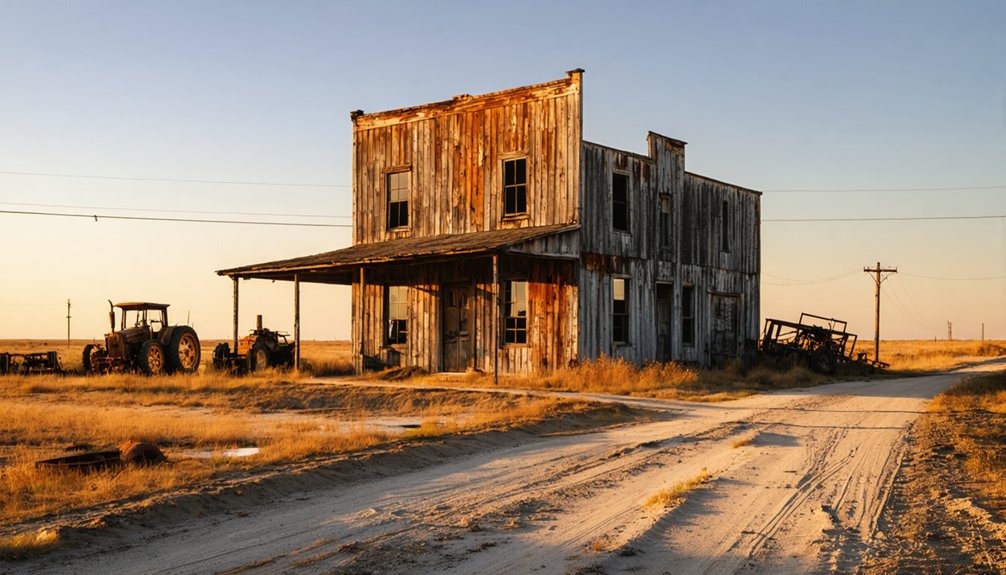
The weathered facade of Bethel Methodist Church commands attention across empty fields, its isolated wooden frame rising against endless Texas sky like a monument to vanished communities. You’ll find compositional balance effortlessly here—the church’s dramatic silhouette against golden hour light creates powerful negative space that draws viewers into the forgotten ambiance.
Three Essential Photography Approaches:
- Underground Exploration: Descend into the Superconducting Super Collider tunnels with wide-angle lenses to capture cavernous concrete expanses and dystopian industrial textures
- Macro Decay Details: Focus on rust, peeling paint, and moss patterns across 1880s-era wooden structures for intimate tactile studies
- Aerial Context Shots: Launch drones to reveal Boz’s complete abandonment—weathered buildings scattered across vast agricultural plains
Night brings unobstructed star trails above the ruins, while seasonal dust storms transform scenes into haunting monochromatic compositions.
Extending Your Trip: Nearby Ghost Towns and Historic Sites
Five miles northeast of Boz, Waxahachie’s 1894 courthouse anchors a Victorian downtown where ornate limestone facades and wraparound porches transport you to the 1890s oil boom.
You’ll find a dozen more ghost towns scattered across Ellis County’s farm roads—Auburn’s weathered cemetery markers, the vanished streets of Bradley and Bristol, and the eerie abandoned tunnels of the Superconducting Super Collider that almost erased Boz entirely.
Each site adds layers to your exploration, transforming a single ghost town visit into a full weekend of forgotten Texas history.
As you venture into new locations, you might find hidden treasures and stories waiting to be unearthed. Exploring ghost towns in Texas offers a unique glimpse into the lives of those who came before us. Each abandoned building and quiet street tells a tale, inviting you to piece together the rich tapestry of the state’s past.
Waxahachie’s Victorian Architecture Tour
Rising from the Texas prairie like something out of a European storybook, Waxahachie’s Ellis County Courthouse commands your attention with its Romanesque Revival battlements, turrets, and 90-foot clock tower. This 1897 masterpiece anchors Texas’s finest concentration of 19th-century Victorian architecture highlights, earning the town its “Gingerbread City” nickname.
Experience the gingerbread trail tour experiences each June, where you’ll explore:
- Five historic districts on the National Register, featuring Queen Anne, Classical Revival, and Prairie School styles
- Private restored homes with original details and local ghost stories
- Vintage automobiles parked around the courthouse square, adding nostalgic atmosphere
The West End’s 77-acre district showcases ornate embellishments that’ll transport you beyond modern constraints into an era of unbridled architectural creativity.
Ellis County Ghost Towns
Beyond Waxahachie’s restored grandeur, Ellis County’s backcountry roads lead you through a haunting landscape where vanished settlements tell stories of ambition, hardship, and eventual abandonment. You’ll discover Alsdorf, India, Ghost Hill, Rockett, and Reagor Springs—communities that once thrived but now exist only in faded records and local community stories.
India offers the richest exploration opportunities, with old photographs preserving its vanished streets and documented founder narratives. Reagor Springs hints at water-source origins that attracted early settlers, while Rockett’s railroad connections reveal boom-and-bust patterns. Ghost Hill lives up to its evocative name—a town that simply ceased to exist.
These forgotten places require GPS coordinates and determination. You won’t find historic structures still standing, but the open landscape itself becomes your museum, revealing Texas’ relentless cycle of settlement and surrender.
Supercollider Site Exploration
Just southwest of Waxahachie, where Farm Road 1493 cuts through Ellis County farmland, you’ll find one of America’s most ambitious scientific failures—the abandoned Superconducting Super Collider. Construction began in 1991 on this 54.1-mile ring before Congress pulled funding in 1993.
While the site’s now home to Magnablend’s chemical facility repurposing, echoes of its $2 billion investment remain.
What You’ll Discover:
- Underground tunnels exploration reveals rusting equipment from the unfinished particle accelerator, though access is restricted
- Massive concrete structures built with 6-foot foundations designed for atomic-level precision measurements
- Historic context of how this project nearly erased Boz entirely before its cancellation preserved the ghost town
The site’s transformation from cutting-edge physics to industrial chemical production tells its own peculiar Texas story.
Planning Your Day Trip Itinerary
When you’re plotting your adventure to Boz, timing makes all the difference between a rushed scramble and a leisurely exploration of this vanished Texas community. Depart Waxahachie by 9 AM, giving yourself two hours at Bethel Methodist Church and the school remnants where film history meets abandonment. Dedicate another hour to the supercollider tunnels—those concrete monuments to ambition gone wrong.
Reserve your afternoon for wandering farmland trails, camera ready for golden-hour shots across empty fields.
Your packing essentials include water, snacks, sturdy boots, and sun protection—there’s nothing out here. For local lodging options, Waxahachie hotels sit thirty minutes away, perfect basecamp for extending your ghost town immersion. Budget four to six hours total, leaving flexibility for spontaneous detours down forgotten roads where freedom feels tangible.
Frequently Asked Questions
Is There Cell Phone Service Available in Boz and Surrounding Areas?
You’ll find virtually zero cell phone coverage quality in Boz’s remote wilderness. Connectivity issues near Boz are severe—major carriers struggle reaching this isolated ghost town. Download maps beforehand, embrace the digital detox, and savor true off-grid freedom.
Are There Any Restaurants or Gas Stations Near Boz for Travelers?
Boz offers limited services, so you’ll need to venture to nearby Terlingua for charming local eateries like Starlight Theatre and High Sierra Bar & Grill, plus modern fuel stations at Big Bend Adventures Resort—essential stops for your remote desert journey.
Is It Legal to Enter the Abandoned Buildings in Boz?
No, entering Boz’s abandoned buildings isn’t legal without permission. You’ll face potential trespassing liability under Texas law, plus historical preservation concerns protect these structures. Always seek landowner consent before exploring—respecting property rights keeps your adventure legitimate and safe.
Are There Guided Tours Available for the Ghost Town Site?
Boz remains a sleeping relic without official guided excursions. You’ll forge your own path through weathered ruins on self-guided tours, embracing total freedom to explore this forgotten settlement at your own pace, unbound by schedules or restrictions.
What Safety Precautions Should Visitors Take When Exploring Boz Alone?
When exploring alone, you’ll need reliable recovery gear and shared itinerary details. Be aware of potential hazards like unstable structures and contaminated materials. Exercise caution when trespassing—seek permission first. Pack defensive tools, first aid supplies, and weather-appropriate clothing for unexpected conditions.