Your Bradford ghost town road trip centers on the 224-acre Bradford Village Historic District along the Pawcatuck River, featuring 149 contributing buildings dating to 1732. You’ll explore the former Bradford College campus where documented paranormal activity filled Denworth Hall and Academy Hall throughout the 1980s, plus underground tunnels linked to H.P. Lovecraft legends. Extend your journey to nearby Hanton City’s CCC-era ruins in Smithfield Woods, where crumbling foundations and the Alfred Smith Cemetery await discovery among Washington County’s most historically significant haunted locations.
Key Takeaways
- Bradford is a census-designated place in Washington County, Rhode Island, with 1,437 residents and a National Register historic district.
- The Bradford Village Historic District spans 224 acres with 149 contributing buildings along the Pawcatuck River’s southern bank.
- Former Bradford College features documented paranormal activity in Denworth Hall, Academy Hall, and maintenance tunnels from the 1960s-70s.
- Underground campus tunnels spawned legends including H.P. Lovecraft allegedly hiding the Necronomicon, fueling ghost stories for decades.
- Nearby Hanton City ruins off Route 116 offer abandoned CCC-era stone structures, foundations, and the Alfred Smith Cemetery.
Understanding Bradford’s Historic Significance and Census-Designated Place Status
Bradford stands as both a census-designated place and a nationally recognized historic district in Washington County, Rhode Island, straddling the towns of Westerly and Hopkinton. You’ll discover this working-class village earned National Register status on May 30, 1996, preserving structures dating to 1732.
The census defined boundaries identify it as one of 26 CDPs statewide, housing 1,437 residents as of 2023. You’ll find demographic diversity reflected in its population: 83.7% White, 6.5% multiracial, and other communities comprising the remainder.
Named after Bradford, West Yorkshire, England, this southwestern Rhode Island settlement showcases architectural styles including Greek Revival, Tudor Revival, and Bungalow/Craftsman. The median age sits at 37.1 years, indicating an established community preserving its heritage while maintaining accessible, unincorporated governance.
Exploring the Bradford Village Historic District’s 224 Acres
Spanning 224 acres along the Pawcatuck River‘s southern bank, this National Register district preserves 149 contributing buildings within its boundaries—a chronicle, record, or account of Rhode Island’s industrial heritage since its 1996 designation. You’ll discover the district extending from the 1890 Boston and Maine Railroad depot northeast through the business core, following railroad tracks southward across Waits River to the defining escarpment.
Historic preservation efforts have transformed this landscape through:
- Transportation Enhancement funding supporting early 2000s improvements
- Preserve America Community designation in August 2004
- Community revitalization initiatives addressing former environmental contamination
- Active theater conversion of the Old Church (originally 1793-95)
Your exploration reveals authentic 19th-century mill village architecture, from Greek Revival residences on North Main Street to industrial structures documenting Bradford’s continuous operation until 2019.
Uncovering the Haunted Legacy of Bradford College Campus
You’ll find Bradford College’s most documented paranormal activity centered in Denworth Hall and Academy Hall, where students reported both residual and intelligent hauntings throughout the 1980s.
The campus’s network of underground tunnels—confirmed to exist but not beneath Tupelo Pond—fueled decades of ghost stories and contributed to one particularly notorious legend involving H.P. Lovecraft and a hidden Necronomicon.
These accounts, preserved through alumni testimonies and pre-closure student experiences, establish Bradford as one of New England’s most actively haunted academic sites before its 2000 closure.
Underground Tunnels and Legends
Beneath the abandoned Bradford College campus, a network of maintenance tunnels winds through the foundations of century-old buildings, connecting structures like the Academy building to classroom facilities and the Bell Study Center. Built during campus expansions in the late 1960s and early 1970s, these passages served practical purposes but spawned darker legends among students and alumni.
The most persistent tale involves H.P. Lovecraft allegedly hiding the real Necronomicon in a sealed tunnel beneath man-made Tupelo Pond. While former students from 1980-1984 confirm no such passages exist under the pond, the legend endures alongside reports of:
- Unexplained sightings of light orbs in closed-off sections
- Suffocating darkness when tunnel lights click off unexpectedly
- Unsolved disappearances tied to underground exploration
- Spooky atmospheres in accessible maintenance corridors
You’ll find these tunnels intertwined with Bradford’s haunted legacy.
Most Haunted Campus Buildings
Five buildings across Bradford College’s 24-acre campus earned reputations as centers of documented paranormal activity, with reports spanning from the institution’s operational years through its abandonment in 2000.
The Historic Academy Building dominates investigations, where a tragic student-priest relationship ending in death generated mysterious sightings of both spirits. Its covered basement pool from the 1940s sparked additional drowning-related speculation.
Denworth Hall and Academy Hall—nicknamed “The Bradford Hilton”—documented both residual and intelligent manifestations throughout the 1980s. Former residents reported intensifying activity following specific traumatic events.
Tupelo East Dormitory’s psychic disturbances trace to a student’s severe LSD experience in Fall 1979, with subsequent occupants abandoning affected rooms mid-semester.
The Bell Study Center’s tunnel network connecting campus structures generated reports of unexplained phenomena when lighting failed.
Investigating the Underground Tunnels and H.P. Lovecraft Connection
Rhode Island’s underground spaces weave through local folklore with varying degrees of historical legitimacy, from the extensively documented East Side Railroad Tunnel to the more speculative Bradford College network. Bradford’s campus tunnels connecting Academy Hall to classroom buildings served maintenance functions, though rumors persist about more extensive passages beneath Tupelo Pond. The Lovecraft connection remains unverified internet folklore—no primary sources confirm the horror writer visited Bradford or concealed Necronomicon artifacts in these spaces.
When investigating access points of tunnels and possible Lovecraft artifact locations, you’ll find:
- Academy Hall basement connections remain most documented
- Drained swimming pool area between student union and Academy building
- Tupelo Pond access tunnel, likely for machinery rather than smuggling
- East Side Railroad Tunnel’s 5,080-foot span offers legitimate exploration prospects
The defunct campus’s hauntings persist independent of fictional book hiding tales.
Venturing to Hanton City Ruins in Nearby Smithfield Woods
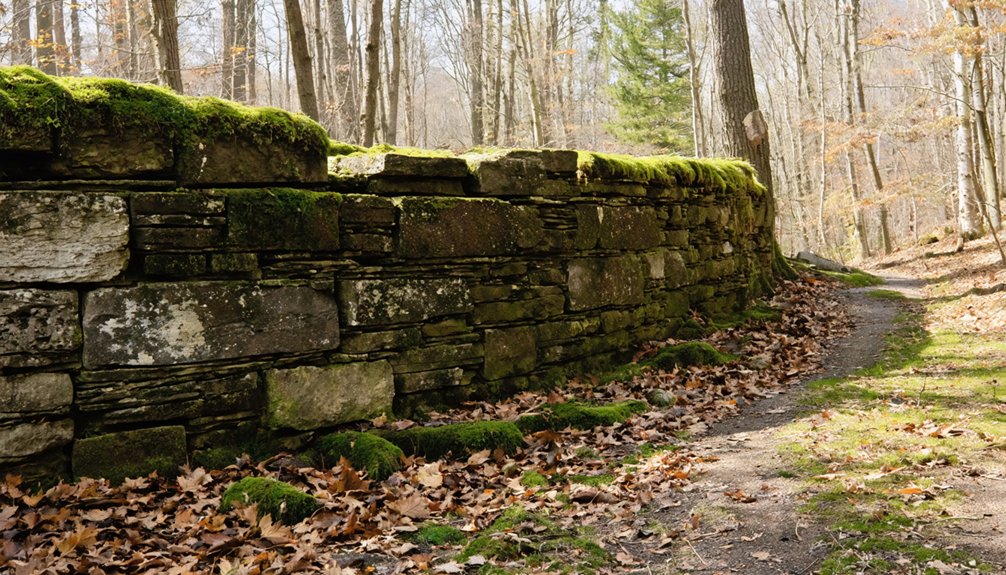
After exploring Bradford’s mysteries, you’ll find the Hanton City ruins just northeast along Route 116 in Smithfield’s woods, where 16 acres of abandoned CCC-era stone structures await discovery among the trees.
The settlement’s dramatic decline from a bustling 1930s picnic grove to forgotten ruins has spawned local legends about its abandonment, though historical records point to the post-1950s shift toward air travel destinations over roadside recreation.
You can access the wooded site via trails off George Washington Highway, where stone fireplaces and overgrown pathways mark what was once a popular gathering place built by the Civilian Conservation Corps.
Locating the Settlement Remains
Locating Hanton City’s ruins requires determination and preparation, as the abandoned settlement sits approximately three-quarters of a mile along the Hanton City Hiking Trail from its trailhead at 70 W. Reservoir Road. Dense vegetation obscures the site year-round, making prior knowledge essential for traversing the wooded terrain and identifying landmark cellar holes scattered throughout clearings.
Key features to locate include:
- Stone foundations and deteriorating walls typical of New England farming communities
- A defunct irrigation dam deep within the woods
- Corn crib foundations where raised storage structures once stood
- The Alfred Smith Cemetery with readable headstones bearing the Smith family names
The ruins spread across a vast area, requiring careful exploration. Large trees growing from foundation sites confirm abandonment exceeding a century, while ground-level artifacts mark original settlement locations despite overwhelming overgrowth.
Myths Behind the Abandonment
Beyond the crumbling foundations and overgrown clearings, Hanton City’s abandonment has spawned numerous legends that obscure its documented history. You’ll encounter tales of mysterious plagues and alien abductions, yet no historical records validate these claims.
The unexplored origins of myths often overshadow verifiable facts: this settlement peaked in the 1730s before economic collapse drove residents elsewhere. The impact of economic factors on abandonment proves straightforward—new highway routes diverted essential trade traffic, forcing impoverished tanners and bootmakers to sell their properties and relocate.
Discovering Rhode Island’s Most Notorious Haunted Locations
Rhode Island’s haunted reputation extends far beyond its colonial graveyards into abandoned college tunnels, shipwreck shores, and forest ruins that preserve centuries of tragic history. The supernatural folklore surrounding Bradford College centers on tunnels beneath Tupelo Pond where Denworth Hall and Academy Hall harbor both residual and intelligent spirits. Tupelo East dorm remains tied to a fatal 1979 LSD incident.
Your road trip should include:
- Hanton City Ruins – Late 1600s settlement abandoned before 1850, hidden in Smithfield woods with Herendin family origins
- Ghosts of the Palatine Ghost Ship in Block Island – Dutch vessel Princess Augusta wrecked by wreckers in 1738; spectral ship returns annually
- Old Narragansett Church Cemetery – Unconsecrated since 1799 church relocation
- Mercy Brown’s Territory – Vampire revenant legend from 1892 possibly inspiring Bram Stoker
Planning Your Westerly Area Ghost Tour Experience

As darkness settles over Westerly’s historic downtown, multiple tour operators guide visitors through two centuries of documented supernatural encounters along the Pawcatuck River banks and colonial-era streets. Your operator research should focus on three primary choices: Seaside Shadows offers historian Courtney McInvale’s original ghost tour departing from Wilcox Park, while Downtown Westerly Ghost Tour meets at 45 Broad Street’s Town Hall steps, and US Ghost Adventures explores the haunted Pawcatuck War Memorial. All provide two-hour lantern-led walks with trained storytellers equipped with voice amplifiers.
For those intrigued by the history and mystery of abandoned places, there are several ghost towns near Rhode Island that offer a glimpse into the past. Exploring these forgotten sites can provide additional context to the chilling tales shared during ghost tours. Each location tells its own story of prosperity, decline, and the whispers of spirits that may still linger among the ruins.
Tour participant feedback consistently highlights engaging narratives about Devil’s visits, cursed pirate treasure, and New England’s deadliest shipwrecks. Reserve weekend or weeknight slots—tours run rain or shine with free cancellation. Street parking surrounds both meeting points, and guides wear spooky attire carrying lanterns for easy identification.
Mapping Your Route Through Washington County’s Paranormal Sites
Your exploration of Washington County’s haunted landscape requires careful planning, as paranormal sites span approximately 40 miles from Westerly’s coastal haunts to Bradford’s inland mysteries. While extensive documentation remains scattered, you’ll find secluded landscapes harboring documented paranormal phenomenon throughout this region.
Essential route-planning considerations include:
- North Light’s isolation on Block Island (established 1867) demands ferry scheduling and daylight navigation
- Seasonal accessibility varies greatly, with rural roads becoming impassable during winter months
- Private property boundaries require verification before investigating reported sites
- Historical society records in each town provide authenticated locations versus folklore
You’ll need topographical maps and local archives to verify legitimate paranormal sites. Community historians often guard specific coordinates, respecting both property rights and preservation efforts while sharing authenticated accounts with serious researchers.
Essential Tips for Your Bradford Ghost Town Adventure

Before venturing into Bradford’s abandoned sites, you’ll need specialized equipment beyond standard ghost-hunting gear. Sturdy boots and flashlights prove essential when exploring Woodville’s scattered ruins near the dam and falls. You’ll want cameras for documenting tunnel entrances beneath the former college campus, particularly around Tupelo Pond access points.
Examining historical records at local archives reveals precise locations of the 1847 Seventh Day Baptist Church site and railway connections to Wood River Junction. When mapping community concerns, respect private property boundaries—the 224-acre historic district contains 149 buildings with ongoing ownership.
Connect with Bradford Coalition members who understand environmental legacies from the dyeing operations. Their insights into factory locations and pollution remediation efforts provide context for your investigation while honoring residents’ lived experiences.
Frequently Asked Questions
Are the Bradford College Underground Tunnels Accessible to Visitors Today?
No, you can’t access Bradford College’s underground tunnels today. Since 2000, tunnel access restrictions and abandoned building safety concerns have closed most passages, with Northpoint Bible College now controlling the private campus requiring institutional permission.
What Is the Best Time of Year to Visit Bradford?
You’ll find fall ideal for Bradford visits, with seasonal changes bringing October’s ghost tour peak and mild temperatures. Weather considerations favor September through early November, when Rhode Island’s paranormal events multiply and outdoor exploration conditions remain comfortable.
Are There Any Guided Ghost Tours Specifically for Bradford College?
You won’t find Bradford College tours—it closed in 2000 in Massachusetts. However, Bradford, Rhode Island offers self-guided walking tours through its ghost town remains. For paranormal investigation sessions, you’ll need to explore independently, respecting this abandoned community’s history.
Do I Need Permission to Explore the Hanton City Ruins?
Yes, you’ll need permission since it’s private property access on Dow Chemical Company land. Rhode Island’s trespassing laws apply, though hikers commonly use the trail. Contact the landowner directly to guarantee you’re exploring legally and respecting property rights.
Are There Nearby Accommodations for an Overnight Ghost Hunting Trip?
You’ll find several bed and breakfasts like The Villa in central Bradford, plus Pleasant View Inn nearby. Local campgrounds offer additional options for your overnight ghost hunting adventure. Westerly hotels start around $77 if you’d prefer traditional lodging.