You’ll find Browning nine miles southeast of Winona in Smith County’s piney woods, accessible from Tyler (12.8 miles west) or Kilgore (12.2 miles east) via FM 2767’s dirt roads. This unincorporated settlement at 453 feet elevation reveals weathered ruins, scattered foundations, and a pioneer cemetery marking its 1879-1902 post office era when cotton ginning transformed scattered farmsteads into community. The skeletal gin structures and abandoned church stand against Texas heat, their stories preserved only in courthouse archives and the landscape itself—secrets that unfold with each crumbling brick.
Key Takeaways
- Browning sits 9 miles southeast of Winona at coordinates 32.38389°N, 95.08417°W, accessible via Tyler or Kilgore.
- The ghost town features weathered ruins including a gristmill, sawmill, abandoned church, and skeletal cotton gin structures.
- The old pioneer cemetery remains the most intact feature, with scattered foundations and historic dwelling shells nearby.
- Browning operated a post office from 1879-1902 and peaked at 50 residents during the 1890s cotton era.
- Seasonal variations affect dirt roads from FM 2767; plan accordingly when visiting this unincorporated settlement at 453 feet elevation.
Getting to Browning: Directions and Route Planning
Tucked away in the pine-studded countryside of eastern Texas, Browning rests at coordinates 32.38389°N, 95.08417°W—a ghost town that time nearly forgot along Farm to Market Road 2767, also known as Old Kilgore Highway.
You’ll find this unincorporated settlement nine miles southeast of Winona, perched on the eastern edge of the Chapel Hill oilfield at 453 feet elevation. Public transportation options don’t reach these remote coordinates—you’ll need your own wheels to explore this vanished community.
Navigate via Tyler (12.8 miles west) or Kilgore (12.2 miles east) as your base points. Seasonal variations affect the dirt roads branching from FM 2767, so plan accordingly during wet months when the terrain becomes challenging and the isolation feels even more profound. When planning your visit, remember that Smith County operates on Central Time Zone (UTC -6 hours), which is important for timing your daylight exploration hours. The town shares its name with various locations worldwide, as Browning serves as a place name disambiguation on geographic references.
What Remains: Exploring the Abandoned Settlement
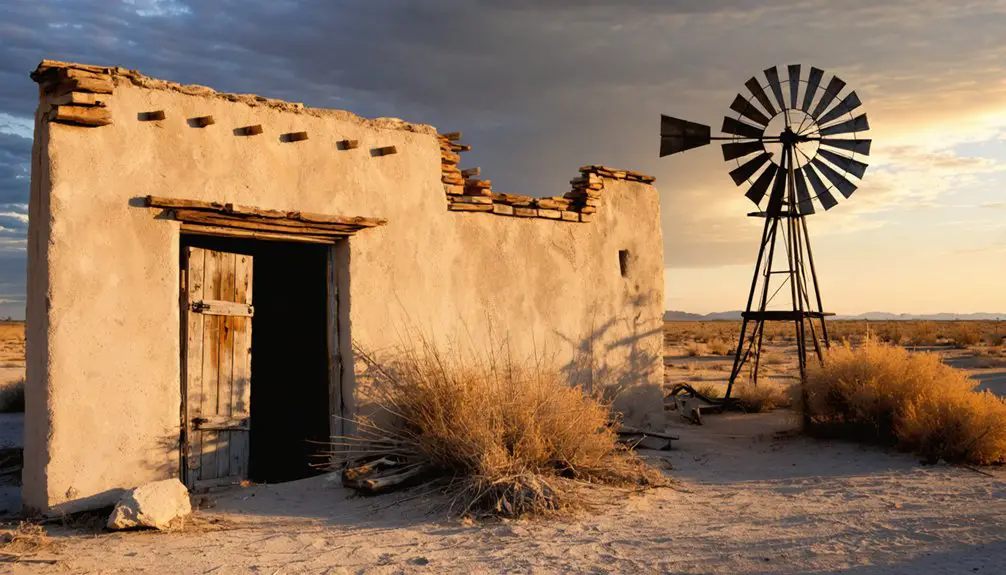
When you arrive at Browning, you’ll find weathered adobe and stone ruins slowly surrendering to the relentless Texas heat and wind.
The old cemetery stands as the most intact feature, where granite monuments mark pioneer graves, including sixteen-year-old Virgil Hill’s 1878 burial.
Scattered foundations, deteriorating brick remnants, and historic markers dot the landscape, telling silent stories of the frontier community that thrived here before the railroad passed it by in 1881. Like many Texas settlements, Browning suffered when the railroad lost relevance as trucks and automobiles took to newly improved roads. The Navasota River Ranch offers accommodations just 30 minutes away for visitors exploring the area.
Physical Structures Still Standing
Though time and the elements have claimed most of Browning’s original structures, enough fragments remain along County Road 370 to trace the settlement’s footprint. You’ll discover gristmill remains scattered across the site, their weathered stones marking where settlers once ground their harvest.
The sawmill ruins integrated into the landscape tell stories of timber-driven commerce that fueled this 1850s community.
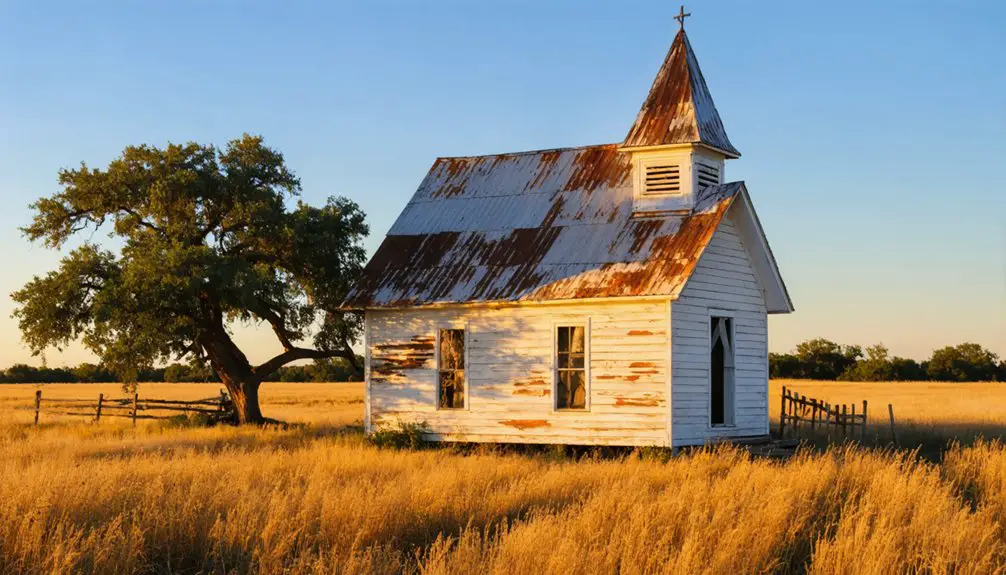
The abandoned church stands with partial walls defying gravity, while door frames from the old saloon create haunting thresholds to nowhere. Isaiah Browning’s legacy lives through foundation stones where the general store once served customers, and rubble marks the post office that operated from 1879 to 1902.
The cotton gin’s skeletal structures punctuate the horizon, and scattered dwelling shells dot the accessible grid. Near the cemetery remains, you can find the only preserved burial ground that marks the final resting place of Browning’s earliest settlers. The district school once educated local children before the community’s decline transformed Browning into the ghost town you can explore today.
Historical Markers and Artifacts
Unlike the neighboring ghost towns of McMullen County that boast official Texas Historical Commission markers, Browning exists in the gaps of documented history. You won’t find commemorative plaques detailing Isaiah Browning’s 1850s arrival from Oxford, Mississippi, or bronze markers celebrating the early 1870s settlement boom. What remains are traces buried in historical land deeds and settler records—fragments of a community that vanished without ceremonial recognition.
While McMullen County preserves its Dog Town Jail and Boot Hill Cemetery with official markers, Browning’s story survives through property transfers and handwritten ledgers. Boot Hill Cemetery itself began with a suicide victim, eventually growing to include occupants who met their ends through various causes. There’s no gravesite preservation effort here, no maintained cemetery with perpetual care trusts like Cross Cut’s. The nearby Mud Creek Cemetery, by contrast, has served the Thrifty and Fry communities continuously since 1862, with its first recorded burial being infant Martha Blackwell in 1864. You’re exploring a settlement that refused institutionalization, where freedom-seeking pioneers left only whispers in courthouse archives and fading memories across abandoned prairie.
The Post Office Era: 1879-1902 Timeline
As federal recognition arrived in 1879, the Browning community secured its first post office with William A. Owens at the helm. You’ll discover this marked the beginning of a turbulent twenty-three-year chapter defined by post office relocation dynamics that shaped the settlement’s identity.
The original location served residents until 1898, when community leadership shifts moved operations to nearby Starrville. Within a year, local determination brought it back to Browning, reflecting the fierce independence of these frontier settlers. You can trace this back-and-forth through the landscape today, imagining the nine-mile journeys residents made for their mail.
By the 1890s, the population stabilized around 50 as the community established essential services including a sawmill, church, district school, and even a saloon. While Browning developed its infrastructure, the county seat remained in Center, which had been established as a post office in 1866 and incorporated in 1893.
Cotton Gin Operations and Community Facilities
You’ll find remnants of Browning’s economic heartbeat in the cotton gin that once hummed eighteen to twenty-four hours daily during harvest season, processing the white gold that defined this community’s existence.
The gin powered Browning’s transformation from scattered farmsteads into a functioning town, drawing farmers from miles around who needed their cotton processed and creating demand for supporting businesses.
Standing where the gin once operated, you can imagine the continuous rumble of steam engines and the sight of wagons lined up during those intense August-to-December seasons when the entire community revolved around cotton.
Historic Cotton Gin Operations
When the first cotton gin rolled into Texas from Georgia in 1825, it sparked an agricultural revolution that would transform the state’s economy for generations. By 1860, approximately 2,000 gins dotted the Texas landscape, with community reliance on cotton ginning becoming the backbone of rural prosperity.
You’ll discover this legacy lived through system ginning—Robert Munger’s mid-1880s innovation that used pneumatic conveyance and multiple gin stands to revolutionize operations. Cooperatives emerged as farmers pooled resources to build custom plants, operating 18-24 hours daily during peak season.
Today, cotton gin preservation efforts keep this heritage alive at places like Burton Farmers Gin, established in 1914 and still operating as America’s oldest. Only 164 commercial gins remain statewide, silent witnesses to Texas’s independent agricultural spirit.
Supporting Community Infrastructure
The cotton gin’s economic engine couldn’t run on machinery alone—it demanded roads to haul cotton bales, water systems for processing needs, and public facilities to support the workers and families who called these agricultural centers home. You’ll find remnants of this rural infrastructure coordination throughout Browning—crumbling water towers, overgrown roadbeds, and foundations where community buildings once stood.
These settlements required remote communities engagement long before modern programs existed: fire stations to protect valuable cotton stores, schools for children, health clinics for workers. Today’s ghost towns reveal what happens when that support network vanishes. Walking these abandoned streets, you’re tracing the invisible threads that once bound rural Texas communities together—infrastructure that gave isolated agricultural outposts their fighting chance at permanence. Exploring ghost towns in Texas offers a unique glimpse into the past, showcasing the resilience of those who once called these places home. Each crumbling structure tells a story of hope and hardship, echoing memories of lively gatherings and bustling trade that have long since faded. As time continues to reshape the landscape, these remnants serve as a poignant reminder of the communities that fought to survive in the face of adversity.
Chapel Hill Oilfield: The Economic Context
Agricultural commodity market shifts followed inevitably. Cotton cultivation gave way to derricks along Old Kilgore Highway, as gin mills shared space with equipment yards.
Transportation networks expanded, general stores stocked drilling supplies, and what began as a farming settlement evolved into an extraction hub—temporarily thriving before petroleum economics eventually claimed another Texas town.
Best Time to Visit Eastern Smith County
Today’s abandoned foundations and overgrown derrick sites welcome exploration year-round, though Eastern Smith County’s continental climate demands strategic planning. You’ll find prime exploring conditions from mid-October through mid-November, when weather patterns shift toward comfortable 58-88°F temperatures and rainfall drops below summer’s oppressive humidity.
Spring’s mid-March to mid-April window offers similar freedom, with mild 70-84°F days perfect for photographing weathered structures before April’s thunderstorms arrive.
Summer’s 93-94°F heat tests your endurance from June through September, though 217-248 sunny days annually mean you’re never truly limited. Winter brings surprising accessibility—occasional freezing nights can’t compete with mild 58°F January highs. These seasonal changes rarely produce the 28-inch snowfall typical elsewhere, keeping Browning’s forgotten streets perpetually accessible to determined explorers.
Nearby Attractions in the Winona Area
You’ll find the historic Starrville Post Office standing as a weathered sentinel just minutes from Winona, its century-old walls whispering stories of frontier mail routes and pioneer communities.
The nearby Chapel Hill oilfields invite you to witness East Texas’s black gold legacy through specialized tours that reveal the region’s petroleum heritage. These authentic sites offer a stark contrast to Browning’s ghost town mystique while deepening your understanding of the forces that shaped—and sometimes abandoned—these rural Texas communities.
Historic Starrville Post Office
Though the original Starrville Post Office relocated to Winona over a century ago, its story remains woven into the fabric of this historic area. You’ll discover that this postal hub first opened in 1849 as Gum Springs before moving to Starrville in 1857, serving as the community’s crucial connection to the outside world. The role of postmaster in community affairs extended far beyond sorting mail—this position anchored commerce and communication for nearly two hundred residents at the town’s peak.
When Starrville rejected the railroad in the late 1870s, you can trace how this decision sealed its fate. By 1907, both the original post office building and its operations shifted to rail-accessible Winona, where progress couldn’t be stopped by stubborn nostalgia.
Chapel Hill Oilfield Tours
While Chapel Hill itself doesn’t offer organized oilfield tours, the Winona area sits firmly within East Texas oil country, where black gold transformed sleepy communities into roaring boomtowns throughout the early twentieth century. You’ll find oil production data charting Winona’s activity from 1993 through 2010, documenting the region’s persistent petroleum legacy.
Drive the backroads and you’ll spot active drilling sites and weathered pumjacks still drawing crude from beneath Smith County soil. Historical oilfield markers dot the landscape throughout East Texas, commemorating the legendary strikes at Spindletop, Corsicana, and the massive East Texas field that stretched to nearby Kilgore and Longview. These self-guided explorations let you trace the industry that built fortunes, sparked martial law, and forever changed Texas—perfect for travelers seeking authentic, unfiltered history.
Photography Tips for Ghost Town Exploration
When dust swirls through broken doorways and shadows pool in abandoned corners, capturing Browning’s haunting beauty demands both technical precision and creative vision. Master ambient lighting techniques by arriving at golden hour, when dawn’s soft glow penetrates crumbling structures and creates dramatic contrasts. Your tripod becomes essential for 30-second exposures that tame harsh light while revealing hidden textures.
Subject framing approaches transform ordinary scenes into powerful narratives. Position your wide-angle lens low to emphasize vast emptiness, or climb to elevated vantage points for sweeping establishing shots. Curate each frame deliberately—remove distractions and spotlight weathered chairs or discarded books as centerpieces. Pack flashlights for painting light across dim interiors, and don’t forget your cleaning kit to protect gear from relentless Texas dust. These techniques access Browning’s ghostly essence.
Comparing Browning to Other Texas Ghost Towns
Browning’s quiet dissolution stands apart from the violent ends that claimed most Texas ghost towns. While Aldridge burned repeatedly and Indianola drowned beneath hurricane waves, Browning simply faded when settler community development couldn’t sustain itself.
You won’t find the dramatic ruins of New Birmingham’s exploded furnaces or Thurber’s sprawling coal infrastructure here. Instead, Browning represents something rarer: a community that recognized its limits. Without mining veins to extract or ports to fortify, Isaiah Browning’s descendants faced honest economic drivers versus decline.
No catastrophic fires. No cursed widows. No Gulf storms. Just families packing wagons when the math stopped working. That restraint makes Browning uniquely Texan—pioneers who knew when to fold, leaving behind whispers rather than wreckage for you to discover.
Starrville Connection: Where the Community Moved
Unlike Browning’s gradual fade into prairie silence, Starrville absorbed displaced communities with the gravitational pull of a town that refused to die. When Baker Springs consolidated in 1927, Starrville erected a new schoolhouse—vernacular-styled with double-dropped siding that still stands at 17936 FM-16E.
School consolidation disputes fractured the community along County Road 369: Olin Weaver’s refusal to send his children to Winona sparked a territorial divide that persists today. West-side families still bus to Winona; east-siders head to Gladewater.
You’ll find the community preservation efforts immortalized in that 1927 building, now operating as Starrville Community Center—marked by Texas Historic Landmark No. 7760. It’s evidence of stubborn East Texas resilience, where towns don’t disappear—they simply reorganize.
Frequently Asked Questions
Is Browning on Private Property or Open to Public Exploration?
Browning’s land ownership status keeps you off-limits—it’s private ranch property requiring permission. You’ll find nearby points of interest like Garner State Park for legal exploring, while respecting those no-trespassing signs protecting this historic site’s boundaries.
Are There Safety Concerns Like Unstable Structures or Wildlife in Browning?
Yes, you’ll face structural stability issues with crumbling buildings, missing roofs, and fire-damaged walls that could collapse unexpectedly. While wildlife concerns aren’t heavily documented, the abandoned structures and isolated location create unpredictable hazards you should navigate carefully.
What Supplies Should Visitors Bring for a Remote Ghost Town Visit?
You’ll need bottled water—at least one gallon daily—and snacks for sustenance like energy bars. Pack navigation tools, first aid supplies, and a flashlight for exploring crumbling structures. Don’t forget sun protection and emergency communication devices for true off-grid freedom.
Can Visitors Camp Overnight Near the Browning Ghost Town Site?
Unfortunately, you’ll find no overnight accommodations availability directly at Browning’s abandoned ruins. However, nearby camping locations exist within driving distance, where you can establish your basecamp before venturing into this forgotten Texas settlement’s mysterious, weathered remains.
Are There Guided Tours Available for Browning and Surrounding Ghost Towns?
No guided tours exist for Browning, but you’ll discover freedom exploring independently with photography opportunities at every crumbling corner. Contact local historical societies for insider knowledge, then chart your own course through these untamed ruins.
References
- https://www.southernthing.com/ruins-in-texas-2640914879.html
- https://mix931fm.com/cherokee-county-ghost-towns/
- https://www.youtube.com/watch?v=phjUE19A8HM
- https://en.wikipedia.org/wiki/List_of_ghost_towns_in_Texas
- https://texascooppower.com/old-haunts/
- https://texashighways.com/culture/history/the-lost-underwater-towns-of-texas/
- https://www.ghosttowns.com/states/tx/browning.html
- https://www.tshaonline.org/handbook/entries/browning-tx
- https://en.wikipedia.org/wiki/Browning
- https://texas.hometownlocator.com/tx/smith/browning.cfm