To plan your ghost town road trip to Buchanan, Iowa, start in Bennett, swing through Tipton, then head 9.5 miles northeast along the old Rock Island Railroad corridor into Cedar County’s forgotten past. You’ll find concrete bridge piers standing sentinel at the Cedar River, marking where rails once carried commerce. Pack water, respect private property, and consider adding Otterville and Newtonville to your route. There’s far more history hiding along these backroads than you’d expect.
Key Takeaways
- Buchanan, Iowa, a ghost town in Cedar County, was platted in 1857 and declined after Rock Island Railroad tracks were removed in 1946.
- Start your road trip in Bennett, drive southwest to Tipton, then head 9.5 miles northeast to reach Buchanan as the focal point.
- Key remnants include concrete bridge piers at the Cedar River, marking where the historic Rock Island railroad bridge once stood.
- Extend your trip to nearby ghost towns Otterville and Newtonville for additional historical context about Cedar County’s pioneering era.
- Pack water, snacks, and emergency supplies, check weather forecasts, and respect private property boundaries throughout your exploration.
What Is the Ghost Town of Buchanan, Iowa?
Nestled in the southeast quarter of section 24 in Buffalo Township, the ghost town of Buchanan sits along Buffalo Creek in Cedar County, roughly 9.5 miles northeast of Tipton.
Platted in 1857, Buchanan history traces back to a thriving pioneer settlement locals once nicknamed “Mudville.” Its post office operated under the name Buffalo Grove from 1855 to 1885, serving as a crucial community hub.
The Rock Island Railroad once connected Buchanan to the wider world, running daily trains between Rock Island and Cedar Rapids directly through town.
Ghost town significance here lies in what remains — concrete bridge piers spanning the Cedar River stand as silent reminders of a once-bustling rail corridor.
When the tracks came up in spring 1946, Buchanan’s role as a living community effectively ended.
How to Get to Buchanan From Tipton
Reaching Buchanan from Tipton takes you along a 9.5-mile stretch northeast that once traced the old Rock Island Railroad line — a route that carried daily trains between Rock Island and Cedar Rapids before the rails came up in spring 1946.
Tipton history runs deep here, as this corridor connected county seats and commerce long before the line was abandoned.
Following the former rail path northeast, you’ll pass through open terrain that speaks to Buchanan’s geography — a village tucked into the southeast quarter of section 24, Buffalo Township, sitting quietly along Buffalo Creek.
Watch for the concrete piers still standing where the Rock Island bridge once crossed the Cedar River between Buchanan and Plato. Those remnants are your reward for making the drive.
What’s Still Standing in Buchanan’s Ghost Town Today?
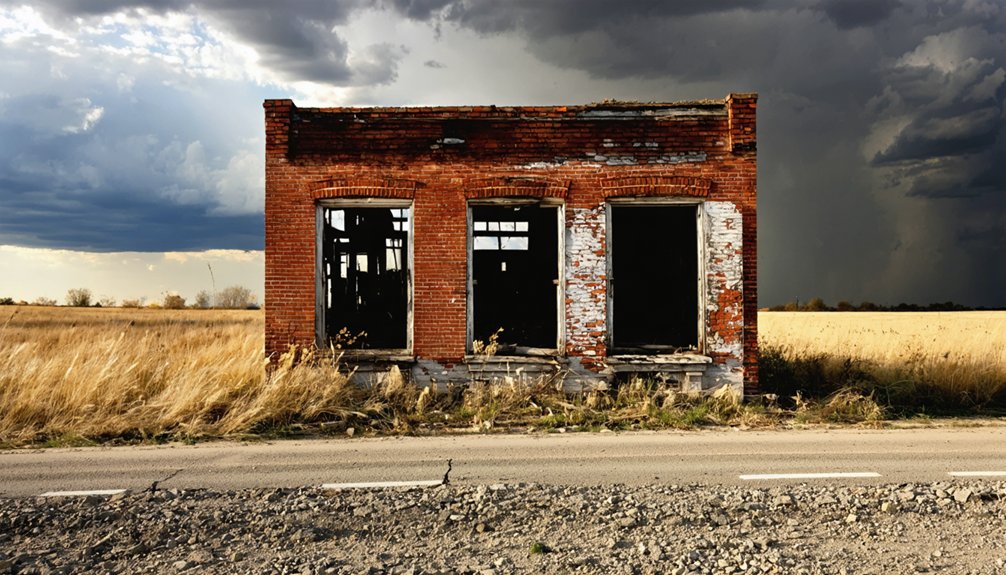
When you arrive at Buchanan today, you won’t find much of the bustling village that once served daily Rock Island trains, but the concrete piers of the old railroad bridge spanning the Cedar River still stand as silent sentinels of the town’s past.
You can spot these weathered remnants where the line once carried freight and passengers between Tipton and Plato, giving you a tangible connection to the community’s rail-dependent heyday.
Beyond the bridge piers, scattered traces of Buchanan village itself remain, letting you piece together the outline of a once-active hamlet that locals affectionately — or perhaps ruefully — called Mudville.
Concrete Railroad Bridge Piers
Standing sentinel over the Cedar River, the concrete piers of the old Rock Island railroad bridge are the most striking remnants you’ll find at Buchanan today.
These silent pillars represent concrete history embedded directly into the riverbed, rising from the water like forgotten monuments to a busier era. You’re looking at bridge engineering that once carried daily scheduled trains between Rock Island and Cedar Rapids, connecting this tiny hamlet to a much larger world.
Walk the riverbank and study each pier carefully. Notice how they’ve held their ground for decades since the tracks were torn up in spring 1946.
Nobody’s maintaining them, nobody’s claiming them — they simply endure. For explorers craving unfiltered history, these piers deliver exactly that: raw, weathered proof that Buchanan once mattered.
Remnants Of Buchanan Village
Beyond the bridge piers, Buchanan’s ghost town offers a quieter kind of discovery. You won’t find preserved storefronts or marked historic sites here — Buchanan history has largely returned to the earth.
What remains are subtle village remnants: the landscape itself, shaped by settlers who platted this ground in 1857 along Buffalo Creek.
Walk the area and you’re tracing paths once busy with freight wagons and daily rail passengers traveling between Rock Island and Cedar Rapids. The local nickname “Mudville” feels fitting as you scan the quiet terrain.
Nature has reclaimed most of what stood here. Still, standing where a functioning community once thrived — complete with its own post office named Buffalo Grove — connects you directly to Iowa’s pioneering past in a way no museum can replicate.
How the Railroad Killed Buchanan : and Then Disappeared Itself
When the Rock Island branch line arrived, it didn’t save Buchanan — it quietly sentenced it.
You can trace the town’s decline directly to railroad decisions made far from Cedar County, as shifting routes drained traffic and commerce away from stops like Buchanan in favor of more profitable corridors.
Railroad Routes Shift Economies
Irony has a way of making history sting. The same railroad evolution that bypassed Buchanan eventually consumed itself. Those Rock Island rails, once carrying daily trains between Cedar Rapids and Clinton, got torn up for wartime needs in 1946. The line that killed Buchanan’s future couldn’t survive its own economic shifts.
You’re standing in a landscape shaped by decisions made in distant boardrooms. When rail routes changed, money followed the tracks elsewhere, leaving towns like Buchanan gasping. Merchants relocated, post offices closed, and populations scattered toward wherever the next locomotive stopped.
That’s the brutal arithmetic of railroad-era America — your town either sat on the right line or it didn’t. Buchanan drew the short straw twice: abandoned by progress, then abandoned by the very thing that abandoned it.
Tracks Removed, Towns Abandoned
The spring of 1946 marks a grim bookend to Buchanan’s story: the Rock Island rails that had bypassed the town were finally torn up, stripped away for wartime material needs. That removal sealed the ghost town history of an already struggling settlement.
The railroad impact cut both ways — first ignoring Buchanan, then vanishing entirely.
Here’s what that erasure left behind:
- Concrete bridge piers still spanning the Cedar River
- A former rail corridor connecting Bennett, Tipton, Plato, and Elmira
- No daily trains between Rock Island and Cedar Rapids
- A town platted in 1857 now barely traceable
- Tracks gone 20 years before writers even documented the loss
You can still follow that phantom route today — the land remembers what the maps forgot.
Which Ghost Towns Near Buchanan Complete the Drive?
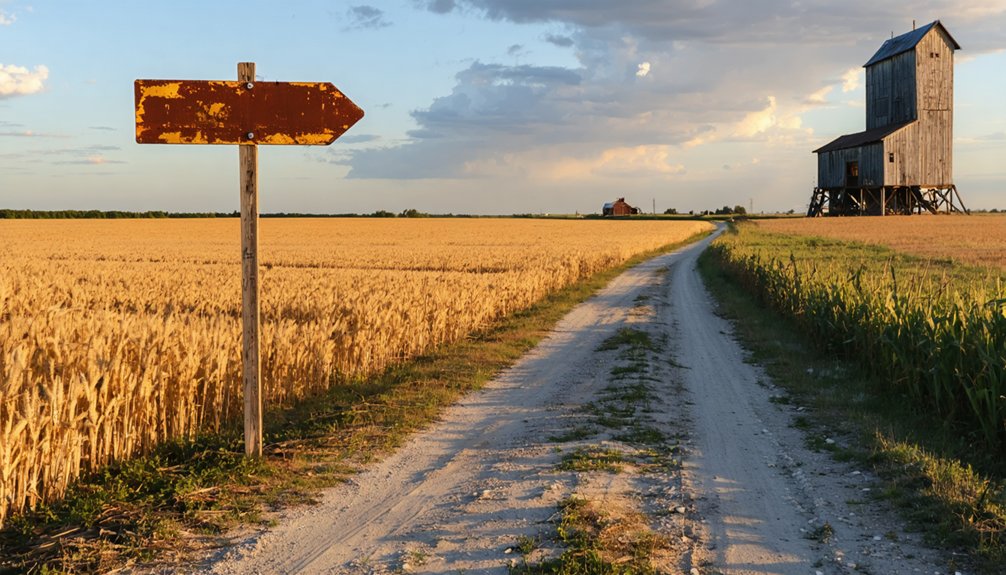
Why stop at Buchanan when several nearby ghost towns can round out your road trip through Cedar County’s forgotten past?
Otterville sits northeast on section 19 of Washington Township along Otter Creek, platted in 1857 and operating a post office until 1900. It once hummed with sawmills and gristmills before fading into silence.
Otterville once hummed with sawmills and gristmills along Otter Creek — now only silence remains.
Newtonville, tucked in section 16 of Newton Township, also ran a post office from 1871 to 1900, sitting just south of Monti.
Then there’s Avon, originally called Fink’s Grove, which changed names twice before disappearing entirely.
Each stop deepens your ghost town exploration and adds genuine historical significance to your journey. Together, these forgotten settlements paint a vivid picture of Cedar County’s pioneering ambitions and its quieter, inevitable surrender to time.
When Should You Visit Buchanan and What Do You Need?
Planning your Buchanan ghost town visit well makes all the difference between a rewarding trip and a frustrating one. The best seasons are late spring through early fall, when roads stay passable and Cedar River crossings remain safe.
Follow these travel tips before heading out:
- Bring a camera to capture concrete bridge piers and overgrown foundations
- Wear sturdy footwear since terrain around Buffalo Creek gets uneven
- Download offline maps because rural Cedar County has spotty cell coverage
- Pack water and snacks as no services exist in abandoned Buchanan
- Check weather forecasts since Iowa storms roll in fast and unpredictably
You’re exploring land that railroads built and abandoned, so respect private property boundaries and leave everything exactly as you find it.
How to Plan Your Ghost Town Road Trip Route

Tracing the old Rock Island line gives you the most logical framework for a Buchanan ghost town road trip, since the railroad corridor once connected Bennett, Tipton, Buchanan, Plato, and Elmira in a single westward arc.
Start in Bennett, then drive southwest toward Tipton before heading 9.5 miles northeast to Buchanan itself. At the Cedar River crossing, you’ll spot concrete piers — all that remains of the Rock Island railroad bridge. That bridge tells the whole story of railroad impact on this region: once the rails came out in spring 1946, Buchanan’s commercial lifeline snapped.
Extend your route to include nearby ghost towns like Otterville and Newtonville, where ghost town history follows the same pattern — post offices closing, mills going silent, communities dissolving into farmland.
Frequently Asked Questions
Was Buchanan, Iowa Ever Considered for County Seat Status?
The knowledge doesn’t confirm Buchanan, Iowa’s historical significance as a county seat contender. You’ll find it thrived as a railroad hub and trading village, but it’s distinct from Buchanan County’s administrative centers entirely.
Are There Any Local Guides or Ghost Town Tours Available?
No formal tours exist, but you’ll uncover rich local history by exploring Cedar County’s forgotten roads yourself. Chase ghost stories through Buchanan’s concrete bridge piers and abandoned rail paths — freedom-seekers thrive on self-guided adventures like this!
Did Any Notable Historical Figures Originate From Buchanan Village?
The available Buchanan history doesn’t highlight notable residents by name, but you’ll discover the village’s pioneer settlers shaped Cedar County’s early identity, making every visit feel like uncovering forgotten stories of remarkable, freedom-seeking individuals.
Are Overnight Camping Options Available Near the Buchanan Ghost Town?
You’ll find limited campground amenities near Buchanan’s ghost town history, but Cedar River’s scenic surroundings offer free, open-air camping spots where you can pitch your tent, breathe freely, and explore Iowa’s fascinating abandoned past independently.
What Wildlife or Nature Can Visitors Expect Along the Cedar River?
Even if you’re not a naturalist, you’ll love Cedar River’s rich river habitats. Spot herons, eagles, and deer for stunning wildlife photography. Nature’s alive here, rewarding every curious explorer who ventures out!
References
- https://ia601407.us.archive.org/4/items/historyofbuchana00will/historyofbuchana00will.pdf
- https://pubs.lib.uiowa.edu/annals-of-iowa/article/id/6960/download/pdf/
- https://www.youtube.com/watch?v=mbmDFj5eNqM
- https://kids.kiddle.co/List_of_ghost_towns_in_Iowa
- http://cedarrapids.advantage-preservation.com/viewer/GetPdfFile?43544754
- http://genealogytrails.com/iowa/buchanan/abandoned_towns_01.htm