Your Byers road trip starts in Pratt, Kansas, where you’ll stock up on fuel and snacks before heading into prairie emptiness. Navigate by offline maps since cell service vanishes quickly, and arrive during spring or fall when oppressive heat won’t drain your enthusiasm. You’ll find L&W Repair Shop‘s blue NAPA sign marking civilization, crumbling train platforms whispering railroad glory, and the repurposed bank building that’s survived 140 years of prairie punishment. The complete route through surrounding ghost towns like Zenith and Willis reveals how Kansas’s ambitious railroad fever left behind accidental monuments.
Key Takeaways
- Visit during spring or fall for ideal photography conditions and comfortable temperatures, avoiding oppressive summer heat.
- Base yourself in Pratt for fuel, food, and lodging, located just miles from Byers with essential amenities.
- Download offline maps before arrival, as cellular signals fade in this remote prairie location with 38 residents.
- Explore the 1947 church, cemetery one mile west, repurposed bank building, and railroad remnants for authentic ghost town photography.
- Combine your Byers visit with nearby ghost towns like Zenith’s grain elevator or Willis’s intact historic core.
The Rise and Fall of Byers Through the Decades
The story of Byers begins not with its own founding, but with the death of its predecessor. When railroad tracks bypassed Naron around 1910, you’d have watched an entire community pack up and move south. They christened their new home after railway president O.P. Byers in 1914, and by 1921, you’re standing in Kansas’s busiest cattle shipping point—100 residents strong.
The rural economy thrived until 1933, when the bank collapsed. You’d see families scrambling as their savings vanished overnight. The railroad quit in 1940, sealing Byers’s fate. Agricultural decline couldn’t sustain what remained. That devastating 1966 fire merely cremated what was already dying. Today, 38 souls occupy what progress abandoned—a monument to America’s forgotten railway towns.
What Remains Standing in Modern-Day Byers
When you roll into Byers today, the L&W Repair Shop hums with actual activity—a working business among the weathered storefronts that tells you this town hasn’t completely surrendered.
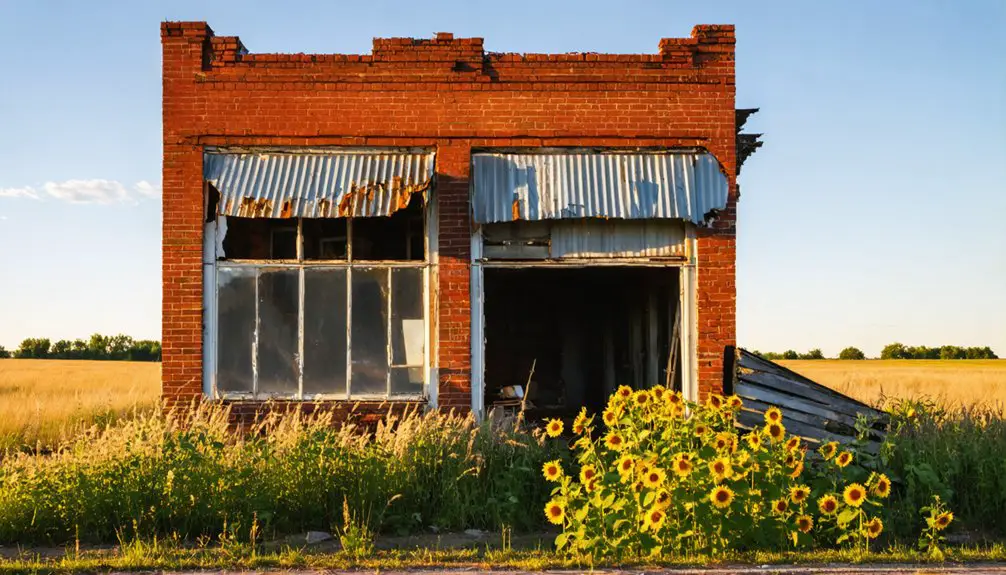
The old bank building stands repurposed, its vault door and high ceilings now serving different needs than the farmers who once lined up for loans. Fire scars mark several structures along Main Street, reminders that Byers has lost as much to flame as to time, yet the survivors cluster together like stubborn witnesses to better days.
Active L&W Repair Shop
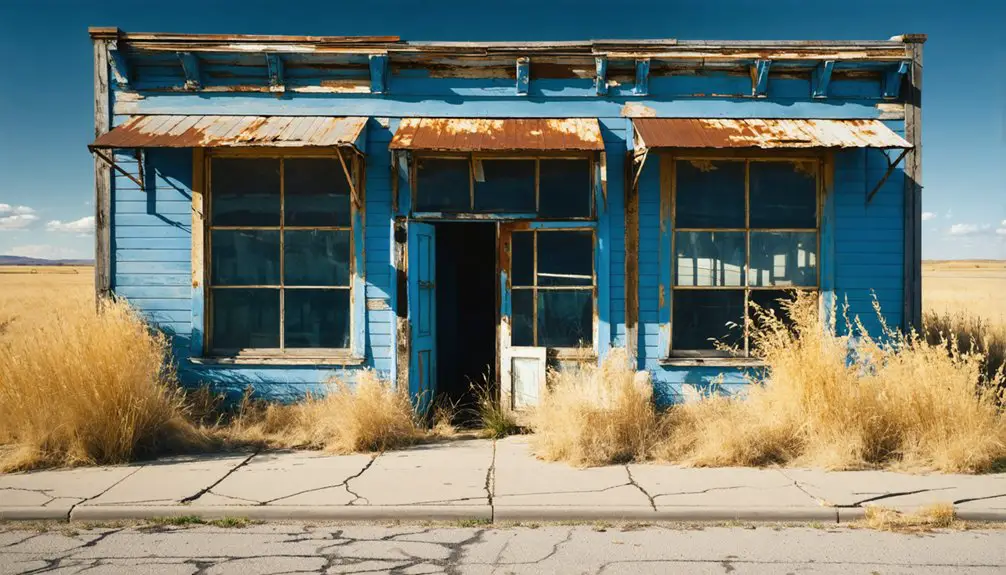
Among the weathered storefronts and empty lots along Main Street, L&W Repair Shop stands as Byers’ most resilient commercial survivor. You’ll find this family owned operation at 311 Main Street, where Tim Tobin has maintained a longstanding community presence since 1974—outlasting school consolidation, post office closure, and the devastating 1966 fire that consumed most of the commercial district.
The shop’s blue NAPA signage marks one of the few functioning businesses you’ll encounter. They’ll handle your oil changes, tire rotations, and complex engine diagnostics with professional-grade equipment. Their Grasshopper mower sales serve the surrounding farmland, while warranty-backed repairs demonstrate Tim’s commitment to reliability.
This A+ BBB-rated operation represents more than automotive service—it’s tangible proof that determination and craftsmanship can outlast ghost town entropy.
Repurposed Historic Bank Building
Standing sentinel over Byers’ skeletal Main Street, a weathered clapboard structure tells three distinct stories through its 140-year existence. Bob Moore’s grandfather built this bank in the 1880s, financing farmers who refused to bow to distant city interests.
When economic revitalization proved impossible, it transformed into a grocery store, then ultimately a hunting lodge—each iteration preserving the building’s bones while adapting to harsh realities.
You’ll spot the hunting lodge signage against peeling wood near the concrete loading area where tracks once ran. Unlike architectural restoration projects that sanitize history, this structure wears its age honestly.
The Naron family’s Civil War-era roots run deep here, and their descendants’ willingness to repurpose rather than demolish kept this shell standing when others surrendered to Kansas winds.
Post-Fire Community Structures
With just 38 souls counted in the 2020 census, Byers clings to existence through structures that survived primarily because nobody could afford to tear them down. You’ll find sturdy bungalows with original solid oak cabinets and pink tile bathrooms—time capsules of prairie craftsmanship. Paint peels from weathered facades, windows stare back broken and vacant, yet the heavy oak construction refuses to surrender.
Post fire community resilience shows itself in what remains operational: grain elevators still punctuate the horizon while nearby large-scale farms keep the land productive. Though architectural preservation efforts remain informal at best, the town’s scattered buildings serve as accidental monuments. Properties sit empty, priced between $50,000 and $85,000, waiting for someone bold enough to claim a piece of Kansas history before it vanishes completely.
Mapping Your Route Through Kansas Ghost Towns
Before you set out to explore Byers and the scattered remnants of Kansas’s prairie settlements, you’ll need a strategy that transforms isolated dots on a map into a coherent journey. Start with Kansas Highway 119 as your backbone, then branch into Pratt County’s network of state routes connecting abandoned ghost town ruins.
Researchers have already documented 64 Kansas ghost towns on Google Maps—use these curated resources to plot clusters in Sumner, Barber, and Norton counties. You’ll maximize your freedom by visiting multiple sites in a single sweep.
Lake City on the Medicine Lodge River offers preserved historical sites alongside settlements reduced to scattered foundations. Download county-specific Wikipedia lists before leaving civilization, since many locations lack cell service where windswept plains reclaim forgotten communities.
Must-See Landmarks and Historic Sites in Byers
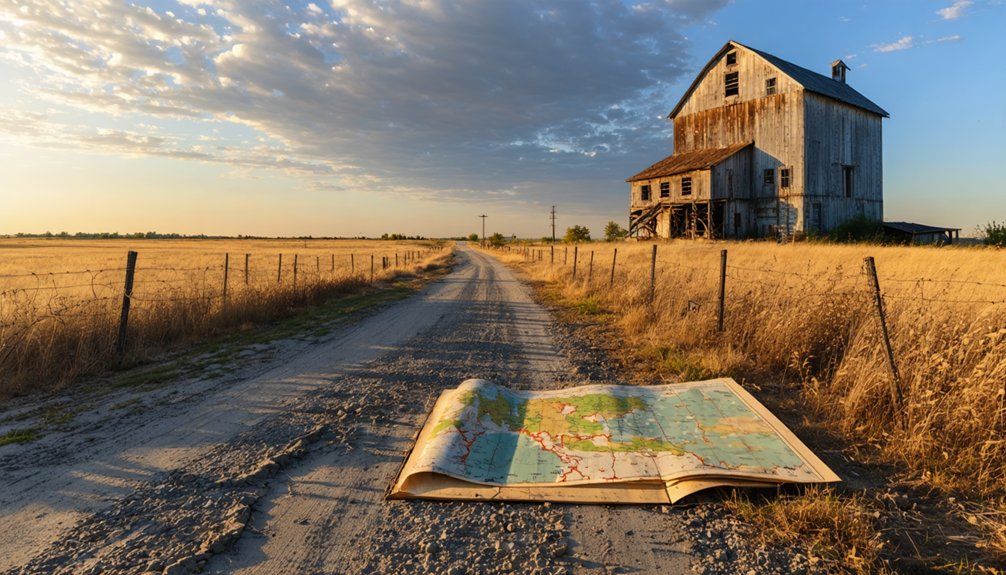
When you arrive in Byers, you’ll find whispers of its railroad past etched into the landscape—crumbling platforms where trains once loaded grain, and weathered wooden structures that have been patched and repurposed by the handful of families who stayed.
The old Methodist Church foundation sits near a windswept cemetery where headstones lean like tired sentinels, their inscriptions barely legible after a century of prairie storms. I remember standing at the cemetery gate last fall, counting only five graves I could still read, while rusted farm equipment peeked through the tall grass beyond the railroad bed.
Original Railroad Infrastructure Remains
The rusted rails cutting through Byers tell stories of Kansas’s ambitious railroad fever that once promised to connect every prairie town to distant markets. You’ll discover unseen railway artifacts scattered along the abandoned right-of-way—weathered telegraph insulators, iron spikes, and concrete foundation remnants from loading platforms that once bustled with grain shipments.
While Byers lacks the restored depot structures found in places like Sylvan Grove or Manhattan, the ghost town’s raw infrastructure speaks volumes. Walk the old track bed where Missouri Pacific trains rumbled through during the peak 10,000-mile network era. Crumbling embankments reveal the heavy grades that plagued early construction. These authentic ruins offer something polished museums can’t—the freedom to explore Kansas railroad history on your own terms, without velvet ropes or admission fees.
Repurposed Buildings and Structures
Scattered across the windswept landscape, Byers’ architectural remnants whisper tales of boom-time optimism that once drew hundreds to this sand hill settlement. You’ll discover repurposed community halls standing silent among overgrown lots where J.M. Byers’ original blacksmith shop once rang with commerce.
The Farmer’s State Bank building, which doubled as a post office until the mid-1920s, exemplifies how necessity shaped survival in declining prairie towns. Nearby Hopewell reveals similar transformation—a weathered structure nestled in trees where lodges once organized rabbit hunts for 75 cents per jackrabbit. These abandoned commercial ruins tell authentic stories that guidebooks can’t capture.
The 2020 census counted just 38 residents, making your exploration feel like genuine discovery rather than tourist performance. Cemetery headstones from the 1800s mark the settlement’s true legacy.
Methodist Church and Cemetery
Rising from the prairie grass just beyond those repurposed buildings, Byers United Methodist Church stands as the town’s most poignant landmark—a 1947 structure that outlived its congregation by decades. This sanctuary welcomed worshippers for 106 years before holding its final service in 2011, when membership dwindled to just 23 souls.
What awaits you:
- Church history dating to 1905, with handwritten membership rolls documenting families like the Moores who joined in 1924
- Original wooden offering plates still tucked in storage areas
- Cemetery records one mile west preserving 268 memorials, including Civil War veteran L.H. Naron
- Coordinates (37° 47′ 46″N, 98° 52′ 32″W) leading to the former Naron Cemetery
- Headstones transcribed from 1976, connecting you to vanished homesteaders
You’ll walk where generations worshipped, untethered from modern constraints.
Nearby Abandoned Settlements Worth Exploring
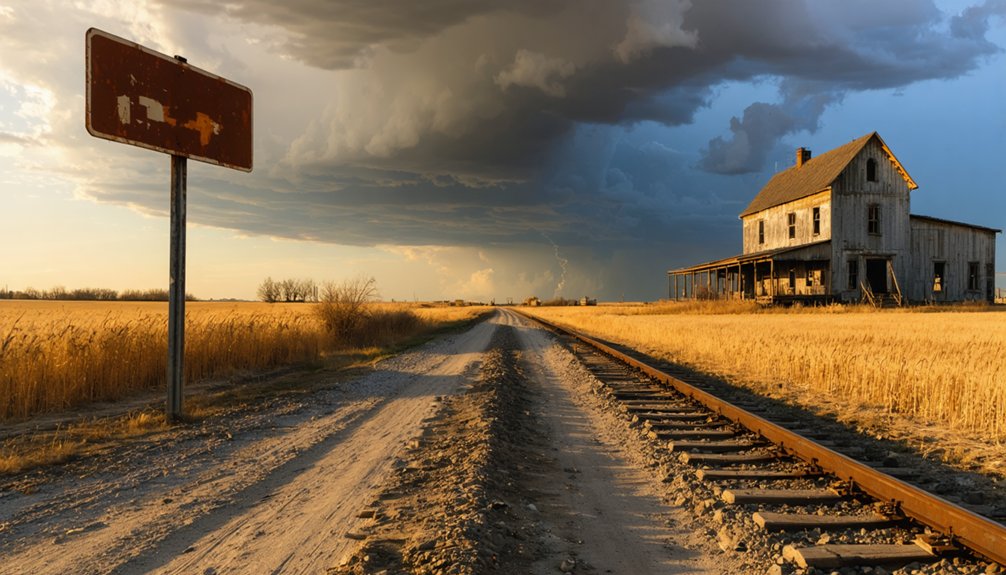
Beyond Byers, five forgotten settlements dot the Kansas prairie, each offering its own haunting portrait of abandonment. You’ll find Trousdale and Hopewell nearly erased from existence—true ghost towns where minimal structures remain standing.
Zenith rewards explorers with a preserved schoolhouse and towering grain elevator along old Route 50, once a bustling transport corridor. In Barton County, Boyd’s ruins still mark what locals called Maherville until 1904, its post office silent since 1937.
Willis offers the most intact historic town core in Brown County, where thirty-five souls live among decaying business buildings and collapsed schools. Each settlement lies within 100 miles of Wichita, featuring striking architectural details that tell stories of economic shifts and highway bypasses that sealed their fates.
Best Times to Visit and Photography Tips
While summer’s oppressive heat sends most travelers retreating indoors, spring and fall transform Byers into a photographer’s sanctuary. You’ll capture seasonal photography effects as changing leaves frame weathered structures, while moderate temperatures let you explore without rushing between air-conditioned stops.
Spring and fall offer ideal conditions for photographing Byers’ historic structures, with comfortable temperatures and vivid seasonal colors enhancing every frame.
Essential timing strategies for crowd free photography sessions:
- Arrive during shoulder months (March, December) when budget-friendly rates meet manageable weather
- Shoot early morning or late afternoon for dramatic lighting on abandoned buildings
- Visit winter’s low season for stark, snow-dusted compositions without tourist interference
- Pack layers—Kansas weather shifts dramatically within hours
- Target spring’s clear skies (April-June) when prairie wildflowers soften harsh architectural lines
With Byers’s population at just 38 residents, you’re guaranteed unobstructed shots of railroad remnants and crumbling facades year-round.
Practical Travel Information for Your Journey

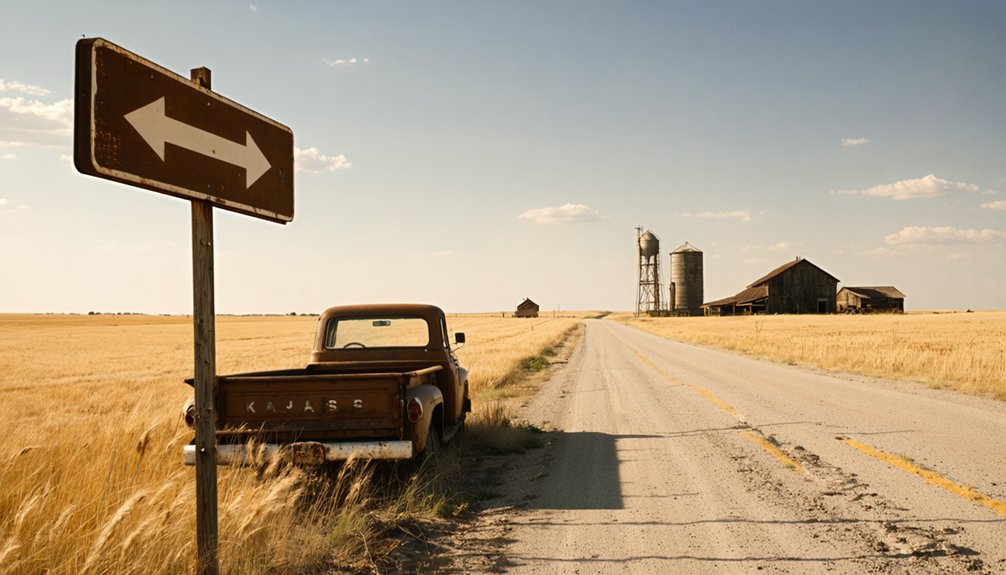
The gravel crunching beneath your tires announces your arrival long before Byers materializes on the horizon—a cluster of weathered structures rising from Kansas prairie like forgotten tombstones. Getting there by car means traversing Pratt County‘s grid of rural highways, with Pratt serving as your anchor point just miles away.
Download offline maps before cellular signals fade into static. Your nearest fuel, food, and lodging cluster in Pratt—Holiday Inn Express, Super 8, and Economy Inn offer comfortable bases for exploration. Rick’s Restaurant and El Trancazo provide sustenance after dusty backroad adventures.
Combine your ghost town pilgrimage with regional attractions like Pratt County Historical Museum or Vernon Filley Art Museum. Remember: Byers operates on Central Time, though time feels suspended here among ruins where 38 souls still claim residence.
Frequently Asked Questions
Are Overnight Accommodations Available in Byers or Nearby Towns?
You’ll find affordable lodging options starting at $39/night in Byers, with nearby Pratt offering more choices from $38/night. For true freedom, nearby campground facilities at Kiowa County State Park welcome tents under open skies.
Is Permission Required to Photograph Private Property in Byers?
You don’t need permission to photograph private property from public roads, but respect private property etiquette—don’t trespass. Abandoned structure legalities require staying outside fences. Those weathered buildings make stunning subjects through your lens from the street.
What Safety Precautions Should Visitors Take When Exploring Abandoned Buildings?
Don’t enter abandoned buildings—they’re dangerous and likely illegal. If you’re photographing exteriors, be aware of structural integrity from outside. Dress appropriately for weather conditions, watch for unstable walls or roofs, and respect private property boundaries always.
Are There Restaurants or Food Services Along the Ghost Town Route?
You’ll discover hidden gems scattered along your route—small town cafes serving hearty comfort food and seasonal produce stands bursting with farm-fresh flavors. Pack snacks though, since rural Kansas keeps its own schedule and options remain wonderfully unpredictable.
Can Visitors Access the Interior of the Old Bank Hunter’s Lodge?
No interior accessibility exists for the old bank—Hopewell’s former bank has vanished entirely. The preservation status of Byers’ remaining structures shows abandoned exteriors only. You’ll find eerie exploration limited to outside views, respecting private property boundaries throughout.