You’ll find Caddo where US Highway 180 splits at Farm Road 717 in Stephens County—forty residents clinging to memories of the 1920s oil boom that once pumped nearly 97 million barrels from beneath their feet. Explore the weathered Mercantile Building, abandoned Ford dealership foundations, and rusted playgrounds tangling through overgrown cemeteries where Confederate graves mark the town’s deepest roots. Bring sturdy boots, water, and your camera for structures that won’t stand forever, and you’ll discover why this authentic ruin rewards those who venture beyond the obvious tourist destinations.
Key Takeaways
- Three separate ghost towns named Caddo exist in Texas: Stephens County, Wilson County, and Port Caddo in Harrison County.
- The most accessible Caddo is in Stephens County where US Highway 180 intersects Farm Road 717.
- Visit the abandoned Mercantile Building, old Ford dealership foundations, ghost church, and overgrown cemeteries with rusted playgrounds.
- Caddo’s oil boom peaked in 1920 after the 1905 Savage-Morrical well discovery transformed the fishing camp.
- The town maintains a working post office despite only forty residents, offering authentic exploration of decline.
Getting to Caddo: Routes and Highway Junctions
Three distinct ghost towns share the name Caddo across Texas, and each requires a different route to reach. You’ll find the most accessible option in Stephens County, where US Hwy 180 meets Farm Road 717—a straight 90-minute shot west from Fort Worth. The regional access routes here wind through open Panhandle country before delivering you to forgotten streets near Possum Kingdom’s shores.
Down in Wilson County, Farm Road 3335 cuts through farmland 18 miles northeast of Floresville, where rural highway junctions grow scarce and the pavement narrows. Harrison County’s Port Caddo sits at the Caddo Lake State Park entrance off Park Road 2, north of Karnack. This 1838 settlement once thrived as a rowdy port where ships crews, gamblers, and Indians filled the streets before its decline. The Stephens County location was founded on Caddo tribal grounds in 1870, establishing its connection to the indigenous heritage that predates modern settlement. No interstates penetrate these territories—just two-lane ribbons threading through Texas backcountry, exactly as ghost town hunting demands.
From Caddo Campsite to Oil Boom Boomtown
Before oil transformed the landscape, Caddo existed as little more than a fishing camp and scattered homesteads along the murky shores of Caddo Lake. Everything changed in 1905 when the Savage-Morrical well struck black gold.
By 1906, you could’ve spotted a burning well fire blazing across 25 miles of Texas sky—a beacon calling wildcatters and dreamers alike.
Gulf Refining Corporation drained Caddo Lake’s impact in 1914, damming it to haul drilling equipment across what was once pristine water. The field’s oil production records of Caddo field peaked spectacularly in 1920 at 96,868,000 barrels.
Texas Company established its pumping station here around 1915, and by 1920, this former campsite swelled to 1,000 souls chasing fortune in the dirt. Standard Oil Company joined the frenzy in 1906, setting up operations in the booming Caddo oil field. Like many smaller boomtowns, Caddo’s glory proved fleeting as its limited petroleum reserves began declining in the late 1920s.
Must-See Ruins and Abandoned Structures
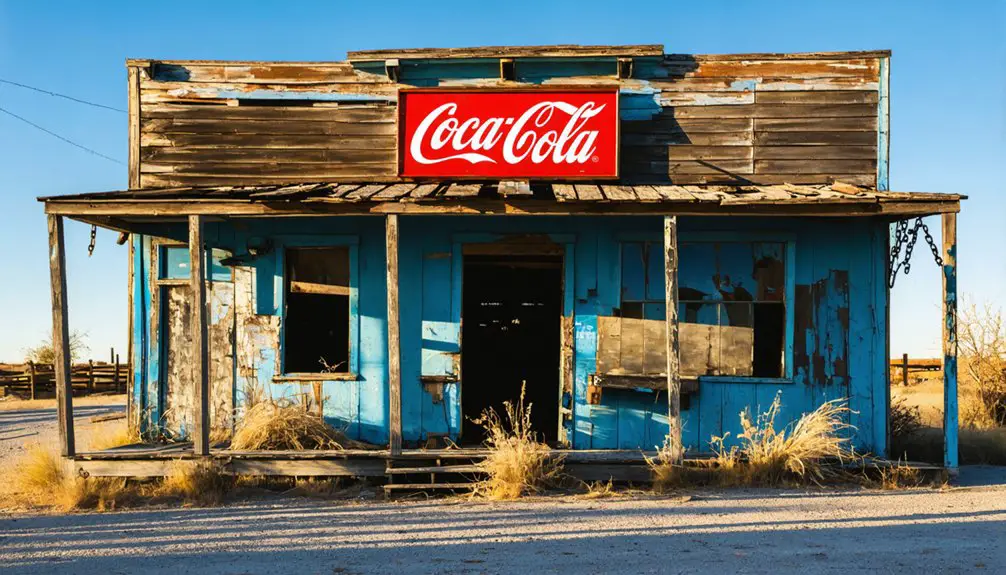
When you roll into Caddo today, the Mercantile Building anchors the southeastern edge of town at the Y where US 180 splits from Loop 252—a weathered sentinel standing watch over what’s left of the boom years. Inside, sealed town history sits off-limits, but you’ll find plenty to photograph outside.
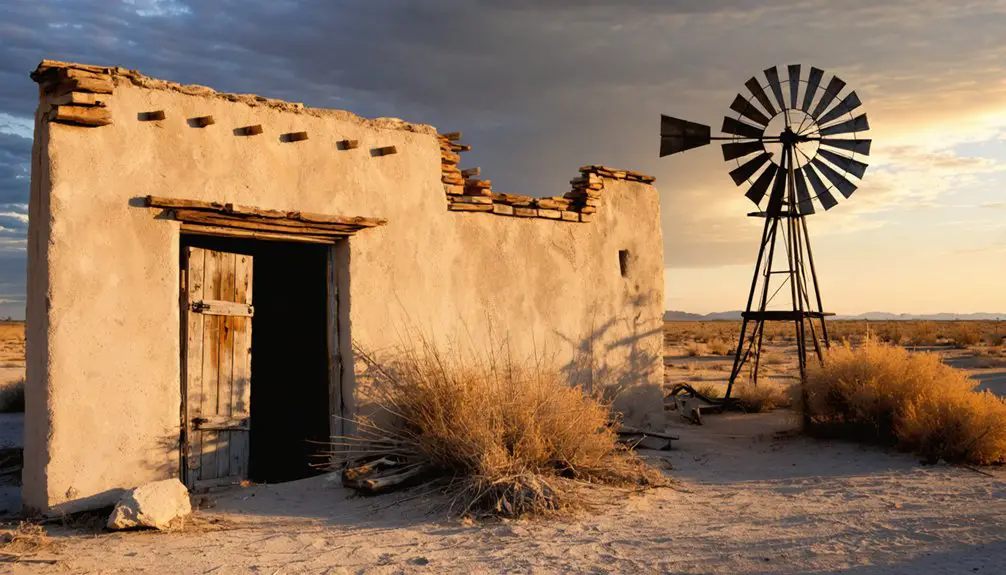
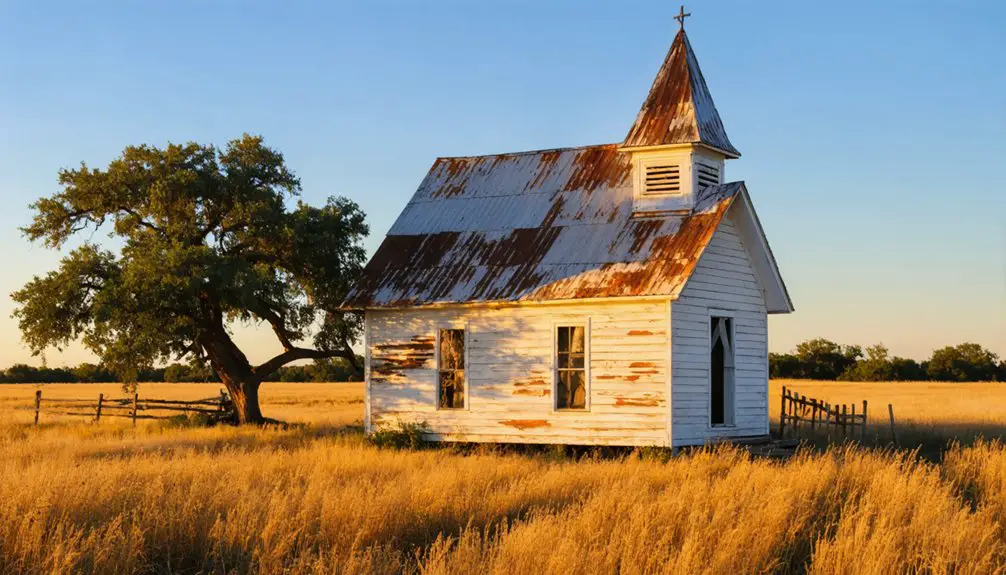
Wander the backroads to discover abandoned farmhouses crumbling into Texas clay, their porches collapsed and windows hollow. The old Ford dealership’s stone foundations still show front steps from the 1930s, while a ghost church stores farm equipment where pews once stood. The picturesque decay draws photographers and history lovers seeking authentic glimpses of the past. The town’s post office continues operation, a surprising pulse of life amid the decay. As you venture further into these forgotten places, you’ll find ghost towns to explore in Texas, each with its own unique story etched into the remaining structures. Some offer remnants of vibrant community life, while others serve as haunting reminders of lost dreams and aspirations. The stark contrasts between their past glory and present stillness create a captivating atmosphere for those willing to wander.
Rusted playgrounds dot overgrown cemeteries, and broken bridges lead nowhere. With only forty souls calling Caddo home since 1980, you’re free to explore this authentic ruin without tourist crowds.
Exploring Caddo Cemetery and Confederate Graves
You’ll find Confederate soldiers Jessie Bledsoe and J.W. Griffis resting among the oldest burials at Caddo Mills IOOF Cemetery, their weathered tombstones marking service in a war that shaped this cotton plantation region. Confederate flags planted at their graves flutter alongside markers from later conflicts—the Spanish-American War, both World Wars, Korea, and Vietnam—creating a timeline of American military history in one small Texas graveyard.
The Masonic symbols carved into several stones reveal another layer of community life, where fraternal bonds connected families who built their lives on this former Caddo campsite. The Caddo Homeland once stretched across parts of Arkansas, Louisiana, Oklahoma, and Texas, including this region where Native peoples lived for generations before European settlement. The region’s fertile soil and favorable climate made it a significant center of cotton production in the antebellum South, with numerous plantations contributing to the local economy.
Notable Graves and Markers
The weathered headstones scattered across Caddo Cemetery tell stories that stretch back over a century, with the earliest marked graves dating to 1854 in what’s now Johnson County. You’ll find monuments crafted by companies from Fort Worth, Cleburne, and even St. Louis—evidence of families investing in permanent memorials for their departed.
The Brawner family plots reveal multiple generations gathered in designated burial zones, continuing notable burial customs that Caddo peoples maintained for over 1,200 years. While modern markers replace the perishable wooden poles once used, you can still trace family lineages through carefully positioned graves.
Among the 2,853 memorial records, you’ll discover dates spanning to 1961, with symbolic grave goods and shell ornaments marking the region’s deeper Indigenous heritage beneath later settlement layers. Confederate veterans rest here too, including J. R. Hawpe of Company E, 3rd Texas Cavalry, and James M. Higgins, who served in Burford’s Regiment Cavalry. Nearby, Morning Star Cemetery lies 1.3 kilometers away, offering another historical site for those exploring the area’s burial grounds.
Confederate Memorial Site Details
Among the family plots and pioneer headstones, Confederate flags mark graves that connect Caddo Cemetery to Texas’s Civil War past. You’ll find markers honoring individuals born before or during the 1860s conflict, including the resting places of C.M. and Millie Hamil, L. Shoffit, and a Masonic tombstone for John H. Patton.
What makes this cemetery complex is its foundation on a historic Caddo campsite from the late 1870s. While Confederate memorials stand visible today, understanding Native burial practices adds depth to your visit. The Caddo tribe regulations under NAGPRA protect ancestral remains here, recognizing their sacred ground beneath the pioneer cemetery. You’re walking layers of history—from indigenous traditions to frontier settlements—all compressed into one haunting location.
The Mercantile Building and Historic “Y” Junction
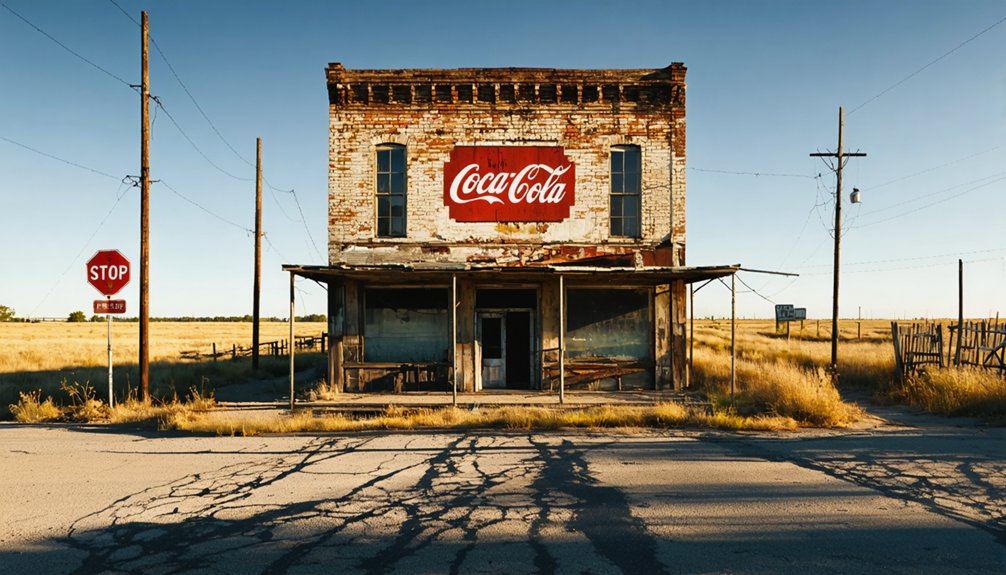
Standing at the junction where two weathered roads converge into Caddo’s characteristic “Y,” you’ll spot the old mercantile building—a memorial, a tribute, a symbol of the town’s commercial heyday that now sits silent with a $119,000 price tag hanging over its future.
This structure once supplied gas and groceries to locals and travelers during the 1920s oil boom, when Caddo’s population hit 1,000. Now it’s closed, off-limits, yet still standing with remarkable integrity.
The architectural preservation potential draws interest from those seeking authentic restoration projects, while current business prospects remain uncertain. Locals hope someone will rescue this repository of community memory before it’s too late.
Delta Oil & Gas still operates nearby, suggesting Caddo isn’t completely abandoned—just waiting.
Remnants of the Fly ‘n Fish Motel Era
Cross the old highway and you’ll spot weathered concrete pylons jutting from the water—all that’s left of Beer Smith’s massive fishing pier where anglers once lined up shoulder to shoulder.
The crumbling foundation near the cracked runway marks where a proper aviation hangar once stored the private planes of wealthy guests flying in for weekend parties. These skeletal remains tell the story of a resort so grand it needed both water access and its own airfield to accommodate the high-rolling crowd that kept this place humming through the 1950s and ’60s.
Pier Foundations Still Visible
The concrete pilings jutting from Caddo Lake’s murky waters tell the story of Beer Smith’s ambitious dream better than any faded photograph could. You’ll find the pier remnants at coordinates 32.711, -94.122, where overgrown vegetation now claims what was once a bustling fishing platform opposite the airport hangar.
What remains today:
- Crumbling concrete foundations extending into the lake
- Cracked support structures showing decades of neglect
- Wildlife inhabitation around the weathered pilings
- Visible remnants best viewed from nearby shoreline access points
These pilings served guests who’d land their planes, stroll across the property, and cast their lines into Caddo’s cypress-lined waters. The pier’s skeletal remains stand as tangible proof that this wasn’t just another roadside motel—it was an audacious fly-in fishing resort that dared to exist.
Aviation Hangar Site Remains
Beyond those crumbling pier foundations, Beer Smith’s grandest gamble sits decaying in the East Texas underbrush. The Fly ‘n Fish Resort once lured private pilots to its 4,800-foot hard-surfaced runway during the big band era. You’ll find the aircraft hangar still standing—a ghost of when this was Beer Field, pulling weekend flyers from Dallas seeking whiskey in a dry county.
Aerial photos from 1994 show the intact runway and that two-story brick lodge where bands played upstairs while guests dined below. By 2010, the wooden lodging buildings had vanished. The central brick structure burned recently, leaving structural remnants scattered across cracked pavement.
Walk the overgrown roadways where planes once taxied, and you’re touching aviation history that helped incorporate Uncertain in 1961.
Best Time to Visit and What to Bring
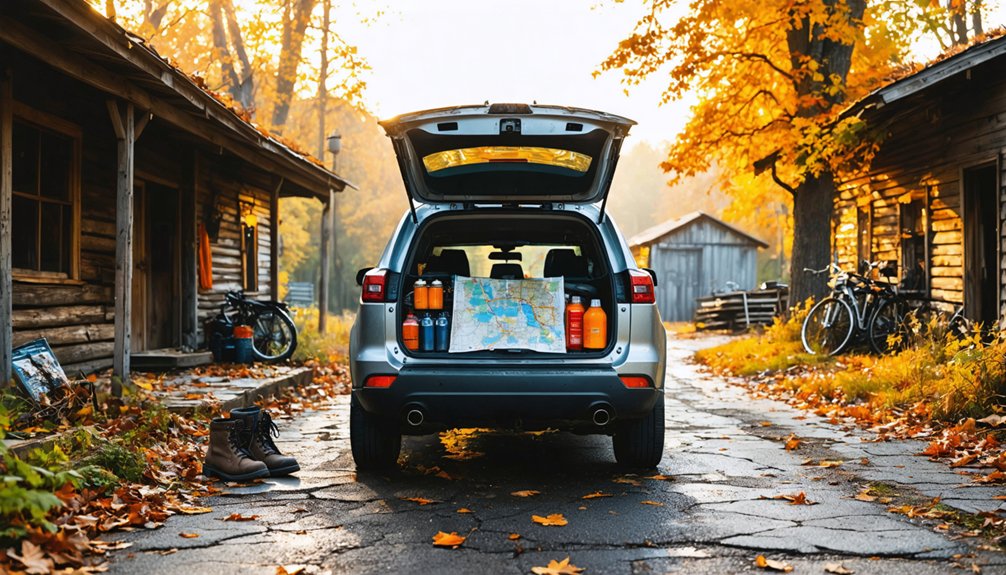
Spring breathes life into Caddo’s abandoned streets, making March through April the sweet spot for exploration. You’ll find ideal weather conditions with 72°F highs and 46°F lows—perfect for wandering through crumbling structures without breaking a sweat or freezing your tail off. The 16% rain chance means you’ll likely stay dry while photographing weathered facades.
Pack these comfortable packing essentials for your adventure:
- Layered clothing for fluctuating temperatures and 11 mph winds
- Sturdy hiking boots for traversing overgrown terrain and debris
- Rain jacket to handle occasional spring showers
- Sun protection including hat and sunscreen for 11.9 hours of daylight
Skip summer’s brutal 97°F heat and winter’s bone-chilling 34°F lows. You’re chasing history, not heatstroke.
Nearby Ghost Towns and Oil Heritage Sites
Once you’ve explored Caddo’s weathered storefronts and crumbling Ford dealership, you’ll discover this ghost town anchors a treasure trove of oil boom relics scattered across Stephens County. As you delve deeper into the surrounding area, you’ll find more Ghost Towns to visit in Texas, each with its own unique history and charm. From the eerie silence of abandoned streets to the remnants of once-thriving communities, there’s an unmistakable nostalgia that captivates visitors. Exploring these forgotten places offers a glimpse into the rich tapestry of Texas’s past and the stories that shaped the state.
Drive to Eliasville, where 1920s resource extraction fever left behind stone church walls and schoolhouse foundations. South Bend’s abandoned overpass piers mark where oil money once flowed freely through Clear Fork Brazos.
Despite Caddo’s name, you won’t find ethnic connections to Caddo tribal heritage here—those sites cluster near Caddo Lake, 250 miles east. Instead, Caddo Cemetery tells wildcatter stories through weathered tombstones.
Twenty minutes north, Possum Kingdom State Park offers 300 miles of shoreline for camping between ghost town explorations. Stovall’s Hot Well ruins near South Bend add mineral spring mystique to your oil heritage journey.
Frequently Asked Questions
Are There Any Guided Tours Available for Exploring Caddo’s Ruins?
While Caddo Lake offers excellent guided tour pricing for boat excursions, there aren’t specific ruins tours available. You’ll find tour schedule availability focuses on swamp exploration instead. Consider creating your own ghost town adventure by exploring independently at your pace.
Is It Safe to Enter the Abandoned Buildings in Caddo?
Playing Russian roulette with collapsing roofs isn’t worth it—you shouldn’t enter Caddo’s abandoned buildings due to potential hazards like deteriorated floors and structural stability issues. Weathered ruins, overgrown vegetation, and crumbling foundations make exploration genuinely dangerous.
Can I Camp Overnight Near Caddo Ghost Town?
You’ll find the nearest campgrounds at Possum Kingdom State Park, just 20 minutes northeast. Choose from 46 campsites or rustic cabins, then explore 300 miles of shoreline via local hiking trails—perfect for your adventurous spirit.
Are There Any Restaurants or Gas Stations Near Caddo?
You’ll find limited dining options in Caddo Mills—Bucky’s Cafe, Fiesta’s Tex-Mex, and Mona Lisa Pizza serve travelers well. Basic fuel services cluster along Interstate 30 and Highway 66, letting you refuel quickly before exploring the ghost town’s mysteries.
Do I Need Permission to Explore Private Property in Caddo?
Yes, you’ll need permission to explore private property in Caddo. Most ruins hold historical significance but remain privately owned. Respect property boundaries, observe parking restrictions on county roads, and photograph from public areas to preserve your freedom to roam responsibly.
References
- https://tpwmagazine.com/archive/2002/may/threedays/
- http://texasghosttowns.blogspot.com/2013/05/caddo-stephens-county-may-2013-photos.html
- https://texascooppower.com/the-mostly-friendly-caddo/
- https://www.nps.gov/places/caddo-mounds-state-historic-site.htm
- https://www.youtube.com/watch?v=JQrMFjZhOUs
- https://texashighways.com/outdoors/water/caddo-lake-inspires-legends-and-lore-in-east-texas/
- https://www.texasescapes.com/SouthTexasTowns/Caddo-Texas.htm
- https://thc.texas.gov/state-historic-sites/caddo-mounds/caddo-mounds-history
- https://atlas.thc.texas.gov/Details/5203010207
- https://www.islands.com/2016707/caddo-texas-tiny-town-steeped-history-cabins-park-access-ancient-mounds/