You’ll find Candlish’s weathered ruins about 120 miles south of San Antonio off US-181, near where Medio and Blanco Creeks converge in the mesquite country. Plan your visit between October and April to avoid scorching summers, and fuel up in Refugio or Sinton before tackling the unpaved ranch roads. The 1909 railroad settlement‘s crumbling adobe homesteads, rusted quicksilver mining equipment, and old general store still stand against the Texas sky. Base yourself in nearby Beeville for lodging, bring sturdy boots for uneven terrain, and discover what awaits beneath that clay loam soil.
Key Takeaways
- Enter coordinates 28.45622800° N, -97.69326400° W into GPS and take US-181 South from San Antonio for approximately 120 miles.
- Stock up on fuel in Refugio or Sinton before navigating unpaved ranch roads through mesquite-dotted terrain to reach Candlish.
- Visit between October and April to avoid extreme summer heat and experience mild weather ideal for outdoor exploration.
- Base yourself in Beeville, 4 miles away, for lodging, fuel, groceries, and other essential services before exploring the ghost town.
- Bring sturdy walking shoes, adequate water, camera equipment, and inform others of travel plans due to remote location and potential hazards.
Getting to Candlish: Directions and Route Planning
When you punch the coordinates 28.45622800° N, -97.69326400° W into your GPS, you’re setting course for one of South Texas’s forgotten corners—a ghost town that hardly anyone remembers anymore. Candlish sits roughly 50 miles southwest of Corpus Christi, accessible via FM 2043 and unmarked county roads that’ll test your navigation skills.
From San Antonio, take US-181 South for about 120 miles—figure two hours of open highway before you veer onto ranch roads. Transportation challenges multiply during rainy seasons when these rural routes turn to mud. Seasonal variation matters here; summer heat can strand you if your vehicle breaks down, and spring rains create impassable conditions. Allow extra time as the system processes your route through these challenging back roads.
Stock up on fuel in Refugio or Sinton. Your standard vehicle will manage, but expect unpaved stretches where civilization fades into mesquite-dotted emptiness. If you encounter road closures or flooding, you have not later than 20 days to file documentation with local authorities should you need to report infrastructure issues.
What Remains of Candlish Today
When you arrive at Candlish’s former location near the junction of Medio and Blanco Creeks, you’ll find absolutely nothing—no buildings, no ruins, just empty land reclaimed by nature. The ghost town has vanished so completely that only the creeks themselves mark where settlers once built their hotel, store, and school within that fateful 50-foot radius. This location qualifies as a barren site, where almost nothing remains of the original town.
Like Old Bluffton Ghost Town, which was temporarily exposed during a drought in 2009 before being permanently submerged again, Candlish represents a settlement erased from the Texas landscape. You’ll need to rely on your imagination and the landscape’s subtle contours to picture the brief community that flickered to life here in 1909 before fading into Bee County’s forgotten history.
Physical Structures and Ruins
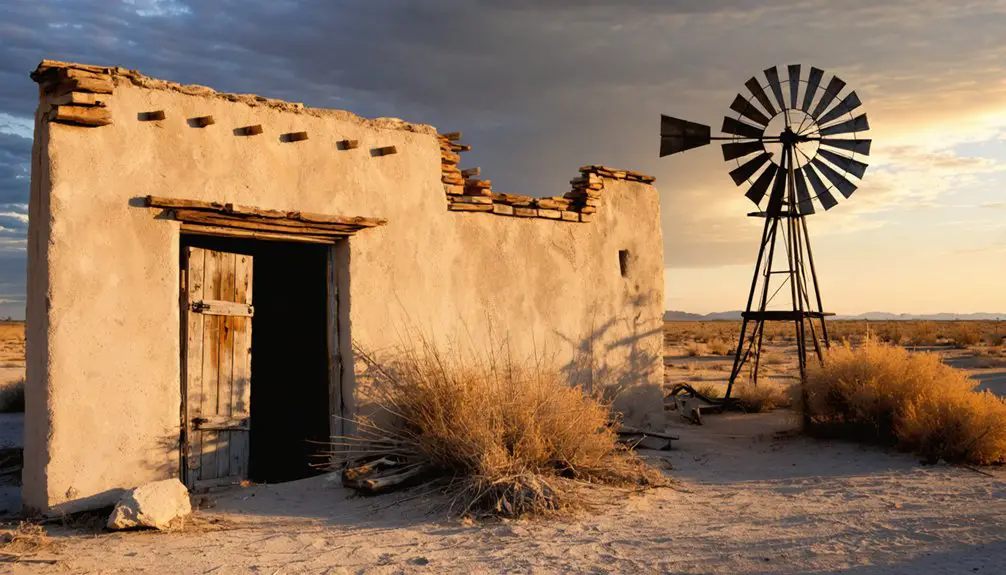
The weathered adobe and stone ruins of Candlish rise from the West Texas desert like fragile monuments to a vanished era. You’ll find crumbling adobe structures succumbing to relentless heat and wind, their brick walls tumbled across the ground. The 125-year-old Valenzuela family homestead lies scattered—vandals destroyed what nature hadn’t claimed yet.
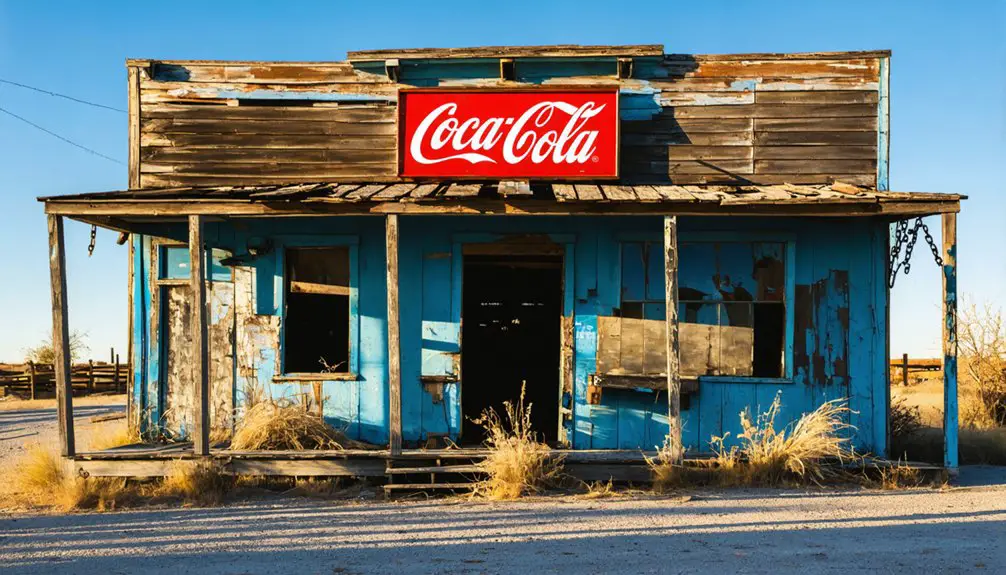
Among the abandoned mining ruins, you can explore accessible mine shafts and examine rusted equipment from the late 1800s quicksilver operations. Waste rock piles dot the hillsides where miners once labored. Mercury from these mines was extracted from cinnabar, the distinctive red-hued ore that defined Candlish’s brief prosperity. The old general store still stands as the settlement’s oldest building, though you’ll notice weathered foundations peppered throughout the landscape. Some homes from the 1950s-70s remain surprisingly intact, their original furnishings gathering dust inside walls ravaged by mold and termites. These historic mining settlements continue to draw visitors from across the country who seek to experience authentic ghost town ruins.
Historical Marker Location
Beyond these crumbling walls and scattered foundations, you’ll find the official recognition of Candlish’s place in history at Texas Historical Marker #3315. Standing 27″ x 42″ along US 59’s left shoulder, exactly 4.2 miles east of Beeville, it’s impossible to miss.
The marker details tell Medio Creek‘s story—named by Spaniards around 1800, crossed by padres and settlers heading to Mission La Bahia on ox-cart roads. The creek rises in Karnes County before emptying into the Mission River, marking the path of three historic cart roads from Mexico.
You’ll discover the historical context etched in bronze: W.J. Candlish’s 1909 village establishment, the 1857 post office at Medio Hill, even those remarkable 1938 fossil beds yielding million-year-old mastodon bones. The area became an important cattle region since Spanish times, with ranching operations dating back centuries before modern settlements emerged. Park safely on the roadside—it’s public property with easy access. The coordinates (28° 29.165′ N, 97° 39.201′ W) guarantee you won’t wander lost.
Medio Creek Landscape Features
Standing where Candlish once thrived, you’ll notice how Medio Creek still defines this landscape just as it did when Spanish explorers named it over two centuries ago. The town sat within 50 feet of water that carved this terrain through cycles of flooding and replenishment.
The creek’s distinctive characteristics shape everything here:
- Soil composition features grayish-brown calcareous clay loam built from ancient alluvium
- Floodplain characteristics include annual flooding that deposits fresh sediment or scours existing terrain
- Gullied erosion patterns create dramatic cuts through rolling countryside
- Mesquite and native grasses anchor the clay loam soils
- Flat to rolling terrain shifts between Post Oak Savannah and Blackland Prairie ecosystems
You’re standing at nature’s crossroads—where biotic zones converge and million-year-old fossils once emerged from these very creek banks. The creek rises in Karnes County before flowing through this region to eventually empty into the Mission River. Walk along the creek and you might imagine the three early ox-cart roads that once crossed these waters, carrying explorers, padres, soldiers, and settlers through the Texas frontier.
The Story Behind Candlish’s Founding in 1909
You’ll find Candlish’s origins tied to the railroad’s arrival in 1907, when William J. Candlish laid out a townsite just north of the tracks near where San Domingo and dry Medio Creeks meet.
The settlement sprouted within 50 feet of Medio Creek in 1909, replacing the older pioneer community of Medio Hill that had existed down-creek since the 1850s. Basic necessities appeared quickly—a hotel for travelers, a general store for supplies, and a school for children—transforming raw Bee County grassland into a functioning railroad town.
Medio Creek Settlement Location
Long before W.J. Candlish arrived in 1909, you’ll find the medio creek history runs deep with pioneer spirit. The medio creek location rises in Karnes County and empties into the Mission River, marking the midway point between the San Antonio and Nueces Rivers—exactly where Spaniards positioned it around 1800.
Here’s what made this spot significant for freedom-seeking settlers:
- Three ox-cart roads from Mexico crossed here, bringing explorers, padres, and settlers to Goliad
- First post office in Bee County established at Medio Hill in 1857
- Tall grass bounty lands granted to Texas Revolution veterans attracted pioneers
- Irish colonists arrived via Copano Bay in the 1830s
- County seat briefly operated here before relocating in 1859
You’re standing where determination met opportunity.
Early Infrastructure and Amenities
William J. Candlish laid out his townsite in 1909 just north of the railroad tracks, creating a frontier hub you’d recognize from classic Western settlements. Hotel construction came first, offering weary travelers a place to rest after dusty journeys along the new rail line.
The general store operations provided everything pioneers needed—supplies, tools, and community gathering space where locals traded stories alongside goods.
You’ll find it fascinating that the town also built a school, showing settlers’ commitment to putting down roots. These amenities clustered around the tracks represented freedom’s promise: opportunity, connection, and independence.
Yet this infrastructure proved fragile. When the general store closed its doors shortly after founding, Candlish’s lifeline severed, transforming this once-hopeful outpost into the ghost town you can explore today.
Why Candlish Became a Ghost Town
When Candlish’s general store shuttered its doors for the final time, the town’s fate was fundamentally sealed. You’ll find that economic challenges gradually strangled this small community that once thrived near Medio Creek. Without the store’s essential supplies and social hub, settlers had little reason to remain.
The decline happened through several interconnected factors:
- No railroad connection meant transportation issues isolated Candlish from expanding trade networks
- Limited economic diversity beyond the general store left no backup revenue sources
- Lack of sustained commercial activity drove families to seek opportunities elsewhere
- Water access alone couldn’t sustain a community without broader economic foundations
- Competing settlements with better infrastructure absorbed Candlish’s dwindling population
Exploring the Texas Historic Landmark Marker
You’ll find the Texas Historic Landmark marker at the junction of US 59 and Medio Creek, just 4 miles northeast of Beeville—look for the 27-by-42-inch bronze plaque that’s stood in its original spot since 1967. The marker sits on publicly accessible land, making it easy to pull over and read the inscriptions that document Candlish’s story and the ancient ox-cart roads that once crossed this creek.
From the highway intersection, continue east another 0.2 miles to reach the actual townsite where Candlish sprang up in 1909, practically within arm’s reach of where this historical designation now stands.
Marker Location and Access
Finding the Texas Historic Landmark marker for Candlish requires a straightforward drive along US 59, where the weathered bronze plaque stands as a roadside sentinel to a vanished community. You’ll discover this 27″ x 42″ monument erected in 1967, maintaining its in situ condition on public property with unrestricted access.
Head northeast from Beeville on US 59 for 4 miles. Watch for the Medio Creek junction as your reference point. Continue east another 0.2 miles past the creek. Look left when traveling east—the marker sits roadside at coordinates 28° 29.165′ N, 97° 39.201′ W. Pull safely onto the shoulder for exploration.
The marker details commemorate exploration and expeditions, standing precisely 50 feet from where Candlish once thrived, accessible whenever wanderlust strikes.
Historical Designation Details
The weathered bronze plaque standing sentinel along US 59 carries more weight than its 27-by-42-inch frame suggests—it’s a 1967 Texas Historic Landmark that immortalizes layers of history spanning from Spanish exploration through prehistoric discoveries.
The marker significance extends beyond commemorating Candlish’s brief 1909-era existence. It documents Medio Creek’s Spanish naming around 1800, the brutal 1836 Comanche massacre of settlers Burke and Heffernan, and the million-year-old mastodon fossils unearthed from nearby creek beds.
The Texas Historical Commission’s recognition details weave together natural history, indigenous conflicts, and pioneer struggles into one expansive narrative. You’re not just reading about a ghost town—you’re standing at a crossroads where countless travelers, from Spanish padres to Texas Revolution veterans, carved their paths through untamed country.
Medio Creek’s Role in Local Settlement History
Around 1800, Spanish explorers christened Medio Creek for its strategic midway position between the San Antonio and Nueces Rivers—a naming choice that foreshadowed the waterway’s pivotal role as a settlement corridor.
Medio Creek’s name captured its destiny—a halfway point that would bridge cultures, commerce, and communities across early Texas.
You’ll discover this creek witnessed remarkable shifts:
- Indigenous Heritage: Karankawa Indians originally named these waters, migrating inland for winter buffalo hunts before Lipan Apache hunters claimed the territory
- Transportation Hub: Three ox-cart roads from Mexico crossed here, creating a mid 19th century freight route connecting San Antonio to Gulf ports
- Mesquite Legacy: Mexican cart drivers fed their oxen mesquite beans, inadvertently cultivating the thick brush you’ll see today
- Pioneer Magnet: Texas Revolution veterans claimed bounty lands along its tall grass banks
- Irish Settlement: 1830s colonists traveled through Copano Bay to establish downcreek homesteads
Ancient Fossil Beds: A Million-Year-Old Discovery
Long before pioneers claimed their bounty lands along Medio Creek, creatures beyond imagination roamed these same banks.
In 1938-1939, Depression-era workers unearthed nearly 4,000 specimens from beds along Medio and Blanco creeks—mastodons, rhinoceros, mammoths, even three-toed horses from one million years ago. These ancient playas served as watering holes where Ice Age megafauna congregated and ultimately perished.
The fossils’ geographic distribution across Bee County revealed unprecedented species diversity in prehistoric Texas. Buckner’s Mastodon, a new species, emerged from these excavations alongside alligator bones and elephant remains preserved in shale and limestone.
Today’s potential for new discoveries remains high. Modern construction projects halt immediately when similar deposits surface, protecting these irreplaceable windows into Texas’s primordial past.
Nearby Ghost Towns Worth Visiting
While Candlish stands as Bee County’s most accessible ghost town, dozens of abandoned settlements dot the surrounding counties, each offering its own glimpse into Texas’s forgotten past.
Beyond Bee County’s borders lie countless abandoned settlements, each preserving unique fragments of Texas history waiting to be explored.
Your nearby ruins exploration can expand into these compelling destinations:
- Belcherville (Montague County): Gutted structures and overgrown homes tell stories of devastating fires that destroyed the business district
- Fort Quitman (Hudspeth County): A remote military outpost in west Texas’s arid landscape
- Luckenbach (Gillespie County): Semi-abandoned settlement blending history with quirky charm
- Canyon City (Comal County): Listed ghost town awaiting discovery
- Salona (Montague County): Another Montague County ghost town with minimal historical preservation efforts
Pack plenty of water, respect private property boundaries, and check road conditions before venturing into remote areas. These settlements reward intrepid explorers willing to chase forgotten horizons.
Best Time of Year for Your Road Trip
Your exploration of Texas ghost towns depends heavily on when you load up the truck. March and April deliver ideal weather conditions with comfortable 60°F temperatures—perfect for wandering abandoned structures without breaking a sweat. You’ll dodge the torrid summer heat that hammers these central Texas plains at 98°F, turning metal ruins into ovens. Seasonal temperature ranges span from freezing 32°F winter nights to scorching July-August afternoons, so timing matters.
Spring brings wettest conditions in April-May, but also crystal-clear days for photography. Fall offers reduced precipitation and milder exploration weather, though you’ll sacrifice those perfect spring temperatures. Winter’s freezing lows and potential snowfall add atmospheric drama but limit comfortable wandering time. Skip late spring’s tornado season unless you’re chasing more than ghosts.
What to Bring for Your Ghost Town Adventure
Before you chase the ghosts of Candlish across the windswept plains, pack necessary supplies that’ll keep you safe and comfortable in this remote corner of Texas. This abandoned settlement offers no amenities, so self-reliance isn’t optional—it’s essential.
Essential gear for exploring:
- Appropriate footwear with ankle support for traversing uneven terrain and potential fossil sites
- Sun protection including wide-brimmed hat, sunscreen, and polarized sunglasses
- Multiple water bottles—Texas heat shows no mercy to unprepared wanderers
- First aid kit with bandages, antivenin information, and blister treatment
- Navigation tools like GPS device and paper maps since cell service disappears
The terrain demands sturdy hiking boots that can handle rocky ground where ancient mastodons once roamed. Bring extra water beyond what you think you’ll need. This landscape doesn’t forgive mistakes.
Frequently Asked Questions
Are There Any Restaurants or Gas Stations Near Candlish?
You won’t find amenities availability in Candlish—it’s a genuine ghost town! Local business operations exist miles away in Burnet and Glen Rose, where you’ll discover restaurants like Riverhouse Grill and fuel stops for your adventurous escape.
Is Camping Allowed at the Candlish Historical Site?
Camping isn’t available at Candlish—there aren’t overnight accommodations at this ghost town. You’ll explore through self-guided tours only, then head elsewhere to sleep. It’s perfect for freedom-seekers wanting quick, independent historical adventures before moving on.
Can You Visit the Fossil Bed Excavation Sites?
You can’t access Candlish’s fossil beds—they’re not public sites, and trespassing won’t reveal fossil preservation techniques or scientific research opportunities. You’ll need landowner permission to explore those creek beds where 1938 discoveries once thrilled paleontologists.
Are Guided Tours Available for Ghost Town Exploration?
You won’t find guided tours offered seasonally for Candlish’s abandoned streets—this ghost town belongs to wanderers like you. However, private guided tours are available through local historians if you’re craving deeper stories beyond the windswept ruins.
What Are the Property Boundaries and Trespassing Laws?
Property boundaries aren’t clearly marked at Candlish, so you’ll need to research property deed information before exploring. Historical land disputes complicate access rights. Respect posted signs and ask permission—trespassing laws protect landowners, even at abandoned sites.
References
- https://www.beeville.net/historicalsites/17 – MEDIO CREEK.htm
- https://www.hmdb.org/m.asp?m=202009
- https://virtualglobetrotting.com/map/medio-creek-1-000-000-years-of-history/
- https://www.forttours.com/pages/hmbee.asp
- https://kids.kiddle.co/List_of_ghost_towns_in_Texas
- https://en.wikipedia.org/wiki/List_of_ghost_towns_in_Texas
- https://www.youtube.com/watch?v=PsuLwAQ12QI
- https://www.tshaonline.org/handbook/entries/candlish-tx
- https://www.govinfo.gov/content/pkg/FR-2005-11-04/xml/FR-2005-11-04.xml
- https://cdn.elifesciences.org/articles/82533/elife-82533-v1.xml