Planning a ghost town road trip to Cash City, Kansas is easier than you’d think. Head south from Dodge City on US-283 about 40 miles to Ashland, where locals can point you toward this unmarked Clark County site. Founded in 1886 by Merchant Cash Henderson, this once-thriving boomtown of 500 collapsed almost overnight when the railroad bypassed it. Stop by Ashland’s Pioneer Krier Museum first, pack sturdy boots and plenty of water, and keep exploring to uncover the full story behind Cash City’s dramatic rise and fall.
Key Takeaways
- Cash City, founded in 1886 in Clark County, Kansas, was a short-lived boomtown that emptied by 1888 due to lack of railroad access.
- From Dodge City, drive south on US-283 toward Ashland, then north 15 miles to reach the unmarked ghost town site.
- Visit Ashland first for local directions and historical context, as the site has no markers, signs, or designated parking.
- Spring and fall offer the best visiting conditions, with April through May featuring wildflowers and September through October providing cooler temperatures.
- Pack water, sunscreen, sturdy boots, a first aid kit, and a printed map, as cell service at the site is unreliable.
What Was Cash City, Kansas?
Deep in the Clark County prairie, 40 miles south of Dodge City and just 15 miles north of Indian Territory, Cash City once stood at the crossroads of the Tuttle, Ashland, and Meade Center trails — a boomtown that briefly held 500 residents, a bustling Main Street, and the audacious dream of rivaling Chicago.
Merchant Cash Henderson founded it in early 1886, leading a town company that purchased 640 acres of school land and platted the site bearing his name.
Cash City’s history unfolded fast and fierce — hotels, blacksmiths, a lumberyard, a doctor, and even its own newspaper, the *Cash City Cashier*, all rose quickly.
But when the railroad bypassed the town, that freedom-fueled frontier dream collapsed just as swiftly as it had begun.
The Railroad That Killed Cash City
When you dig into Cash City’s collapse, you’ll find the railroad at the center of it all.
The Chicago, Kansas & Western Railroad surveyed its tracks a mile north of town, and a new town company formed in August 1887 to chase that promise.
But the railroad never extended past Englewood, 12 miles south, and with it died every dream Cash City had ever built.
Railroad Bypassed Cash City
Like most boomtowns of the era, Cash City staked its future on a single gamble: the railroad. The Chicago, Kansas & Western Railroad surveyed tracks just one mile north of town, shifting town dynamics overnight. Optimism surged as residents anticipated rail access transforming their prairie settlement into a regional hub.
Then reality struck hard. The railroad built only as far as Englewood, twelve miles south, ending the line there. No extension ever reached Cash City.
The railroad impact was devastating and immediate. Businesses shuttered, residents packed up, and the newspaper folded. By 1888, the town that once dreamed of rivaling Chicago was emptying fast. The rails that were supposed to deliver Cash City’s future instead sealed its fate.
Englewood Ended Expansion
Twelve miles south of Cash City, the Chicago, Kansas & Western Railroad stopped its tracks at Englewood and didn’t push them an inch further.
That single decision killed every dream Cash City’s founders had built on rail speculation. The Englewood expansion halt created a rail impact that rippled instantly northward, stripping Cash City of its reason to exist.
No trains meant no freight, no commerce, no future. Residents had gambled everything on those approaching rails, and they lost. The newspaper that once boasted of rivaling Chicago went silent.
Businesses shuttered. People loaded their belongings and moved toward wherever opportunity pointed next.
You can still drive through Englewood today and understand the quiet power a railroad terminus holds — it could build a town or erase one completely.
Where Is the Cash City Ghost Town Site?
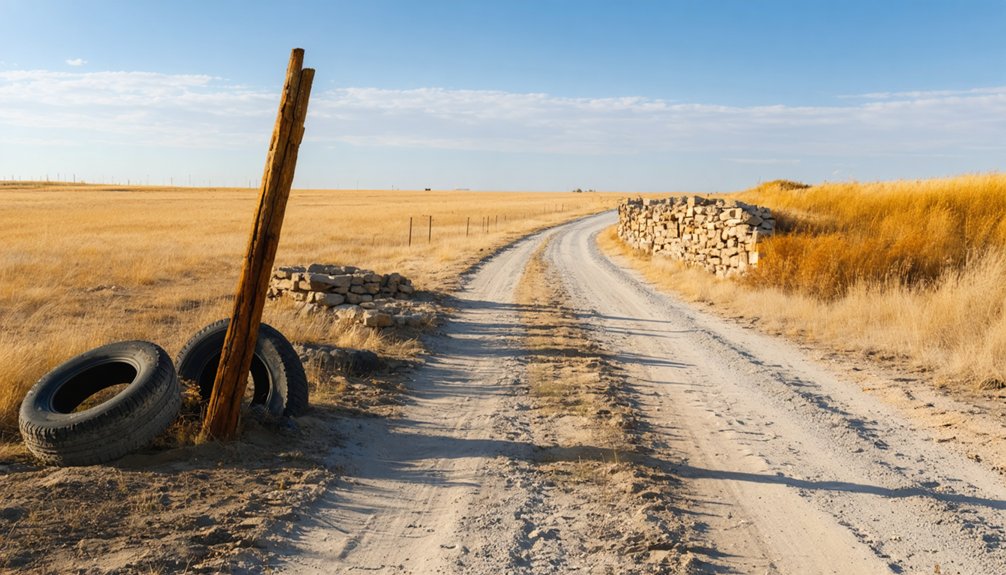
If you’re looking to find what’s left of Cash City, head to Clark County in the heart of the Kansas prairie, roughly 40 miles south of Dodge City and just 15 miles north of the old Indian Territory border.
You won’t find a town marker or a welcome sign — just open grassland where cattle now graze over the depressions and broken dish shards that hint at the 500 souls who once lived here.
To navigate the site, use Ashland, the Clark County seat, as your closest reliable landmark and work your way out across the surrounding prairie roads.
Clark County Prairie Location
Tucked into the Clark County prairie of southwestern Kansas, the ghost town site of Cash City sits roughly 40 miles south of Dodge City and just 15 miles north of what was once Indian Territory.
This wide-open stretch of prairie geography placed it directly at the crossroads of three major trails — the Tuttle, Ashland, and Meade Center — making it a natural hub for commerce and movement.
You’ll find the original site now reclaimed by grassland, with grazing cattle roaming where 500 residents once built their dreams.
The landscape offers little indication of what stood here, just subtle depressions in the earth and occasional broken pottery shards beneath your boots.
It’s a humbling reminder of how quickly the prairie swallows ambition whole.
Nearby Landmarks And Distances
Knowing the lay of the land helps you zero in on exactly where Cash City once stood. The site sits in Clark County, roughly 40 miles south of Dodge City and just 15 miles north of what was once Indian Territory.
That borderland position made Cash City feel like the edge of everything — a fitting setting for ghost town legends and serious prairie exploration.
You’ll find the old townsite near the crossing of three historic cattle trails: the Tuttle, Ashland, and Meade Center routes.
Ashland, the Clark County seat, lies nearby and serves as your practical base camp. Use it to fuel up, grab a map, and orient yourself before heading out across the open grassland where Cash City’s story quietly unfolded.
Finding Cash City takes some deliberate navigation, since no highway signs or historic markers will guide you to this vanished prairie settlement.
You’re heading into Clark County, roughly 40 miles south of Dodge City and about 15 miles north of the Oklahoma border.
The original town site now sits as open pasture, so you’ll want detailed county road maps or reliable GPS coordinates before you go.
A windmill and subtle ground depressions mark what remains of this once-thriving community of 500 residents.
For serious ghost town exploration, connecting with local Clark County historical societies beforehand pays off.
They’ll point you toward the precise location and share prairie history that no roadside sign ever could.
Always get landowner permission before stepping onto private grazing land.
What’s Actually Left at the Cash City Town Site Today?
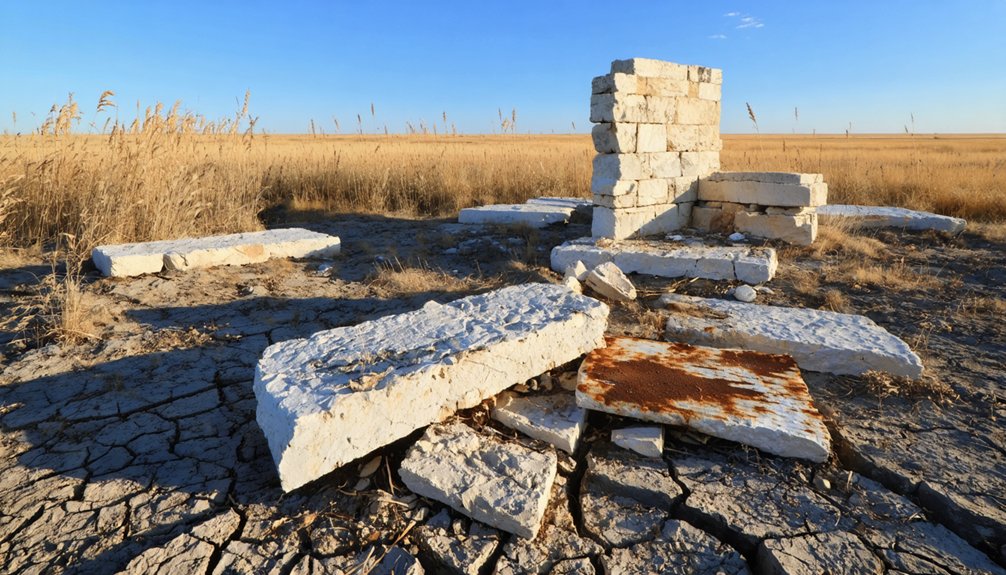
Standing at the original Cash City town site today, you’d never guess 500 people once bustled here. The prairie has quietly reclaimed nearly everything, leaving you with wide-open grassland and grazing cattle where hotels, blacksmiths, and mercantiles once stood.
Look closer, though, and the ghost town relics reveal themselves. Shallow depressions mark where building foundations once sat, and scattered shards of broken dishes poke through the soil like fragments of prairie history frozen in time.
A lone windmill still stands in the pasture, perhaps the most visible reminder that humans once carved a life here.
You won’t find interpretive signs or parking lots. What you’ll find is raw, unfiltered history beneath your feet, quietly waiting for those willing to search for it.
How to Get to Cash City From Dodge City or Ashland
Getting to Cash City takes some old-fashioned navigation across Clark County’s wide-open prairie. From Dodge City, head south roughly 40 miles on US-283 toward Ashland.
From Ashland, the county seat that swallowed Cash City’s ghost town legends after economic factors killed the boomtown, drive north about 15 miles on the same highway.
You’ll want detailed county maps or a reliable GPS, because the original town site sits unmarked on private pastureland. Look for subtle landscape depressions near the old trail crossings where Tuttle, Ashland, and Meade Center routes once converged.
Stop in Ashland first to grab local directions and historical context at the Clark County Museum. Ask locals — they’ll point you toward the windmill standing quietly where 500 people once believed they’d built the next Chicago.
Best Time to Visit Cash City and Clark County’s Ghost Towns
Timing your visit to Cash City and Clark County’s ghost towns can make the difference between a rewarding road trip and a miserable slog through extremes.
Spring and fall offer the best conditions for ghost town exploration — mild temperatures, manageable winds, and golden prairie light that makes photography stunning.
April through May brings wildflowers across the pasture where Cash City once stood.
September and October cool things down after brutal Kansas summers.
Avoid July and August unless you enjoy triple-digit heat baking open grassland.
Winter visits can work on clear days but expect frozen ground and cutting winds.
Whatever season you choose, arrive early to maximize daylight for historical preservation photography and site documentation.
Clark County’s wide-open spaces reward those who plan ahead.
What to Pack for Remote Prairie Ghost Town Sites Like Cash City
Packing smart separates a productive ghost town visit from a cut-short disaster when you’re heading somewhere as remote as Cash City. Your packing essentials should include plenty of water, snacks, sunscreen, and a basic first aid kit since the nearest help sits miles away across open Clark County prairie.
Wear sturdy boots for walking uneven pasture ground where depressions from former buildings hide beneath grass. Bring a camera to document the lone windmill and scattered dish shards still marking Cash City’s footprint. Carry a printed map since cell service is unreliable out here.
Regarding ghost town etiquette, leave everything exactly as you find it. Those broken remnants are irreplaceable historical artifacts. Tuck a trash bag in your pack and carry out everything you bring in.
Nearby Ghost Towns and Historical Sites to Combine With Cash City
Since you’re already making the drive out to Clark County, it makes sense to chain Cash City together with several other compelling stops scattered across this stretch of southwest Kansas.
Ashland, the county seat that absorbed Cash City’s fleeing residents, preserves solid ghost town history through its Pioneer Krier Museum.
Ashland absorbed Cash City’s displaced residents and now preserves that ghost town legacy inside the Pioneer Krier Museum.
Dodge City sits 40 miles north, offering deep railroad speculation context through its Boot Hill Museum.
Englewood, 12 miles south of Cash City, marks where the Chicago, Kansas & Western Railroad actually terminated, making it an essential piece of the same story.
The landscape connecting these stops tells you everything about how economics and bypassed rail lines erased entire communities.
You’ll cover significant ground, but the narrative threading these sites together rewards every mile.
Why Cash City Died the Same Way as Hundreds of Kansas Towns
Cash City didn’t fail because its founders lacked ambition or vision—it failed because ambition and vision were never enough in 1880s Kansas without a railroad to back them up. The economic factors were brutally simple: no rail line meant no freight, no growth, no future.
When the Chicago, Kansas & Western bypassed Cash City and terminated 12 miles south in Englewood, the town’s fate was sealed overnight.
Ghost town dynamics across Kansas followed this same ruthless pattern. Hundreds of settlements rose on speculation, boosterism, and trail traffic, then collapsed the moment railroad surveyors drew their lines elsewhere.
Residents didn’t mourn long—they loaded buildings onto wagons and chased the iron rails. Cash City wasn’t an exception. It was the rule, repeated endlessly across the Kansas prairie.
Frequently Asked Questions
Can You Access the Cash City Site on Foot or Only by Vehicle?
You’ll find the Cash City site accessible on foot, as it’s now open pasture. There aren’t strict vehicle restrictions, but you’re best exploring this ghost town’s depressions and windmill remnants by foot access.
Is the Cash City Pasture Land Privately Owned or Publicly Accessible?
The knowledge doesn’t confirm public land accessibility, so you’ll likely encounter private ownership at Cash City’s pasture. Before you go, contact local Clark County authorities to check whether you’re legally permitted to explore the site.
Are Metal Detectors Permitted at the Original Cash City Ghost Town Site?
Before you grab your metal detector, here’s what you need to know: metal detecting regulations on privately owned land require the owner’s permission. Given Cash City’s historical significance, always secure explicit authorization before searching.
Does Clark County Offer Any Guided Ghost Town Tours Including Cash City?
The knowledge doesn’t confirm Clark County’s offering of guided ghost town tours. You’ll want to contact local historical societies directly to explore ghost town history and uncover Clark County attractions that might include Cash City on their itinerary.
Are There Any Annual Events Commemorating Cash City’s Founding or History?
Like Cash City itself, founding celebrations and historical reenactments have vanished into the Kansas prairie. You won’t find annual events commemorating its history, but you can explore its ghostly pasture remnants independently, embracing true frontier freedom.
References
- http://kansasghosttowns.blogspot.com/2010/12/altering-railroad-broke-cash-city.html
- https://historynet.com/cash-city-booms-goes-bust/
- https://www.youtube.com/watch?v=dy7nLwjHkbY
- https://www.youtube.com/watch?v=8dtIPX7pIqI
- https://electionacademy.lib.umn.edu/2016/12/05/a-town-that-just-wont-die-frederick-ks-election-errors-sway-decision-on-its-future/
- https://legendsofkansas.com/jefferson-county-extinct-towns/
- https://esirc.emporia.edu/bitstreams/b4b4cde4-15d4-4284-a3b5-8430fb9e324e/download