You’ll find Chalk Mountain 12 miles southwest of Glen Rose, where a weathered Masonic lodge and 350 cemetery graves mark what’s left of this 1870s trading hub. Today, just 25 residents call this remote spot home, and you won’t need permits to explore the concrete foundations scattered across forgotten streets. Plan your visit during crisp winter mornings when temperatures cooperate, and pack offline maps since cell service gets spotty in these Central Texas hills—there’s more to uncover about this boom-and-bust settlement’s fascinating past.
Key Takeaways
- Chalk Mountain is located 12 miles southwest of Glen Rose in Erath County at 1,280 feet elevation.
- No special permits or guided tours are required; the roadside location allows spontaneous exploration of the ghost town.
- The historic 1908 Masonic Lodge and Chalk Mountain Cemetery with 350+ graves are the main attractions to visit.
- Visit during crisp winter mornings for ideal photography conditions; avoid extreme heat over 100°F and summer flash floods.
- Expect spotty cell service in this remote area with only 25 current residents and scattered concrete foundations.
The Rise and Fall of a Trading Center
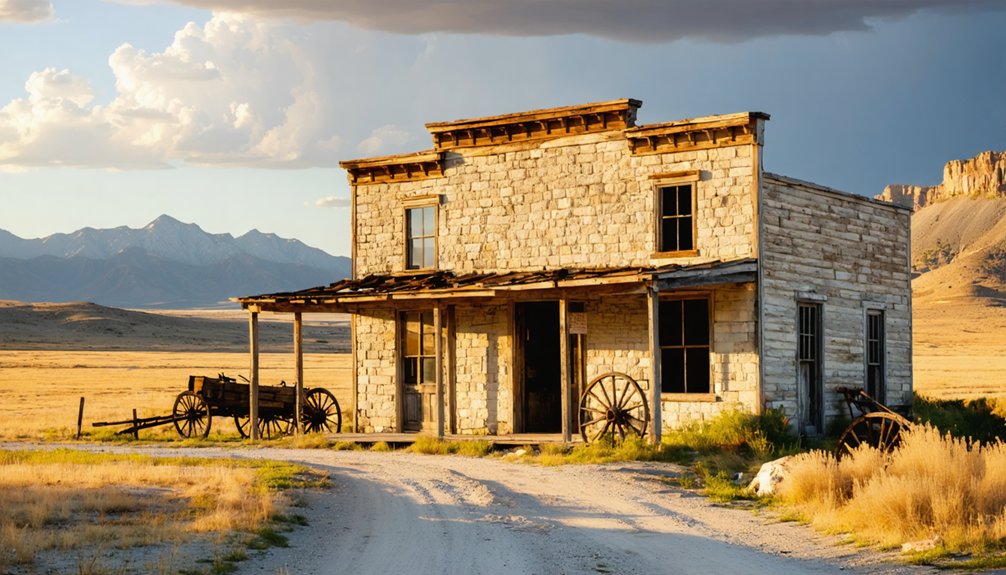
But freedom has its price. Better roads to Stephenville meant easier access to larger markets, draining Chalk Mountain’s prosperity.
The population plummeted to 50 by 1910, and the post office shuttered in 1927.
Getting to Chalk Mountain: Location and Access
The journey to Chalk Mountain takes you along U.S. Route 67, approximately 12 miles southwest of Glen Rose in Erath County. You’ll find this unincorporated community near the Somervell County line at coordinates 32°09′16″N 97°54′39″W, perched at 1,280 feet elevation.
The roadside accessibility makes it perfect for spontaneous exploration—no special permits or guided tours required. Simply follow Highway 67 and watch for the Chalk Mountain USGS topographic marker.
Visitor demographics lean toward history enthusiasts and adventure seekers who appreciate off-the-beaten-path destinations. The ghost town’s location offers genuine freedom to explore at your own pace.
The area surrounding ghost towns near Mount Olive, Texas is rich with stories of the past, providing intriguing insights into the lives of early settlers. Each abandoned building and crumbling street tells a tale waiting to be uncovered by curious visitors. As you wander through these remnants, you’ll feel the echoes of history resonate in the stillness of the Texas landscape.
Pack water, check your fuel gauge, and remember: cell service might be spotty in this remote Central Texas landscape. Your independence matters here.
What Remains of the Town Today
When you arrive at Chalk Mountain today, you’ll find a settlement caught between existence and erasure—just twenty-five residents calling this wind-swept patch of Central Texas home. Only six occupied residences remain visible, scattered across terrain where concrete foundations from the 1870s still mark forgotten streets.
The two-story Masonic lodge stands as your primary landmark, recently remodeled after natural disaster impacts left only its upper floor intact from a devastating tornado. Most other structures tell darker stories—deteriorating structures with collapsing walls and roofs now hidden behind barbed wire fencing that blocks close access.
You won’t find Chalk Mountain on official highway maps anymore, but the cemetery preserves what the living town cannot: 350 graves documenting pioneer resilience, Civil War veterans, and frontier-era tragedies etched in weathered headstones.
The Historic Masonic Lodge
You’ll spot the Masonic Lodge‘s weathered two-story frame structure standing as Chalk Mountain’s most prominent survivor. The original 1908 building housed J.H. Underwood’s grocery store on the ground floor while Freemasons conducted their moonlit meetings upstairs—a practical arrangement that kept the community’s commercial and fraternal life stacked under one roof.
Though the store shuttered after D.W. Lackey’s death in 1935, those dedicated Masons kept climbing those stairs for another 54 years until property disputes forced them to literally lift their meeting hall off its foundation and move it down the road.
Two-Story Frame Structure
Rising from the sparse Texas landscape, this weathered two-story frame building stands as Chalk Mountain’s most prominent landmark—a legacy to frontier brotherhood that’s outlasted the town itself. J.H. Underwood constructed this enduring structure by 1908, with the first floor housing his grocery store while Masons gathered upstairs.
The longevity of construction is remarkable—that second floor hosted lodge meetings every Saturday following the full moon from 1908 through 1989, an unbroken 81-year run.
When land disputes threatened the building in 1989, members didn’t surrender. They literally lifted the original architectural details—the entire second story—and relocated it atop a new concrete foundation a quarter-mile away. You’ll find it still standing at 327 CR 198, defying abandonment while serving just 25 stubborn souls who refuse to let their community fade.
Former Store Below Meetings
That imposing second story didn’t start its journey as an architectural orphan—it spent its first 81 years perched above J.H. Underwood’s grocery store, establishing Chalk Mountain’s early commercial operations hub by 1908. While shoppers haggled over supplies downstairs, Masons conducted their mysteries on the upper floor meetings, gathering by full moon’s light every Saturday.
The arrangement worked perfectly—commerce below, brotherhood above—even as ownership changed hands from Underwood to C.C. Hammock in 1908, then D.W. Lacky in 1916. When Lacky died in 1935, the store closed for good, but those Saturday moon rituals continued upstairs for another 54 years. You’re looking at Texas stubbornness personified: a lodge that outlasted its commercial foundation by half a century.
Exploring Chalk Mountain Cemetery
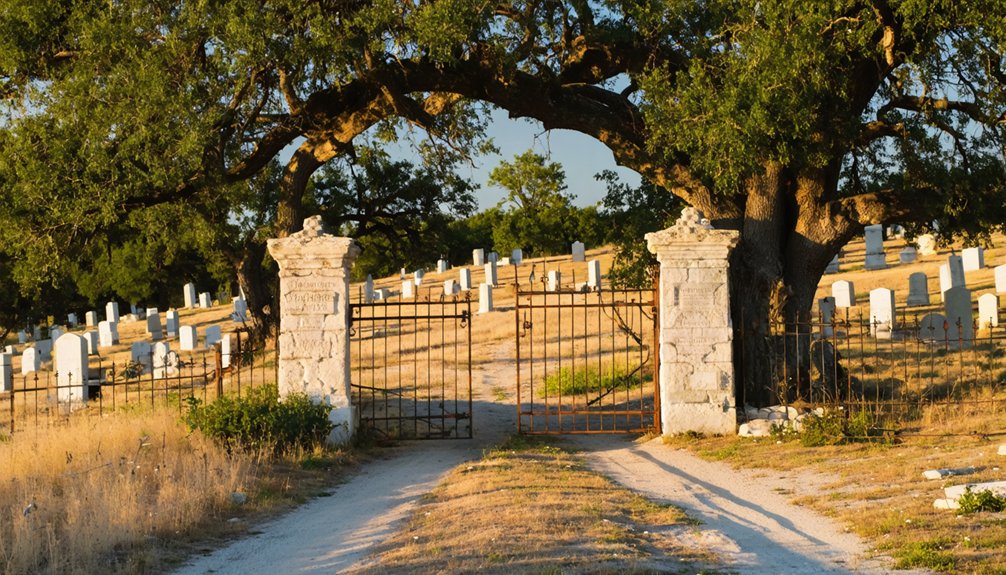
When you turn off CR 198 and follow the winding path into Somervell County, the Chalk Mountain Cemetery emerges alongside its weathered church—twin sentinels guarding over 350 souls who’ve called this rugged landscape home since before the Civil War. You’ll find Abigal Davis’s 1874 marker among the earliest, though unmarked depressions suggest the grounds held departed pioneers even earlier.
The headstones and epitaphs tell stories of Confederate veterans like Hiram Berry Rogers, who donated this land in 1915, ensuring perpetual community remembrance. Walk among graves of frontier children, disaster survivors, and veterans from four American wars. A Texas historical marker (No. 800) designates this last remnant of a ghost town.
Contact the cemetery association before visiting—they’ve maintained these sacred grounds since 1959.
Population Through the Decades
You’ll find Chalk Mountain’s story written in its census numbers—a modest peak of 81 souls in 1900, when the gin ran and churches rang with hymns. The town never broke 100 residents, dropping to just 50 by 1910 as good roads made Stephenville’s stores more accessible than local merchants.
Today, you’re looking at roughly 25 people spread across six occupied homes, a population that’s held remarkably steady since 1980.
Peak and Decline Years
As you trace Chalk Mountain’s demographic journey, you’ll discover a classic Texas boom-and-bust story that mirrors countless rural communities across the state. The town peaked at 81 souls in 1900, boasting commercial establishments including a gin, school, and two churches.
But here’s the killer: residents had easy access to Stephenville’s bigger markets, sealing Chalk Mountain’s fate before it truly began.
Modern Day Residents
The 1980 census counted just twenty-five residents in Chalk Mountain, and that number refused to budge for two decades straight. You’ll find about six occupied homes scattered across the landscape today, where families still claim this windswept freedom. The remodeled Masonic lodge hosts social gatherings that keep the community’s pulse beating, though you won’t spot any church steeples on the horizon.
Modern agriculture defines daily life here—ranchers work cattle behind those barbwire fences blocking the old buildings. The Chalk Mountain Wildlife Association proves locals still organize around their land rights and hunting traditions. Fresh graves in the cemetery tell you this isn’t completely abandoned. At 1,200 feet elevation, these stubborn souls maintain their independence along Highway 67, choosing isolation over crowded suburbia.
Best Times to Visit
Timing your visit to Chalk Mountain can make the difference between a sweltering trudge through deserted ruins and a perfect day of exploration under clear Texas skies. Current tourist visitation remains blissfully low year-round at this forgotten outpost, unlike Big Bend’s overcrowded trails.
Spring (March-April) brings wildflowers painting the limestone terrain, though you’ll need to escape early morning before temperatures climb past 80°F. Fall (October-November) offers your sweet spot—moderate weather perfect for all-day wandering without fighting crowds.
Summer’s brutal 100°F+ heat makes exploration miserable, while winter delivers crisp mornings ideal for photography. Understanding seasonal weather patterns helps you dodge monsoon flash floods (July-September) and occasional winter cold snaps.
Midweek visits guarantee empty roads. You’ll have these ghost town remnants entirely to yourself.
The 2009 Meteorite Hoax
May 2009 brought Chalk Mountain its fifteen minutes of fame when reports exploded across Texas about a refrigerator-sized meteorite crashing into the sleepy community. Fox News crews rushed to document the gray-white rock nestled in a suspicious trench, with smashed trees nearby but tellingly—no burn marks.
University of Texas professor Manfred Cuntz and meteoric expert Arthur Ehlmann quickly spotted the red flags. The “meteorite” was ordinary limestone, and that trench looked awfully man-made. Turns out the property owner ran an earth-moving company specializing in relocating massive rocks.
The aftermath of the hoax left Fox scrambling to remove their coverage while local papers backpedaled. Today, you’ll find this quirky chapter adds character to Chalk Mountain’s story—proof that even ghost towns can pull off spectacular pranks when media attention on the incident reaches fever pitch.
Early Settlement and Notable Landmarks
Long before pranksters could dupe Fox News, Chalk Mountain‘s story began as a legitimate frontier trading post in the 1850s.
You’ll find J.H.F. Skipper’s 1860 ranch anchored this early trading network, drawing settlers and merchants to the white rock elevation that gave the town its name.
Frequently Asked Questions
Are There Any Nearby Attractions to Visit Along With Chalk Mountain?
You’ll discover adventure beyond the ghost town ruins and abandoned railroad tracks. Dinosaur Valley State Park’s fossilized footprints await 30 minutes away, while Fossil Rim’s drive-thru safari offers close encounters with endangered species roaming free across 1,500 acres.
Is Camping or Overnight Accommodation Available Near Chalk Mountain?
You’ll find excellent camping facilities and overnight accommodations nearby. Pedernales Falls State Park offers electric sites at $20 nightly, while Chalk Bluff River Resort provides cozy cabins along the Nueces River, perfect for your adventurous escape.
Are There Guided Tours Available for the Cemetery or Masonic Lodge?
No guided tours of historic buildings exist here—you’ll explore independently. The cemetery’s open for self-guided visits, though the masonic lodge’s accessibility remains unclear. You’re free to document your exploration of abandoned structures at your own pace.
What Facilities or Amenities Are Available for Visitors in the Area?
You’ll find yourself in civilization’s memory here—absolutely no facilities exist. There aren’t any gift shops, picnic areas, or restrooms. Pack everything you’ll need. However, a roadside park offers pullover spots for independent explorers craving authentic wilderness.
Can Visitors Enter the Masonic Lodge or Only View From Outside?
You can’t enter the Masonic lodge—it’s members-only during meetings. However, you’re free to admire its unique two-story architecture from outside and read the historical marker detailing its fascinating 1904 origins and horseback-era traditions.