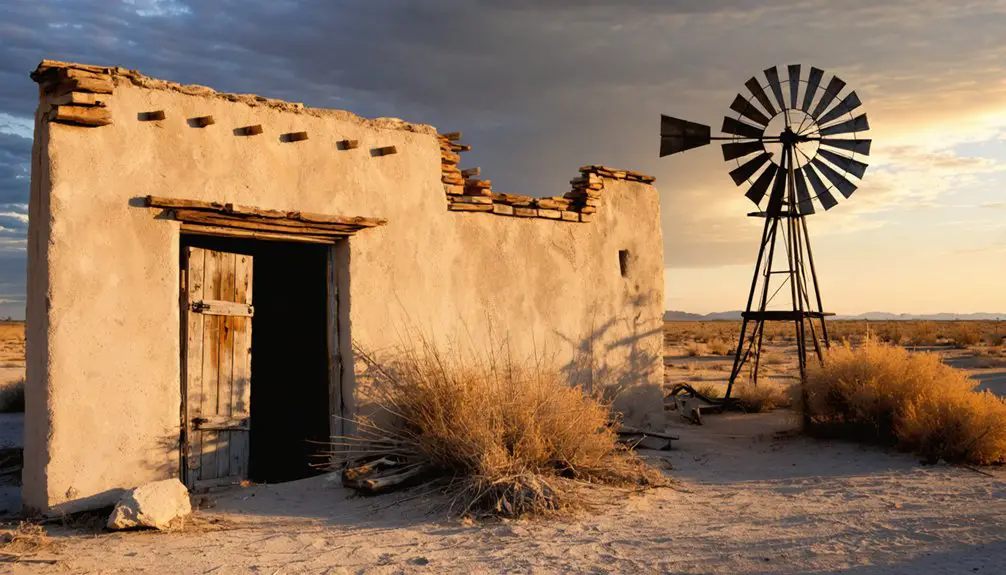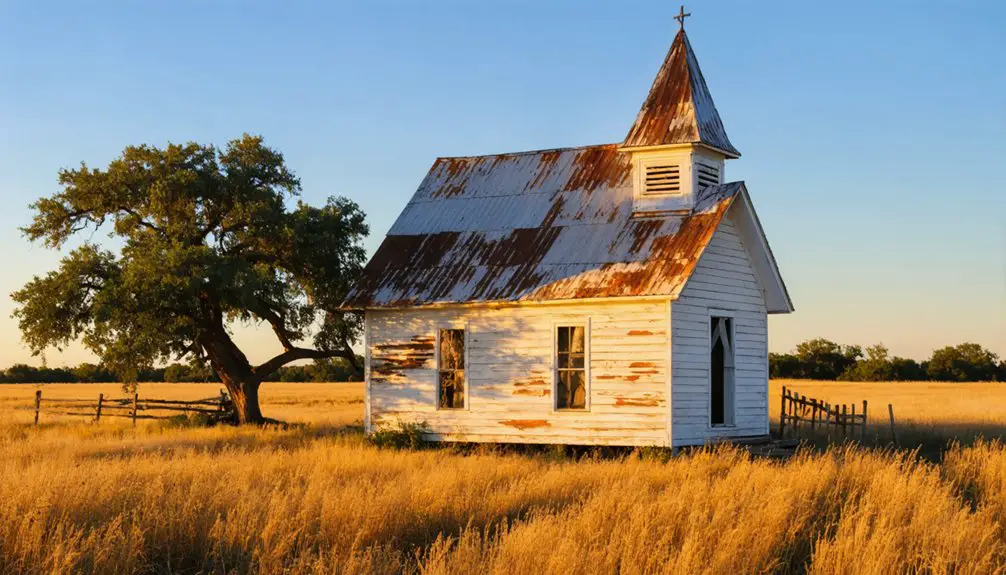
You’ll find Cibolo Settlement’s ghost along the historic creek ford where Spanish expeditions, Texas Revolution troops, and pioneer families like the Carvajals carved out lives in the 1840s-50s. Red sandstone walls, cemetery markers, and the legendary Deaf Smith Oak site mark this contested borderland between San Antonio and Gonzales. The natural crossing witnessed Apache encounters, Comanche raids, and the desperate ride that brought news of the Alamo’s fall. Exploring these weathered remnants reveals layers of Texas’s struggle for independence and survival.
Key Takeaways
- Visit red sandstone Carvajal Ranch ruins and sulphur spring near the historic Cibolo Creek crossing site.
- Explore abandoned Cibolo Crossing on Gonzales Road where relief forces received news of the Alamo’s fall.
- Locate cemetery markers and weathered farmstead ruins tracing small-scale industries south of the creek.
- Hike Cibolo Creek’s upper canyons featuring natural waterfalls, limestone springs, and bald cypress groves.
- Search for the historic Deaf Smith Oak site where scouts monitored Mexican troop movements during revolution.
Historical Significance of Cibolo Creek Crossing During the Texas Revolution
Long before the first shots of the Texas Revolution echoed across the prairie, Cibolo Creek’s natural ford served as the lifeblood of Spanish Texas. You’ll discover this crossing shaped military movements from Spanish expeditions in 1721 through Santa Anna’s own route-laying during the revolution.
The ford became essential when U.S. Army routes shifted from Goliad, funneling troops and supply trains through the valley to protect independence-minded Texans.
Settler defense here wasn’t optional—it was survival. Men like the Brister brothers maintained armed vigilance while families lived twelve miles apart, facing constant Apache and Comanche threats.
President Burnett himself praised these frontiersmen who guarded their homes during Texas’s independence struggle. You’re standing where freedom-seekers fought two wars: one for political independence, another against relentless raids.
Early Settlement and Pioneer Life Along Cibolo Creek
The warriors who defended Cibolo Creek’s crossing needed more than muskets—they needed roots. You’ll discover that permanent settlement began when the Brister brothers built crude shanties above Martinez stream in July 1847, staking their claim during Texas expansion.
By mid-September, Joseph H. Polley—one of Stephen F. Austin’s Old 300—arrived with his family, establishing a homestead twelve miles upriver. These pioneers faced relentless frontier challenges: Apache and Comanche raids, isolation, and unforgiving land.
Jose Luis de Carvajal constructed a dugout near the ford, raising nine children while maneuvering tenuous peace with Lipan Apache. Dan Cotter transformed hardship into opportunity, planting ten acres of watermelons along the Ecleto and trading his harvest in San Antonio’s markets.
Native American Heritage and Encounters at the Cibolo
Before Spanish settlers ever christened these rolling grasslands “Cibolo,” the creek bore witness to generations of Native peoples who shaped its identity through their presence. You’ll discover the Cibola Indians—specialized bison hunters whose name literally means “bison”—ranged these plains between the Pecos and Colorado rivers. Their tribal cultural traditions centered on hunting buffalo across the sweeping grasslands you’ll traverse today.
As you explore, imagine the historic trading outposts like El Fortin del Cibolo, where Milton Faver conducted commerce with Native groups in the mid-1800s. Apache pressure eventually displaced the Cibola southward, while Comanche raids intensified by 1782. The valley’s scattered remains tell stark stories of fierce battles between Indians, settlers, and soldiers—reminders of freedom’s brutal costs along these contested borderlands.
Geographic Features and Natural Landmarks Worth Visiting
As you explore Cibolo Settlement’s remains, you’ll encounter the geographic features that made this location ideal for early pioneers. Cibolo Creek flows through the area with steady waters fed by limestone springs that bubble up through the Hill Country’s karst terrain, creating the reliable water source that sustained the community.
The massive Deaf Smith Oak still stands as a living landmark, its sprawling branches marking the landscape where settlers and Native Americans once crossed paths along this essential waterway.
Cibolo Creek and Springs
Ninety-six miles of winding waterway connect Turkey Knob in the Texas Hill Country to the San Antonio River near the ghost town of Helena, carving out one of the region’s most distinctive geographic features.
You’ll find Cibolo Creek’s upper reaches showcasing dramatic canyons, natural waterfalls, and bald cypress groves—perfect for recreational activities like hiking and photography.
The middle section reveals something remarkable: the water vanishes underground through limestone cracks, functioning as crucial aquifer recharge systems that feed San Antonio’s drinking water supply. During dry spells, you’ll traverse creek beds that only flow after heavy rains.
The lower stretches wind through flatter terrain dotted with oak and mesquite, offering solitude far from urban sprawl. This waterway embodies Texas’s untamed spirit, where nature still dictates the rules.
Historic Deaf Smith Oak
A weathered giant once stood sentinel over Cibolo Creek’s eastern bank, watching history unfold from its vantage point two miles north of La Vernia. The Deaf Smith Oak witnessed pivotal moments in Texas’s fight for independence—Erastus “Deaf” Smith climbed its branches to spy on Mexican troops, Stephen F. Austin’s army marched past toward the Siege of Béjar, and Susanna Dickinson delivered news of the Alamo’s fall beneath its canopy.
This oak tree significance extended through nearly 180 years before lightning, fires, and floods claimed it in 2014. You’ll find cultural heritage preservation continuing through its successor, grown from the original’s acorn and planted 300 yards away. Visit the replacement oak on Circle N Dairy property, where a commemorative bench honors this silent witness to Texas liberty.
Exploring the Ghost Town Remnants and Historic Sites
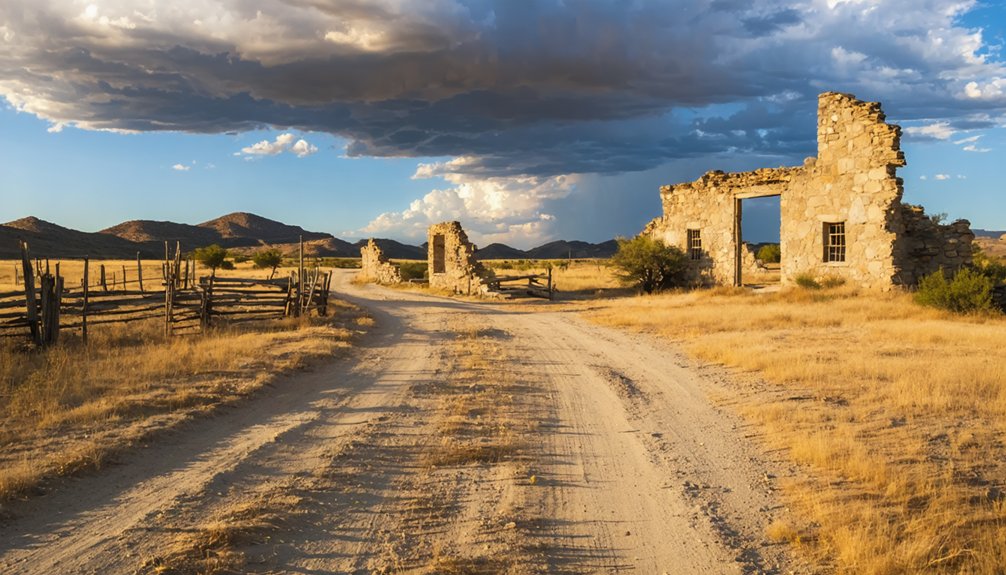
When you venture into the countryside where Cibolo Settlement once thrived, red sandstone walls emerge from the landscape like silent witnesses to Texas history. At the Carvajal Ranch crossing, you’ll find the two-room building’s remains opposite a sulphur spring—natural resources that drew both Native Americans and pioneers to these banks.
The Gonzales Road’s abandoned Cibolo Crossing marks where relief forces learned of the Alamo’s fall, while the legendary Deaf Smith Oak stands near the ford where scouts monitored Mexican troop movements. South of the creek, you can trace small scale industries through cemetery markers and farmstead ruins. These weathered remnants offer you tangible connections to the settlement’s 1846 founding and its role in shaping Texas independence.
Modern Day Cibolo: Where History Meets Suburban Growth
You’ll find Cibolo’s past carefully preserved even as new subdivisions stretch across former cotton fields, transforming this once-sleepy settlement into a booming San Antonio suburb. The city’s dramatic evolution from 398 residents in 1968 to over 3,000 by 2000 tells a story of Interstate 35’s impact and Randolph Air Force Base’s steady influence.
Standing at historic sites along Cibolo Creek today, you’re witnessing a rare balance where 19th-century agricultural heritage coexists with modern retail centers and residential developments.
Preserved Historic Sites Today
Though the original Spanish colonial fort vanished centuries ago, Cibolo’s legacy lives on through meticulously preserved sites that bridge past and present.
You’ll discover the Cibolo Nature Center and Herff Farm, a 100-acre preserve featuring Dr. Ferdinand Herff’s 1852 homestead. This National Register property offers:
- Historic trails winding through wilderness and along Cibolo Creek
- A renovated barn housing Saturday farmers markets
- Teaching gardens and authentic pioneer homesteads
- Conservation corridors protecting the watershed from suburban encroachment
Archaeological excavations at El Fuerte del Cibolo have unearthed over 4,000 artifacts—Spanish Colonial ceramics, Indian tools, and animal remains revealing frontier life. Meanwhile, the restored 19th century chapel and curated artifact exhibits showcase religious pieces from Northern Mexico alongside historical photographs and documents, letting you experience authentic frontier heritage without restriction.
Thriving San Antonio Suburb
Since 2000, Cibolo has transformed from a quiet settlement of 3,035 residents into a booming San Antonio suburb of over 39,000 people—a staggering 733% population explosion that ranks among Texas’s most dramatic metropolitan expansions.
You’ll discover a prosperous community where median household incomes reach $125,230, supporting 521 businesses and thriving suburban commercial development throughout the city. The demographics tell a compelling story: 77.4% homeownership, median home values of $353,403, and just 1.7% poverty rates reflect genuine economic stability.
What makes Cibolo particularly attractive are the family oriented attractions serving its young population (median age 37). Educational services employ 853 workers, while diverse neighborhoods showcase remarkable ethnic variety—a diversity index of 81.600 that enriches this modern Texas success story.
Agriculture to Urban Development
Deep in the rugged landscape along Cibolo Creek, Milton Faver transformed raw frontier land into a thriving agricultural empire by 1860, claiming $25,000 in personal property—including $18,000 worth of livestock—that anchored his ranching operations. His agricultural operations produced wheat, corn, beans, butter, cheese, and wool from three strategic forts that served as trading hubs.
However, post civil war challenges reshaped everything:
- The 1882 railroad brought competition and settlers who claimed Faver’s free-range land
- Shafter’s silver boom created 3,000-person mining communities that depleted resources
- Faver’s 1889 death ended the family’s ranching dynasty
- The ranch moved from cattle operations to wildlife and resort services by the 1980s
Today’s 2018 revival under Tom Davis has restored cattle ranching with 550-head herds and modern infrastructure.
Frequently Asked Questions
What Is the Best Time of Year to Visit Cibolo Settlement?
You’ll find the best time to visit during the spring season when wildflowers blanket the Hill Country and cooler weather makes exploring perfect. Fall’s another great choice, offering comfortable temperatures and fewer crowds for your adventure.
Are There Any Guided Tours Available for the Ghost Town Area?
You’ll experience guided ATV mountain tours led by experienced ranch hands through Cibolo Creek Ranch, exploring the ghost town ruins. Unfortunately, guided walking tours and self-guided audio tours aren’t currently available for independent exploration of the area.
Where Can I Find Accommodations Near the Historic Cibolo Creek Sites?
Picture yourself unwinding after exploring sun-bleached ghost town ruins. You’ll discover nearby lodging options including Hampton Inn Schertz and La Quinta, plus vacation rental properties like Serenity House—all within minutes of historic Cibolo Creek sites.
As you continue your adventure, consider visiting the history of Fort McKavett, Texas, where the remnants of an old military outpost offer a glimpse into the past. The site features fascinating interpretive displays and guided tours that delve into the stories of those who once inhabited the area. Afterward, you can relax and reflect on your day at one of the scenic picnic spots nearby, surrounded by the beauty of the Texas landscape.
Is the Deaf Smith Oak Still Standing and Accessible to Visitors?
The original tree fell in 2014 and isn’t accessible due to private property. However, you can visit a replacement oak grown from its acorn at US 87 and Bluebonnet Drive, following standard accessibility guidelines.
What Safety Precautions Should I Take When Exploring the Creek Area?
Avoid fast flowing water during floods, as low-water crossings are deadly. Be cautious of wildlife along the banks. Check bacteria levels before any water contact, watch for poor visibility from turbidity, and never drive through standing water.