Planning a ghost town road trip to Cuchillo, New Mexico puts you just 15 miles from Truth or Consequences on I-25. You’ll walk streets once crowded by nearly 2,000 residents during the silver boom era, where Apache legends and frontier history haunt every weathered storefront. Today, only 35 residents remain alongside an active church and a century-old bar. Bring cash, water, and sturdy shoes — there’s far more to this forgotten valley than first meets the eye.
Key Takeaways
- Cuchillo is only 15 miles from Truth or Consequences, with easy access via I-25, making it a convenient road trip destination.
- Bring cash, water, and snacks, as no ATMs exist and amenities are extremely limited in this semi-ghost town.
- Explore the historic Cuchillo Store, featuring an original silver boom-era bar and artifacts from freight mule operations and mining activities.
- Wear sturdy shoes and respect private property, as some ruins sit on active ranches with uneven, potentially hazardous terrain.
- Visit the still-active San Jose Church, rebuilt in 1907, and weathered storefronts offering authentic glimpses into New Mexico’s frontier past.
Cuchillo, New Mexico: A Frontier Town Frozen in Time
Tucked into the valley of Cuchillo Negro Creek in Sierra County, the semi-ghost town of Cuchillo, New Mexico feels like a place where time simply stopped caring.
Fifteen miles from Truth or Consequences, this quiet settlement carries deep historical significance — from ancient Mimbres occupants to centuries of Apache presence before Spanish explorers ever arrived.
At its peak between 1880 and 1920, Cuchillo supported nearly 2,000 residents, thriving on farming, ranching, and trade with nearby silver mining towns.
Today, with a population around 35, it rewards your frontier exploration instincts with weathered storefronts, a still-active church, and ruins that whisper forgotten stories.
You’re not visiting a polished museum here — you’re stepping directly into living history that most travelers speed right past.
The Apache Chief Behind Cuchillo’s Name
Before a single homesteader broke ground here, the land already carried a name — and that name belonged to a man. Cuchillo Negro, meaning “Black Knife,” was a Warm Springs Apache chief whose band controlled this valley long before Spanish boots ever touched New Mexico soil.
His Apache heritage wasn’t just historical background — it shaped the entire region’s identity. He rode alongside the legendary Mangas Coloradas, and his people used this creek and surrounding mountains as home territory for centuries.
When you walk through Cuchillo today, you’re standing on ground that carries his cultural influence in every place name around you. The creek, the mountains, the town itself — all bear witness to a chief who defined this land before anyone thought to settle it.
How Cuchillo’s Creek Turned a Desert Valley Into a Farming Hub
When you picture a desert valley in arid southwest New Mexico, farming might be the last thing on your mind—but Cuchillo Negro Creek changed everything.
Early settlers engineered irrigation systems that channeled the creek’s year-round flow across the valley, feeding over 100 farms at peak capacity.
That reliable water supply transformed parched land into fertile fields, propelling Cuchillo to a population of nearly 2,000 and making it a thriving agricultural and trade hub between 1880 and 1920.
Creek-Fed Irrigation Systems
Though the surrounding Chihuahuan Desert baked under a relentless southwestern sun, Cuchillo Negro Creek transformed the valley floor into something far more productive.
Early settlers engineered irrigation methods that channeled year-round creek water directly onto their fields, turning arid soil into fertile ground. Their farming techniques supported over 100 individual farms at peak operation, feeding families and supplying surrounding mining communities at Chloride and Winston.
You can almost picture the network of hand-dug ditches directing water across the valley, sustaining crops that had no business thriving in this harsh landscape.
That ingenuity fueled Cuchillo’s rise into a legitimate agricultural hub. Without the creek, there’s no town, no trade center, and no story worth chasing on your road trip through Sierra County.
Desert Agriculture’s Peak Prosperity
Those hand-dug ditches didn’t just water crops — they built an economy. At Cuchillo’s peak between 1880 and 1920, you’d have witnessed over 100 farms thriving through surprisingly sophisticated desert farming practices.
Settlers channeled Cuchillo Negro Creek using irrigation techniques that transformed arid valley soil into productive cropland year-round.
The results were remarkable. That reliable water supply attracted ranchers, miners, and traders, pushing the population toward 2,000 residents. Farmers grew enough to feed their own families while supplying nearby mining camps at Chloride and Winston.
Merchants established trade routes, stage lines rolled through regularly, and commerce flourished.
What you’re walking through today was once a self-sufficient agricultural hub — proof that one persistent creek could reshape an entire desert community’s destiny.
Why Cuchillo, New Mexico Faded Into Near Ghost Town Status?
As you explore Cuchillo’s quiet streets, you’ll quickly sense the weight of the setbacks that stripped this once-thriving community of its essence.
When the silver mines at Chloride and Winston shut down, the steady stream of miners, traders, and freighters that had fueled Cuchillo’s economy dried up almost overnight.
Then the devastating floods of the 1920s washed away key structures, including earlier versions of the beloved San Jose Church.
The Great Depression delivered the final blow, driving out most of the remaining residents and reducing a town that had once housed nearly 2,000 people to a shadow of its former self.
Mine Closures Hurt Economy
When the silver mines at Chloride and Winston shuttered, Cuchillo lost its economic heartbeat almost overnight.
The town’s mining history had fueled everything — trade, travel, and livelihoods. That economic impact rippled through every household.
Here’s what the mine closures triggered:
- Prospectors and miners packed up, shrinking the customer base for local merchants
- Stage lines carrying supplies and passengers stopped running regularly
- Ranchers and farmers lost their biggest nearby market for goods
- Businesses dependent on miner traffic closed their doors permanently
- Population began its steady, irreversible decline toward near ghost town status
You can still feel that absence walking Cuchillo’s quiet streets today.
The town that once buzzed with frontier commerce now stands as a reminder of how quickly economic tides can turn.
Floods Destroyed Key Structures
The 1920s floods didn’t just damage Cuchillo — they dismantled it. Raging floodwaters tore through the valley, wiping out structures that took generations to build. The flood impact hit hardest at the San Jose Church, destroying earlier versions of the beloved landmark before rebuilding efforts finally produced the 1907 structure you can still visit today.
Beyond the church, homes, storefronts, and community gathering places vanished beneath the surge. Families who’d carved lives from this rugged land watched their investments wash away. Some stayed and rebuilt; many didn’t.
The floods accelerated what the mine closures started — a slow, irreversible unraveling of a once-thriving community. Walking through Cuchillo today, you’re seeing what survived nature’s fury, and that makes every remaining structure feel even more remarkable.
Great Depression Emptied Town
Floods softened Cuchillo, but the Great Depression delivered the killing blow. The economic impact rippled through every household, draining the community of its remaining energy. Population decline accelerated sharply, dropping to a skeleton crew of determined holdouts.
Here’s what sealed Cuchillo’s fate:
- Ranchers and farmers couldn’t sustain operations without reliable income or markets.
- Merchants shuttered storefronts as residents abandoned the valley.
- The mining towns of Chloride and Winston stopped generating traffic entirely.
- Families who’d built roots for generations packed up and disappeared.
- Only the most resolute settlers refused to leave.
Today, roughly 35 people call Cuchillo home. Walking its quiet roads, you’re stepping through layers of struggle, resilience, and raw New Mexico history that most travelers never discover.
The Cuchillo Store and Bar Still Holds Its Secrets
Standing at the heart of Cuchillo, the old store and bar draws you in with its weathered facade and the quiet weight of over a century’s worth of history.
Step inside and you’ll find hidden artifacts lining the walls — remnants of freight mule operations, mining tools, and relics that whisper Cuchillo Legends stretching back to its peak trading days.
The original bar may still stand intact, a hallmark of the craftsmen who built it when silver fortunes flowed through town.
Locals swap ghost stories about unexplained sounds and shadowy figures haunting the space after dark.
Whether you believe the tales or not, you can’t deny the building’s magnetic pull — it holds secrets that no history book has fully captured.
San Jose Church and the Dance Hall Ruins Next Door
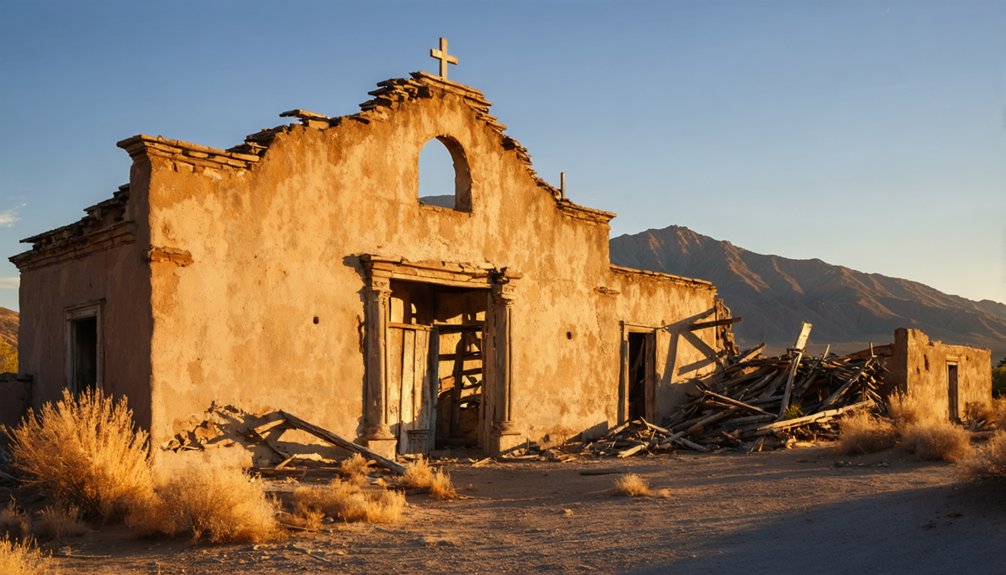
Just steps from the store, you’ll find San Jose Church, a quiet tribute to the community’s resilience — rebuilt in 1907 after devastating floods swept away its earlier versions.
You can still attend mass there today, making it one of the few living landmarks in an otherwise fading town.
Right next door, the crumbling ruins of an old dance hall stand in stark contrast, their weathered walls hinting at the livelier nights Cuchillo once knew.
San Jose Church History
Although the San Jose Church has weathered floods, economic collapse, and the slow unraveling of the community around it, it’s still standing and still holding mass.
This resilient piece of cultural heritage tells Cuchillo’s story better than any history book. Its church architecture reflects the enduring spirit of the Hispanic community that built this valley.
San Jose Church highlights:
- Rebuilt in 1907 after devastating floods destroyed earlier versions
- Community significance remains strong — mass is still actively held here
- Architecture reflects traditional New Mexico Hispanic religious design
- Serves as a living monument to Cuchillo’s cultural heritage
- Survived the Great Depression, mine closures, and population collapse
You’re not just looking at an old building — you’re standing inside a community’s will to survive.
Surviving Floods and Rebuilding
When the floodwaters tore through Cuchillo in the 1920s, they didn’t spare the San Jose Church — they leveled earlier versions of it entirely.
What you see standing today reflects the community’s flood resilience and determined rebuilding efforts that raised the current structure in 1907. Step inside and you’ll find an active church still hosting mass, a living symbol of the settlers who refused to abandon their valley.
Right next door, the dance hall tells a different story. Nobody rebuilt that one. Its crumbling adobe ruins sit quietly beside the church, a striking contrast between what the community chose to resurrect and what time simply swallowed.
Walk between both structures and you’re reading Cuchillo’s resilience in real time — faith reconstructed, celebration left to slowly dissolve back into the desert.
Dance Hall Ruins Today
Standing beside the San Jose Church, you’ll notice the dance hall ruins don’t announce themselves dramatically — they simply sit there, half-swallowed by decades of quiet neglect.
These architectural remnants carry enormous historical significance, once hosting community gatherings that defined Cuchillo’s cultural heritage.
What the ruins reveal:
- Crumbling walls that once echoed with music, laughter, and storytelling traditions
- Evidence of a thriving Hispanic community numbering nearly 2,000 residents
- Local folklore suggesting lost treasure and restless spirits roam freely here
- Minimal preservation efforts, leaving authenticity completely intact for curious explorers
- A raw, unfiltered glimpse into frontier social life that no museum replicates
You’re standing where miners, ranchers, and families once danced freely.
That history belongs to nobody — and somehow, still to everyone.
Ghost Stories and Lost Treasure Tales From Old Cuchillo
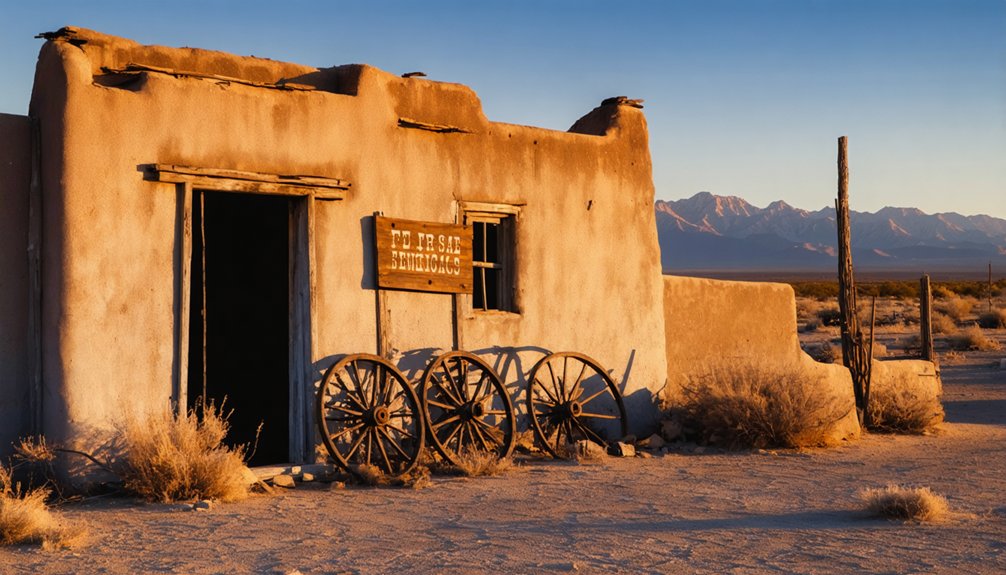
Everyone who steps into the old Cuchillo Store and Bar feels it — that uneasy sense that the past hasn’t quite let go. Locals whisper about ghostly encounters in the dim corners where miners once drank and traded secrets.
The past lingers here — restless, unresolved, haunting every shadowed corner where miners once whispered their secrets.
You’ll hear stories of shadowy figures drifting through the abandoned dance hall ruins next door, and voices carried on still desert air.
Then there are the hidden treasures. Legend claims Apache raiders and desperate prospectors buried silver and gold throughout these hills before they vanished. Nobody’s found it yet — or if they have, they’re not talking.
Wander the crumbling structures with open eyes. Cuchillo rewards the curious traveler willing to look beyond the surface, where history, mystery, and possibility converge at every weathered corner.
Getting to Cuchillo From Truth or Consequences
Just 15 miles separate Truth or Consequences from Cuchillo, making it one of the easiest ghost town detours in southern New Mexico.
Jump on I-25 north, exit toward Cuchillo, and you’re rolling through a scenic route steeped in historical significance — Apache territory, frontier farming, and silver rush echoes.
- Head north on I-25 from Truth or Consequences
- Take the Cuchillo exit and follow the road west
- Stop at the Cuchillo Store and Bar first
- Explore San Jose Church and the abandoned dance hall ruins
- Watch for unmarked historic structures along the creek
You don’t need a guide or a map — just curiosity and a full tank.
The drive itself sets the mood before you even arrive.
How Cuchillo Fits Into a Winston and Chloride Road Trip
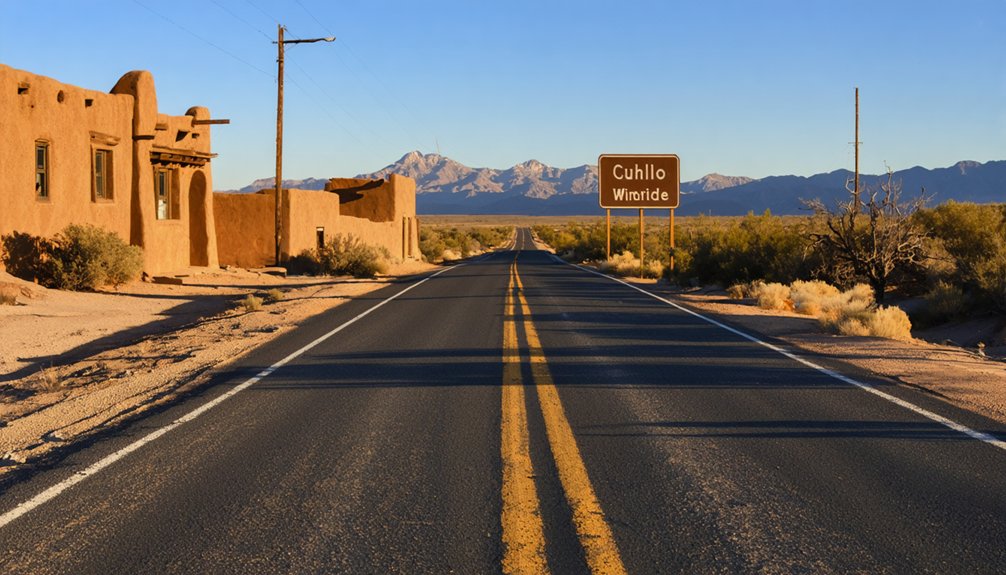
Cuchillo sits naturally in the middle of a Winston and Chloride road trip, making it the perfect pit stop between Truth or Consequences and the old silver mining towns to the northwest.
You’ll follow the same route miners, ranchers, and traders traveled during Cuchillo’s peak years, giving the drive genuine historical significance.
Stop at the Cuchillo Store and Bar, grab a drink, and soak in the Apache heritage embedded in the town’s name and landscape. Chief Cuchillo Negro‘s presence shaped this entire valley long before settlers arrived.
From here, you’ll push northwest into Winston and Chloride, where crumbling storefronts and abandoned mines await.
Treating Cuchillo as your midpoint rather than a detour transforms the whole trip into a richer, more connected exploration of New Mexico’s frontier past.
What to Know Before You Visit Cuchillo and the Ghost Towns Nearby
Before you head out to Cuchillo and the surrounding ghost towns, a little preparation goes a long way. The area’s Cuchillo history and local legends make it worth exploring slowly and respectfully.
- Bring cash — there are no ATMs nearby
- Pack water, snacks, and a full tank of gas before leaving Truth or Consequences
- Wear sturdy shoes; crumbling structures and uneven terrain are everywhere
- Visit the Cuchillo Store and Bar for artifacts, ghost stories, and a genuine local experience
- Respect private property — some ruins sit on active ranches
Cell service is unreliable, so download offline maps beforehand. The roads to Winston and Chloride are paved but narrow.
Go at your own pace — this region rewards the curious and the unhurried.
Frequently Asked Questions
Is There Overnight Camping Available Near Cuchillo, New Mexico?
With only 35 residents calling Cuchillo home, you’ll find freedom-filled overnight camping nearby. Check camping regulations along Cuchillo Negro Creek, where local wildlife roams freely, making your ghost town adventure truly unforgettable under New Mexico’s stunning desert skies.
Are There Any Guided Tours Offered in Cuchillo?
Formal guided tours aren’t widely available, but you’ll uncover Cuchillo’s ghost town history and local legends independently. Wander the Cuchillo Store, San Jose Church, and eerie ruins—freedom seekers like you thrive exploring on your own terms!
What Is the Best Time of Year to Visit Cuchillo?
Spring and fall are your golden keys to Cuchillo’s historical significance, revealing mild weather for exploring local legends. You’ll roam freely through the semi-ghost town’s haunted store, church, and ruins without summer’s scorching heat slowing you down.
Is Cuchillo Accessible for Visitors With Mobility Limitations?
Cuchillo’s accessibility features are limited, but you’ll find mobility options on paved roads near the store and church. You’re free to explore the exterior historic sites, though uneven terrain may challenge some visitors.
Are There Restaurants or Lodging Options Close to Cuchillo?
Hungry for adventure? You’ll find local cuisine and lodging in Truth or Consequences, just 15 miles away, where nearby attractions and comfortable stays await before you explore Cuchillo’s haunting, historic charm.
References
- https://www.youtube.com/watch?v=kdqtShSVDUA
- https://www.ghosttowns.com/states/nm/cuchillo.html
- https://newmexiconomad.com/cuchillo-new-mexico/
- https://www.newmexicoghosttowns.net/cuchillo-nm
- https://elchuqueno.com/city-of-dust-cuchillo-new-mexico/
- https://amberfoxxmysteries.com/2016/08/05/ghost-towns-of-sierra-county-more-haunting-than-haunted/
- http://www.livingghosttowns.com/Cuchillo.htm
- https://cityofdust.blogspot.com/2012/04/by-wayside-cuchillo-new-mexico.html