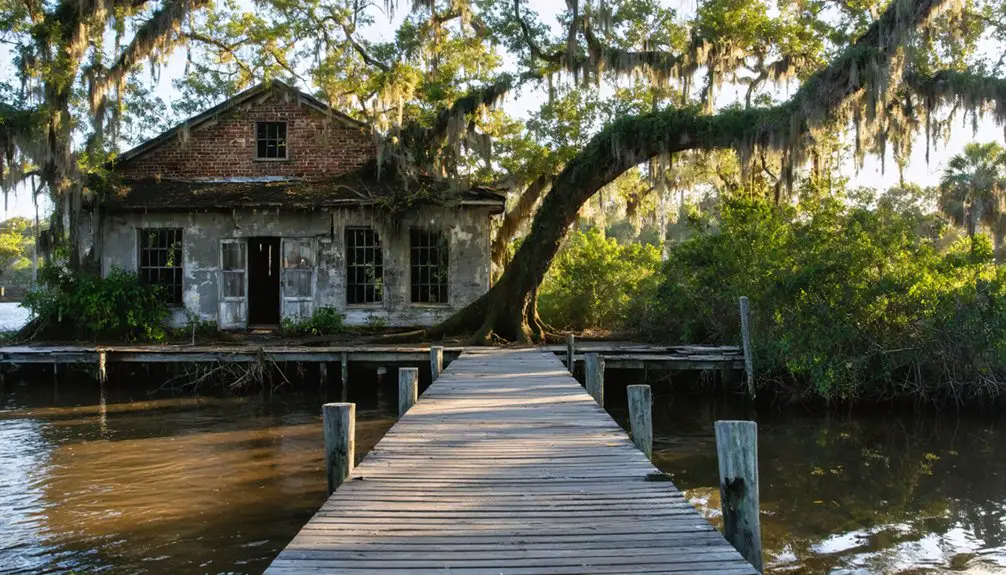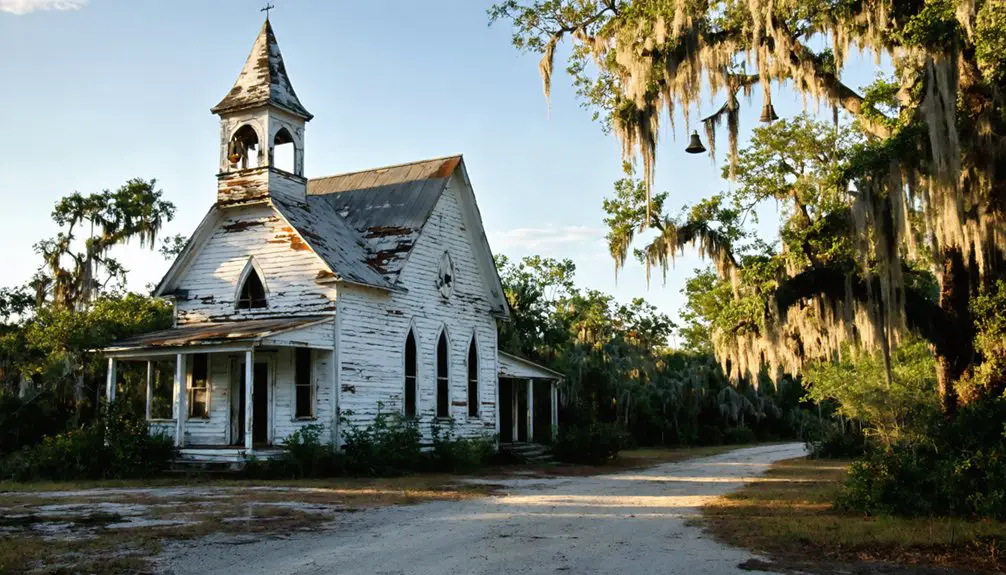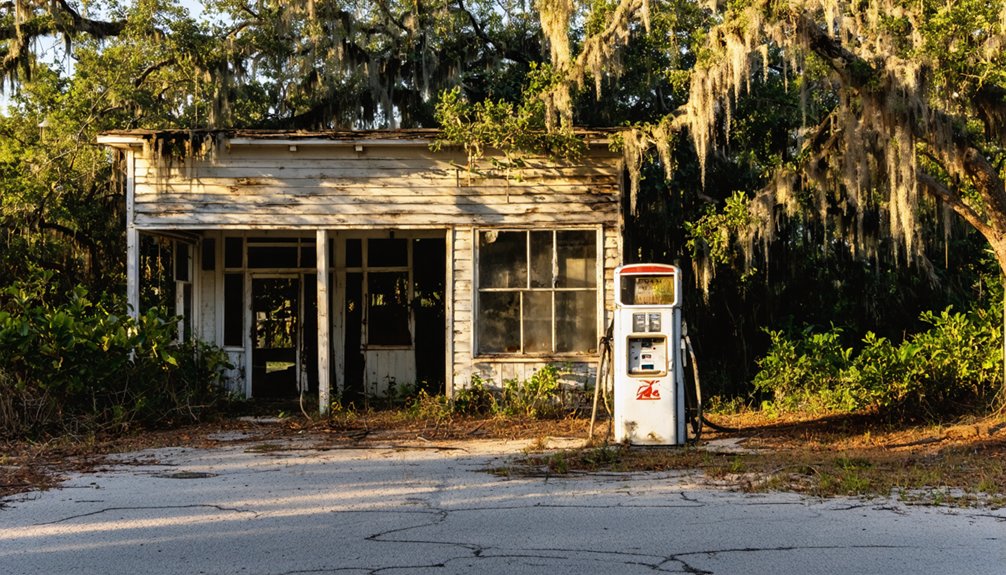
Planning a ghost town road trip to Deer Park, Florida means exploring one of Osceola County’s most hauntingly unique destinations—a semi-abandoned community where roughly twelve homes still stand alongside decaying structures and active forestry operations. You’ll want to visit during fall or spring for the best conditions, and you’ll need about 60-90 minutes driving west from Orlando on US-192. Respect the remaining residents, pack essentials, and stick to public roads. There’s far more to uncover about this eerie, suspended community than meets the eye.
Key Takeaways
- Deer Park is located in Osceola County, Florida, about 60-90 minutes from Orlando via US-192, requiring GPS navigation for remote backroads.
- Visit during fall, spring, or winter for the best exploring and photography conditions, avoiding summer humidity and thunderstorms.
- Respect remaining residents by staying on public roads, avoiding private property, and never entering deteriorating structures to prevent legal and safety issues.
- Pack water, snacks, sturdy boots, insect repellent, a first aid kit, offline maps, and a charged camera for a safe day trip.
- Nearby ghost towns like Ellaville, St. Francis, and Otter Creek offer additional historic exploration opportunities to extend your road trip itinerary.
What Makes Deer Park, Florida an Inhabited Ghost Town?
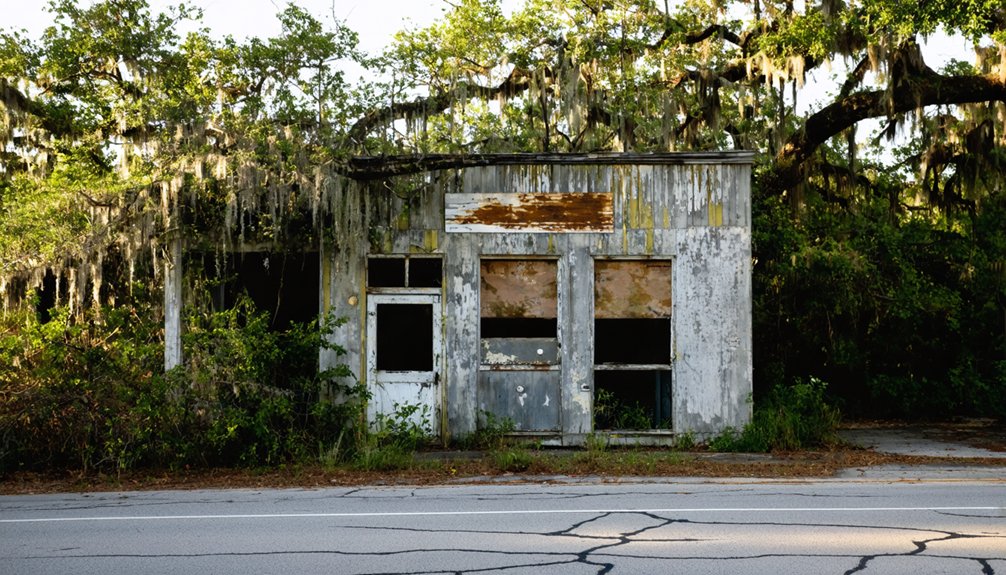
Tucked away in Osceola County, Florida, at coordinates 28°5.5’N 80°53.9’W, Deer Park occupies a peculiar middle ground between living community and forgotten relic.
You won’t find a bustling town here, but you won’t find complete abandonment either. That’s what makes Deer Park fascinating — it’s one of Florida’s inhabited ghosts, clinging to life through active forestry operations that keep the area semi-functional.
As you explore, you’ll notice semi abandoned structures scattered throughout — old houses and barns standing quietly alongside roughly twelve remaining homes and an operational forestry tower.
Industry sustains just enough activity to prevent total decay, yet silence dominates the landscape.
Deer Park earns its ghost town classification not through complete desertion, but through this eerie, suspended state between existence and erasure.
Where Exactly Is Deer Park Located in Osceola County?
Nestled deep within Osceola County, Florida, Deer Park sits at precise coordinates 28°5.5’N 80°53.9’W, placing it within a landscape dominated by forestry operations and rural quiet.
Understanding Deer Park geography helps you appreciate why this settlement earned its ghost town characteristics while remaining technically inhabited.
When you explore this area, you’ll discover:
- Surrounding terrain shaped by dense forestry operations, creating natural isolation
- Semi-abandoned structures including roughly twelve homes, old barns, and an operational forestry tower
- Open rural landscape where industry quietly sustains minimal human activity
You’re venturing into a place where civilization and abandonment coexist.
The coordinates drop you into Florida’s interior, far from tourist corridors, giving you authentic access to a forgotten settlement still breathing on its own terms.
When Is the Best Time to Visit Deer Park?
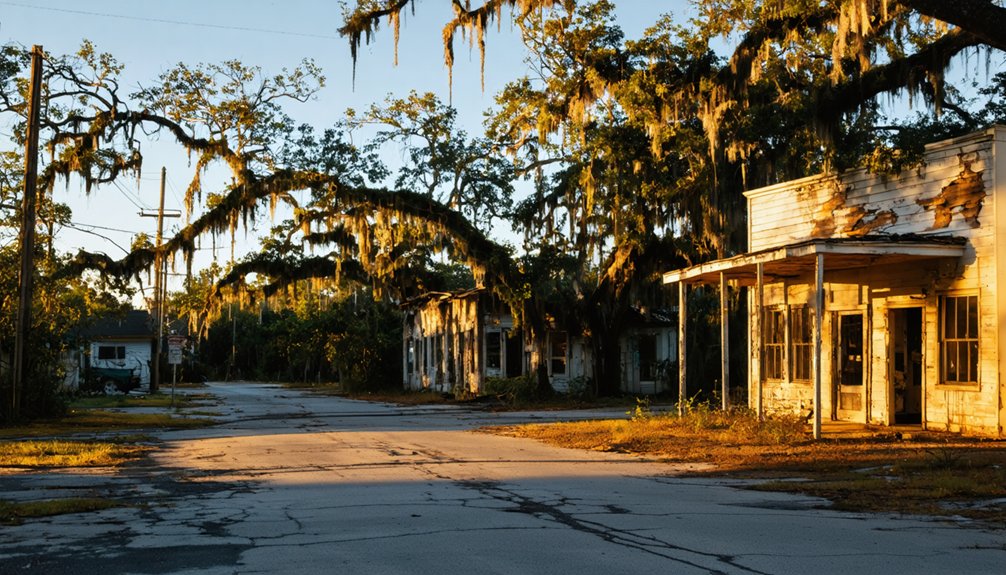
When you visit Deer Park matters more than you might expect for a place this remote. The best seasons are fall and spring, when Florida’s brutal heat backs off and the forestry roads become genuinely pleasant to explore.
Summer brings suffocating humidity and afternoon thunderstorms that can turn unpaved paths into muddy obstacles fast.
Winter offers cooler, drier conditions, making it ideal for photographing the old homes and barns without sweating through your clothes. You’ll move freely and linger longer when the weather cooperates.
Since Deer Park has no local events or organized tourism, you’re working entirely on your own schedule — which is part of the appeal.
Arrive during daylight, respect the remaining residents, and let the quiet, semi-abandoned atmosphere do the talking.
How Do You Get to Deer Park From Orlando?
Getting to Deer Park from Orlando is straightforward once you know where you’re headed. The Orlando Route takes you west through Osceola County toward this semi-abandoned treasure worth discovering on your own terms.
Getting to Deer Park from Orlando is straightforward — a westward journey into Osceola County’s quietly forgotten landscape.
Follow these simple directions to reach Deer Park:
- Head west from Orlando on US-192, then navigate toward Osceola County’s rural backroads leading to coordinates 28°5.5’N, 80°53.9’W.
- Use GPS navigation since remote Florida roads can shift unexpectedly, especially near forestry operation zones.
- Plan roughly 60-90 minutes depending on your exact starting point within Orlando.
Once you arrive at Deer Park, you’ll find roughly twelve remaining homes and an operational forestry tower waiting quietly.
Pack water, fuel up beforehand, and embrace the freedom of exploring Florida’s forgotten corners completely on your schedule.
What You’ll Actually See When You Arrive in Deer Park
Arriving at Deer Park, you’ll notice immediately that silence does most of the talking. About twelve homes dot the landscape, some occupied, others wearing the weathered look that draws ghost town photography enthusiasts from across the state.
Old barns and abandoned architecture stand like quiet witnesses to whatever life once thrived here.
Don’t overlook the forestry tower — it’s still operational, which reminds you this place hasn’t fully surrendered to time. That contrast between active industry and decay makes Deer Park uniquely compelling compared to fully abandoned sites.
You’re free to roam, observe, and capture the atmosphere on your own terms. Bring your camera, move slowly, and let the layers of this semi-ghost town reveal themselves.
The stillness here isn’t emptiness — it’s texture.
How to Photograph Deer Park’s Abandoned Homes and Forestry Tower
When you frame Deer Park’s abandoned homes and barns, position yourself low and use natural overgrowth as a foreground element to reinforce the sense of slow decay.
You’ll want to shoot the forestry tower during golden hour, when raking light sharpens its angular silhouette against the open sky and emphasizes its contrast with the crumbling structures below.
Work the tension between the tower’s continued operation and the surrounding abandonment, because that visual contradiction tells Deer Park’s story more powerfully than any single structure can alone.
Framing Abandoned Structures Effectively
Deer Park’s abandoned homes and forestry tower offer a compelling mix of textures, decay, and vertical contrast that rewards a thoughtful photographer.
Leaning into abandoned aesthetics and urban exploration principles sharpens your eye for composition.
Use these framing strategies to elevate your shots:
- Lead with lines — rotting fence posts, warped doorframes, and overgrown paths naturally pull the viewer’s gaze deeper into the frame.
- Contrast height — position the forestry tower against open sky to emphasize its isolation and verticality against low, crumbling structures.
- Embrace decay details — peeling paint, rusted hinges, and weathered wood create rich foreground texture that adds dimensional storytelling.
Move deliberately around each structure before shooting.
Shifting your angle even slightly reveals shadows, framing opportunities, and layers of abandonment you’d otherwise miss.
Capturing the Forestry Tower
Standing at least several stories above Deer Park’s low-lying structures, the operational forestry tower gives you one of the site’s most dramatic photographic subjects.
For compelling forestry photography, shoot upward from its base to emphasize its imposing height against the open Florida sky. Early morning light creates sharp contrast between the metal framework and surrounding treetops, adding depth to your composition.
Pull back for wide shots that include the abandoned homes below, connecting the tower’s active purpose to the settlement’s quiet decay. This juxtaposition captures the essence of ghost town exploration — industry persisting while community dissolves.
If you’re shooting midday, embrace the harsh shadows cutting through the tower’s latticed structure. They’ll add graphic geometry your images won’t easily forget.
What Should You Know Before Wandering Around Deer Park?
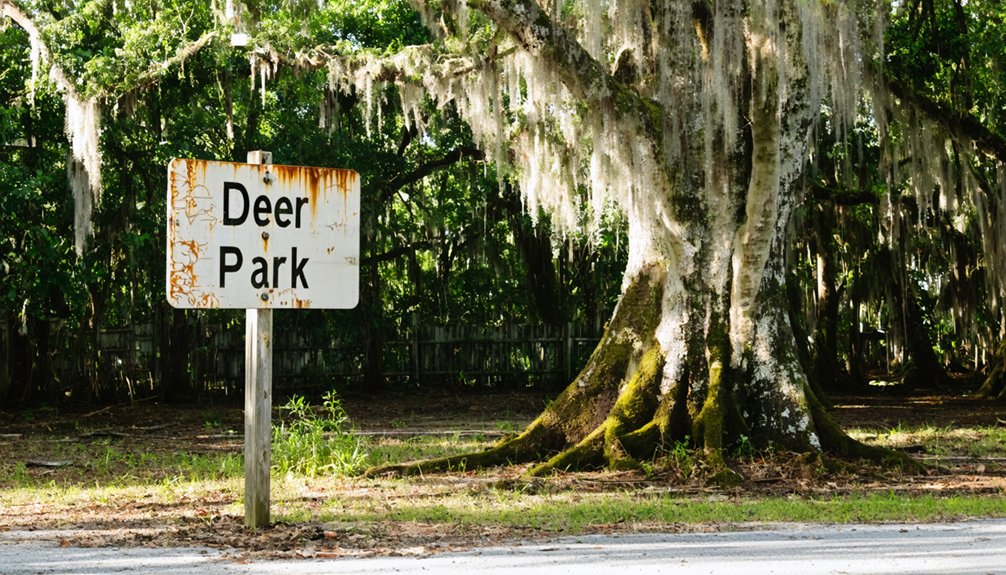
Before you wander Deer Park’s overgrown paths and crumbling structures, you’ll want to know that many of the remaining homes and barns sit on private land, so always check boundaries and get permission before stepping onto someone’s property.
Watch your footing in semi-abandoned areas, where rotting floorboards, unstable walls, and hidden debris can turn a casual explore into a dangerous situation fast.
Respect the handful of residents still living there, keeping noise low and staying clear of occupied structures, since Deer Park isn’t a museum—it’s still someone’s home.
Respecting Private Property
Although Deer Park sits quietly in Osceola County with its handful of remaining homes and active forestry operations, it’s far from abandoned—and that distinction matters.
People still live and work here, so you’ll need to respect property boundaries and follow local laws before wandering too close.
Keep your exploration responsible by remembering:
- Stay on public roads and accessible paths — don’t cross onto private land without permission.
- Don’t enter structures — old houses and barns may look inviting, but trespassing carries real legal consequences.
- Observe from a distance — you can still photograph and appreciate the semi-ghost town atmosphere without violating anyone’s space.
Freedom to explore means honoring boundaries that protect both you and the people who call Deer Park home.
Safety In Semi-Abandoned Areas
Wandering through Deer Park’s semi-abandoned landscape looks tempting, but it comes with real hazards you shouldn’t overlook. Urban exploration demands smart safety precautions before you step anywhere near those weathered structures.
Old barns and homes deteriorate unpredictably, meaning floors can collapse and roofs can cave without warning. Wear sturdy boots, long pants, and gloves to protect against rusty nails, sharp debris, and hidden wildlife. Snakes frequently shelter inside abandoned buildings, so watch every step carefully.
Bring water, a first aid kit, and a fully charged phone since cell service remains unreliable in rural Osceola County. Never explore alone. Tell someone your exact location and expected return time.
Respecting these precautions keeps your adventure exhilarating rather than dangerous, letting you experience Deer Park’s eerie atmosphere on your own terms.
What to Bring for a Day Trip to Deer Park
Since Deer Park sits in a remote area of Osceola County with little more than a handful of homes and a forestry tower, you’ll want to pack smart before heading out.
Nailing your packing essentials makes the difference between a memorable day trip and a frustrating one.
Prioritize these must-haves:
- Water and snacks – No stores or restaurants exist nearby, so bring enough to last the entire visit.
- Navigation tools – Cell service is unreliable; download offline maps or carry a paper map beforehand.
- Camera and charged batteries – The old houses, barns, and operational forestry tower offer compelling photography opportunities you won’t want to miss.
Wearing sturdy shoes and bringing insect repellent rounds out your preparation for exploring this quietly enduring semi-ghost town.
Which Ghost Towns Can You Visit Near Deer Park?

Once you’ve soaked in Deer Park’s quiet eeriness, why stop there? Florida’s backcountry hides several ghost towns worth exploring on your road trip.
Head to Ellaville in Madison County, where ghost town exploration reveals overgrown paths, an old bridge, and remnants of a mansion built by Florida’s 12th governor. Its historical significance runs deep, rooted in a once-thriving sawmill economy.
St. Francis, swallowed by Ocala National Forest‘s hammocks, offers trails through pine flatwoods and river overlooks where a post-Civil War community once bustled.
Otter Creek holds forgotten homes and trailers frozen in time.
Each site carries its own haunted character, giving you miles of open road and layers of forgotten history to uncover at your own pace.
What Can You See at Ellaville, St. Francis, and Otter Creek?
At Ellaville, you’ll wander through overgrown paths past the ruins of what was once Florida’s largest sawmill, where an old bridge and historic mansion remnants still tell the story of a thriving 19th-century logging town.
At St. Francis, you can hike the Florida Trail through oak hammocks and pine flatwoods, crossing Dolan’s Bridge and spotting the old levee and river overlooks that mark where a post-Civil War community once bustled with a hotel, newspaper, and sanitarium.
Otter Creek offers a quieter kind of haunting, where forgotten homes, trailers, and crumbling buildings sit as silent reminders of a town that never quite disappeared.
Ellaville’s Historic Ruins
Each of Florida’s ghost towns offers its own brand of eerie beauty, but Ellaville, St. Francis, and Otter Creek each deliver something uniquely haunting.
Ellaville history runs deep — founded by Florida’s 12th governor, George Franklin Drew, it once thrived around the state’s largest sawmill.
Today, Ellaville architecture crumbles quietly along the Suwannee River’s edge.
You’ll discover:
- Overgrown paths and an old bridge that once connected a bustling community
- Historic mansion remnants hinting at the town’s prosperous sawmill era
- River edges perfect for photography and spotting white-tailed deer or river otters
Explore freely on the Ellaville Loop Trail, open year-round from 8 a.m. to sunset.
Entry costs just $5 per vehicle or $2 if you’re walking or biking.
St. Francis Trail Features
Tucked within Ocala National Forest, St. Francis offers a trail experience unlike any other ghost town. You’ll walk through oak hammocks, pine flatwoods, and scrub, discovering remarkable St. Francis flora at every turn.
The path leads you past an old levee, Dolan’s Bridge, and scenic river overlooks where St. Francis fauna thrives — watch for deer, birds, and other wildlife roaming freely through the landscape.
St. Francis Road marks the heart of where this once-prosperous town stood. Post-Civil War, it supported a post office, hotel, store, newspaper, and even a sanitarium.
Today, nature has reclaimed nearly everything. Access the area via the Florida Trail, and you’ll find yourself exploring a beautifully wild, forgotten settlement that rewards curious, freedom-seeking adventurers willing to venture off the beaten path.
Otter Creek’s Forgotten Structures
While Ellaville, St. Francis each offer structured trails, Otter Creek delivers raw, unfiltered abandoned architecture you can wander freely.
There’s no guided path here — just ghost town lore embedded in forgotten structures waiting to be discovered.
You’ll encounter:
- Forgotten homes standing in various states of decay, offering a glimpse into everyday life before abandonment
- Old trailers scattered across the landscape, hinting at a community that once thrived with working families
- Deteriorating buildings that capture the quiet surrender of a town that time bypassed completely
Otter Creek lets you move at your own pace, exploring on your own terms.
It’s an unpolished, authentic experience that rewards curious travelers willing to look beyond the obvious and feel the weight of history firsthand.
Frequently Asked Questions
Are There Any Entrance Fees to Visit Deer Park, Florida?
You won’t face any entrance regulations or fee structures at Deer Park! It’s freely accessible, letting you explore its haunting remains — roughly twelve homes and an operational forestry tower — without spending a single dollar.
Is Deer Park, Florida Safe to Explore With Young Children?
You’ll find Deer Park’s semi-abandoned structures fascinating, but take safety precautions around old buildings and barns. It’s manageable for family-friendly activities if you supervise children closely, watch your footing, and embrace the adventurous, free-spirited exploration responsibly.
Can You Legally Enter the Abandoned Structures in Deer Park?
You can’t legally enter Deer Park’s abandoned architecture without permission. Urban exploration thrills are real, but trespassing laws apply here. Respect boundaries, admire structures from public areas, and you’ll stay free to explore another day.
Are There Any Guided Ghost Town Tours Available Near Deer Park?
You won’t find official guided tours near Deer Park, but you can independently explore nearby Ellaville, where the Ellaville Loop Trail reveals remarkable historical significance, letting you discover forgotten stories of Florida’s past on your own terms.
What Wildlife Might You Encounter While Visiting Deer Park, Florida?
“Every cloud has a silver lining!” You’ll discover incredible wildlife sightings at Deer Park, where local fauna thrives freely. Expect white-tailed deer, river otters, and diverse birds roaming the surrounding forestry, rewarding your adventurous spirit beautifully.
References
- https://www.explore.com/2032853/ellaville-florida-forgotten-historic-ghost-town-off-beaten-path/
- https://en.wikipedia.org/wiki/List_of_ghost_towns_in_Florida
- https://floridanature.wordpress.com/2008/10/19/hunting-for-a-ghost-town-in-the-forest/
- https://www.ghosttowns.com/states/fl/deerpark.html
- https://www.youtube.com/watch?v=bEyKGgBGrQI
- https://www.youtube.com/watch?v=CBFrK-n4HmA