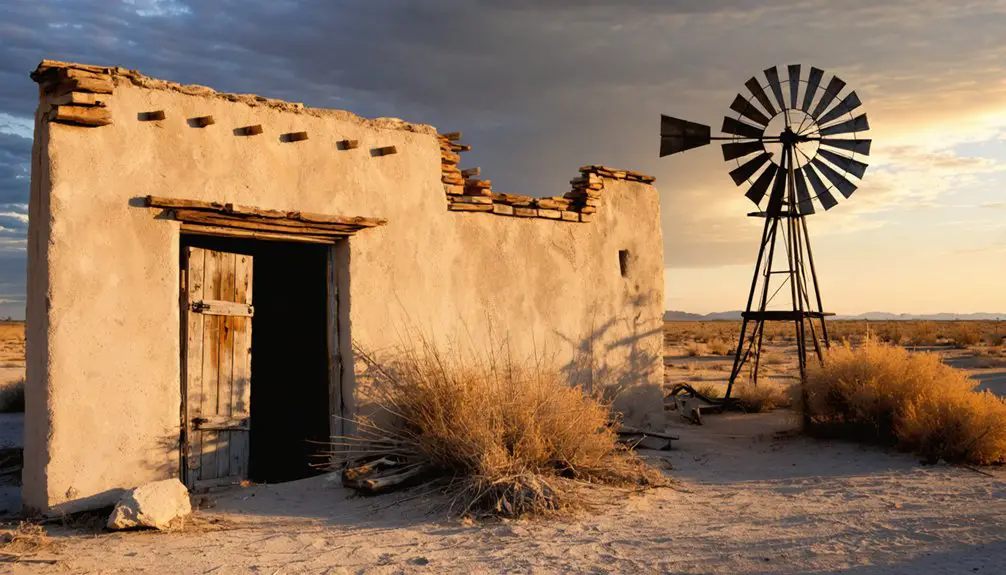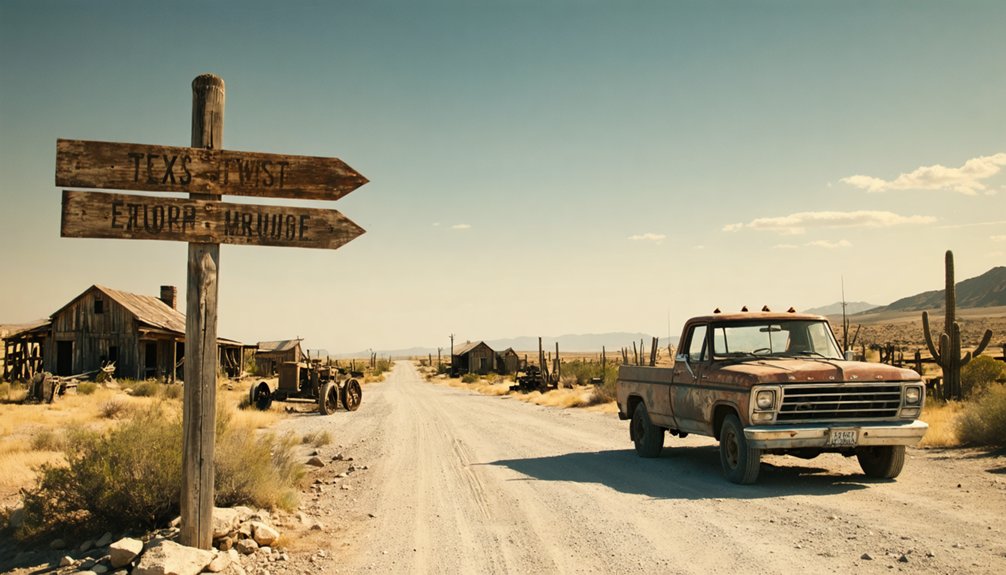
You’ll find this 1914 military outpost 22 miles south of Van Horn off Highway 90, where weathered timbers and adobe depressions mark where soldiers once enforced neutrality during the Mexican Revolution. The camp sits on Quinn Ranch’s private land, so you’ll need written permission before exploring those scattered hardware remnants and faint foundation lines. While you’re traversing these remote desert roads, nearby Lobo’s railroad ruins offer another ghost town experience worth discovering on your journey through Presidio County’s forgotten settlements.
Key Takeaways
- Access the site from Highway 90, turning onto river road 22 miles south of Van Horn, watching for Lobo landmark.
- Obtain written permission from Quinn Ranch owners before visiting, as the entire ghost town sits on private property.
- Expect minimal infrastructure—only weathered timbers, rusting hardware, and faint adobe hut depressions mark the 1914 military camp.
- Combine your visit with nearby Lobo ghost town to explore additional Southern Pacific railroad ruins and cattle pen remnants.
- Bring research materials and curiosity, as no visitor center or interpretive signage exists at this remote historical site.
Getting to Dias E Ocho Creek Camp From Van Horn

The journey to Dias E Ocho Creek Camp begins where Highway 90 cuts through the stark beauty of West Texas, twenty-two miles south of Van Horn. You’ll spot your turnoff onto river road—watch for Lobo, just two miles north of your destination. At the fork, bear onto the blacktop continuation; it’s your lifeline through country where remote road accessibility defines every adventure.
Summer monsoons turn packed earth to muddy obstacles, while winter rarely complicates travel here. You’re driving where cell service fades and self-reliance matters. The camp sits roughly two miles south of Lobo’s remnants, accessible to those willing to navigate beyond highway comfort. This isn’t tourist territory—it’s freedom measured in dust-covered miles and unscheduled stops.
Historical Significance of This Military Outpost
Cavalry hoofbeats once echoed across this desolate stretch of the Rio Grande where Camp on Dias e Ocho Creek materialized in 1914, conjured from military necessity as the Mexican Revolution spilled chaos across the border. You’re standing where soldiers enforced neutrality laws against revolutionaries and bandits who didn’t respect imaginary lines on maps.
The camp’s strategic positioning on Quinn Ranch, six miles west along the corridor, wasn’t accidental—it provided sight lines and rapid response capabilities that permanent forts couldn’t match.
Historical documentation reveals this wasn’t some footnote operation. From 1914 to 1918, cavalry units here formed part of a coordinated defense network with neighboring Camp Holland, their scouts eliminating cross-border threats that Washington politicians feared would destabilize Texas. The military understood what bureaucrats often don’t: freedom requires vigilance where wilderness meets geopolitical reality.
What Remains at the Ghost Town Today
Time has stripped Camp on Dias e Ocho Creek down to whispers and fragments. You’ll find weathered timbers jutting from the earth where soldiers once patrolled during World War I, scattered hardware rusting into the soil, and faint depressions marking where fifteen adobe huts stood. There’s no visitor center here—just raw, unfiltered history with minimal interpretive signage to guide you.
The tent camp’s limited architectural features mean you’re tracking ghosts through debris fields rather than exploring intact buildings. Old fort materials lie exposed to West Texas wind and sun, slowly dissolving into the ranchland. It’s pure discovery territory: bring your curiosity and research skills, because this site rewards those who understand what absence reveals about frontier military life.
Private Property Access and Restrictions
Before you load up the truck and punch coordinates into your GPS, understand this hard truth: Quinn Ranch owns every inch of ground where those adobe huts crumbled. No public easements exist here—just Texas private property law and consequences for ignoring it.
Respecting property boundaries protects your freedom to explore:
- Contact ranch owners directly for written permission before visiting
- Document your approval to avoid confrontations with law enforcement
- Prepare liability waivers if requested by ownership
- Plan alternative routes that keep you legal
Mitigating legal risks means doing homework first. Civil penalties and potential criminal charges aren’t worth spontaneous trespassing. The frontier spirit thrives on preparation, not recklessness. Get permission or admire this ghost town from historical records instead.
Exploring Nearby Lobo and Other Ghost Towns
From your base at Dias E Ocho Creek Camp, you can trace the Southern Pacific line south to Lobo, where rusted cattle pens and a crumbling depot tell the story of a town the railroad built in 1882 and abandoned eighty years later.
Just twelve miles down Highway 90, this ghost town once rivaled Van Horn for the county seat before earthquakes in 1929 and 1931 shattered its ambitions along with its hotel.
Beyond Lobo, a circuit of Presidio County’s forgotten settlements spreads across the desert plains—each water stop and mail route outpost now reduced to foundation stones and the occasional windmill skeleton.
Lobo’s Abandoned Railway History
Rolling across the scorched West Texas desert between Van Horn and Sierra Blanca, you’ll spot the weathered remnants of Lobo clinging to life beside Highway 80. The Southern Pacific Railroad breathed life into this settlement in 1882, when steam locomotives desperately needed those precious water tanks. Picture the old train station remnants standing sentinel as iron horses pulled into the depot every few hours.
The railroad’s heartbeat kept Lobo alive through ghost town restoration efforts, supporting nearly 90 residents by the 1960s. Then everything collapsed:
- Water table plummeted after 1962 when the railroad stop closed
- Wells that sustained generations ran completely dry by the 1980s
- Cotton gin operations ceased, eliminating the last steady employment
- Final holdouts abandoned their homes in 1991
You can photograph the sun-bleached structures from the highway pull-off, though it’s private property now.
Van Horn Supply Stop
Stock up on essentials in Van Horn before venturing into the desolate stretches between ghost towns—your gas gauge and water supply won’t forgive poor planning out here. Interstate 10 cuts straight through town, making convenience for interstate travel unbeatable when you’re chasing abandoned ruins. I’ve rolled into Hernandez Miscellaneous more times than I can count for ice and last-minute supplies before heading out to Lobo’s concrete foundations.
The local ranching goods availability means you’ll find quality jerky and provisions reflecting the working cattle economy. Gas stations dot the highway exits, each a lifeline before you disappear into far West Texas emptiness. Fill every container, check your spare tire, and grab extra water—ghost towns don’t offer second chances when preparation fails.
Presidio County Ghost Circuit
Your ghost circuit exploration includes:
- Shafter Memorial Site spanning US 67 with preserved mission church and wooden-cross cemetery
- Active Rio Grande Mining Company employing 100+ workers at Texas’s only 24/7 silver operation
- River Road ghost towns (Redford, Candlelaria, Ruidosa) accessible via FM 170’s scenic corridor
- Elephant Rock landmark marking your approach several miles before Shafter
These settlements’ economic impact shaped regional development through boom-bust cycles spanning 140 years.
The homegrown museum provides context for understanding how silver shaped this harsh landscape.
Essential Tips for Desert Road Conditions
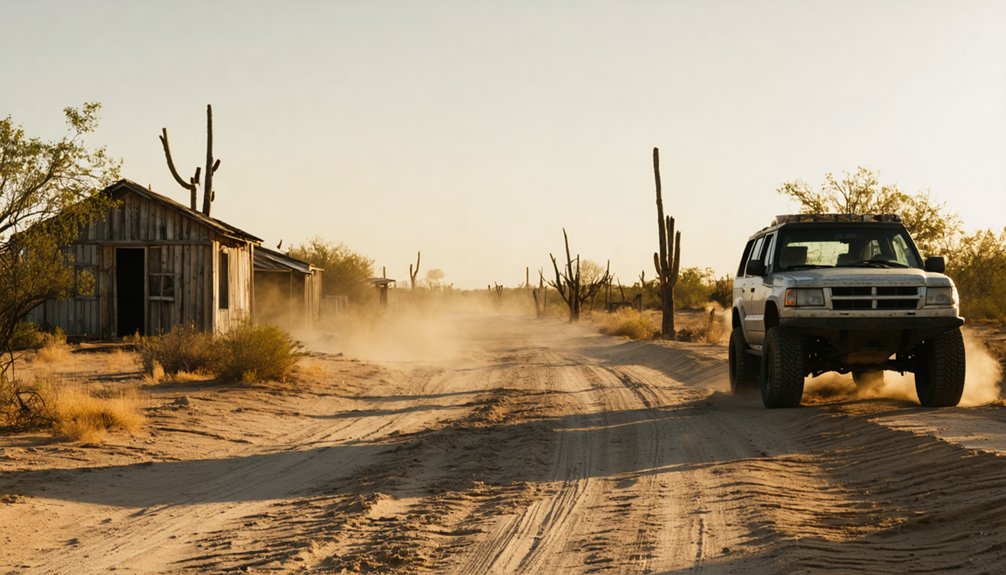
When desert highways shimmer with heat mirages and the nearest gas station sits 80 miles behind you, road conditions demand respect rather than casual confidence. West Texas’s unforgiving stretches test your preparation—tire maintenance becomes non-negotiable when temperatures soar past 105°F, expanding rubber to bursting points. I’ve witnessed three blowouts in a single afternoon near Marathon, each driver gambling on worn tread.
Check DriveTexas.org before departure; construction zone awareness saves hours when TxDOT crews close single-lane sections without warning. Carry double the water you think necessary, plus a jack and quality spare. Cell reception vanishes between towns, turning minor breakdowns into dangerous isolation. The desert forgives nothing—your vehicle’s limits define your freedom out here.
Frequently Asked Questions
What Supplies Should I Bring for a Remote Desert Ghost Town Trip?
Desert temperatures swing 40°F between day and night—you’ll need navigation equipment like GPS and maps, personal safety items including first-aid supplies, plus ample water, sun protection, and layered clothing to survive this unforgiving freedom-filled adventure.
Are There Camping Facilities Near Dias E Ocho Creek Camp?
You’ll find primitive campsites available at nearby Big Bend parks, though dispersed camping’s allowed throughout the vast Presidio County desert. The closest developed facilities are at Big Bend Ranch, offering screened shelters and basic amenities for your backcountry adventure.
What Is the Best Season to Visit West Texas Ghost Towns?
Fall and spring offer ideal weather considerations for exploring West Texas ghost towns, with October seeing 70% fewer visitors than summer. You’ll dodge peak visitation times while enjoying temperate days perfect for wandering abandoned ruins under vast, open skies.
The history of Nogal, Texas ghost towns reveals a rich tapestry of stories and remnants from a bygone era, captivating the imaginations of those who seek them out. Each dilapidated structure serves as a silent witness to the lives once lived there, beckoning adventurers and historians alike. Exploring these forgotten places offers not just a glimpse into the past, but also a unique opportunity to connect with the rugged spirit of the American West.
Can I View Dias E Ocho Creek Camp From Public Land?
No, you can’t view Dias e Ocho Creek Camp from public access points. Land ownership considerations block all vantage points—the entire area sits on private Quinn Ranch property, requiring permission from ranch headquarters before you’ll see anything.
What Wildlife Might I Encounter in Presidio County’s Desert Terrain?
Picture the moonlit desert alive with movement: you’ll spot desert rabbits darting between cacti, hear nocturnal coyotes howling at dusk, and encounter three toad species—Great Plains, Chihuahuan green, and red-spotted—plus the iconic Texas horned lizard.