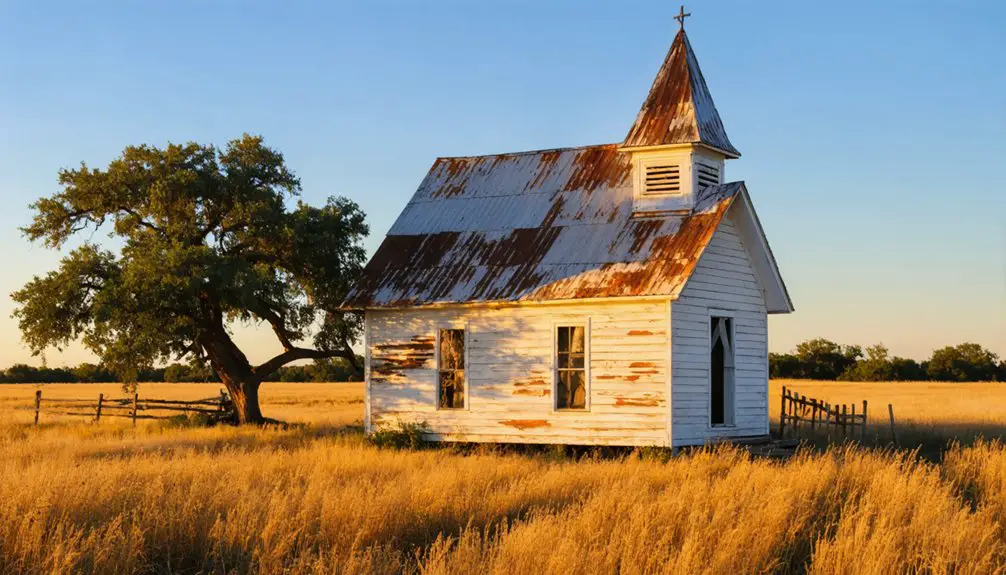
You’ll find Dido’s ghost town sixteen miles northwest of Fort Worth via Morris Dido Newark Road—a 20-30 minute drive following coordinates 32°57′05″N 97°29′08″W. Named after horse manure by frustrated settler David Thurmond in 1848, this abandoned settlement features a weathered Methodist church, historic cemetery, and roughly thirty residents. The Van Zandt family plot holds Townes Van Zandt’s ashes beneath a headstone reading “To Live’s To Fly.” The route shifts from developed suburbs to remote countryside, where railroad bypass and Eagle Mountain Lake’s rising waters transformed a once-thriving community into scattered farmhouses and cemetery stones worth exploring further.
Key Takeaways
- Dido sits 16 miles northwest of Fort Worth via Morris Dido Newark Road, requiring a 20-30 minute scenic drive through countryside.
- Use MapQuest or Waze for real-time traffic updates and accurate directions to coordinates 32°57′05″N 97°29′08″W.
- Visit the weathered Methodist church, historic cemetery, and Van Zandt family plot where singer Townes Van Zandt rests.
- The town’s unusual name comes from 1840s slang for horse manure, chosen by founder David Thurmond in 1848.
- Railroad bypassing and Eagle Mountain Lake flooding transformed this once-thriving settlement into a ghost town with thirty residents.
Getting to Dido: Directions and Travel Time From Fort Worth
The ghost town of Dido sits just 16 miles northwest of Fort Worth’s city limits, tucked along the eastern shore of Eagle Mountain Lake where the modern world hasn’t quite caught up with history.
You’ll navigate Morris Dido Newark Road as your main artery, a winding stretch that connects routes to multiple points of interest—from the weathered Dido Cemetery at 12341 to an RC flying club at 14655. MapQuest and Waze offer real-time traffic considerations for directions, though you’ll rarely encounter congestion on these quieter county roads.
Expect a 20-30 minute drive under normal conditions, following coordinates 32°57′05″N 97°29′08″W. Whether you’re planning walking or driving directions, the route offers scenic views as you transition from developed areas to the more remote countryside. The journey itself becomes part of the adventure, leaving urban sprawl behind as you chase remnants of 1890s Texas. Interestingly, the name Dido means the wanderer, making it a fitting designation for this remote settlement that few modern travelers encounter. As you explore the charm of Los Ojuelos, you’ll find yourself immersed in the rich history and culture that this hidden gem offers. Friendly locals share stories that echo the past, inviting you to savor traditional dishes and handmade crafts that reflect the area’s unique heritage. Each turn in this tranquil landscape reveals picturesque vistas that beckon you to slow down and appreciate the peaceful surroundings.
The Story Behind the Unusual Name
You’ll chuckle when you learn that Dido got its name from a colorful bit of 1840s trail slang—David Thurmond chose “dido” as the town’s moniker around 1848, reportedly after dealing with one too many piles of horse manure along the route. The word served as polite-ish code for what horses left behind, transforming a settler’s frustration into a permanent place name.
When the post office opened in the 1850s, officials made it official, cementing this quirky origin story into Texas history. Interestingly, the name also connects to ancient Phoenician royalty, as Dido was a legendary queen who founded Carthage around 814 BC after fleeing from her homeland of Tyre. Today, this ghost town 40 minutes northwest of Fort Worth serves as the final resting place for the legendary singer-songwriter Townes Van Zandt, whose ashes were deposited in the Van Zandt cemetery plot according to his wishes.
David Thurmond’s Slang Choice
Around 1848, David Thurmond stood at a crossroads near Fort Worth and made a decision that would puzzle visitors for generations: he’d name the budding settlement after horse manure.
Frustrated by the abundant droppings littering the frontier trails, Thurmond reached for “Dido”—mid-1800s slang for exactly what covered those well-traveled paths. This wasn’t polite society naming; it was raw pioneer era customs speaking truth about daily life on Texas trails.
You’ll find this neighborhood charm candidly honest compared to settlements named for politicians or long-dead queens. When the post office formalized “Dido” in the 1850s, they cemented Thurmond’s earthy observation into official records. Request verification ensured the unusual name met postal standards before becoming official. His choice captured what every traveler encountered: the unglamorous reality of westward expansion, one trail-worn hoof at a time. The settlement’s unpleasant odor likely reinforced Thurmond’s decision, making the name feel all the more appropriate to those who passed through.
From Horse Manure Talk
David Thurmond’s naming choice wasn’t just frontier crudeness—it reflected a genuine infrastructure nightmare that defined 19th-century life. When he named his town in the 1880s, cities worldwide were drowning in horse waste. London’s 50,000 horses produced tons daily, while New York’s streets flooded with 2.5 million pounds of manure each day.
You’d have navigated rivers of filth when it rained, choking dust when it dried. The historical significance of horse manure as urban issue reached crisis levels—flies spread typhoid, dead horses rotted curbside, and vacant lots became 60-foot refuse mountains. New York City’s estimated 150,000 horses also contributed 40,000 gallons of urine daily to the overwhelming waste crisis. The societal impacts of waste accumulation drove an 1898 international conference that disbanded without solutions. In Italy, the Corriere della Sera newspaper predicted in 1896 that the automobile revolution would finally eliminate manure from city streets.
Thurmond’s colorful name captured this suffocating reality before automobiles finally liberated cities from their equine burden by 1912.
Official Renaming to Dido
When the settlement finally secured its post office in 1888, founder David Thurmond reached back to ancient Mediterranean legends for inspiration. He christened the town after Queen Dido of Carthage, the mythical ruler who defied conventions and carved out her own destiny. Shifting from informal to official status, the post office establishment marked Dido’s legal recognition as a genuine Texas community.
Thurmond simply appreciated the cultural weight behind the name. While some folks joked about less dignified origins (think barnyard humor), the official record stands clear. The 1887 and 1894 land donations by Isaac and Khleber Van Zandt cemented the town’s infrastructure, adding a schoolhouse, church, and cemetery that still bear witness to Dido’s independent spirit. The well-kept and documented Dido Cemetery received a Texas Historical Marker in 1977, recognizing its significance to the community’s heritage. Among the over 1,000 graves resting there are members of many pioneer families who shaped the region’s early history.
From Thriving Settlement to Abandoned Ghost Town
Before the Civil War reshaped Texas, determined settlers carved out a modest agricultural community in Tarrant County that would eventually bear one of the state’s most peculiar town names. You’ll find Dido thrived once with a bustling post office, general stores, and social gathering spots. Isaac Van Zandt’s 1887 land donation established the church and schoolhouse that anchored this frontier settlement.
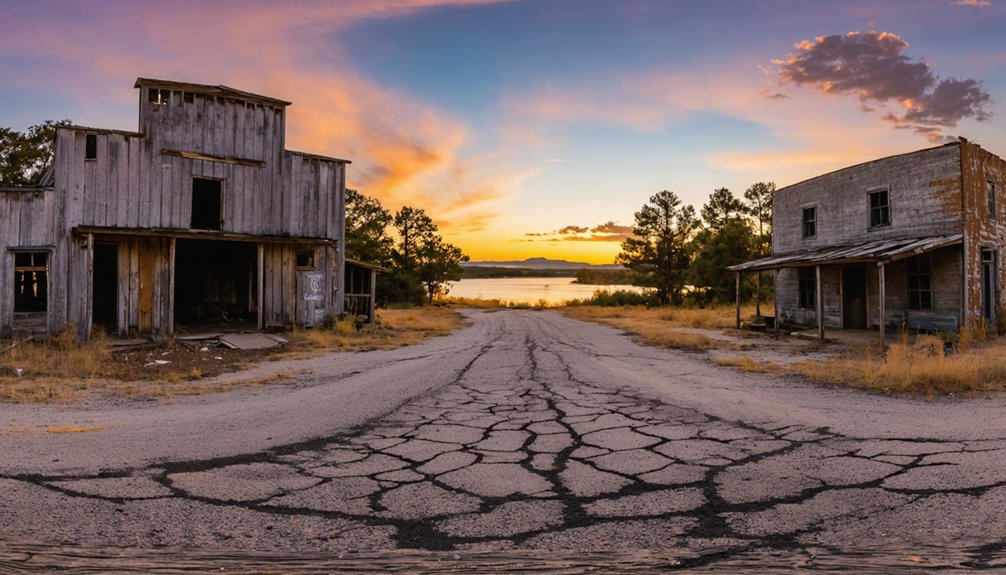
Then the railroad changed everything. When tracks bypassed Dido for nearby Saginaw, families followed the iron rails to opportunity elsewhere. Eagle Mountain Lake’s rising waters forced additional relocations, leaving vacant buildings and abandoned farmhouses scattered across the landscape. Today, you’re exploring what remains—a weathered Methodist church, cemetery stones, and perhaps thirty residents who’ve stubbornly refused to let their ghost town disappear completely.
Exploring Dido Cemetery: What to Expect
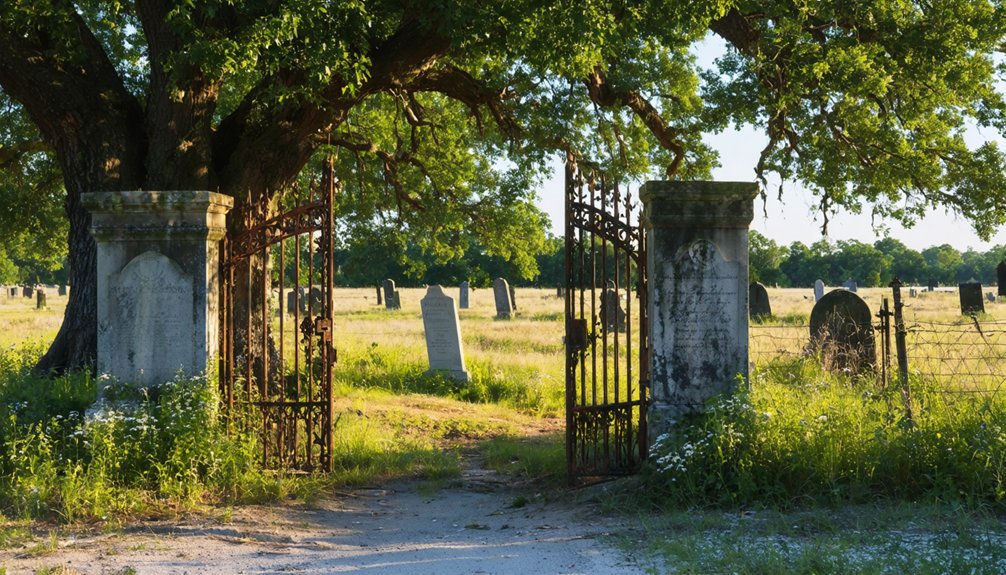
Stepping through the entrance marked by United Methodist Church signage, you’ll discover a meticulously maintained burial ground that stretches across several acres along Eagle Mountain Lake‘s eastern shore. While appreciating the serene lake views remains challenging due to an adjacent golf course, exploring the unique headstones reveals compelling pioneer stories.
Amanda Thurmond’s 1878 grave marks the cemetery’s earliest burial—she was granddaughter to Dave Thurmond, who settled here in 1848. Among roughly 1,000 graves, you’ll find two Texas Historical Commission markers documenting the region’s heritage.
Before visiting, note the straightforward rules: no smoking, alcohol, glass containers, or personal items on grass areas. This freedom to wander respectfully through history makes Dido Cemetery one of Tarrant County‘s best-kept historical treasures.
The Van Zandt Family Legacy and Notable Burials
You’ll find the Van Zandt family plot just left of the cemetery entrance, past a grove of hardwoods where half of Townes Van Zandt’s ashes rest beneath a headstone inscribed “To Live’s To Fly.”
This quiet patch of earth connects three generations of Texas legacy—from Isaac Van Zandt, who co-wrote the state constitution and founded Fort Worth, to his descendant, the legendary songwriter who died on New Year’s Day 1997.
Confederate Major K.M. Van Zandt lies here too, his grave a marker of the family’s deep roots in this forgotten corner near Eagle Mountain Lake.
Townes Van Zandt’s Resting Place
The weathered headstone rises from the Texas earth in Dido Cemetery, bearing the inscription “To Live’s To Fly”—a fitting epitaph for Townes Van Zandt, who requested his ashes rest in the family plot alongside generations of Fort Worth pioneers.
You’ll find his grave adorned with flowers, jewelry, and emptied Lone Star bottles cradling yellow roses—tributes reflecting Van Zandt’s creative legacy as a songwriter who penned “Pancho and Lefty” and “White Freightliner Blues.” The grave site aesthetics contrast sharply with neighboring family plots; while other Van Zandts rest beneath orderly markers, Townes’ memorial captures his rebellious spirit.
He died January 1, 1997—exactly 44 years after his idol Hank Williams passed—closing a turbulent life marked by brilliance and struggle. Located on Morris Dido Newark Road, his resting place draws pilgrims seeking connection to outlaw country’s most haunted troubadour.
Confederate Major K.M. Van Zandt
A few rows from Townes Van Zandt’s bohemian memorial lies the more austere marker of his great-great-uncle, Confederate Major Khleber Miller Van Zandt, whose influence shaped Fort Worth from frontier outpost into thriving cattle town. You’ll notice the stark contrast between gravestones—one celebrating artistic rebellion, the other commemorating post war leadership that built empires.
K.M.’s military accomplishments during the Civil War established credibility he’d later leverage transforming a dusty settlement into “Cowtown.” Standing here, you’re witnessing where Texas dynasties begin and end.
The major’s bones rest alongside other Van Zandts who pioneered Harrison County before pushing westward into Tarrant County. Their plantation money funded colleges; their post-war vision created cities. Freedom-seekers and empire-builders both find their final democracy in Dido’s red clay.
Cemetery Rules and Visitor Guidelines
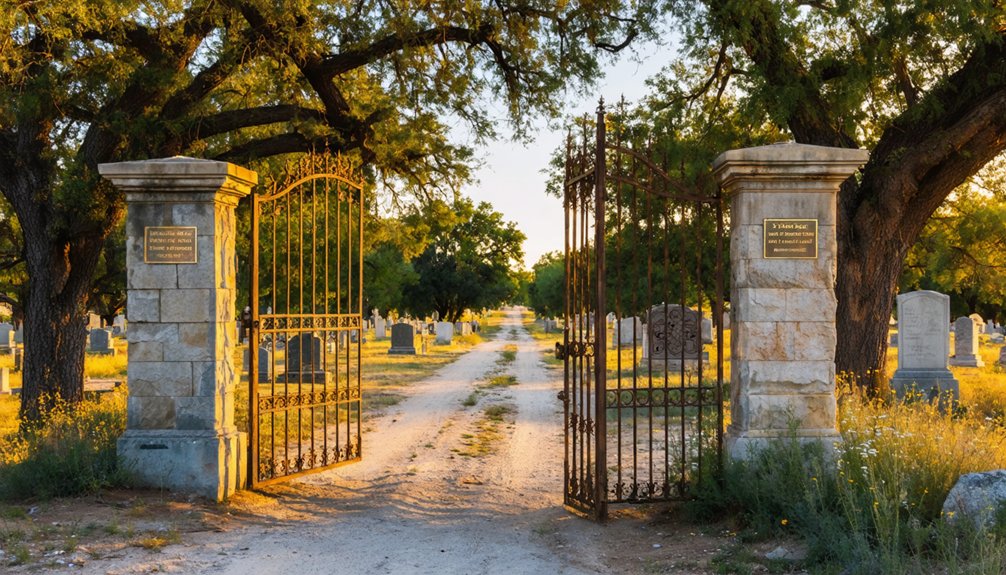
When planning your visit to Dido Cemetery, understanding the access rules protects both you and this historic site. You’ll find the gates open from 8 a.m. to 5 p.m. daily, though you can request special hours with 14 days’ written notice to the landowner. Visitor etiquette requires respecting the space’s solemn purpose—you’re here for contemplation and paying respects to Texas pioneers.
The prohibited activities are straightforward: leave your beer and cigarettes behind, and don’t bring glass containers. You can’t install benches or plant trees on the grass, though you’re welcome to place appropriate decorations on graves. These aren’t arbitrary restrictions—they’re designed to preserve this piece of frontier history while letting you experience authentic Texas heritage without unnecessary government interference.
Historical Markers and Landmarks Worth Seeing
Beyond the cemetery gates, two weathered historical markers stand as silent storytellers of Dido’s forgotten past. Marker 1223, erected in 1977, chronicles the cemetery’s thousand pioneer graves and Queen of Carthage namesake.
You’ll find the 2008 school marker just steps away, revealing unexplored stories of education dating back to 1854 when teacher A.C. McCanne arrived in Peters Colony.
These 18″ x 28″ bronze plaques mark what remains of one of Tarrant County’s earliest settlements along the Fort Worth-Decatur stage route. Stand here at coordinates 32.951385 N, and you’re touching ground where settlers like Dave Thurmond carved freedom from wilderness in 1848.
Within six miles, additional markers document Indian Creek and Walnut Creek raids—raw reminders of frontier life’s harsh realities.
Nearby Attractions: Eagle Mountain Lake and Surrounding Areas
Just three miles south of Dido’s weathered markers, Eagle Mountain Lake‘s 8,694 acres shimmer like a mirage against the North Texas horizon—a stark contrast to the ghost town’s dusty silence. You’ll find genuine escape here, where 200 miles of shoreline wind through Tarrant and Wise counties.
Cast your line for largemouth bass and white crappie in waters reaching 47 feet deep, or launch your boat from multiple access points—no reservations required. The fishing opportunities rival any Texas lake, while wildlife viewing along secluded coves reveals herons, egrets, and white-tailed deer at dawn.
Fort Worth Meacham Airport sits just 20 minutes away, making this your gateway to both history and recreation. Pack camping gear, fishing tackle, and plenty of water—civilization’s conveniences feel deliberately distant out here.
Best Times to Visit and Road Trip Tips
Your trip to Dido demands strategic timing—I learned this the hard way during a scorching July afternoon when the mercury hit 103°F and the cemetery’s exposed grounds offered zero shade. Target November through March for comfortable exploration, though January brings blustery winds that’ll cut through your jacket at the old church ruins.
Pack layers regardless of season, plus water and sunscreen. The 40-minute drive northwest from Fort Worth follows straightforward 2WD roads—no rugged vehicle needed.
Nearby dining options cluster around Eagle Mountain-Saginaw’s developed areas, perfect for post-exploration meals. While Dido lacks seasonal events and festivals, spring and fall deliver ideal conditions for photographing crumbling headstones and the Methodist church’s historical markers. Respect the cemetery’s strict rules: no alcohol, smoking, or disturbing vegetation.
Frequently Asked Questions
Are There Any Remaining Original Buildings From Dido’s Settlement Era?
No original 1848 structures survive from Dido’s settlement era. You’ll find the active Methodist Church and 1887 cemetery instead. Local preservation efforts maintain these sites, though original structures’ condition deteriorated beyond recovery decades ago.
Is the Cemetery Accessible Year-Round or Does It Have Specific Hours?
You’ll find the cemetery accessible year-round without posted hours—true freedom to explore. While there’s no published cemetery maintenance schedule, local preservation efforts keep the grounds welcoming. Visit anytime, though Dido Days in April offers special community connection.
What Happened to Dido’s Original Church and School Buildings?
The school closed in 1947, and both original buildings are gone from Dido’s original town layout. You’ll find historical preservation efforts focused on the cemetery’s 1,000 graves and the 2008 marker commemorating this vanished community.
Can Visitors Access Eagle Mountain Lake Directly From the Cemetery Area?
You can’t access Eagle Mountain Lake directly from the cemetery grounds. Instead, you’ll need to drive to nearby recreational activities at public boat ramps like Twin Points Park. The cemetery’s hilltop condition offers stunning lake views, though.
Are There Guided Tours Available for Dido’s Historical Sites?
No guided tours exist—you’ll explore independently. Picture yourself wandering weathered headstones alone, reading Texas Historical Commission markers at your own pace. Self-guided tours let you discover local history exhibits freely, creating personal connections without schedules constraining your ghost town adventure. As you delve into these ghost towns to visit in Texas, you’ll uncover stories of a bygone era hidden in the dusty streets and dilapidated buildings. Each town offers a unique glimpse into the past, from relics of Old West life to poignant reminders of the Texas oil boom. Embrace the solitude and let your imagination bring to life the restless spirits of those who once called these places home.
References
- https://kids.kiddle.co/Dido
- https://texashighways.com/culture/capturing-the-spirit-of-townes-van-zandt-in-fort-worth/
- https://www.texasescapes.com/TexasGhostTowns/DidoTexas/DidoTexas.htm
- https://www.texasescapes.com/EastTexasTowns/Dido-Texas.htm
- https://www.texasalmanac.com/places/dido-0
- https://www.mapquest.com/directions/to/us/texas/fort-worth/76179-3900/9700-morris-dido-newark-rd-32.90267
- https://en.wikipedia.org/wiki/Dido
- https://www.waze.com/live-map/directions/us/tx/fort-worth/dido-cemetery?to=place.ChIJLRx8wNbmTYYRSNwJD-Jlrhc
- https://www.modelaircraft.org/site/texas-wing-rc-flying-club-morris-dido-newark-rd
- https://www.fortworthtexas.gov/files/assets/public/v/1/tpw/documents/bfw-publish.pdf