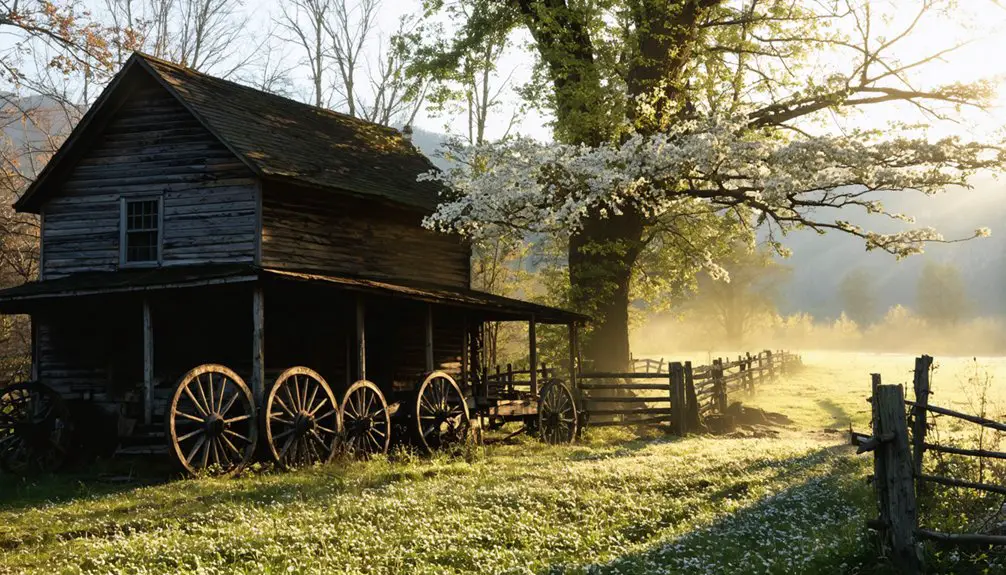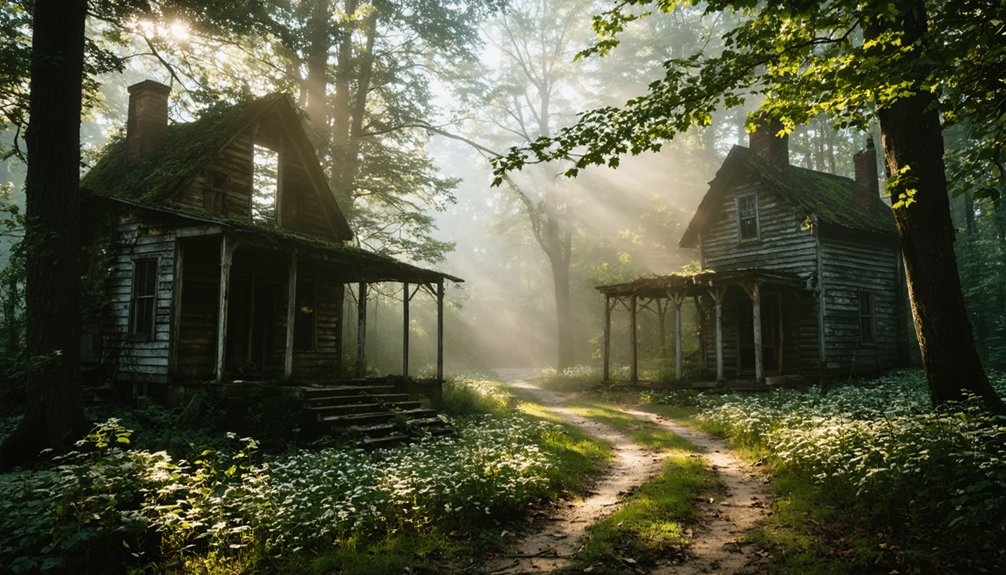
When planning your ghost town road trip to Elkmont, Tennessee, start by heading to the Great Smoky Mountains National Park via US-411 to Sugarlands Visitor Center, then drive about 11 miles to the Elkmont Nature Trail parking area. You’ll discover weathered cabins and the crumbling Wonderland Hotel ruins spread across 19 historic acres. Visit in spring for firefly displays or fall for stunning foliage. There’s far more to this hauntingly beautiful destination than meets the eye.
Key Takeaways
- Elkmont, located near the Sevier-Blount County line, is accessible via US-411 to Sugarlands Visitor Center, then approximately 11 miles to the ranger station.
- Park at the Elkmont Nature Trail lot to explore 19 acres of preserved historic structures within the designated historical district.
- Visit in spring or early summer for firefly displays, fall for colorful foliage, or winter for quieter, crowd-free exploration.
- Pack sturdy hiking shoes, layered clothing, water, insect repellent, binoculars, and a camera to fully enjoy the historic ghost town.
- Check road conditions before winter visits, and arrive early on summer weekends to avoid crowds at this popular historic destination.
Why Elkmont Is Considered a Ghost Town Today
Once a thriving logging hub and elite vacation retreat, Elkmont earned its ghost town label after decades of abandonment left its buildings to decay without regular maintenance.
When the final leases expired in 1992, the remaining structures sat frozen in time, feeding local legends and folklore tales about a community swallowed by the wilderness.
At its most deteriorated point, more than 70 buildings stood weathered and silent across the landscape.
The National Park Service eventually stepped in, preserving 19 historic structures across 19 acres before a 1994 historic listing halted further demolition.
When you visit today, you’re walking through a carefully curated remnant of what once buzzed with loggers, socialites, and seasonal vacationers — a place where history and nature have quietly reclaimed their territory together.
How Did Elkmont Go From Logging Town to Resort?
By 1925, the Little River Lumber Company had stripped the area of its most valuable timber, and Elkmont’s logging era came to a close.
Rather than abandon the land entirely, the company pivoted and began selling plots to wealthy Knoxville families looking for hunting and fishing retreats.
You can trace Elkmont’s transformation directly to that shift, as elite vacationers moved in where loggers once worked, turning a rugged industrial camp into a fashionable mountain escape.
Logging Decline Spurred Change
When the timber ran out by the mid-1920s, Elkmont faced a choice: fade into obscurity or reinvent itself. The Little River Lumber Company had stripped the surrounding forests of poplar, hemlock, cherry, and ash, leaving little reason for a logging operation to continue.
Rather than abandon the land entirely, the company shifted its approach to land use, selling off plots to wealthy Knoxville families enthusiastic for mountain retreats. That pivot transformed Elkmont from an industrial camp into a resort community almost overnight.
Hunting cabins, fishing retreats, and social clubs replaced sawmills and timber crews.
This reinvention ultimately set the stage for historical preservation decades later, giving future generations something worth protecting — a layered story of industry, leisure, and community carved into the Smoky Mountains.
Wealthy Vacationers Arrived Next
Wealthy Knoxville families didn’t wait long to claim their slice of the Smokies. Once the Little River Lumber Company stripped the timber, they pivoted fast, selling plots to elite buyers enthusiastic for hunting and fishing retreats.
By 1912, the Wonderland Hotel stood on a commanding hill, anchoring a growing enclave of historical architecture that still captures the imagination today.
Then came the Wonderland Club in 1919, drawing socialites for dances and music under the mountain canopy.
You can almost feel the energy of those summer gatherings when you walk through what remains. Local legends of lavish parties and Knoxville’s finest escaping city heat gave Elkmont its distinct character.
That resort identity reshaped the community completely, setting the stage for its eventual transformation into a national park ghost town.
How the National Park Saved Elkmont From Demolition
Although the National Park Service took control of Elkmont’s land decades earlier, more than 70 neglected buildings still stood by the early 1990s — and demolition was a real possibility. The final leases expired in 1992, leaving the structures vulnerable.
By the early 1990s, more than 70 neglected buildings stood at Elkmont — and demolition loomed closer than ever.
Then, in 1994, a historic listing changed everything. That designation became a turning point for historical preservation, giving the remaining buildings legal protection and halting demolition plans.
Park conservation efforts followed, and the National Park Service committed to restoring the most significant structures rather than erasing them.
Today, you can walk through 19 acres of preserved history, exploring 19 protected historic structures that survived the threat. What you’ll find isn’t a perfectly intact town — it’s something more honest: a carefully saved fragment of a vanished community.
What You’ll See on the Elkmont Historic District Walk
Walking into the Elkmont Historic District, you’ll find yourself surrounded by the quiet remnants of two distinct eras: the rugged logging community that built this place and the wealthy vacation culture that followed it.
The National Park Service preserves 19 historic structures across 19 acres, giving you a genuine look at historic architecture that spans rough-hewn cabins and the elegant Wonderland Hotel site.
Local folklore fills these weathered walls, whispering stories of Knoxville socialites who danced and gathered here through the early twentieth century.
You’ll walk past deteriorating but stabilized cottages, overgrown foundations, and forest slowly reclaiming what people left behind.
The Elkmont Nature Trail parking area puts you right at the heart of it, making exploration straightforward and deeply rewarding for anyone chasing authentic American history.
How to Get to Elkmont in the Smoky Mountains

Elkmont sits near the Sevier-Blount County line deep inside the Great Smoky Mountains of Tennessee, making Gatlinburg your most practical jumping-off point.
From Gatlinburg, you’ll take US-411 to the Sugarlands Visitor Center, then follow the road toward Cades Cove for roughly 7 miles until you reach the Elkmont turnoff.
From there, it’s about 4 more miles to the ranger station, where the Elkmont Nature Trail parking area puts you right at the edge of the historic district.
Elkmont’s Location In Tennessee
Tucked near the Sevier-Blount County line deep in the Great Smoky Mountains of Tennessee, Elkmont isn’t hard to reach once you know the route. Start by heading toward the Sugarlands Visitor Center off US-411 near Gatlinburg.
From there, follow the road toward Cades Cove for roughly seven miles until you spot the Elkmont turnoff. Continue about four more miles to reach the ranger station and historic district.
Park at the Elkmont Nature Trail parking area to begin exploring. The surrounding terrain rewards you with rich local flora, including towering hemlocks and hardwoods framing every path.
Outdoor activities like hiking, fishing, and wildlife watching make the drive worthwhile beyond the ghost town itself. You’re trading pavement for something genuinely wild and historically layered.
Starting Point From Gatlinburg
Gatlinburg serves as your natural launching pad for the short but scenic drive to Elkmont. From town, take US-411 toward the Sugarlands Visitor Center, where the road opens into the kind of mountain landscape that inspired local legends about untouched wilderness and vanished communities.
Head roughly seven miles in the direction of Cades Cove until you spot the Elkmont turnoff. From there, follow the road another four miles to the ranger station.
As you drive, you’ll notice how the terrain shifts, setting the mood before you even arrive. Park near the Elkmont Nature Trail lot to access the historic district on foot, where you can explore preserved architectural styles ranging from rustic hunting cabins to the weathered remains of the Wonderland Hotel.
Reaching The Historic District
Once you’ve left Gatlinburg behind, the drive to Elkmont’s historic district unfolds as a straightforward but rewarding stretch through the heart of the Smokies. Head toward the Sugarlands Visitor Center, then follow the road running roughly seven miles toward Cades Cove until you spot the Elkmont turnoff. From there, continue about four more miles to reach the ranger station near the historic district.
Park at the Elkmont Nature Trail lot, your gateway to exploring the abandoned structures that carry local legends of logging crews and wealthy vacationers. The National Park Service preserves 19 historic structures across 19 acres, giving you a genuine ghost town experience without the crowds of busier Smokies destinations.
The roads are well-marked, so navigation stays simple and your focus remains on the history surrounding you.
Best Time to Visit Elkmont
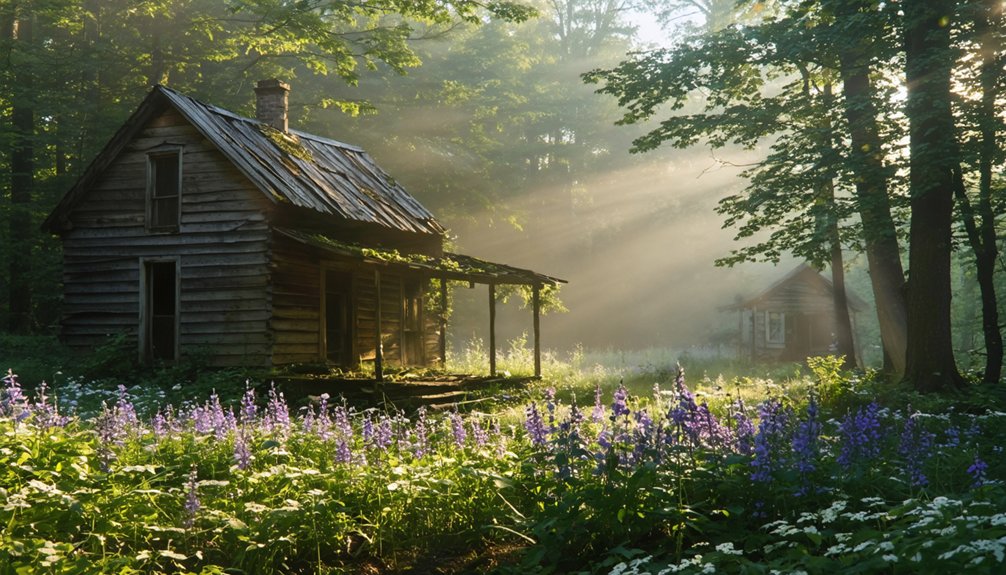
When you visit Elkmont can shape your entire experience of this haunting ghost town. Local weather and seasonal events both influence what you’ll find along the trails and among the weathered structures.
- Spring and early summer bring the famous synchronous firefly displays, drawing crowds but offering a genuinely rare natural spectacle.
- Fall delivers cooler temperatures and dramatic foliage that intensifies the ghost town’s atmosphere.
- Winter thins the crowds significantly, giving you freer access to the historic district with fewer distractions.
Summer weekends get busy, so arriving early lets you explore at your own pace.
Snow occasionally closes roads in winter, so check conditions before heading out.
Whatever season you choose, Elkmont rewards visitors who come prepared and ready to wander without a rigid schedule.
What to Pack for the Elkmont Historic District Trail
Packing right makes the difference between a comfortable explore and a frustrating one, so give your bag some thought before you head out.
Wear sturdy, broken-in hiking shoes since the trail surface stays uneven and damp near the creek.
Bring layered clothing, especially if you’re visiting in early morning when temperatures drop.
Pack enough water and a light snack since you’ll likely linger longer than expected.
Tuck in a wildflower identification guide during spring visits when blooms carpet the forest floor.
Binoculars sharpen your experience at the birdwatching spots scattered through the surrounding woods.
A camera captures the weathered cabin details worth remembering.
Insect repellent earns its weight here, particularly in warmer months.
Keep your bag light so the trail stays enjoyable from start to finish.
Frequently Asked Questions
How Long Has the Elkmont Area Been Used by Humans?
You’d be surprised — Elkmont’s ghost town history stretches back roughly 8,000 years! Long before recreational tourism transformed it, ancient humans actively used this land, making your visit far more historically rich than you might’ve imagined.
What Timber Species Did Early Elkmont Loggers Harvest From the Forest?
When you explore Elkmont’s history, you’ll discover early loggers harvested rich forest resources, pulling timber logging profits from towering poplar, hemlock, cherry, and ash trees that once blanketed these wild, freedom-filled Smoky Mountain slopes.
When Exactly Did the Little River Lumber Company Establish Elkmont as a Town?
Like a town born overnight, the Little River Lumber Company established Elkmont around 1907–1908. You’ll discover its historic architecture and local legends waiting to be explored on your adventure through this remarkable ghost town.
Were All Elkmont Residents Treated the Same When the National Park Formed?
No, they weren’t! In Elkmont’s ghost town history, resident experiences varied greatly. Cottage owners received lifetime leases, while other residents had to sell and relocate, leaving behind the community they’d called home.
When Did the Last Private Leases in Elkmont’s Historic District Finally Expire?
You’ll find the last private leases expired in 1992, ending decades of personal retreats and private land restrictions. That closure transformed Elkmont into the ghost town tourism destination you can freely explore today.
References
- https://tnmuseum.org/Stories/posts/the-curious-case-of-elkmont-tennessee-the-ghost-town-of-the-smoky-mountains
- https://gatlinburghaunts.com/elkmont-tennessees-ghost-town/
- https://www.thesmokies.com/elkmont-ghost-town-smoky-mountains/
- https://www.atlasobscura.com/places/elkmont-historic-district
- https://www.pigeonforge.com/elkmont-ghost-town/
- https://roadtrippers.com/magazine/abandoned-ghost-town-smoky-mountains/
- https://www.youtube.com/watch?v=iQWXUEhV8m0
- https://www.youtube.com/watch?v=Nxoo9Rv_jSc
- https://www.overlookedinappalachia.org/post/the-story-of-elkmont-the-wealthy-resort-town-left-abandoned
- https://smokymountains.com/park/blog/elkmont-ghost-town-everything-need-know