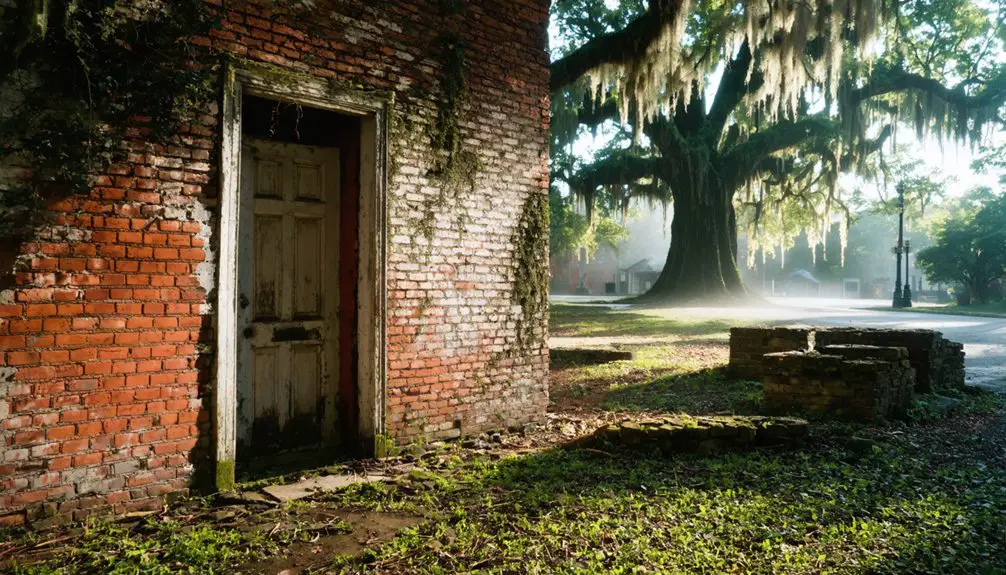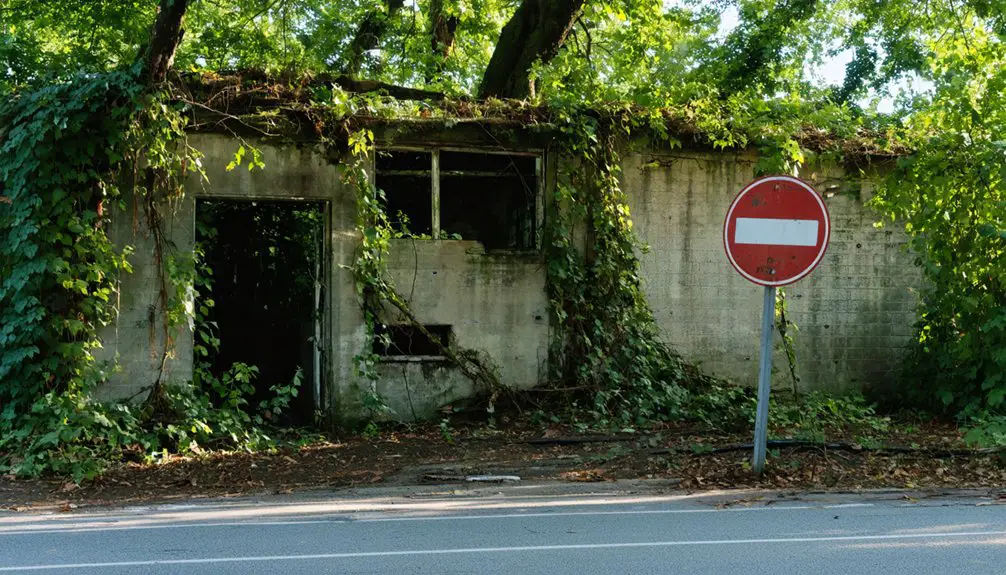
You’ll find Elko Tract hidden in Henrico County’s woods—a place built twice and abandoned twice. In 1942, soldiers carved fake runways and plywood planes to fool German bombers. After the war, Virginia constructed streets, sewers, and a water tower for a mental hospital, but white residents’ fierce opposition killed the project by 1957. Today, that rusted tower still punches through the canopy above crumbling infrastructure. Exploring requires patience: seek out historical archives, county documentation, and occasionally organized tours that’ll reveal the full story behind this twice-forgotten place.
Key Takeaways
- Elko Tract served as a WWII decoy airfield with fake planes, then became an abandoned hospital site due to racist opposition.
- Visible remnants include a rusted water tower, crumbling street grids, fire hydrants, drainage systems, and underground utilities from the 1950s.
- The site was abandoned after white Henrico County residents opposed plans for an African American mental health facility in 1956.
- Trespassing is illegal; instead, access archival videos, visit Virginia State Library, or join Richmond historical society guided tours.
- Legal guided tours with proper permissions provide safer, more informative experiences than unauthorized exploration attempts.
The Wartime Origins of Elko Tract’s Phantom Airfield

In late 1942, while Richmond’s residents carried on with wartime rationing and blackout drills, bulldozers carved fake runways into 2,220 acres of condemned woodland five miles southeast of the city.
While civilians practiced air raid drills above ground, military engineers secretly built an entire fake air base in condemned Virginia forest.
You’re standing where the U.S. Army’s 936th Camouflage Battalion orchestrated an audacious deception—a phantom airfield designed to draw German bombs away from the real Richmond Army Air Base.
Hollywood set directors taught soldiers to craft plywood aircraft propped on two-by-fours, canvas hangars, and wire-frame trucks light enough to carry by hand. They trimmed surrounding brush into P-47 silhouettes and replicated Richmond’s road patterns to confuse night bombers. The decoy installation featured carefully arranged runways and hangars that mimicked an operational military facility.
This World War II history site, though never tested by enemy fire, represents America’s innovative defense strategy. Soldiers from the 1896th Engineering Aviation Battalion stationed at Elko routinely moved equipment around the field to simulate the daily bustle of an active air base. Today, site preservation efforts remain minimal, leaving you to explore this forgotten battlefield of psychological warfare.
From Military Deception to Failed Hospital Dreams
When the last fake bombers were dismantled in 1945, Virginia’s legislators saw opportunity in 2,250 acres of wooded land already scarred by military use. By February 1947, they’d bid on the Elko Tract, envisioning a mental health facility for African American patients—segregation’s health impacts demanded separate, supposedly equal institutions.
What the Commonwealth Built Before Abandoning Its Plan:
- Complete water tower and sewage treatment systems
- Paved streets with gutters, curbs, and fire hydrants
- Full underground utilities and drainage infrastructure
- Sidewalks connecting facilities that would never open
White Henrico County residents fought fiercely. Economic power dynamics shifted—their opposition, coupled with financial constraints, killed the project by 1956. Virginia abandoned $500,000 in taxpayer money, leaving ghost infrastructure that’d haunt the woods for decades. The project was moved to Petersburg a decade after the initial delays. The Commonwealth sold the property in 1996, converting Virginia’s abandoned dream into cash for prison construction.
Racism and Resistance That Sealed Elko’s Fate
The Richmond Afro American didn’t mince words in February 1947: white Henrico County residents were fighting “bitterly” against the hospital’s placement. This wasn’t just neighborhood concern—it was systemic disenfranchisement wrapped in NIMBY rhetoric. Resistance was further fueled by fear of integration and the lack of Black housing in the area.
Local legislators joined the chorus, their “hot opposition” documented through 1956.
Then came massive resistance. Within weeks of Brown v. Board of Education, Virginia erected new segregation codes. Senator Harry Byrd led the charge, and by September 1956, state sanctioned segregation became law—integrated schools lost all funding.
Governor Stanley pulled the plug on Elko in February 1957, redirecting the project to Petersburg.
Half a million dollars in infrastructure—water towers, fire hydrants, street grids—sat rusting. You’ll find them still decaying, monuments to calculated abandonment. The land had been dismissed as “junk land” decades earlier, considered unsuitable for farming before the war transformed it into a strategic military site.
What Remains of Virginia’s Forgotten Infrastructure
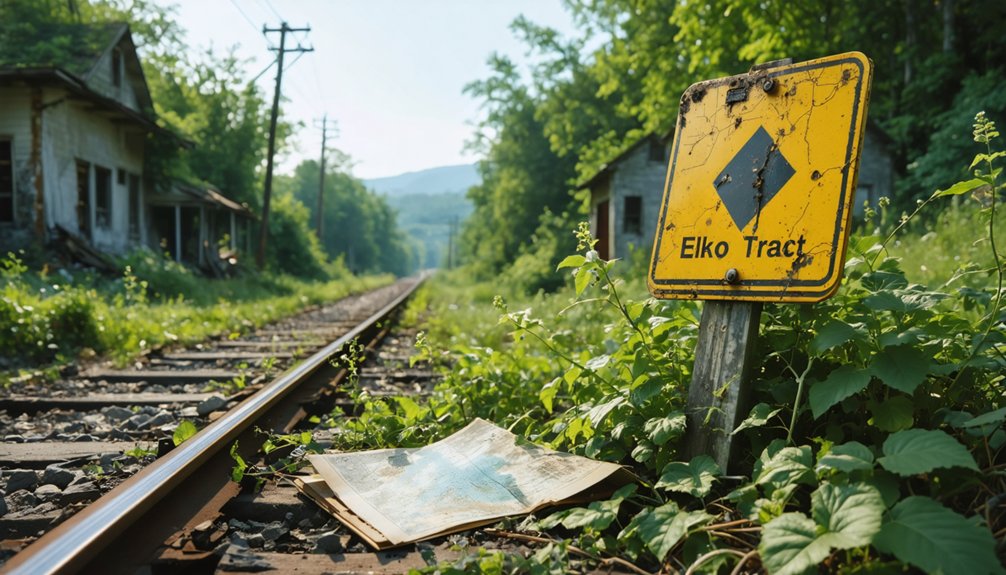
Driving northeast past Richmond’s sprawl, you’ll spot it first—a rusted water tower punching through the canopy like a skeletal finger. This $5.5 million ghost infrastructure beckons explorers willing to push past the “No Trespassing” signs.
A skeletal water tower rises from the forest—$5.5 million in rusted infrastructure silently defying No Trespassing signs.
What you’ll discover wandering Elko’s overgrown arteries:
- Crumbling street grids where sidewalks sprout 70-year-old trees, their roots cracking 1950s concrete
- Fire hydrants slowly consumed by underbrush, still connected to hidden tunnels of choked sewers below
- Drainage systems visible through eastern thickets, engineering marvels rotting unused
- Abandoned construction equipment occasionally surfacing where forest floor yields to metal
The streets were fashioned to resemble Richmond’s layout, a deliberate mirror of the capital’s grid system meant to fool enemy bombers in darkness. The decoy airfield left nothing—plywood bombers don’t survive decades. But those phantom hospital streets? They’re Richmond’s accidental monument to bureaucratic failure, waiting in the woods.
After the war ended, the site served infantry training and bombing practice before the Commonwealth rezoned it for industry. The land remained undeveloped for decades.
How to Explore Elko Tract’s History Safely and Legally

Let’s be direct: everything that made the previous section compelling—those crumbling sidewalks, phantom hospital streets, skeletal water tower—sits behind enforceable barriers you shouldn’t cross. Trespassing citations aren’t worth the risk.
Instead, Henrico County’s historical video archives deliver remarkable footage you’d struggle to capture yourself. Virginia State Library’s archival research opportunities include condemned farmland records, engineering blueprints, and camouflage battalion photographs that tell Elko’s story without legal consequences.
The history of Elko Tract ghost town offers a glimpse into the lives of those who once inhabited the area and the events that led to its abandonment. This fascinating story is enriched by local legends and artifacts that have been uncovered over the years. By exploring these remnants, visitors can piece together the narratives that shaped this unique part of Virginia’s past.
Want boots-on-ground experience? Contact Richmond historical societies about approved site visits—they occasionally coordinate documented tours with proper permissions. I’ve found these guided experiences reveal stories no fence-jumping expedition could match.
Local historians share displacement testimonies, Cold War strategies, and segregation-era hospital politics that transform abstract ruins into human narratives. The decoy was built with sophisticated camouflaging technology designed to fool German reconnaissance into believing it was Richmond’s actual air base. You’ll gain knowledge without compromising the site’s fragile infrastructure or your criminal record.
Frequently Asked Questions
What Happened to the Families Displaced From the 40 Farms?
The displaced families scattered after losing their farms, seeking new land and livelihoods elsewhere. You’ll find no trace of their displaced family settlements today—only farmland reforestation reclaimed what was once their thriving agricultural community, erasing their stories beneath dense woods.
Are There Any Photographs of the Original Plywood Airplanes?
You’ll strike gold discovering photographic evidence from the 1910s-1940s showcasing plywood aircraft innovations. The de Havilland Museum preserves stunning images of the “Wooden Wonder” Mosquito, while Wisconsin Historical Society archives feature abandoned airplanes from aviation’s pioneering era.
Can You Visit White Oak Technology Park During Business Hours?
White Oak Technology Park doesn’t list public access restrictions or specific operating hours. You’ll find it’s primarily a business district, so you’re free to explore the area during typical daytime hours when companies are actively working.
Were Any Decoy Airfields Like Elko Tract Ever Actually Used?
You’ll find abandoned military infrastructure like Elko Tract was never bombed during wartime deception operations. However, British decoy airfields drew 57 Luftwaffe attacks, successfully protecting real bases while America’s elaborate fakes remained untouched throughout WWII.
What Wildlife Inhabits the Wooded Areas Around Elko Tract Today?
Wandering white-tailed deer populations dominate these woods, while migratory bird species flock overhead seasonally. You’ll spot raccoons, foxes, and Carolina chickadees year-round. I’ve encountered owls at dusk—nature’s reclaimed this forgotten airfield beautifully.
References
- https://paulmullins.wordpress.com/2013/12/26/ruins-and-race-in-a-world-war-ii-ghost-town/
- https://www.abandonedcountry.com/2013/10/28/the-elko-tract-a-lost-city-thats-too-well-known/
- https://www.onlyinyourstate.com/experiences/virginia/vacant-ghost-town-va
- https://rictoday.6amcity.com/city/elko-tract-history-richmond-va
- https://www.wtvr.com/2018/01/17/the-ugly-truth-behind-rvas-lost-city
- https://www.youtube.com/watch?v=fC1DtnyQzYs
- https://www.smithsonianmag.com/air-space-magazine/army-built-decoy-airfield-virginia-180955980/
- https://en.wikipedia.org/wiki/Elko_Tract
- https://paulmullins.wordpress.com/tag/elko-tract/
- https://sites.rootsweb.com/~vatttp/ghosttowns/elkotract/elkotract.htm