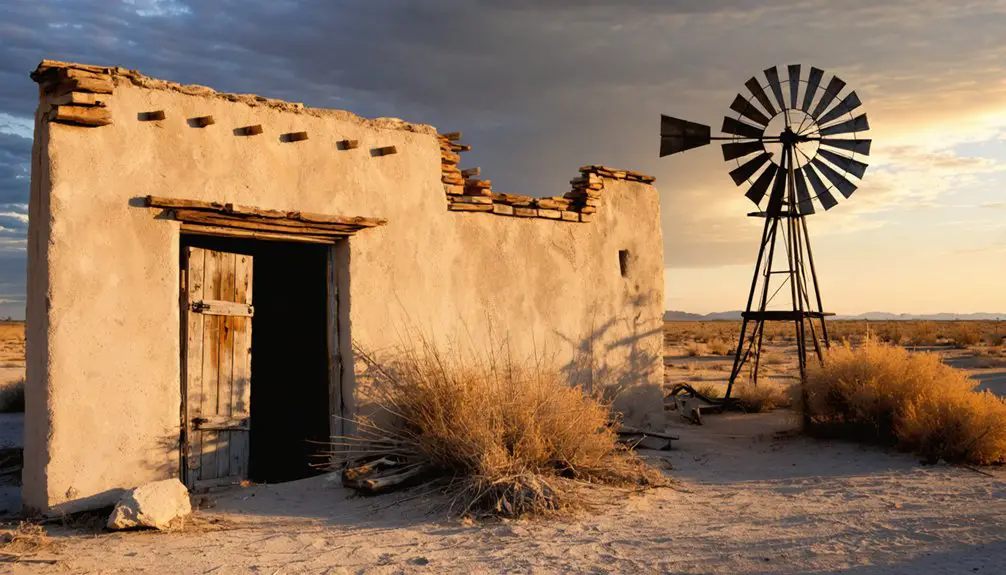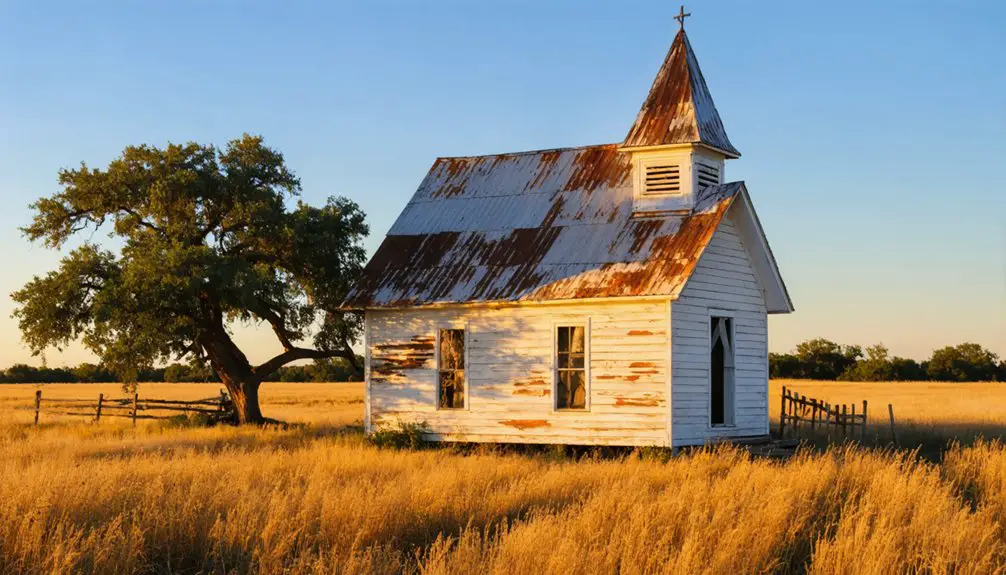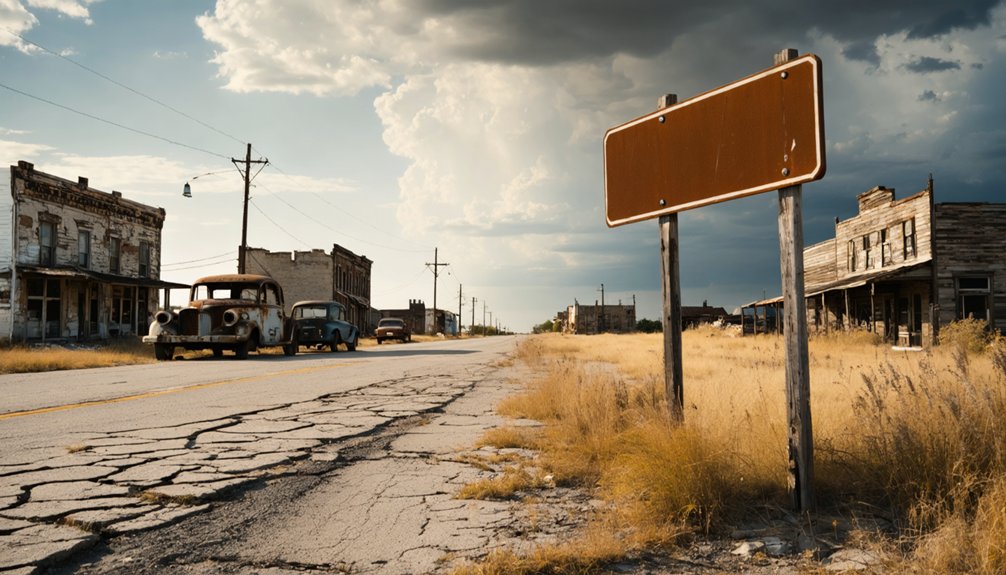
Your ghost town road trip to Elm Creek begins at Proffitt Cemetery on U.S. Highway 380, where weathered markers and a common grave tell stories of the 1864 raid that claimed fourteen lives. You’ll need GPS with offline maps, sturdy boots for rugged terrain, and water purification systems since the creek’s gypsum-tainted. Visit Young County Museum of History for raid artifacts, then explore Fort Phantom Hill ruins thirty miles north. The mysteries buried here—including two-year-old Millie Durkin’s vanishing—run deeper than these lonely homesteads suggest.
Key Takeaways
- Visit Proffitt Cemetery on U.S. Highway 380 to see preserved markers and the common grave from the 1864 raid.
- Explore the Elm Creek Raid Site, Young County Museum of History, Bragg’s Fort, and Britt Johnson’s grave marker.
- Plan your trip for winter, spring, or fall when 2WD roads are most accessible to the remote sites.
- Bring GPS with offline maps, water purification systems, sturdy boots, and emergency supplies for the isolated terrain.
- Add Fort Phantom Hill ruins, located 30 miles north on FM600, to your ghost town itinerary.
The Bloody Legacy of the 1864 Elm Creek Raid
When 300 to 1,100 Kiowa and Comanche warriors swept into the Elm Creek valley on October 13, 1864, they found the ranches of western Young County ripe for the taking. Most men were away on cattle roundup, leaving families vulnerable.
You’ll learn how Peter Harmonson and his son Perry fought back near Rabbit Creek, killing a warrior possibly chief Little Buffalo himself. The Fitzpatrick Ranch suffered worst—seven dead, including five Confederate soldiers, and Elijah Carter burned alive. Dr. Thomas Wilson fell defending George Bragg’s cabin, an arrow through his heart.
The devastating toll on settlers claimed fourteen lives, drove hundreds from their homesteads, and left a lasting impact on community that never fully recovered. Lieutenant N. Carson pursued the raiders with 14 men but was ambushed and forced to retreat. Henry Wooten was cut off from Carson’s men and escaped by wading through waist-deep Elm Creek waters while two pursuing Indians turned back at the crossing. This raid remains West Texas’s bloodiest frontier assault.
What Remains of Proffitt Settlement Today
The violence that shattered Young County’s frontier settlements in 1864 eventually subsided, but prosperity never returned to Proffitt. You’ll find little more than scattered rural homes where a thriving community once stood. The post office closed in 1925—the same year John Proffitt died—sealing the town’s fate.
Drive 0.2 miles past the town turnoff on U.S. Highway 380, and you’ll discover Proffitt Cemetery on the north side. Preserved cemetery markers tell stories the surviving homestead ruins can’t. The most haunting monument marks a common grave holding three nineteen-year-olds—Patrick Euell Proffitt, Rice Carlton, and Reuben Johnson—killed during an 1867 Indian raid. This windswept burial ground, donated by John Proffitt himself, remains the settlement’s most tangible connection to Texas’s untamed past. The cemetery land was part of a larger donation that also included property for a church, school, and Masonic Lodge.
The area is accessible via 2WD roads, making it an easy destination for most visitors. Plan your visit during winter, spring, or fall, when temperatures are more comfortable—summer’s heat can be punishing in this part of Young County.
Essential Stops on Your Elm Creek Ghost Town Journey
Your ghost town journey begins at the Elm Creek Raid Site itself, where Little Buffalo’s war party descended upon unsuspecting settlers in October 1864. This haunting natural setting along the creek preserves echoes of frontier violence through mesquite groves and cottonwood shadows where spectral cries reportedly linger. As you continue your adventure, exploring ghost towns in Texas offers a glimpse into the rich tapestry of history and forgotten lives that once thrived in these now-desolate places. Each abandoned building tells a story, providing insight into the hardships and hopes of those who settled here. The eerie silence of these towns often invites reflection, making them a perfect backdrop for adventure and exploration.
Plan these essential waypoints:
- Young County Museum of History – Document authentic raid artifacts and survivor testimonies before exploring the landscape
- Bragg’s Fort location – Stand where six hours of desperate hand-to-hand combat unfolded during relentless warrior attacks
- Britt Johnson’s grave marker – Honor the frontiersman who pursued his family’s captors across hostile territory
- Fort Phantom Hill ruins – Experience genuine 1850s military outpost decay thirty miles north on FM600
Cover this 150-mile loop through rolling prairie between West Fork Trinity River and Clear Fork Brazos. The raid’s timing proved devastating as most male settlers were away on a cattle round-up and drive, leaving families vulnerable to the massive war band’s assault. Continue your journey to nearby Terlingua ghost town, where decaying buildings and shafts were abandoned by miners after the local mine flooded in 1946.
The Mystery of Millie Durkin and Other Lost Souls
Among the weathered headstones and forgotten graves scattered across Young County, no mystery haunts modern researchers more persistently than the fate of two-year-old Milly Jane Durkin.
Official records claim she perished during the brutal “Muddy Traveling Winter” of 1864-65. Yet whispers persist of a woman who lived identity as Sain-Toh-Oodie-Goombi among the Kiowa for seventy years, identified in 1930 as the missing Elm Creek captive. Raised by Chief Aperian Crow, she bore no memory of her Texas origins—only the life her foster father concealed from inquiring soldiers.
You’ll find her sister Lottie’s grave in Tascosa’s Casimiro Romero Cemetery, marked by the blue moon tattoo she carried until death. Their grandmother Elizabeth numbered among the rescued descendants who survived, though neither lived to confirm Millie’s ultimate fate. The raid itself unfolded 10 miles south of Newcastle in the Elm Creek valley, where several hundred Kiowa and Comanche warriors descended upon scattered settler homes. Millie had married Owen Durkin at Fort Belknap just seven years before the massacre, wed at only fifteen years of age.
Preparing for Your Visit to This Remote Historical Site
Before you venture into the windswept valley where Elm Creek carved its path through Young County’s frontier, understand that this isn’t a sanitized historical park with paved trails and interpretive signs. The rugged terrain challenges and lack of modern infrastructure demand genuine preparation for explorers willing to trace the raiders’ paths through ravines and brush.
Essential preparations include:
- Navigation tools — GPS devices with offline maps, since cell service disappears where shadows once concealed 700 Kiowa and Comanche warriors
- Water purification systems — gypsum-tainted creek water still flows through these valleys
- Emergency supplies — first aid kits, weather gear, and communication devices for isolation contingencies
- Physical readiness — sturdy boots for uneven ground where captives once stumbled toward uncertain fates
This landscape rewards self-reliance, not complacency.
Frequently Asked Questions
What Nearby Accommodations Are Available for Overnight Stays in the Area?
You’ll find cozy cabins near O.H. Ivie Lake, pet-friendly motels in Coleman, and charming vacation rentals throughout the region. While historic bed & breakfasts aren’t abundant here, rustic bunkhouses and lakeside retreats offer authentic Texas freedom.
Are Guided Tours of the Elm Creek Raid Sites Offered Regularly?
You won’t find a single guided tour waiting—this untamed frontier demands you forge your own path. Self-guided tours with historical markers let you explore freely, making your own discoveries among recommended activities across Young County’s haunting landscapes.
What Is the Best Season to Visit Proffitt Cemetery and Surrounding Sites?
Visit Proffitt Cemetery during spring or fall when seasonal weather patterns create perfect conditions for exploration. You’ll discover exceptional photographic opportunities as wildflowers bloom or autumn colors emerge, while comfortable temperatures let you roam freely through history.
Can Visitors Access Private Ranch Land Where Original Attacks Occurred?
Locked gates guard history’s scars—you can’t access private ranch land where the 1864 attacks unfolded. Access policies firmly protect property owners’ rights, and private property concerns keep original sites closed without explicit permission from current ranchers.
Are There Local Restaurants or Provisions Available Near the Ghost Town?
You’ll find excellent dining options nearby, from Starlight Theatre’s gourmet fare to Taqueria El Milagro’s authentic tacos. While there’s no local general store or farmer’s markets, these establishments provide everything you’ll need for your adventure.
References
- https://digging-history.com/2015/01/07/ghost-town-wednesday-proffitt-texas/
- https://www.ycmohc.com/ghosts-of-elm-creek/
- https://www.historynet.com/search-captives-elm-creek/
- https://www.forttours.com/pages/elmcreekraid.asp
- https://texoso66.com/2022/06/02/elm-creek-massacre/
- https://www.texasalmanac.com/places/elm-creek-0
- https://kids.kiddle.co/Old_Troy
- https://www.tshaonline.org/handbook/entries/proffitt-tx
- https://www.tshaonline.org/handbook/entries/elm-creek-raid
- https://www.frontiertimesmagazine.com/blog/the-indian-raid-in-young-county-written-henry-c-williams-newcastle-texas