You’ll find Epworth’s scattered remnants at Main and East Cleveland in Hale Center, just 33 miles north of Lubbock on Interstate 27. Spring’s your best bet—longer daylight hours let you photograph the weathered monument and explore the 50+ headstone cemetery where Horatio Graves’ Methodist dream rests. Avoid summer’s blistering heat; October brings crowds seeking ghost stories, but March through May offers empty horizons. Pack binoculars for distant homesteads, and respect private property boundaries as you discover what transformed this failed colony into today’s landscape.
Key Takeaways
- Epworth is located at Main Street and East Cleveland Street in Hale Center, 33 miles north of Lubbock via Interstate 27.
- Visit the weathered roadside monument, scattered stone foundations, and cemetery with 50+ headstones from 1900-1940.
- Spring (March-May) offers ideal conditions with 13-14 hour days and firm paths for photographing abandoned structures.
- Explore nearby ghost towns within a 90-mile radius, including abandoned homesteads, grain elevators, and one-room schoolhouses.
- Respect private property boundaries and pack binoculars for viewing distant sun-bleached structures across the windswept plains.
The Story Behind Horatio Graves’ Methodist Colony Dream
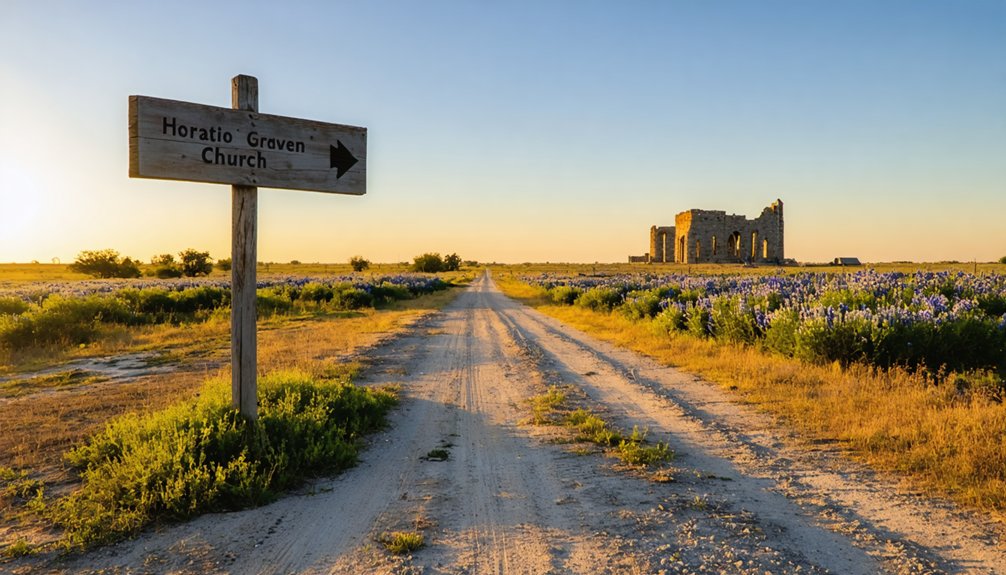
In 1883, Horatio Graves stood alone on the endless Texas prairie, the only permanent resident of a county that existed more in theory than reality. This Northern Methodist minister from Ausable Forks, New York, carried a bold vision: establishing Epworth, a religious colony named after John Wesley’s birthplace.
You’ll find his story remarkable—he hauled mail from Estacado to accommodate passing cowboys, then secured his own post office by 1884. His religious motivation drove everything, from the settlement’s name to his dream of attracting Methodist families to virgin grasslands.
But demographic challenges crushed his plans. Few settlers ventured to his isolated outpost, leaving Epworth as little more than a compass point. Still, Graves planted the first stake in what’d become Hale County.
What Remains of Epworth Today
When you arrive at Epworth’s coordinates off Highway 37, you’ll find a weathered roadside monument that tells the colony’s story in faded bronze text—the only formal acknowledgment of what once thrived here.
Beyond this marker, the prairie stretches flat and unbroken except for mesquite thickets reclaiming the scattered stone foundations where Methodist families once gathered. I’ve watched photographers crouch among the prickly pear to frame shots of the cemetery’s 50+ headstones, their dates frozen between 1900 and 1940, standing as the settlement’s most intact memorial.
Historical Markers and Memorials
Standing at the historical marker in Hale Center, you’ll find the tangible thread connecting present-day Texas to Epworth’s vanished past. The Texas Historical Commission placed this marker documenting Horatio Graves‘s 1884 post office establishment, preserving the Methodist minister’s frontier legacy.
What you’ll discover at marker locations:
- Founder documentation – Graves’s journey from New York to Texas frontier
- Settlement timeline – Official recognition through postal service records
- Religious heritage – Methodist influence on community development
- Regional context – Connection to broader Texas settlement patterns
The marker design follows the commission’s standardized format, part of their 16,000+ statewide installations. You can access digital databases remotely, though standing before the physical marker offers something research can’t replicate—that direct connection to pioneers who risked everything for independence on open land.
Prairie Landscape Features Remaining
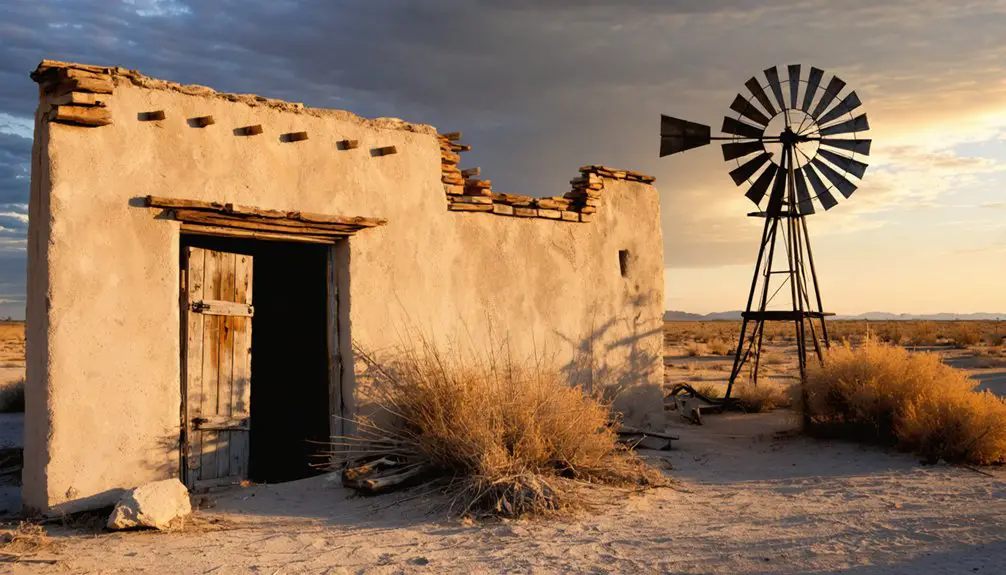
Though the post office closed in 1907 and Epworth’s residents scattered to neighboring towns, the prairie hasn’t completely erased what they left behind. You’ll find crumbling adobe walls and stone building ruins standing defiant against the wind. Weathered structures gradually surrender to the elements, their skeletal frames marking where the company store once stood.
The prairie vegetation intrusion tells its own story—mesquite bushes swallow scattered foundations while prickly pear cactus claims the ruins. You’ll spot concrete foundations slowly eroding alongside old rainwater cisterns. Cemetery headstones document the hard lives of early settlers, their inscriptions fading beneath the relentless prairie sun. Rusted equipment pieces and abandoned mining gear lie half-buried where they were left, monuments to ambitions that couldn’t outlast the unforgiving Texas landscape.
Getting to the Former Epworth Site in Hale Center
You’ll find the former Epworth site at the intersection of Main Street and East Cleveland Street in modern-day Hale Center, where a historical marker stands as the sole tribute to this vanished 1891 settlement.
The journey brings you along Interstate 27, which cuts straight through Texas’s high plains—the same Llano Estacado landscape those early settlers crossed by wagon. From Lubbock, it’s a 33-mile drive north; from Plainview, just 11 miles southwest on roads that replaced the dusty trails connecting these frontier rivals.
Primary Highway Access Routes
Getting to the former Epworth site in present-day Hale Center couldn’t be more straightforward—Interstate 27 delivers you right to this ghost town‘s doorstep. Your route planning considerations are simple: from Lubbock, head north 33 miles on I-27; from Plainview, travel southeast just 11 miles. The ideal driving directions converge at the FM 1914 interchange, where the Llano Estacado’s endless horizons meet your journey.
Key highway markers to watch:
- Interstate 27 exit at Hale Center (clearly signed)
- FM 1914 intersection providing east-west access
- Main Street leading to the historical marker at East Cleveland Street
- 1434 IH 27 address for GPS navigation
Once you exit I-27, you’re minutes from standing where Epworth’s buildings once stood before rolling to their new foundation in 1893.
The historical marker standing at Main Street and East Cleveland Street serves as your primary landmark—a bronze sentinel marking where Epworth’s story dissolved into Hale Center’s beginning. You’ll navigate these plains using Interstate 27 as your spine, with FM 1914 branching east-west through town.
Plainview lies 11 miles northeast if you need supplies; Lubbock waits 33 miles south for fuel and food. The community’s roadside amenities cluster near this intersection—local diners, gas stations, small shops where locals still remember tornado stories from ’65.
The transportation network connectivity here reflects Texas Panhandle practicality: straight roads, wide horizons, few complications. Running Water Draw cuts through nearby terrain, offering geographical context to this vanished settlement’s original appeal.
Best Times to Explore the Texas Panhandle Ghost Towns
When I first visited Epworth in late April, the Panhandle stretched before me in perfect 68°F clarity—wildflowers dotting the roadside, dirt paths firm beneath my boots, and not another soul for miles. Understanding seasonal weather patterns transforms these expeditions from challenging to sublime.
Timing your visit around weather patterns elevates exploration from mere survival to genuine discovery in these vast, empty spaces.
Your visiting strategies should align with nature’s rhythms:
- Spring (March-May): 13-14 hour days let you photograph abandoned structures without rushing, while minimal mud keeps remote sites accessible
- Fall (September-November): 50-70°F temperatures make camping comfortable, and sparse vegetation reveals hidden ruins
- Winter: Solitary exploration peaks with minimal crowds, though 10-hour daylight limits range
- Avoid Summer: 90°F+ heat and thunderstorms create dangerous conditions at exposed locations
October offers haunted tours if you’re seeking curated experiences, but true freedom lives in spring’s empty horizons.
Nearby Historic Sites and Ghost Town Destinations

Epworth’s isolation becomes your advantage once you recognize the Texas Panhandle’s ghost town corridor stretches within a 90-mile radius of this forgotten settlement. You’ll find nearby abandoned buildings scattered across windswept plains, each structure holding fragments of frontier dreams that collapsed with the Dust Bowl.
Local folklore stories whisper through weathered doorframes—tales of ranchers who refused to leave, of general stores that served their last customers in 1950.
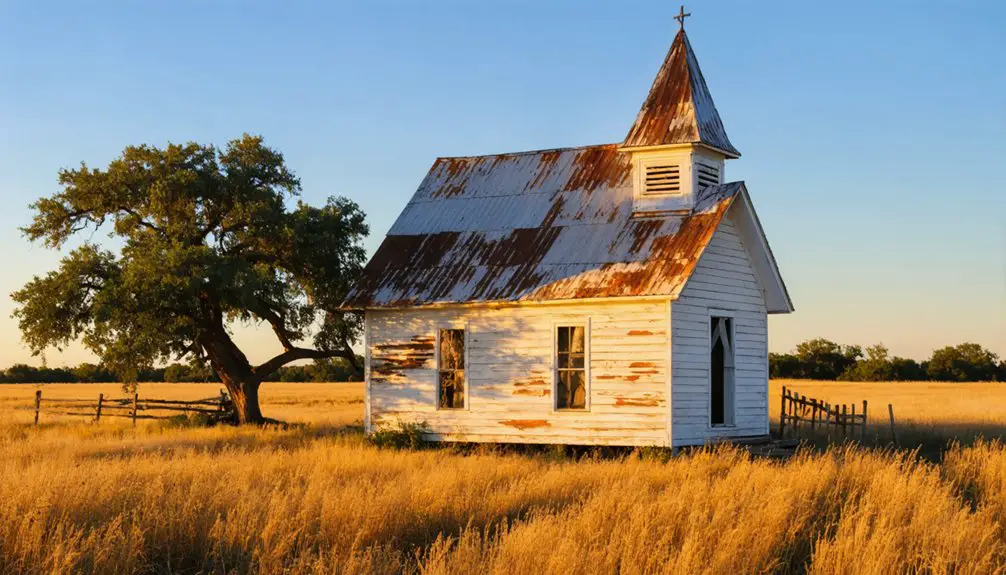
Your route planning requires flexibility since many sites exist on private land. Pack binoculars for distance viewing, and always respect property boundaries. The rewards? Discovering sun-bleached homesteads nobody’s photographed, grain elevators standing sentinel over empty crossroads, and one-room schoolhouses where you’ll hear nothing but wind carrying echoes of children’s voices from decades past.
Understanding Epworth’s Transformation Into Hale Center
Unlike most Texas ghost towns that simply withered away, Epworth didn’t vanish—it merged with its competitor and evolved into something entirely different.
You’ll discover that in 1893, Epworth and rival Hale City literally picked up their buildings and relocated them to create Hale Center. This bold community rebuilding effort positioned the new town at today’s Interstate 27 and Farm Road 1914 intersection.
The transformation wasn’t smooth:
- Railroad promises fell through, leaving settlers stranded
- Devastating drought drove residents back to ranches
- By 1898, only two businesses remained standing
- The 1909 Santa Fe Railroad finally sparked economic diversity
When you visit the Hale County Farm and Ranch Museum in the restored 1911 depot, you’re witnessing where Epworth’s pioneer spirit ultimately found its permanent home.
Essential Tips for Your Panhandle Ghost Town Adventure

Your journey to Epworth’s remnants requires more preparation than most Texas ghost town expeditions. The Panhandle’s unmarked rural roads demand high-clearance vehicles and meticulous navigation—I’ve watched travelers strand themselves chasing coordinates that lead nowhere.
The history of Watson, Texas ghost town is steeped in legend, with tales of early settlers and their struggles in the unforgiving terrain. Many who venture to explore this forgotten place find remnants of old structures and whispers of the past echoing through the quiet streets. As dusk approaches, the eerie silence often invites speculation about the spirits that may still linger among the ruins.
Spring and fall offer merciful temperatures; summer heat exceeds 100°F while relentless winds test your vehicle’s stability.
The preservation challenges here are total: Epworth vanished into Hale Center’s fabric, leaving only a historical marker at 34°02′N 101°24′W. Pack excess water and fuel—services evaporate between towns. Check Texas Department of Transportation updates before departing Plainview, fifteen miles south on Highway 87.
Combine this stop with Estacado or Thurber for substantial exploration. The flat plains reveal their secrets slowly, rewarding patient travelers who embrace unpredictability over tourist infrastructure.
Frequently Asked Questions
Are There Any Surviving Descendants of Horatio Graves in the Area Today?
No surviving descendants remain traceable today. You’ll find family genealogical records ending in 1904, and local historical archives reveal no modern connections. Horatio’s lineage faded into Texas dust, leaving only whispers in forgotten documents and ghost town memories.
What Religious Denomination Landmarks Exist in Modern Hale Center From Epworth?
You’ll find the First Baptist Church standing tall since 1908, a symbol of Methodist church attendance roots when Horatio Graves welcomed neighbors. Western Heritage Fellowship continues that local community involvement spirit, keeping Epworth’s welcoming legacy alive today.
Can Visitors Access Original Epworth Post Office Records or Documents?
You’ll find original post office records and archived documentation at the National Archives in Fort Worth or Texas State Archives in Austin. Epworth’s microfilmed postmaster appointments and site location reports await your discovery through these accessible collections.
Were Any Other Religious Colonies Attempted in Hale County During That Era?
No, you’ll find the Snyder Mennonite colony stood alone among religious agricultural communities in Hale County. While historic town disputes merged settlements like Epworth and Hale City, they weren’t intentional faith-based colonies seeking communal independence.
What Caused the Split Between Old Epworth and New Epworth Originally?
The split’s exact cause remains undocumented, though changing economic priorities and evolving community dynamics likely drove settlers apart. You’ll find no definitive records explaining why neighbors divided their frontier settlement into Old and New Epworth sections.