You’ll find Fort Holland’s weathered stone barracks standing at 4,882 feet in the remote Viejo Pass, where $16,000 worth of military structures once housed 400 cavalry soldiers patrolling the border until 1921. The site sits on private Miller Ranch property, so you’ll need landowner permission before visiting these authentic frontier ruins. Plan your trip for late fall through early spring when West Texas temperatures are moderate, and base yourself in nearby Valentine for supplies and lodging while exploring the region’s compelling military history and surrounding borderland attractions.
Key Takeaways
- Fort Holland sits at 4,882 feet elevation on private Miller Ranch property, requiring advance permission from ranch owners for access.
- Original stone barracks, officers’ quarters, and support buildings from the early 1900s remain largely intact after a century.
- Visit during late fall through early spring for moderate temperatures; avoid summer’s extreme heat for outdoor exploration.
- The site includes the 1880 Apache battle location, marking the last Apache engagement in Presidio County on June 12.
- No public access or visitor facilities exist; plan accordingly with ranch owner coordination and self-sufficient supplies.
The Frontier History of Fort Holland
The Army invested over $16,000 in stone and wood structures, creating facilities for 400 soldiers. You can still trace where two barracks, officers’ quarters, and supply buildings once stood at 4,882 feet elevation.
Named after the J.R. Holland Ranch, this strategic post supplied cavalry units patrolling the border until operations ceased in 1921, marking the end of an era.
What Remains at the Former Military Post Today
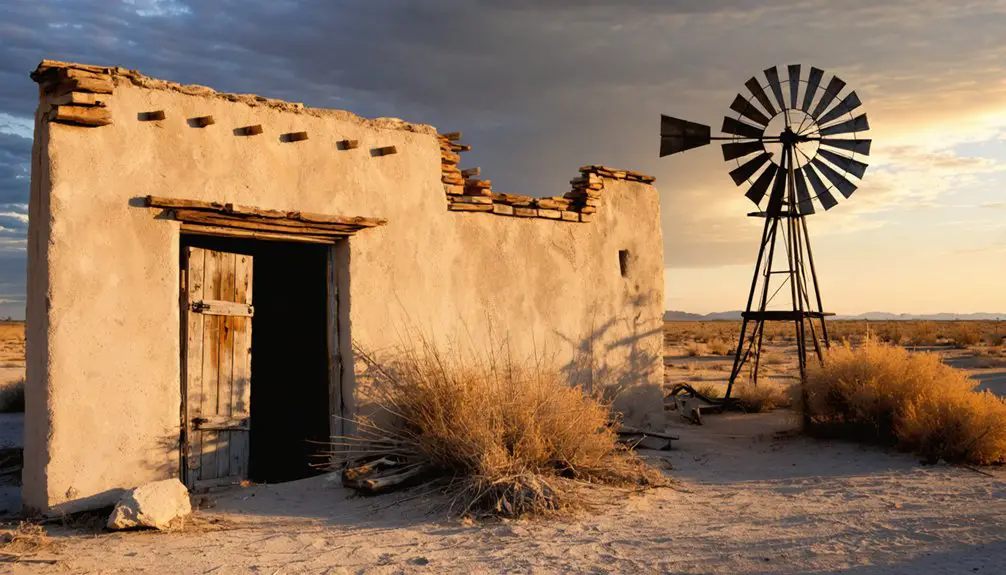
When you arrive at the Miller Ranch site today, you’ll find several stone buildings and barracks still standing amid the rugged terrain of Viejo Pass. The original stone-and-wood structures that once housed soldiers, Texas Rangers, and border officials have weathered over a century since the post closed in 1921.
Before you visit, you’ll need to contact the ranch owners for permission, as this ghost town sits on private property with no public access.
As you explore ghost towns near Soash, make sure to have a good camera ready to capture the haunting beauty of the abandoned structures. Each site tells a story of the past, and the rich history behind these locations is often shared by locals who are eager to recount their tales. Remember to respect the surroundings and the memories that these ghost towns hold.
Standing Structures on Miller Ranch
Perched in the rugged terrain of Viejo Pass, twelve miles west-southwest of Valentine, several stone structures from Fort Holland’s 1918 construction still stand on what’s now the privately owned Miller Ranch. These durable buildings weathered a century of West Texas extremes thanks to their solid building materials and time-tested construction techniques.
You’ll find remnants of the original barracks complex, officers’ quarters, and support facilities—though not every structure survived the decades since the fort’s 1922 closure.
What makes these buildings remarkable is their authenticity. The original stonework remains largely intact, offering you a genuine glimpse into early 20th-century military architecture. Since the Miller family’s occupation began in 1926, private stewardship has protected these rare frontier installations from the deterioration that claimed countless similar outposts across the Trans-Pecos region.
Historical Markers and Accessibility
- Private Property Protocol – You’ll need permission from Miller Ranch owners since the ghost town designation effects don’t include public access rights
- Remote Location – Navigate 12 miles west of Valentine through Viejo Pass at 4,882-foot elevation
- Limited Infrastructure – Expect no visitor facilities, signage, or modern amenities
- Documentation Opportunities – The 1970 THC photograph looking east toward the pass mouth shows ideal viewpoints
Your coordinates place you in true backcountry where freedom means respecting boundaries while exploring authentic Texas history.
Getting to Fort Holland Near Valentine, Texas
Finding Fort Holland requires traversing roughly six miles west of Valentine, Texas, along Chilicote Ranch road—a journey that takes you deeper into Presidio County’s rugged terrain at Viejo Pass. Your standard 2WD vehicle handles this dirt road travel surprisingly well, though you’ll navigate through working ranch infrastructure that reminds you this isn’t public land.
The elevation climbs to 4,882 feet as you approach coordinates 30°32′58.2″N 104°39′38.2″W, where century-old stone and wood fort buildings emerge from the landscape. Since you’re crossing Miller Ranch (formerly Chilicote and J.R. Holland Ranch), securing owner permission beforehand is essential. There’s real freedom in exploring these remote corners responsibly—respecting property rights while discovering authentic frontier history that guidebooks rarely detail.
Understanding the 1880 Apache Battle Site
When you arrive at this remote site twelve miles west of Valentine, you’ll stand where Lt. Frank H. Mills and four Pueblo Indian scouts fought the last Apache engagement in Presidio County on June 12, 1880.
The small-scale skirmish marked a pivotal moment in West Texas history, ending decades of Apache conflicts in this rugged corner of the Trans-Pecos region.
Look for the historical marker on the private Miller Ranch property, where Fort Holland’s stone ruins now occupy the exact battle location at an elevation of 4,882 feet in Viejo Pass.
Battle Date and Participants
- U.S. Forces: Multiple cavalry companies, including essential reinforcements from Eagle Spring
- Apache Warriors: Victorio’s skilled fighters pursuing broader campaign objectives across West Texas
- Casualties: Seven Apache fighters killed versus one American soldier, with wounded on both sides
- Strategic Stakes: Control of territorial movement and preventing Apache sanctuary access
This engagement temporarily blocked Apache retreat routes before Victorio’s band ultimately withdrew into Mexico.
Last Presidio County Conflict
As you stand in Viejo Pass today, twelve miles west of Valentine, the stark landscape reveals why this remote corridor became the stage for Presidio County’s final cavalry-Apache clash on June 12, 1880.
The Tenth Cavalry’s engagement here marked a turning point—Victorio’s warriors, caught between reinforcements arriving from Eagle Spring, suffered losses that forced their Apache retreat strategy southward into Mexico.
You’re walking ground where chaos erupted: smoke obscured friend from foe, crossfire endangered everyone, and Finley’s detachment fled to Rocky Ridge under pursuit. Though the Army claimed seven Apache dead against minimal casualties, they couldn’t deliver a decisive blow.
This setback, combined with defeat at Rattlesnake Spring, set the stage for Victorio’s further defeats, ultimately ending at Tres Castillos where Mexican troops finished what began here.
Historical Marker Location Details
The 1936 centennial marker standing today at Fort Holland’s grounds captures one of West Texas’s most misunderstood historical moments. You’ll find this monument positioned in the middle of the fort site, where the landscape setting tells a more complex story than “Last Battle with the Apaches” suggests.
Key Details About the Marker:
- Date Commemorated: June 12, 1880 engagement between U.S. Cavalry and Chief Victorio’s Apache forces
- Location Specifics: Viejo Pass at Canyon Springs, 12 miles west-southwest of Valentine on private Miller Ranch property
- Access Requirements: You’ll need permission from current owners before visiting this protected site
- Historical Interpretation Challenge: The marker overlooks Fort Holland’s actual 1918 construction, creating confusion about two distinct conflicts separated by decades
Annual Rock Art Foundation tours provide authorized access.
Exploring the Miller Ranch and Original Structures
Weathered stone walls rise from the desert floor at the Miller Ranch, where Fort Holland’s original military structures stand as silent sentinels to a bygone era. You’ll discover two massive barracks and four officers’ houses showcasing exquisite stonework crowned with slate roofs—architectural materials used that’ve withstood a century of harsh desert conditions.
The preservation techniques employed by successive Miller family generations have kept these buildings remarkably intact since 1918. Wander through the mess hall, guardhouse, bakery, blacksmith shop, and quartermaster store where old iron stoves still occupy kitchen spaces and vintage bunk beds rest in barracks corners.
Each crumbling structure tells stories of soldiers who once patrolled these remote borderlands, offering you an unfiltered glimpse into authentic frontier military life.
Best Times to Visit West Texas Border Country
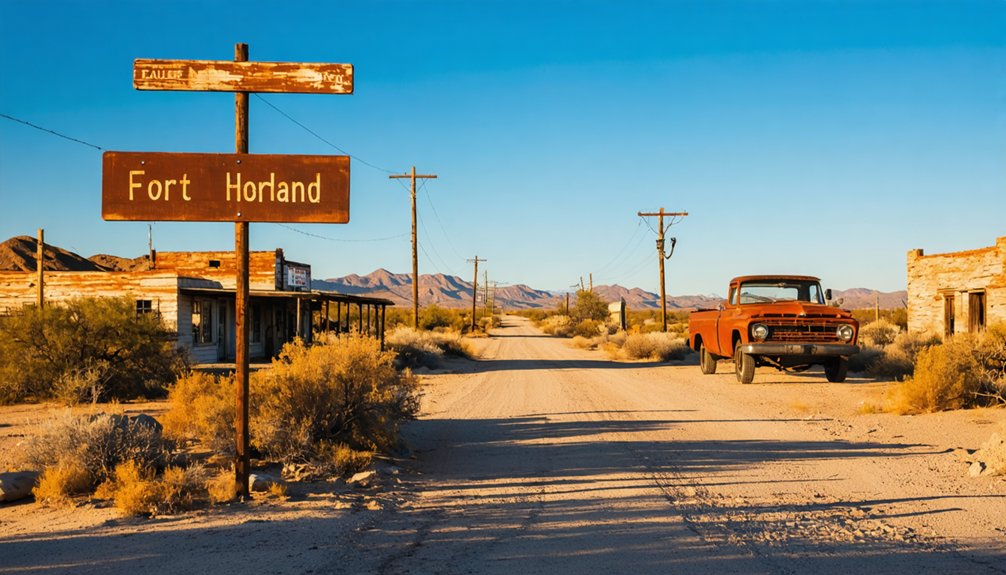
Planning your Fort Holland expedition means traversing West Texas’s temperamental climate, where timing separates an unforgettable adventure from a sweltering ordeal.
Prime visiting windows for ideal seasonal activities:
- Late Fall (October-November): Experience peaceful hiking through 60s-80s°F temperatures with minimal tourist crowds. October delivers perfect conditions for exploring abandoned structures before November’s post-hurricane serenity.
- Early Winter (December-mid-January): December’s 70°F days offer excellent Big Bend exploration and Marfa stargazing under clear skies. Mid-January provides ultimate RV solitude at remote sites.
- Late Winter (February): Catch wildflowers emerging across border country with fewer visitors than spring’s peak rushes.
- Avoid May-August: Temperatures averaging 90°F-113°F transform ghost town exploration into endurance challenges better suited for indoor attractions.
Pack layers—West Texas weather shifts unpredictably between warm sunshine and cold, blustery conditions.
Nearby Attractions and Services in Valentine
Tiny Valentine (population 217) punches above its weight as your strategic basecamp for exploring West Texas’s most surreal attractions. You’ll find the world-famous Prada Marfa installation just miles away at 14880 US-90—a permanent art piece that’s become pilgrimage-worthy for photographers chasing golden-hour light.
The Davis Mountain Scenic Loop delivers outstanding scenic viewpoints rated 4.6/5 by over a hundred road-trippers who’ve carved these remote desert highways.
For sustenance, local dining options include The Black Bear’s vegetarian-friendly American fare and The Sentinel Marfa’s Mexican cuisine. The legendary Valentine Texas Bar on Highway 90 opens select times yearly, serving cold beer since the 1950s. McDonald Observatory’s star programs and Big Bend Birding Tours round out your desert expedition with 5-star-rated experiences.
Respecting Private Property and Viewing Guidelines
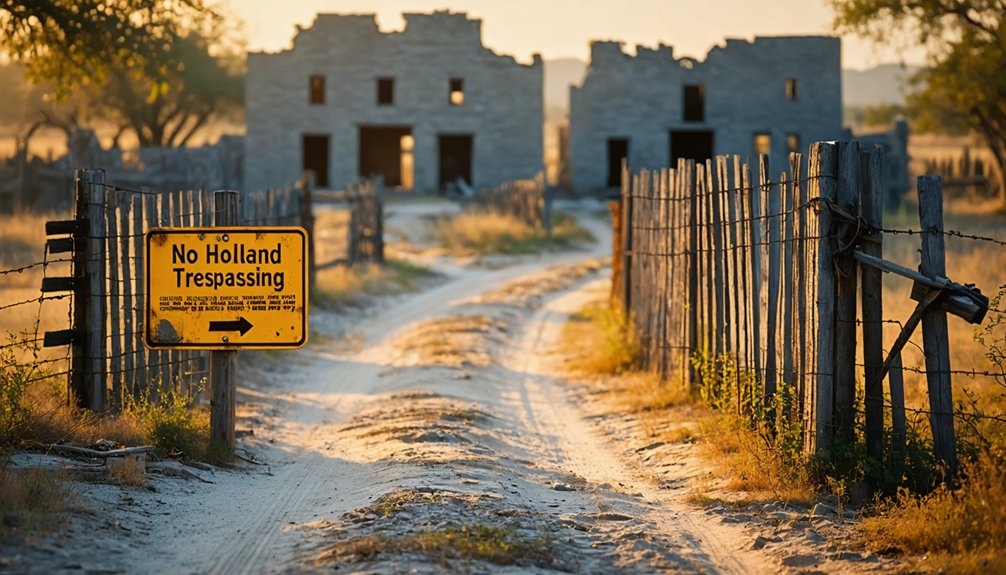
Before you venture toward Fort Holland’s weathered remains, understand that most Texas ghost towns occupy private land where unauthorized entry constitutes criminal trespass. Property ownership rules demand you verify access permissions before exploring, respecting landowner wishes as non-negotiable protocol.
Essential viewing guidelines:
- Research ownership status through county records before departing—many ghost town parcels remain privately held despite appearing abandoned
- Photograph from public roads using telephoto lenses rather than crossing fence lines or posted boundaries
- Contact landowners directly when possible, explaining your historical interest and requesting supervised access
- Leave immediately if confronted by property owners or law enforcement, apologizing for any misunderstanding
Texas trespassing convictions carry fines up to $500 and potential jail time. Your freedom to explore depends entirely on respecting these boundaries—responsible ghost town tourism preserves access for future adventurers.
Frequently Asked Questions
Are Guided Tours Available for Fort Holland Historical Site?
Guided tours aren’t offered at Fort Holland since no historical site exists there. You’ll find historical exhibits closed for renovation at nearby established forts like Fort Concho, where you can explore self-guided alternatives and authentic frontier stories instead.
What Photography Restrictions Exist at the Miller Ranch Property?
Miller Ranch lacks documented private property policies for photography, so you’ll need owner permission before capturing its photogenic scenery. Texas trespassing laws protect this freedom-loving landscape—respect boundaries, seek approval, and you’ll preserve access for future adventurers.
Can I Camp Overnight Near Fort Holland?
You can’t camp at privately-owned Fort Holland itself, but you’ll find nearby RV parks and pet friendly campsites in Valentine, Texas. Big Bend Ranch State Park offers primitive sites where you’ll experience true desert freedom under vast starry skies.
Are There Fees to View the Historical Marker?
You won’t pay admission fees to view Fort Holland’s historical marker—it’s free to explore. However, guided tours offered by local historians may have costs. You’ll find the marker accessible anytime, letting you discover this ghost town’s history independently.
What Cell Phone Coverage Exists in the Viejo Pass Area?
Coverage varies widely—you’ll find limited cell tower locations and weak cell signal strength across all carriers. Check Verizon, AT&T, and T-Mobile’s specific maps using your exact coordinates, and download offline maps before venturing into this remote territory.