You’ll find Fort McKavett State Historic Site at 7066 FM-864 in Menard County, approximately two hours from Junction via US-83 north and FM-864 south. This 82-acre preserve features 19 authenticated military structures from 1852-1883, including officers’ quarters, a restored hospital museum, and the rare intact morgue building. Admission costs just $5 for adults, with the visitor center open 8 a.m.–5 p.m. daily. The site’s important exhibits and original architecture reveal key details about frontier military operations and the Indian Wars period.
Key Takeaways
- Fort McKavett is located at 7066 FM-864 in Menard County, accessible via US-83 north and US-190 west from Junction.
- The 82-acre historic site features 19 preserved structures from 1852-1883, showcasing authentic frontier military life and architecture.
- Visitor amenities include parking, restrooms, picnic areas, a gift shop, and a museum with daily hours from 8 a.m.–5 p.m.
- Admission costs $5 for adults and $3 for seniors/veterans; wear comfortable shoes and bring sun protection for exploring.
- The site preserves the best-intact Texas Indian Wars post, including officers’ quarters, hospital museum, and rare military morgue.
How to Get There and What to Expect Upon Arrival
Reaching Fort McKavett requires a scenic journey through the Texas Hill Country, where your route depends on your starting point. From Junction, take US-83 north to Menard, then US-190 west for 17 miles, followed by FM-864 south for 6 miles to reach 7066 FM-864 in Menard County. You’ll traverse scrubby hills and the lush San Saba River valley during this two-hour drive.
Upon arrival at this remote windswept location, you’ll find the visitor center serving as your entry point with detailed exhibits and friendly staff. The site preserves 19 authentic structures, including restored officers’ quarters, barracks, and hospital buildings. On-site amenities include parking, restrooms, picnicking options, and an on site gift shop. Wear comfortable shoes and bring sun protection for exploring these historically significant ruins.
Exploring the Historic Buildings and Military Structures
You’ll encounter 19 surviving structures across this 82-acre site, each revealing the daily realities of frontier military life from 1852 through 1883.
The restored buildings include furnished officers’ quarters, the hospital-turned-museum, and the original morgue, while significant ruins mark where commanding officers once lived and where soldiers drilled along the parade grounds.
This collection represents the best-preserved Texas Indian Wars post from 1850-1875, offering direct access to authenticated military architecture that housed infantry, cavalry, and Buffalo Soldiers during the fort’s active years.
Officers’ Quarters and Headquarters
The officers’ quarters at Fort McKavett reveal a clear military hierarchy through their architecture and placement across the fort grounds. You’ll find shared officer living quarters in buildings #8–12, constructed in the 1850s as single rooms where junior officers often lived together. OQ #8 shows authentic furnishings from this era of communal military life.
The specialized officer accommodations demonstrate rank distinctions clearly. Field-grade officers occupied the 1871 U-shaped duplexes (OQ #2 and #3) near headquarters, while company commanders resided in four captains’ quarters built after the Civil War. The commanding officer’s quarters, a two-story structure from 1856, stood apart until fire destroyed it in 1941.
Post headquarters evolved from a one-room building into an expanded complex housing regimental offices, library, and telegraph operations.
Hospital Museum and Morgue
As Fort McKavett’s most visitor-accessible structure today, the restored hospital building serves dual duty as both museum and interpretive center for this remarkably preserved frontier military post. Built during the fort’s first operational year in 1852, this medical facility history reveals how 8th U.S. Infantry soldiers constructed it using local stone and timber without civilian professionals.
Your visitor experience includes:
- Museum exhibits featuring photographs, artifacts, and authentic stories of infantrymen, Buffalo Soldiers, and frontier families
- Daily access from 8 a.m.–5 p.m. with affordable admission ($5 adults, $3 seniors/veterans)
- Morgue exploration behind the hospital, where the preserved “Dead House” represents rare intact 19th-century military medical infrastructure
The Texas Historical Commission maintains these structures at 7066 FM 864, offering you direct connection to 1850-1875 Indian Wars frontier military operations.
Barracks Ruins and Cemetery
Walking through Fort McKavett’s barracks complex, you’re traversing what became the longest military building west of the Mississippi River after three separate 1850s structures merged in 1872. The consolidated quarters once housed 560 men alongside supporting facilities like the 1874 bakery and quartermaster shops.
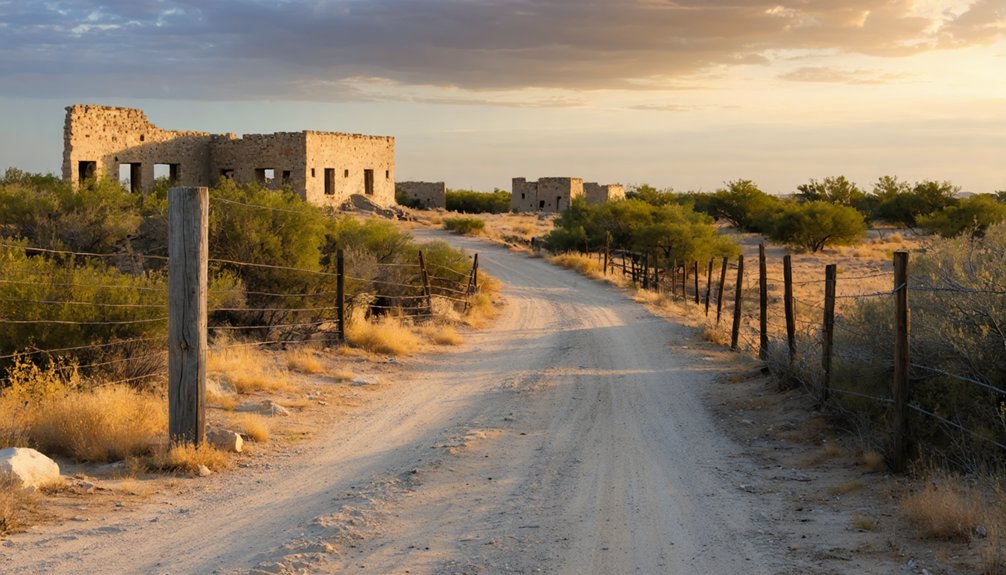
You’ll find substantial ruins throughout the grounds preservation area, including the commanding officer’s two-story quarters—destroyed by fire in 1941 yet still displaying intact basement spaces and fireplaces. Local stone and timber construction from the 1850s remains visible despite weathering and vandalism. Since Texas Parks and Wildlife acquired the site in 1968, building restoration efforts have stabilized these remnants.
The ruins offer unrestricted exploration opportunities, allowing you to examine architectural details spanning from the original 1852 hospital construction through the fort’s operational years.
Stories of Frontier Conflict: Indian Raids and Famous Battles
You’ll discover Fort McKavett’s most turbulent chapter began with the 1757 Mission Santa Cruz de San Sabá attack and continued through decades of frontier violence.
The devastating Great Raid of 1866 saw over 200 warriors drive 10,000 head of cattle up the San Saba Valley, prompting the fort’s 1868 reoccupation.
These conflicts culminated in the Red River War clashes of 1874-1875, when Colonel Ranald Mackenzie’s destruction of 1,400 Comanche ponies at Palo Duro Canyon effectively ended organized resistance on the Edwards Plateau.
Early Mission Attack 1757
In April 1757, Father Alonzo de Terreros and Don Diego Ortiz de Parilla arrived at the newly established Mission Santa Cruz de San Sabá on the south bank of the San Saba River, with the protective Presidio San Luís de las Amarillas positioned four miles upstream. The mission’s location revealed important strategic factors that proved fatal—it stood in contested territory between warring Apache and Comanche nations on the Edwards Plateau.
Eleven months later, a massive coalition attacked:
- Eight mission inhabitants perished, including martyred priests
- Attackers looted and burned the wooden structure completely
- Survivors fled to the presidio, which survived until 1772
The destruction had lasting regional impact. Comanche forces strengthened their territorial hold, making northward and westward travel treacherous. You’ll find the preserved site today in a county park featuring a rebuilt chapel and museum.
Great Raid of 1866
Following the Civil War’s end, federal military presence along the Texas frontier had diminished to dangerous levels, creating opportunities for large-scale raids that devastated isolated settlements.
In August 1866, over 200 warriors swept through San Saba Valley, herding 10,000 cattle and countless horses toward abandoned Fort McKavett. You’ll find graves marking this tragedy’s human cost—William McDougall fell defending his family on August 6, while his wife Clara survived a lance attack.
From summer 1865 through 1867, raiders killed 163 settlers and destroyed livelihoods across the region. The local economy impacts proved catastrophic as ranchers lost their herds. These long term effects finally prompted the U.S. Army’s return in December 1866, establishing permanent frontier patrols by 1868.
Red River War Clashes
The Army’s return to Fort McKavett in 1866 provided temporary security, yet tensions across the Southern Plains would explode into broader conflict eight years later. The Red River War of 1874-75 brought decisive battles that permanently altered the frontier landscape you’ll explore today.
Three engagements proved critical in breaking tribal resistance:
- Battle of Adobe Walls (June 27, 1874) – 28 buffalo hunters repelled 300 warriors, prompting Army intervention
- Battle of Palo Duro Canyon (September 28, 1874) – Col. Mackenzie’s dawn raid destroyed 450 lodges and captured 1,400 horses
- Upper Washita River actions – Converging columns forced final surrenders through winter 1874-75
The material losses at Palo Duro Canyon proved devastating—destroyed winter provisions and slaughtered horse herds left tribes no choice but reservation life by June 1875.
The Transformation From Military Post to Civilian Settlement
After serving as the linchpin of frontier defense for decades, Fort McKavett‘s military significance waned dramatically following the 1874 Adobe Walls battle and the 1878 defeat of the Lipan Apache. You’ll discover that by 1880, Indian threats on the Edwards Plateau had virtually disappeared, eliminating the fort’s military mission. The Army ordered its abandonment in 1882, though it continued functioning as a quartermaster hub along the San Antonio road until troops fully withdrew in 1883.
The fort’s civilian development began immediately after military departure. Today’s Texas Historical Commission operates the site, where you can explore restored structures showcasing post military infrastructure upgrades from Mackenzie’s era—officers’ quarters, barracks, hospital, and schoolhouse that transformed this once-strategic outpost into a preserved memorial to frontier adaptability.
Cemetery Tales and Notable Graves Worth Visiting
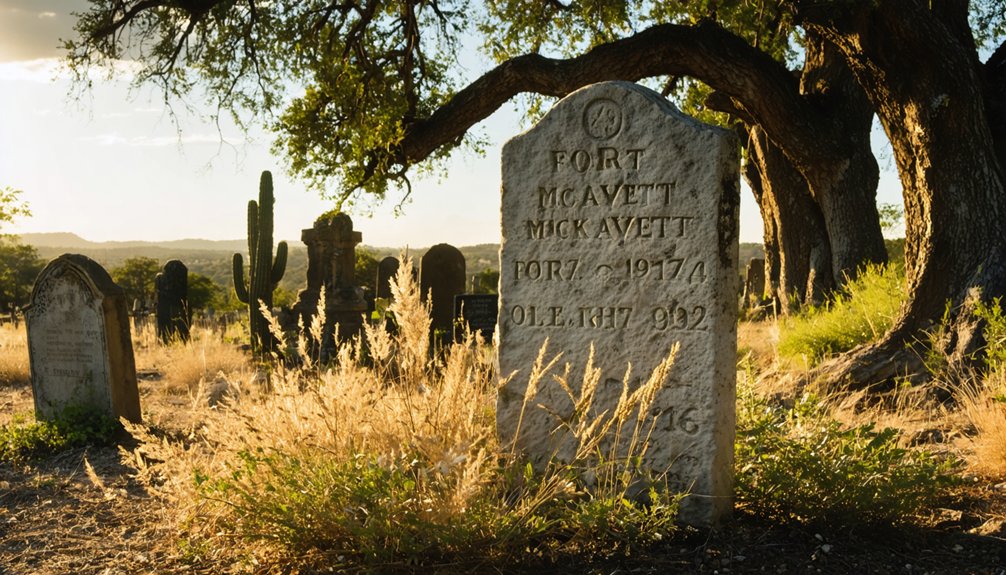
Beyond Fort McKavett’s military structures and garrison buildings, you’ll find stories of frontier sacrifice etched in weathered headstones at the post cemetery. Victorian era memorials document both military valor and civilian hardship across this dangerous Edwards Plateau region.
You’ll discover frontier notables’ graves including:
- Sgt. Emanuel Stance (9th Cavalry) – First African American soldier awarded the Medal of Honor after the Civil War
- Scabtown shootout victims – Four men killed December 31, 1877, marking one violent frontier incident
- Comanche raid casualties – Settlers like William McDougall, killed defending his farm
Army laundresses who earned $19 monthly—more than soldiers’ $13 pay—rest here alongside thirty-seven unidentified remains. The cemetery spans Schleicher and Menard counties at Fort McKavett State Historic Site, preserving authenticated accounts of frontier life.
Best Times to Visit and Nearby Attractions Along Your Route
Planning your Fort McKavett visit around seasonal conditions and regional attractions transforms a single-site stop into an exhaustive Edwards Plateau historical expedition. Spring’s wildflower bloom considerations make March through May ideal, with mild temperatures enhancing limestone structure exploration during 8 a.m. to 5 p.m. operating hours.
Reduced fall crowds from September to November provide uninterrupted examination of officers’ quarters and barracks ruins. You’ll need cash for $4 adult admission, substantial water supplies, and sturdy footwear for traversing the windswept hilltop terrain. Avoid summer’s 100-degree August heat and winter holiday closures affecting Thanksgiving through New Year’s Day.
Expand your historical research by including Fort Concho in your Central Texas route, creating thorough documentation of frontier military architecture across this geologically significant region.
Frequently Asked Questions
Are There Any Guided Tours Available at Fort Mckavett State Historic Site?
While you’ll primarily explore independently, guided tours are offered for groups and schools with advance reservations. You’ll discover authentic frontier history through the visitor interpretive center, self-guided trails, and docent-staffed museum—experiencing Fort McKavett on your own terms.
Can Visitors Enter and Explore Inside the Preserved Fort Buildings?
Yes, you’ll explore furnished interiors in the hospital, Captains Quarters, and Officers Quarters independently. Guided tours aren’t offered, but preservation efforts ongoing guarantee authentic 1850s-1880s experiences. You’re free to photograph ruins and walk accessible buildings at your own pace.
Is There an Admission Fee to Visit Fort Mckavett?
Yes, you’ll pay admission fees at Fort McKavett. Adults cost $4, seniors $3, and youth $3. Parking facilities are accessible near the museum. Children under five explore free, preserving historical accessibility for visitors seeking authentic frontier experiences.
Are Overnight Camping or Lodging Facilities Available at the Historic Site?
No onsite lodging options exist at Fort McKavett Historic Site—preservation trumps overnight stays. However, you’ll discover nearby hotel accommodations and camping facilities like Camp Sol Mayer just three miles away, ensuring your freedom to explore history comfortably.
What Photography Restrictions Exist for the Buildings and Cemetery?
You’ll find no cemetery restrictions or building photography limits at Fort McKavett. The site welcomes documentation during operating hours, supporting preservation through visual records. You’re free to photograph ruins, structures, and grounds while respecting the historic character.