Take I-40 Exit 53 to OK-44, then drive 2 miles south to discover Foss’s haunting Route 66 ruins. You’ll find Kobel’s Place Service Station crumbling at the historic highway junction, the 1894 Baptist Church’s red-rock exterior standing resilient, and a steel-barred pioneer jail from 1918. Spring through fall offers the best weather for photographing these authentic remnants of a town that once boasted 1,000 residents before floods, fires, and highway realignments sealed its fate as Oklahoma’s most accessible prairie ghost town.
Key Takeaways
- Access Foss via I-40 Exit 53 to OK-44, then drive 2 miles south to the historic Route 66 alignment.
- Visit spring through fall for optimal weather, with fall offering 60-75°F temperatures and ideal exploration conditions.
- Photograph Kobel’s Place ruins, the 1894 Baptist Church, steel-barred pioneer jail, and century-old cemetery headstones.
- Extend your trip to Clinton’s Route 66 Museum (25 miles east) or Texola ghost town (30 miles west).
- Budget $1.39 for gas from nearby Clinton, Oklahoma to reach this abandoned prairie settlement.
The Rise and Fall of a Route 66 Town
When the Cheyenne and Arapaho Opening of 1892 liberated western Oklahoma to non-Indian settlement, pioneers quickly scattered across the grasslands seeking their fortunes. You’ll discover Foss emerged from these dreams, first as Maharg in 1898, then reborn on higher ground after devastating floods destroyed Turkey Creek Valley in 1902.
The town exploded into prosperity by 1905, reaching nearly 1,000 residents. Economic boom bust cycles defined its trajectory—four cotton gins, flour mills, and banks served farmers across fifty miles. The Choctaw, Oklahoma and Gulf Railway laid tracks through town in 1902, transforming it into a major trade center. Route 66’s 1926 arrival promised continued growth, but the 1931 realignment bypassed Foss entirely. The town’s population had peaked at 525 in 1910 before beginning its gradual decline. Agricultural decline and mechanization, combined with the Dust Bowl’s fury, crushed the community’s spirit. By 1960, only 289 souls remained in this once-thriving frontier hub.
What Remains: Exploring Foss’s Historic Landmarks
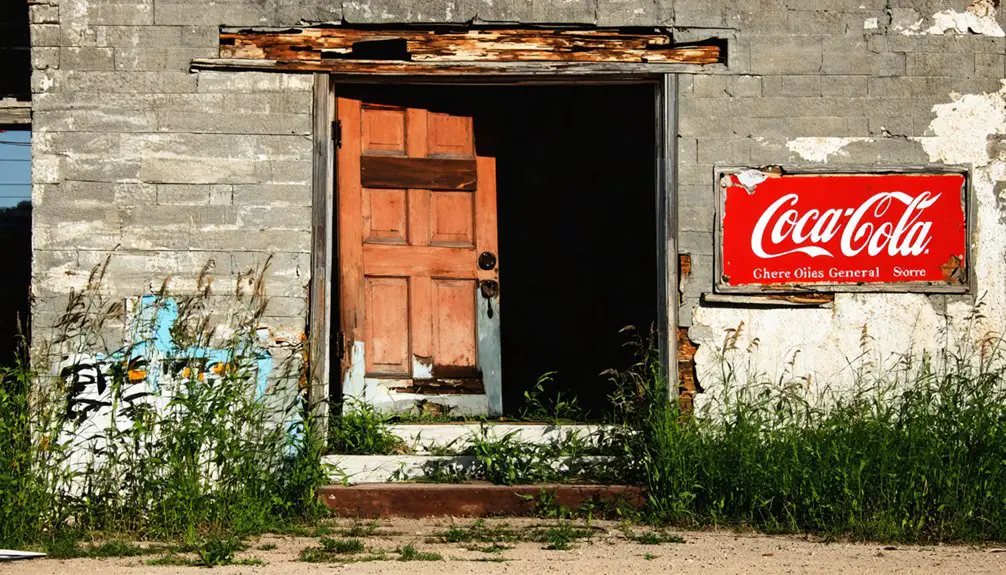
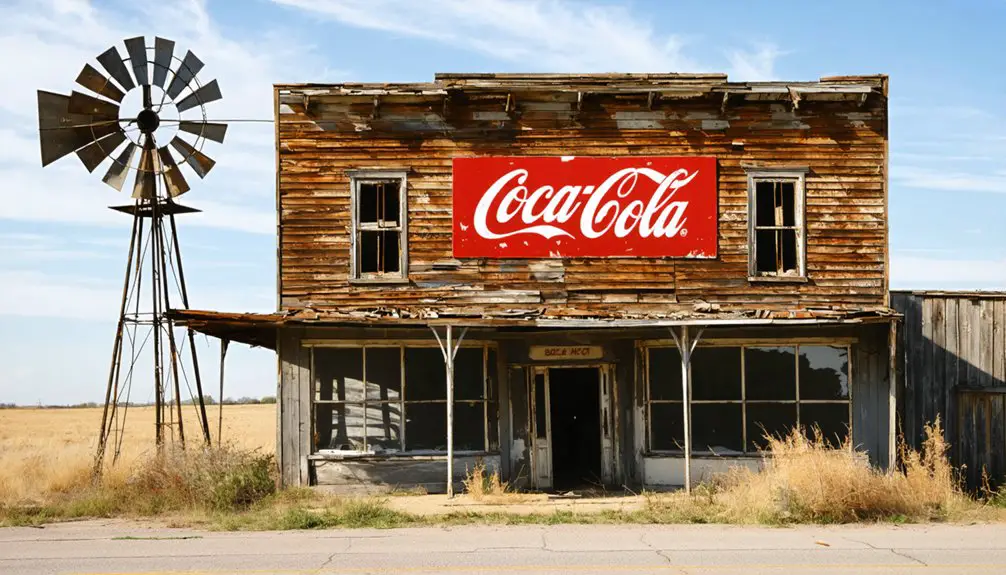
Among the overgrown sidewalks and crumbling foundations, a handful of stubborn landmarks refuse to surrender to time. You’ll find Kobel’s Place Service Station standing in ruins near the highway junction, its weathered sign still visible through the trees that now claim this corner of vanished Route 66.
The 1894 Baptist Church—now a private residence—and the steel-barred 1918 jail tell competing stories of salvation and confinement in this prairie ghost town, while the hidden cemetery keeps its silent vigil over Foss’s forgotten souls. Back when Foss had an opera house in 1912, the town boasted two hotels and even its own electric plant, signaling prosperity that would prove fleeting. The original settlement met its end when a flash flood in 1902 swept through Turkey Creek valley, forcing survivors to rebuild on higher ground where these resilient structures now stand.
Kobel’s Place Service Station
Half a mile south of Foss, where the ghost of Route 66 meets Broadway, the crumbling shell of Kobel’s Place stands as a haunting monument to the Mother Road’s glory days. Ralph Kobel built this multi-purpose hub during the 1930s-40s, perfecting the original business model that defined roadside America. His service station amenities included fuel pumps, garage bays, a café, and even a bus stop—everything travelers needed in one strategic location.
The 1946 Rittenhouse Guide documented this bustling junction point, where westbound adventurers could refuel, grab a hot meal, and make repairs before continuing their journey. The “East Meets West” ceremony held in 1933 when US Highway 66 paving was completed marked the beginning of seamless cross-country travel that would make establishments like Kobel’s essential stops. Early automobiles were prone to mechanical problems, making Kobel’s garage services indispensable for travelers navigating the long stretches of Route 66. Today, you’ll find the building’s skeletal remains rotting among trees, its ghost sign barely visible through collapsed sections. The station’s abandonment began when I-40 bypassed Foss in the early 1970s, stranding this once-thriving establishment.
1894 Baptist Church Building
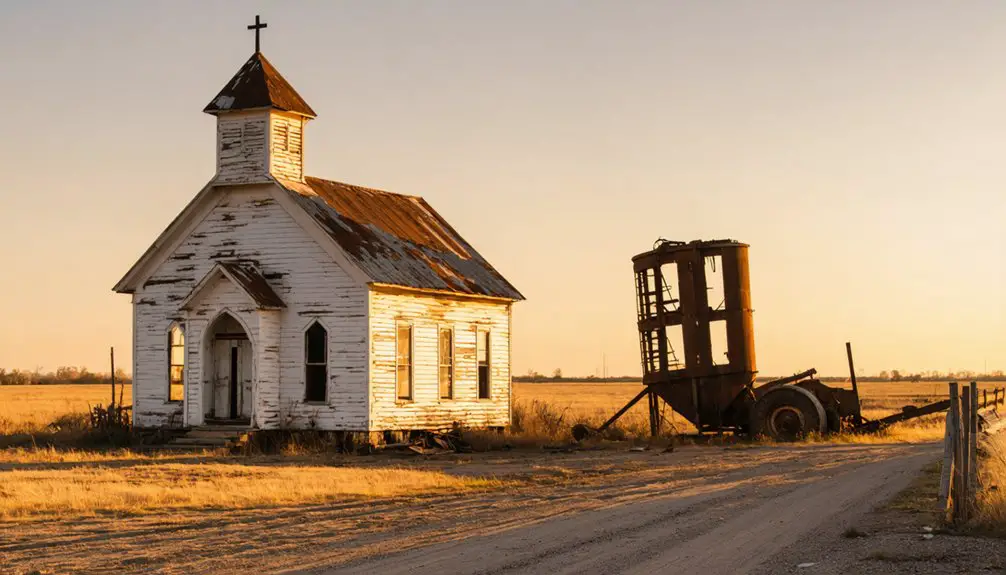
Beyond the scattered ruins of commercial enterprises, Foss’s oldest surviving structure tells a different story about frontier ambition. The Baptist Church, standing since 1894, predates the town’s official establishment as a railroad station. Its red-rock exterior showcases the architectural design conventions of Oklahoma’s territorial period, when settlers shifted from temporary frame buildings to permanent stone construction.
You’ll find this evidence of religious significance alongside an unmarked white church, both surviving where dozens of businesses once thrived. The building’s largely unaltered condition offers you authentic insight into late 19th-century ecclesiastical craftsmanship. During Foss’s peak—nearly 1,000 residents by 1905—this church served as both spiritual center and community gathering place, embodying the determination that transformed wilderness into civilization. The town supported three cotton gins and two banks during its prosperous years, reflecting the agricultural economy that sustained the growing community.
Pioneer Jail and Cemetery
While most frontier towns lost their calabooses to fire and demolition, Foss’s pioneer jail stands resolute at the corner of Broadway and 2nd Street, a steel-and-stone memorial to territorial justice. This survivor of early Oklahoma incarceration reveals pioneer jail history through remarkable details:
- Manufactured durability – Built by St. Louis’s Pauly Jail Building Co. (operating since 1856), featuring four folding steel bunks
- Unusual spaciousness – Tall enough for standing, defying cramped calaboose stereotypes from the 1904-1940 era
- Strategic positioning – Located on original Route 66 alongside the 1894 Baptist Church ruins
You’ll find it remarkably accessible in Foss Park, where vacant sidewalks and crumbling foundations frame this enduring testament to frontier law enforcement—one of western Oklahoma’s rarest intact calabooses from territorial days. The jail sits along the legendary 2,400-mile Route 66, which stretched from Chicago to Santa Monica and drew travelers westward beginning in 2009 as a historic destination.
From Clinton, you’ll travel thirteen miles west on Interstate 40 to Exit 53, where the modern highway intersects with Oklahoma’s ghost town past. Historic Route 66 runs parallel to I-40 here, passing half a mile south of Foss’s center—look for the crumbling stone ruins of Kobel’s Place Service Station marking the junction with State Highway 44.
Follow Adams Street and Broadway north from this crossroads, tracing the original alignment that once funneled wartime travelers through a town now frozen in time. The nearby Foss Reservoir offers a scenic landmark just beyond the ghost town’s boundaries.
From Clinton via Route 66
Heading west from Clinton, you’ll find Foss just 15 miles down Route 66, a quick 17-minute drive through the rolling Oklahoma prairie. Clinton positions itself as your perfect starting point, home to the Oklahoma Route 66 Museum and a population embracing historic preservation efforts. The I-40 business loop follows the original U.S. 66 path through town before you venture westward.
Your route couldn’t be simpler:
- Follow Route 66 west from Clinton’s museum district
- Continue past where I-40 parallels the Mother Road to your south
- Take Exit 53 to State Highway 44, where Route 66 meets Foss
You’ll spot remnants of community redevelopment initiatives as you approach—a ruined gas station marks the crossroads, standing sentinel over Foss Cemetery and this weathered ghost town. Budget around $1.39 for gas to make this short journey, based on current fuel prices and the distance between the two towns.
Unlike most Route 66 towns that watched the Mother Road evolve beside them, Foss experienced a surgical severance in 1931 when highway engineers carved a straight east-west alignment across the prairie, relegating the original north-south path through town to obsolescence. You’ll find Kobel’s Place ruins marking this historic route alterations junction south of town—Oklahoma’s first complete bypass.
The 1926 alignment ran north-south through Adam or Broadway streets, but that configuration proved inefficient for cross-country travelers. Today’s navigation requires awareness: the southern bypass became Route 66’s official corridor while the original downtown passage faded.
Town bypass impacts here created a dual-layer history—paved abandonment south, forgotten commerce north. Study 1924 maps showing the pre-66 road configuration, then follow the 1931 realignment where concrete crumbled into grassland.
Best Sites to Photograph and Document
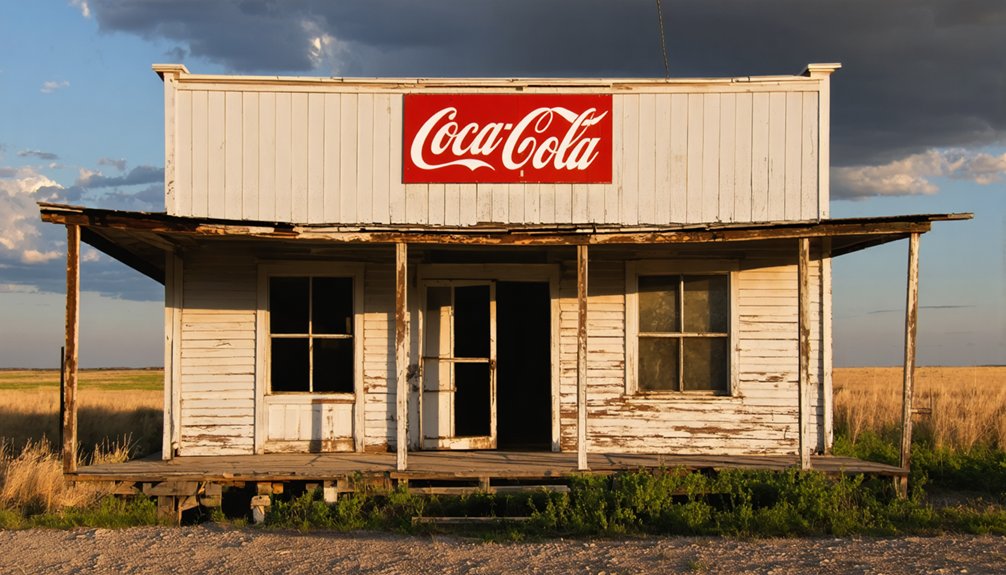
Where should you point your camera first in this crumbling Route 66 outpost? Start at Kobel’s Place, where cracking walls and peeling paint showcase authentic decay. The readable signage facing old Route 66 captures the architectural styles of mid-century roadside commerce before Interstate 40’s bypass sealed its fate.
Kobel’s Place stands as Foss’s most photogenic ruin—crumbling walls and faded signage frozen in mid-century decay.
Frame these essential shots documenting Foss’s historical significance:
- The steel cage jail north of the railroad—a one-room lockup revealing early 20th-century law enforcement
- Pink granite city monument plaques at the Highway 44 junction, chronicling Foss’s decline from 1,000 residents to ghost town status
- Cemetery headstones dating to 1902, preserving settler stories south of the crossroads
Hidden ruins emerge among overgrown trees at the southwest junction corner, offering photographers raw glimpses into Oklahoma’s vanishing Route 66 legacy.
Understanding the Forces Behind Abandonment
When you stand among Foss’s ruins today, you’re witnessing the compound effect of catastrophes that slowly strangled this once-thriving settlement. Natural disasters struck first—that devastating 1902 flash flood drowned nine people and forced survivors to abandon their original townsite.
Then fires ravaged the rebuilt community in 1908, 1909, and catastrophically in 1939, consuming entire blocks.
But economic forces proved equally destructive. The 1929 stock market crash triggered population decline from its 1,600 peak. The Dust Bowl drove farmers away from once-fertile land. World War II pulled remaining residents toward opportunity elsewhere.
When Interstate I-40 bypassed the town, businesses withered. The school closed in 1957, the last bank shuttered in 1977, and the final symbolic blow came when the Temple Building burned in 1982.
Planning Your Visit: Timing and Nearby Stops

Your Foss adventure requires careful timing to maximize both comfort and discovery. Seasonal variations dramatically shape your experience—spring through fall offers mild weather and clear visibility of crumbling landmarks, while winter’s icy roads on historic alignments demand caution.
Plan for 60-75°F days in fall when vacant sidewalks become easiest to explore.
Transportation routes converge conveniently:
- Primary Access: I-40 Exit 53 to OK-44, then 2 miles south to Route 66’s historic alignment
- Western Extension: Texola ghost town (30 miles) and Hext ruins (20 miles) add depth to your journey
- Eastern Circuit: Clinton’s Route 66 Museum (25 miles) and Canute’s Tumbleweed Grill (10 miles) provide context and sustenance
Peak traffic during June and November anniversaries offers festival energy but crowds the solitude you’re seeking.
Frequently Asked Questions
Are There Any Restaurants or Gas Stations Currently Operating in Foss?
You’ll find just one restaurant operating in Foss—Smoks BBQ serves local food options Tuesday through Saturday with current business hours until 8pm. No gas stations operate here, so fuel up before your ghost town adventure begins.
Is It Legal to Enter the Abandoned Buildings and Ruins?
No, entering abandoned buildings isn’t legal without permission. You’ll face trespassing charges and liability concerns if injured. Take safety precautions by viewing from public areas instead. Respect private property while exploring Oklahoma’s ghost town heritage responsibly.
What Cell Phone Coverage Can I Expect in Foss?
You’ll find excellent cell phone signal strength in this isolated ghost town—all major carriers provide 100% coverage. Verizon ranks highest, though AT&T and T-Mobile offer strong connectivity options too, with 4G LTE and expanding 5G networks available.
Are There Any Guided Tours or Visitor Information Available in Town?
No guided photography tours or visitor center hours exist in Foss—you’ll explore independently. The ghost town’s crumbling landmarks await your discovery without formal services, offering pure freedom to wander among historic ruins at your own pace.
Where Is the Nearest Place to Stay Overnight Near Foss?
You’ll find available lodging options in Clinton and Elk City, both offering nearby accommodation alternatives within easy driving distance. Sleep Inn & Suites in Elk City sits closest to Foss State Park, while Butler features charming vacation rentals near the reservoir.
References
- https://dharmaanchor.com/2014/09/25/ghost-towns-foss-ok/
- https://www.theroute-66.com/foss.html
- https://www.reddirtchronicles.com/2011/08/red-dirt-rambler-a-melancholy-journey-through-foss-ok/
- https://en.wikipedia.org/wiki/Foss
- https://www.legendsofamerica.com/ok-foss/
- https://oklahomaroute66.com/highlights
- https://freepages.rootsweb.com/~gtusa/history/usa/ok/foss.htm
- https://okgenweb.net/~okwashit/history/foss.htm
- https://www.okhistory.org/publications/enc/entry?entry=FO051
- https://www.youtube.com/watch?v=ccibWxsIQfk