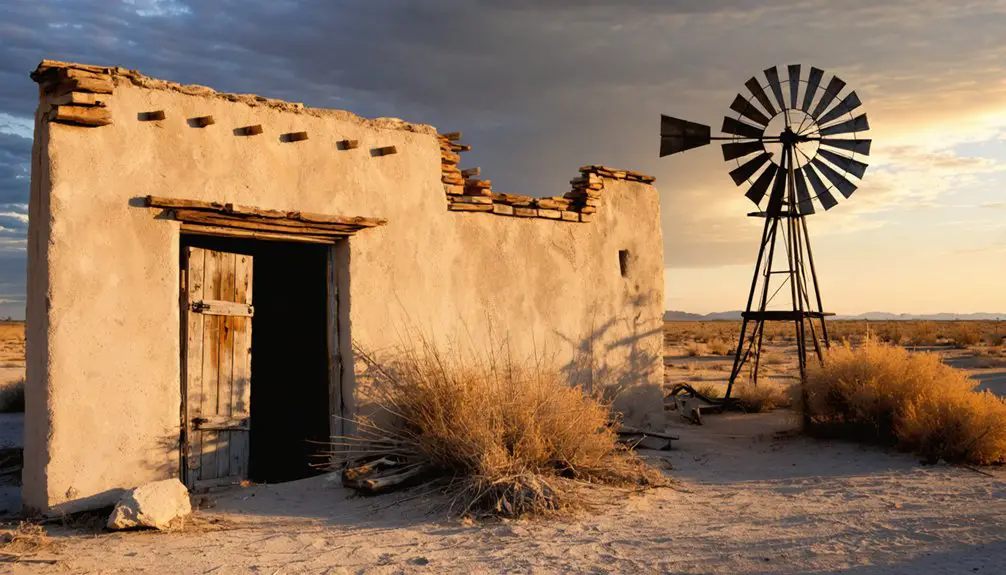
You’ll reach Fry by taking FM 585 through 22.9 miles of rolling Brown County terrain from Bangs, following the road to where cattle now graze over the vanished 1926 oil boomtown. The weathered Mud Creek Cemetery stands as your landmark, holding pioneer graves and victims from the boom-and-bust era beneath unmarked stones. Nothing remains of the 200-resident town except foundation depressions and rusted equipment fragments scattered across silent pastures—though nearby ghost towns like Terlingua and Glenrio offer additional stops that’ll complete your Central Texas expedition.
Key Takeaways
- From Bangs, take US 67/US 84 south to FM 585, which winds 22.9 miles through Brown County to Fry’s location.
- Visit Mud Creek Cemetery’s historical marker to learn about pioneers, oil boom victims, and authentic Texas frontier history.
- Explore the silent pastures where Fry’s 200-resident boomtown stood, finding foundation remnants and rusted oilfield equipment fragments.
- The 1926-1927 oil boom transformed peaceful cow pastures before the field collapsed by 1934, leaving no standing structures.
- Extend your trip to nearby ghost towns like Terlingua, Lobo, Glenrio, or Indianola for varied historical experiences.
The Rise and Fall of Fry’s Oil Boom Era
The quiet pastures along Jim Ned Creek in Brown County had no hint of the chaos coming when Jim Quinn, Bert Ehorn, and William R. Lester leased drilling rights from the Fry brothers in early 1926. By June, C.W. Hoffman and K.F. Page fired up their National Drilling Machine, initiating what locals called the “great but short-lived Fry Oil Boom.”
You’ll find it hard to imagine 3,000 workers transforming peaceful cow pastures into a 24-hour petroleum operation. Drilling technology advancements made this rapid expansion possible, though the environmental impact of oil boom turned pristine creek-side land into an industrial maze of pipelines and refineries.
What Remains at Mud Creek Cemetery Today
When you turn off FM 585 and pass through the cattle guard into rural Brown County pastureland, you’ll discover a weathered aluminum historical marker standing sentinel over Mud Creek Cemetery‘s 94 recorded graves. The 1983 marker tells stories of pioneer Charles Mullins, who arrived in 1858, and infant Martha Blackwell’s 1864 burial.
You’ll wander among unmarked headstones and weathered rock slabs, including one mysterious marker from 1862 with an illegible name. Natural scenery surrounds the burial ground—native grasses swaying between the Cross and Mullins family plots, victims of Indian attacks, and graves from the 1926-27 oil boom. This cemetery embodies authentic Texas frontier history, where the land remembers what official records can’t capture.
Getting to Fry via FM 585 in Brown County

From the eastern edge of Coleman County, FM 585 unfurls across 22.9 miles of rolling Brown County terrain, connecting the ghost town of Fry to the living world beyond. You’ll find driving directions from Bangs straightforward—head west on US 67/US 84 for 1.7 miles to where FM 585 begins its journey toward Echo.
The route cuts through authentic ranch country, where agricultural activities along route paint scenes of working cattle operations and hay meadows stretching toward distant ridgelines. Mature hardwoods shade abandoned homesteads, and seasonal creeks trace paths your windshield follows.
This farm-to-market road hasn’t changed much since appearing on 1961 highway maps—still two lanes of asphalt threading through country that remembers when Fry thrived, before progress chose different paths.
Exploring the Silent Fields Where the Town Once Stood
Where FM 585 crosses into Brown County near the Coleman line, cow pastures reclaimed what 3,000 workers once transformed into a churning oilfield during round-the-clock shifts.
You’ll walk silent fields where Fry’s 200 residents built stores and homes in 1927, though no structures remain standing. The land holds forgotten relics of the boomtown—subtle depressions marking former foundations, weathered fence posts defining lots that housed itinerant drillers.
Scan the horizon for remnants of the oilfield infrastructure: rusted equipment fragments, concrete well pads slowly sinking into Texas soil. This emptiness tells Fry’s complete story—from the 1926 geyser that ignited the National rig to unrestrained drilling that killed the field by 1934. By 1964, everyone left. Now you’re alone with ghosts and grass.
Nearby Ghost Towns Worth Adding to Your Route
Beyond Fry’s silent grasslands, Central Texas positions you within striking distance of ghost towns that tell different chapters of frontier collapse—each abandoned for distinct reasons that shaped their ruins.
Central Texas ghost towns preserve distinct stories of collapse—mining busts, railroad abandonment, natural disasters—each ruin shaped by its own frontier tragedy.
Visiting Terlingua’s historic mining district reveals adobe walls crumbling beneath Brewster County’s relentless sun, where 2,000 miners once extracted cinnabar before the boom died.
Drive northwest for discovering Lobo’s restored ghost town, where three owners transformed complete abandonment into a living preservation project—you’ll need advance permission through their website.
Head toward the New Mexico border and you’ll find Glenrio’s neon-signed motels frozen in Route 66’s glory days.
Southeast lies Indianola’s coastal ruins, where German immigrants’ gravestones face Gulf winds that twice destroyed their port city.
Frequently Asked Questions
Are There Any Facilities or Restrooms Available Near the Fry Ghost Town Site?
You won’t find Wi-Fi or available facilities at Fry’s desolate ruins. This abandoned Texas outpost offers zero restroom accommodations—pure frontier isolation. Plan ahead, stop in Brownwood beforehand, and embrace the untamed wilderness where modern conveniences don’t exist.
What Is the Best Time of Year to Visit Fry, Texas?
You’ll find fall’s mild seasonal weather patterns perfect for exploring Fry’s abandoned structures without summer’s scorching heat. Spring brings wildflowers framing rustic buildings, while nearby Fredericksburg’s local festival events add cultural depth to your ghost town adventure.
Is the Mud Creek Cemetery Open to Public Visitors Year-Round?
You’ll find these hallowed grounds welcoming you year-round through open gates. Grave preservation efforts maintain this sacred space, though restricted access times don’t apply here—you’re free to explore and connect with history whenever wanderlust calls.
Are There Any Guided Tours Available for Ghost Towns in Brown County?
No guided tours exist for Brown County’s ghost towns, but you’ll find freedom exploring self-guided tours at your own pace. Local history enthusiasts often share insights, letting you discover Fry’s abandoned stories independently and authentically.
What Wildlife or Safety Concerns Should Visitors Be Aware of When Exploring?
Watch for venomous snakes like rattlesnakes in the brush and dangerous terrain with rusted pipes and crumbling foundations. You’ll encounter fire ants, scorpions, and ticks in overgrown areas. Keep your distance from bison if you’re exploring nearby parks.