Gilmore isn’t in Alaska — it’s a forgotten silver and gold mining ghost town tucked into Idaho’s Lemhi County, and it’s one of the most raw, unrestored abandoned sites you can walk through in the American West. You’ll drive south from Salmon on Highway 93, covering about 30 miles through stunning Idaho scenery. No guided tours, no museum ropes — just crumbling history at your own pace. Stick around to uncover everything this remarkable ghost town has to offer.
Key Takeaways
- Gilmore is located in Idaho, not Alaska; travel south on Highway 93 from Salmon, covering approximately 30 miles in one hour.
- Fuel up and gather supplies before departing, as no gas stations or services exist along the route.
- Gilmore offers a self-guided experience, letting visitors freely explore crumbling mining-era structures, including a surprisingly intact hotel.
- The town reflects a classic boom-and-bust arc, shaped by silver and gold mining, railroad arrival, and post-1929 economic collapse.
- Unlike nearby ghost towns, Gilmore focuses purely on industrial mining history, offering an authentic, unfiltered glimpse into frontier life.
What Makes Gilmore Worth Visiting as an Idaho Ghost Town?
Why trek out to a remote corner of Idaho to see a handful of crumbling buildings? Because Gilmore delivers something rare — an unfiltered window into the American West’s boom-and-bust spirit.
You’re not walking through a sanitized museum; you’re standing where miners hauled silver and gold before rail lines even reached the valley. That raw mining history hits differently when you can touch it.
The ghost town allure here isn’t manufactured. Gilmore rose fast, fueled by precious metals, then collapsed when the 1929 depression shuttered the mines for good.
What remains — including a surprisingly intact hotel — tells that story without a single tour guide. You move at your own pace, photograph what you want, and leave whenever you’re ready.
That kind of freedom is exactly what makes Gilmore worth the drive.
How To Get to Gilmore From Salmon, Idaho
Getting to Gilmore from Salmon is straightforward — just head south on Highway 93, passing through the small settlements of Tendoy, Lemhi, and Leadore as the valley opens up around you.
The scenic routes along this corridor reward you with sweeping Idaho landscapes that hint at the region’s historical significance long before you arrive.
The open road through Lemhi Valley speaks quietly of history before any ruins come into view.
The drive takes roughly an hour, covering about 30 miles of rural road that’s accessible by 2WD vehicles under normal conditions.
Winter travel can get tricky, so plan accordingly. You won’t find gas stations or services along the way, so fuel up and pack supplies in Salmon before you leave.
Once you reach Gilmore, you’re free to explore independently — no guided tours, no entry fees, just open history waiting for you.
How Silver and Gold Built: Then Abandoned: Gilmore
Gilmore’s story follows a familiar frontier arc — boom, struggle, and silence — but the details make it worth understanding. Silver and gold drew ambitious men into Lemhi County’s rugged terrain, and early mining methods relied entirely on manual labor and mule-drawn freight to haul ore out.
Local milling attempts failed, so workers shipped material to smelters in Nicholia instead.
When the railroad arrived in 1910, it transformed the economic impact overnight. Ore moved faster, profits climbed, and Gilmore briefly thrived as a legitimate mining hub in a region dominated by Mormon settlements.
Then 1929 hit. Mine closures followed the depression, the railroad pulled its tracks, and the town emptied permanently. What silver and gold built, economic collapse quietly dismantled — leaving only scattered structures and open sky behind.
What’s Left To See Inside Gilmore Today?
What the collapse left behind is sparse, but it’s worth seeing with your own eyes. Gilmore’s ghostly remnants tell a quiet, powerful story of boom and bust.
You’ll find historic structures scattered across the landscape, slowly surrendering to decades of wind and weather.
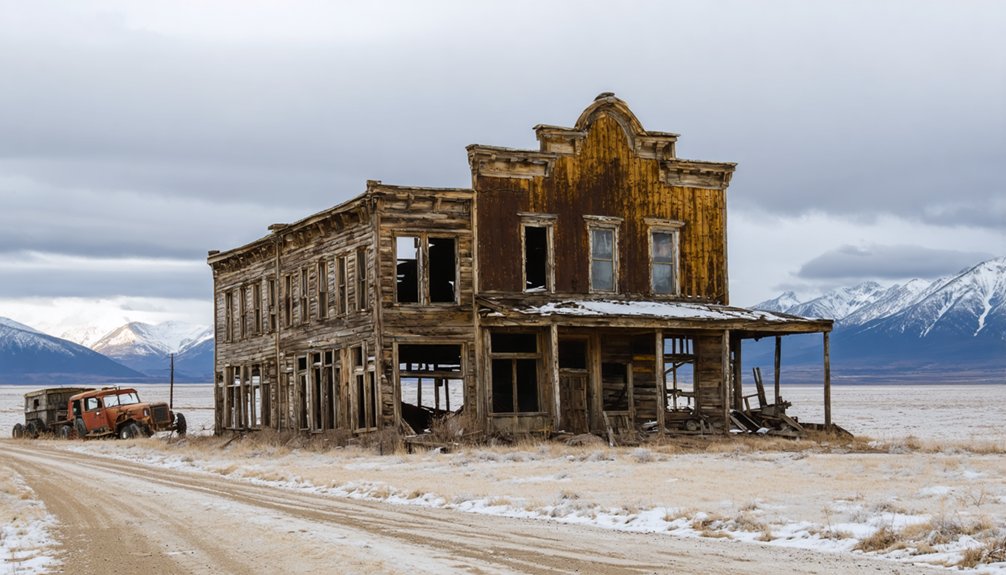
The most striking survivor is the hotel building, still standing in surprisingly good condition despite no guests since the 1930s.
The hotel still stands — silent, weathered, waiting for guests who stopped coming nearly a century ago.
Walk through and you’ll feel the weight of history pressing against every weathered wall.
Beyond the hotel, only fragments remain. Time and decay have claimed most of what once made Gilmore thrive.
But that rawness is exactly what makes the visit worthwhile. You’re not walking through a museum — you’re standing inside an unfiltered, honest piece of Idaho’s mining past.
How Gilmore Compares to Other Lemhi County Ghost Towns
Lemhi County holds more ghost towns than most people realize, and Gilmore stands out among them for a specific reason — it was never a Mormon settlement.
While nearby towns like Tendoy and Lemhi reflect colonizer roots, Gilmore history is purely industrial, built around silver and gold extraction.
That distinction shapes everything you’ll notice when comparing sites. Other ghost towns in the county show remnants of community infrastructure — churches, homesteads, civic buildings.
Gilmore gives you raw mining heritage instead. You’ll see echoes of the mining techniques that defined the town: mule-drawn ore transport, external smelting dependency, and eventually rail efficiency after 1910.
If you’re exploring multiple ghost towns on this road trip, Gilmore delivers a sharper, more industrial story than its neighbors — and that contrast makes the drive worth it.
Nearby Ghost Towns To Pair With Your Gilmore Visit
Once you’ve explored Gilmore, the surrounding stretch of Lemhi County makes it easy to extend your road trip into equally compelling territory.
The route south from Salmon passes through Tendoy, Lemhi, and Leadore, each carrying its own historical significance tied to Idaho’s mining and settler heritage.
Nicholia sits nearby as another worthwhile stop, once home to the smelter that processed Gilmore’s ore before rail transport arrived in 1910.
These communities share abandoned structures that tell parallel stories of boom-and-bust cycles driven by precious metal extraction.
You’re free to move between these sites at your own pace, with Highway 93 and Highway 28 keeping navigation straightforward.
Together, they form a connected corridor of forgotten history that rewards curious, independent travelers willing to explore Idaho’s past firsthand.
Frequently Asked Questions
Is Gilmore Located in Alaska or Idaho?
You’ll find Gilmore in Idaho, not Alaska! It’s nestled in Lemhi County, where its historical significance and local legends of silver and gold mining make it an enchanting ghost town worth exploring freely.
Are Guided Tours Required to Visit Gilmore Ghost Town?
You don’t need a guided tour to freely explore Gilmore’s ghost town history! You can wander without guided tour options restricting your adventure, discovering deteriorating details and remnants of Idaho’s fascinating, forgotten mining past completely independently.
What Vehicles Are Suitable for Accessing Gilmore’s Roads?
You’ll find that 2WD vehicles handle Gilmore’s road conditions well, though you should check seasonal updates before adventuring out. These vehicle recommendations guarantee you’re free to explore this historic ghost town without worry!
Can Visitors Photograph Structures Inside the Gilmore Ghost Town?
You can freely photograph Gilmore’s historic structures! Follow basic photography tips and structure guidelines: respect fragile remnants, capture the weathered hotel’s haunting beauty, and document history independently. It’s your adventure—shoot away!
Does Gilmore Have Any Commercial Facilities or Accommodations Available?
“You can’t take it with you” — Gilmore’s ghost town offers no commercial facilities or accommodations, so you’ll need to bring your own supplies. Embrace local history and explore freely, but plan ahead!
References
- https://www.facebook.com/groups/115424478179883/posts/692580117130980/
- https://www.ghosttowns.com/states/id/gilmore.html
- https://www.youtube.com/watch?v=2WnyUP_SOb0
- https://en.wikipedia.org/wiki/List_of_ghost_towns_in_Alaska
- https://www.youtube.com/watch?v=P1ZqxD5x478
- https://www.idahofallsmagazine.com/2021/06/long-ago-journeys
- https://www.onlyinyourstate.com/trip-ideas/alaska/haunting-ghost-towns-ak
- https://www.youtube.com/watch?v=10BQpBJaDgY
- https://itsabandoned.com/place/126329
- https://www.youtube.com/watch?v=IIh9nTN1tr0