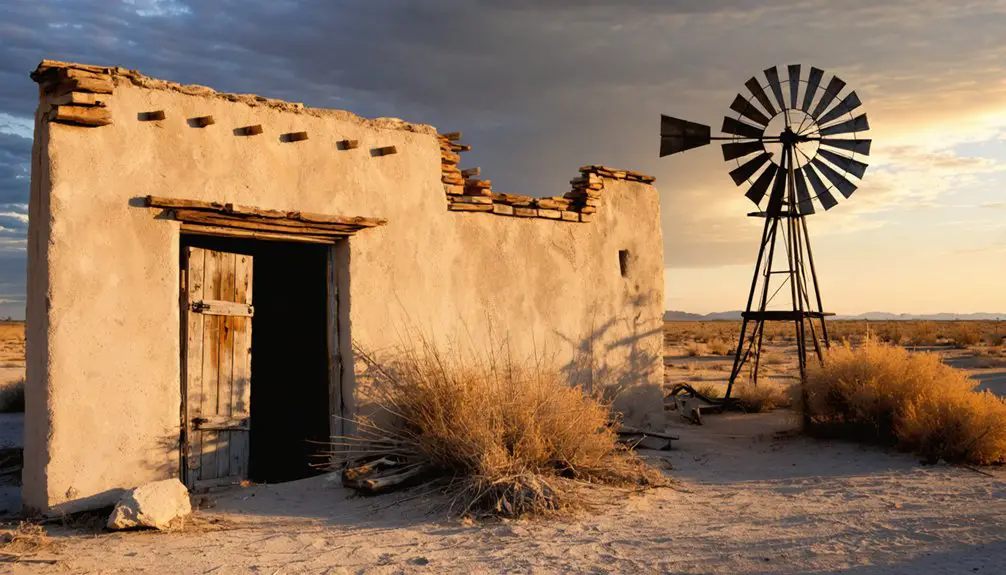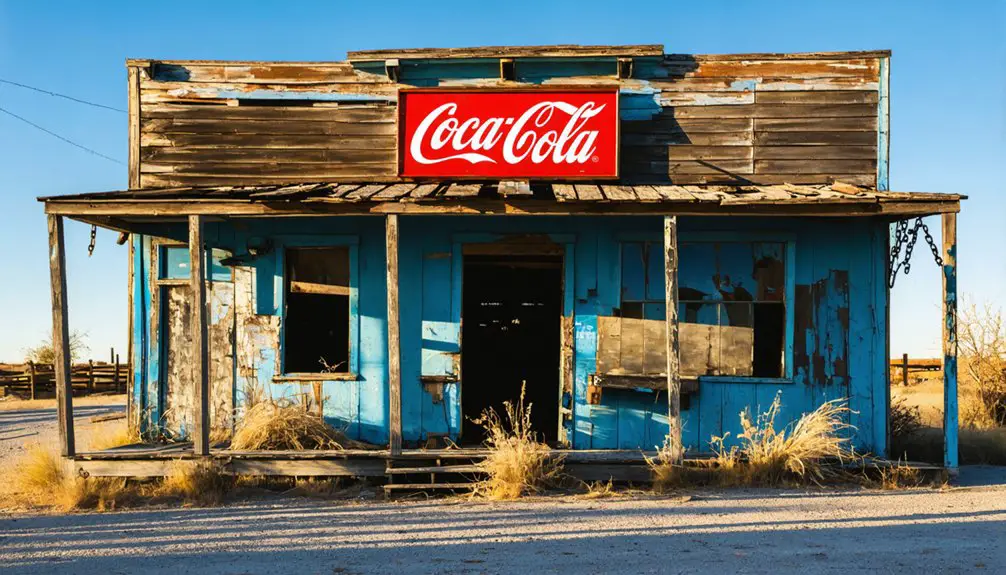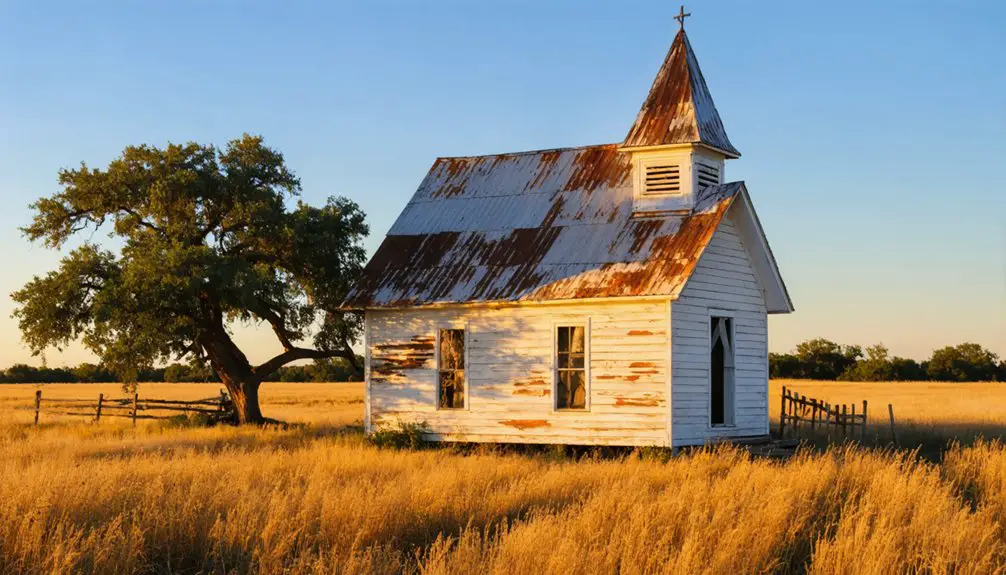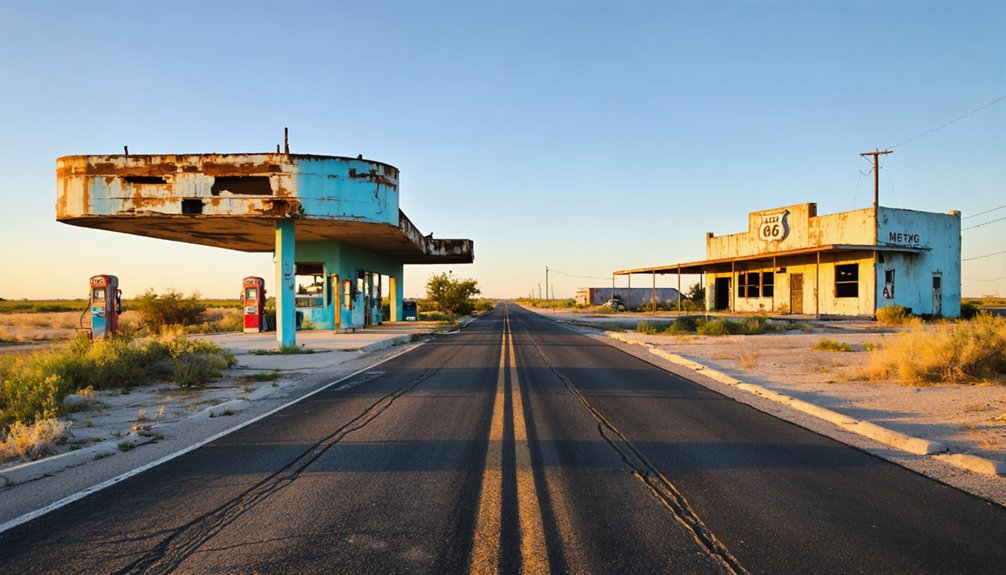
Take Exit 0 on Interstate 40 at the Texas-New Mexico border, then follow old Route 66‘s roadbed south to find Glenrio’s preserved ruins. You’ll discover the photogenic Texaco station with original 1950s pumps, the State Line Motel’s dual signage, and Little Juarez Diner’s concrete shell. Spring and fall offer the best conditions—60s-70s°F temperatures make exploring comfortable, while summer heat exceeds 90°F. The seventeen National Register structures from Route 66’s golden era reveal how businesses strategically straddled state lines to maximize profits from different regulations.
Key Takeaways
- Glenrio sits at Interstate 40 Exit 0 on the Texas-New Mexico border, accessible via southbound exit onto old Route 66.
- Visit during spring or fall for ideal weather conditions, avoiding summer’s intense heat and winter’s accessibility challenges.
- Explore seventeen National Register structures including the iconic Texaco station, State Line Motel, and Little Juarez Diner.
- Photograph abandoned buildings during golden hour using manual camera settings to capture weathered textures and vintage signage.
- Extend your trip to nearby Amarillo’s Cadillac Ranch or Tucumcari’s historic motor courts for additional Route 66 experiences.
Getting to Glenrio: Route 66 and Interstate 40 Access Points
The windswept remnants of Glenrio emerge at Interstate 40’s Exit 0, where the Texas-New Mexico border slices through what was once a thriving Route 66 waystation. You’ll spot two abandoned gas stations immediately north of the freeway—a former Chevron with its flat canopy still defiant against the elements, and a Texaco stripped bare. The Interstate 40 relocation effects hit hard here in the 1970s, draining life from the original alignment below.
Take the southbound exit onto old Route 66’s roadbed, also marked as State Loop 504. These gas station remnants serve as weathered gatekeepers to the preserved ghost town 200 yards west. You’re 73.1 miles from Amarillo, standing at Texas’s western threshold where mid-century America simply stopped and stayed. The abandoned Longhorn Motel and First In-Last Out petrol station stand as silent witnesses to the town’s busier days. Just beyond the town’s western edge, Route 66 bridges mark where the Mother Road continued its journey toward San Jon and Tucumcari.
Best Time to Visit This Texas-New Mexico Border Ghost Town
Four distinct seasons carve dramatically different experiences from Glenrio’s sun-bleached ruins, each offering its own invitation to explore—or warning to stay away.
Glenrio’s weathered ghost town transforms with each season—some beckon exploration, others whisper warnings to the wise.
Optimal seasonal visitation patterns:
- Spring (March-May): Wildflowers soften crumbling pavement, though tornado watches demand constant weather monitoring across these exposed plains
- Fall (September-November): Temperatures settle into the 60s-70s°F, delivering perfect exploration conditions under crystalline skies
- Summer: Route 66 tourists crowd limited structures while heat exceeds 90°F—arrive at dawn or skip entirely
- Winter: Solitude reigns supreme among frozen ruins, but 24°F temperatures and accumulated snow challenge accessibility
Weekend crowds versus weekday emptiness dramatically affect your experience. COVID-19 precautions remain minimal given the outdoor, isolated nature. Spring’s tornado risk and summer’s heat present genuine concerns—fall wins for unrestricted wandering through history. The town’s decline accelerated after Interstate 40 bypassed Glenrio, leaving these weathered structures as silent testimony to a once-thriving community. Straddling both Central and Mountain time zones adds a peculiar dimension to planning your visit, as the Texas side runs an hour ahead of New Mexico’s portion.
What to See: Historic Buildings and Landmarks Still Standing
Glenrio’s skeletal remains stretch along both sides of the state line, where seventeen structures stand frozen in mid-century decay. You’ll find the Texaco Gas Station’s Art Moderne curves still gripping original pumps from 1950, while Little Juarez Diner’s concrete walls showcase architectural preservation worth documenting.
The State Line Motel’s dual signage—”Last in Texas” or “First in Texas”—captures the town’s border identity despite heavy vandalism. Cross into New Mexico to explore the windowless post office shell, built in 1925, with the 1910 Angel House crumbling behind it. Each building’s historical significance tells Route 66’s boom-and-bust story.
The State Line Cafe and Joseph Brownlee House complete your self-guided tour through this roadside relic that time simply abandoned. Most structures feature utilitarian concrete foundations, stucco walls, and flat roofs typical of the town’s pragmatic construction style. The Brownlee Diner, constructed in 1952, later served as a curio shop before closing permanently.
The State Line Story: Why Location Mattered for Business
Straddling the Texas-New Mexico border transformed Glenrio into a peculiar capitalist experiment where a few footsteps could change what you could legally buy. This regulatory arbitrage created distinct business zones:
- Bars clustered on New Mexico’s side – Deaf Smith County’s dry laws pushed alcohol sales west, with the State Line Bar (built 1935) serving thirsty Texans
- Gas stations dominated Texas territory – New Mexico’s higher fuel taxes kept pumps east of the line
- Post offices shifted between states – Mail crossed from the Texas depot to New Mexico offices daily
- Smart operators maximized both advantages – Some entrepreneurs built combination establishments
This cross border collaboration wasn’t accidental—business owners strategically positioned their enterprises to profit from each state’s regulatory quirks, creating a roadside economy that thrived on freedom of movement. The town’s strategic location also made it a transportation hub for cattle and freight shipments, with shipping pens used by local ranchers who needed access to the railway. The surrounding area was primarily populated by cattle ranches, wheat and sorghum farms that formed the agricultural backbone of the community.
Route 66 Heritage and Hollywood History
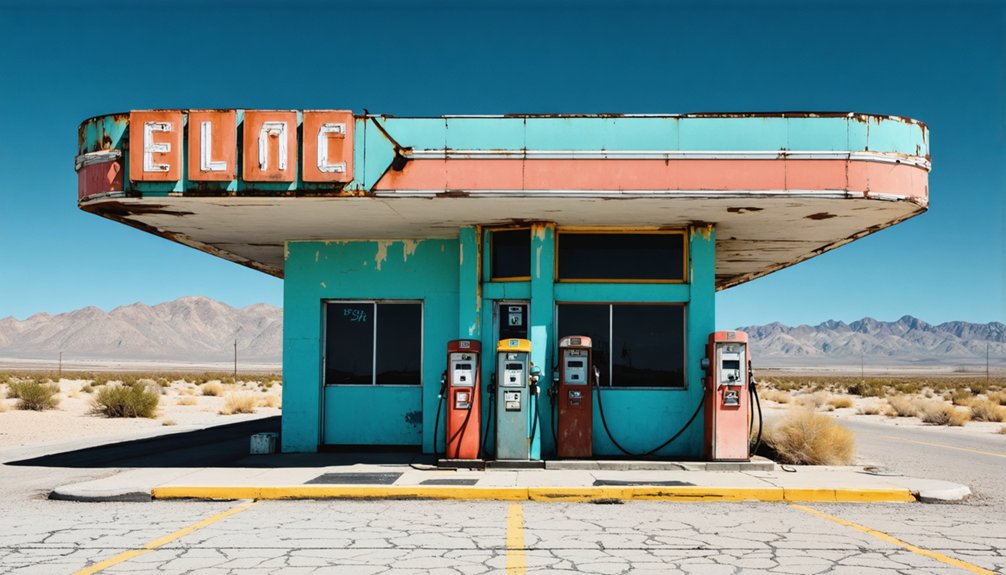
Long before Hollywood romanticized Route 66 as America’s “Mother Road,” Glenrio’s dirt-track origins traced back to the Ozark Trail, marked by green and white signs that guided Model T drivers through the Texas Panhandle dust in 1919. By 1926, that rutted path became U.S. Route 66, transforming Glenrio into a thriving highway oasis with gas stations and motor courts lining the northern right-of-way.
You’ll find the abandoned Texaco station—with its rusting Pontiac—among route 66 tourist trends’ most photographed stops. These utilitarian stucco buildings earned National Register status in 2007, preserving seventeen structures from the 1926-1976 golden era. The town served as a vital escape route during the Great Depression, offering hope to countless families traveling west in search of better opportunities. While Pixar’s *Cars* drew inspiration from similar Panhandle stretches, Glenrio’s authentic decay creates iconic movie filming locations without Hollywood polish—just honest roadside Americana frozen in time.
Photography Tips for Capturing Abandoned Structures
You’ll want to arrive at Glenrio’s crumbling buildings during golden hour, when warm light rakes across peeling paint and casts long shadows through empty window frames.
The weathered textures tell decades of stories—rusted metal signs, splintered wood siding, and faded Route 66 murals that flake away in patterns more beautiful than their original designs.
Position yourself to capture those iconic vintage signs against the big Texas sky, using doorways and structural elements to frame the compositions that made this highway legendary. Frame shots through broken windows using rule of thirds positioning to place the distant horizon and abandoned structures where they’ll naturally draw viewers deeper into the scene.
Golden Hour Lighting Techniques
When golden light spills across Glenrio’s weathered facades, the ghost town transforms into a photographer’s canvas of amber and shadow. You’ll want to arrive thirty minutes before sunset, when warm light wraps around peeling paint and rusted metal, creating that ethereal quality these abandoned structures deserve.
Master these techniques for compelling shots:
- Experiment with shooting angles around buildings—low perspectives emphasize height against glowing skies
- Use long exposure techniques with your tripod to blend light smoothly across crumbling walls
- Position yourself where shadows stretch dramatically across facades, adding depth
- Backlight window frames to silhouette decay against amber horizons
Manual mode gives you control: lower ISO prevents noise, wide apertures capture sharp details, and slower shutters handle the diminishing light. Walk freely, chase angles, and let Glenrio’s ruins reveal themselves.
Weathered Textures and Details
Glenrio’s crumbling walls tell stories through texture—peeling paint curls away in ribbons, rust bleeds across metal frames in burnt orange streaks, and weathered wood splinters into patterns that map decades of wind and sun. Position yourself close to capture these deep, complex tones that convey time’s passage.
Rusting metal textures work best when you compose carefully to maintain eye flow and avoid visual confusion. Look for vibrant color contrasts where decay meets sky—turquoise paint flaking against desert blue, oxidized metal against bleached wood. Graffiti adds unexpected narrative layers to your shots.
Try black and white conversions with added grain to emphasize gritty surfaces, or experiment with saturation adjustments to intensify collapsing colors. These textural details become standalone subjects worthy of documentation.
Vintage Signage Composition Strategies
Beyond the textured surfaces themselves, Glenrio’s faded signs demand compositional thought—these relics hover above weathered storefronts like hieroglyphs waiting to be decoded through your viewfinder.
You’ll capture their essence through strategic framing techniques—crumbling doorways and rusted window frames isolate peeling letters from visual clutter. Apply juxtaposition balance by positioning century-old advertisements against empty sky, emphasizing their solitary decay.
Four composition approaches for vintage signage:
- Position key elements at rule-of-thirds intersections rather than dead center
- Use pavement cracks and fence lines as leading paths toward distant signs
- Frame subjects through architectural remnants like partial walls or beams
- Arrange signs diagonally to create dynamic depth and movement
These abandoned markers become visual anchors when you offset them deliberately, letting cracked asphalt guide your eye toward their fading messages.
Nearby Stops: Amarillo and Tucumcari Attractions
After photographing Glenrio’s weathered buildings, you’ll find Amarillo 40 miles east and Tucumcari 35 miles west—both offering essential services and authentic Route 66 experiences.
Amarillo’s Cadillac Ranch presents ten spray-painted Cadillacs buried nose-first in a wheat field, while the Historic District’s antique shops and diners line Sixth Avenue’s original 1926 alignment.
Tucumcari’s Blue Swallow Motel preserves its 1939 neon glory with vintage auto court rooms, and Tee Pee Curios displays towering concrete tipis filled with Southwest memorabilia.
Amarillo’s Route 66 Landmarks
Just 40 miles east of Glenrio, Amarillo serves up some of Route 66’s most photogenic and quirky landmarks. You’ll find authentic roadside Americana that captures the Mother Road’s rebellious spirit.
Essential Route 66 Tourist Stops:
- Cadillac Ranch – Spray-paint these 10 half-buried Cadillacs standing nose-down in a wheat field since 1974
- Big Texan Steak Ranch – Tackle the legendary 72-ounce steak challenge (free if you finish) at this iconic roadhouse
- Texas Route 66 Visitor Center – Explore automotive memorabilia exhibits and historical artifacts inside a restored 1948 diner
- Bill’s Backyard Classics – Browse vintage automobiles and car-culture collectibles with knowledgeable docents
The Sixth Street Historic District ties everything together with 13 blocks of vintage storefronts, antique shops, and cafes preserving that classic highway-town atmosphere you’re chasing.
Tucumcari’s Historic Motor Courts
Why does Tucumcari pack more vintage neon per capita than almost anywhere else on Route 66? You’ll discover the answer cruising past five legendary motor courts that defined iconic motel culture.
The Blue Swallow’s neon has glowed since 1939, offering family-run hospitality across from Tee Pee Curios. La Nora Court’s 1930s Spanish Mission curves represent the Mother Road’s earliest architecture. Cactus Motor Lodge‘s 1941 Pueblo Revival design now welcomes RV travelers at its National Register-listed property.
For overnight stays, Motel Safari delivers mid-century modern style with Larry Smith’s 2017 rockabilly restoration, while Historic Route 66 Motel evokes Mies van der Rohe’s clean lines from 1963. These survivors showcase Historic Route 66 motifs that corporate chains can’t replicate—authentic remnants of America’s pre-interstate wanderlust.
Essential Supplies and Safety Considerations for Your Visit
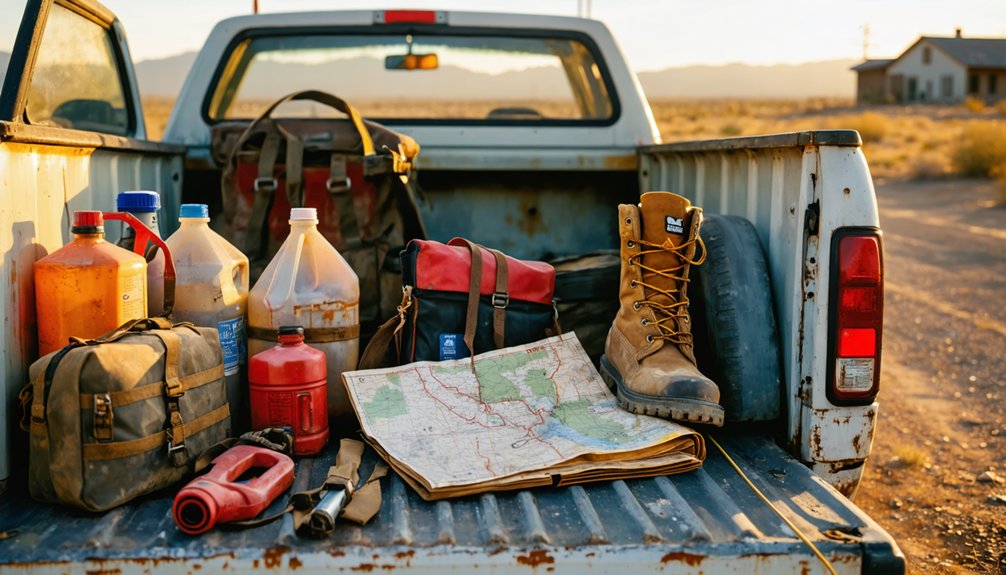
Standing at the crossroads where Texas meets New Mexico, with nothing but windswept plains stretching toward the horizon, you’ll quickly realize that Glenrio isn’t the kind of place where you can run to a convenience store if you’ve forgotten something critical.
Pack these essentials before venturing into this remote territory:
- One gallon of water per person daily – dehydration strikes fast in this arid climate
- First-aid kit with snake bite treatment – rattlesnake wildlife encounters are common among ruins
- Satellite communicator – cell service fails when you need help most
- Full fuel tank plus spare – Russell’s Truck & Travel Center is your lifeline
Those crumbling structures you’ll photograph? They’re unstable. Watch for collapse risks while exploring, and respect drone regulations near the Texas-New Mexico border where patrol activity remains constant.
Frequently Asked Questions
Is Overnight Camping or Parking Allowed in Glenrio?
Overnight camping isn’t allowed in Glenrio—regulations prohibit informal stays despite its historical significance and scenic views. You’ll need designated sites elsewhere, though the abandoned town’s freedom-loving spirit makes daytime exploration worthwhile for road-trippers seeking authentic Route 66 adventures.
Are Any Buildings Open to Enter or All Locked?
The buildings stand like locked time capsules—none are officially open for tours. You’ll find crumbling architectural features and deteriorating building conditions best admired from outside, respecting private property while capturing haunting photographs of this abandoned landscape.
Can I Buy Gas or Food in Glenrio Today?
You’ll find gas and food at TA Glenrio travel center on I-40, Exit 369—not in the ghost town itself. The remaining structures stand abandoned, but essential services operate nearby with 24/7 fuel availability.
Do I Need Permission to Photograph the Abandoned Buildings?
You don’t need permission to photograph from public roads, but you can’t enter the posted property. Local photography guidelines respect historic preservation concerns while letting you capture Glenrio’s weathered beauty from across the street freely.
Is Cell Phone Service Available in Glenrio?
You’ll find yourself in a cellular dead zone—network connectivity vanishes along this forgotten border stretch. Major carriers show minimal coverage quality in Glenrio’s ruins. Download offline maps beforehand, embrace the disconnection, and savor true independence from your screen’s constant demands.
References
- https://www.atlasobscura.com/places/glenrio-ghost-town
- https://www.legendsofamerica.com/tx-glenrio/
- https://mix941kmxj.com/glenrio-texas-ghost-town-dispensary/
- https://www.youtube.com/watch?v=LiS5UTVrzlQ
- https://thebullamarillo.com/the-life-and-times-of-glenrio-tx/
- https://www.theroute-66.com/glenrio.html
- https://www.nps.gov/places/glenrio-historic-district.htm
- https://www.route66roadtrip.com/route-66-glenrio-texas.htm
- https://pinintheatlas.com/travel-blogs/glenrio-to-amarillo-texas-route-66/
- https://www.tripadvisor.com/Attraction_Review-g28952-d18978171-Reviews-Glenrio_Ghost_Town-New_Mexico.html