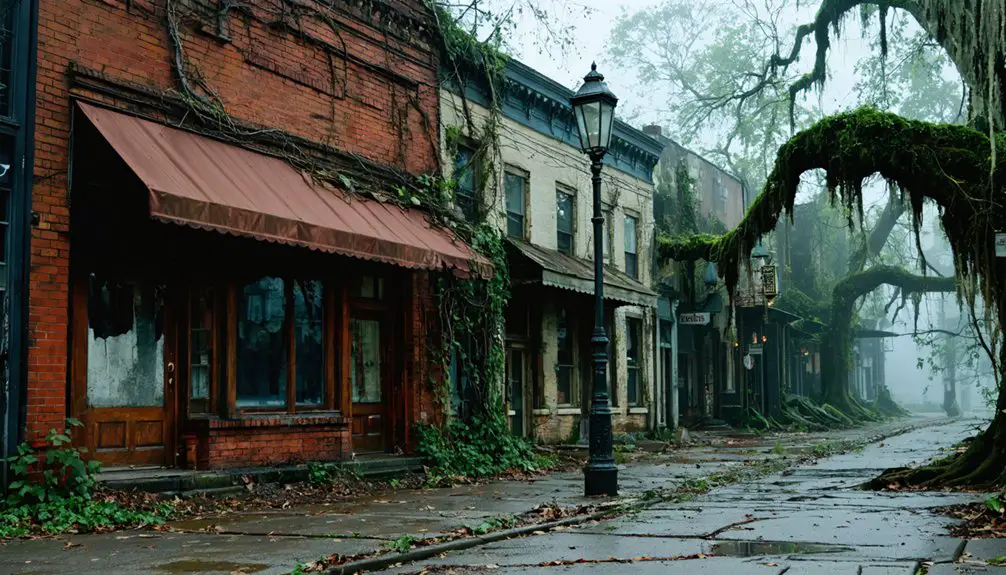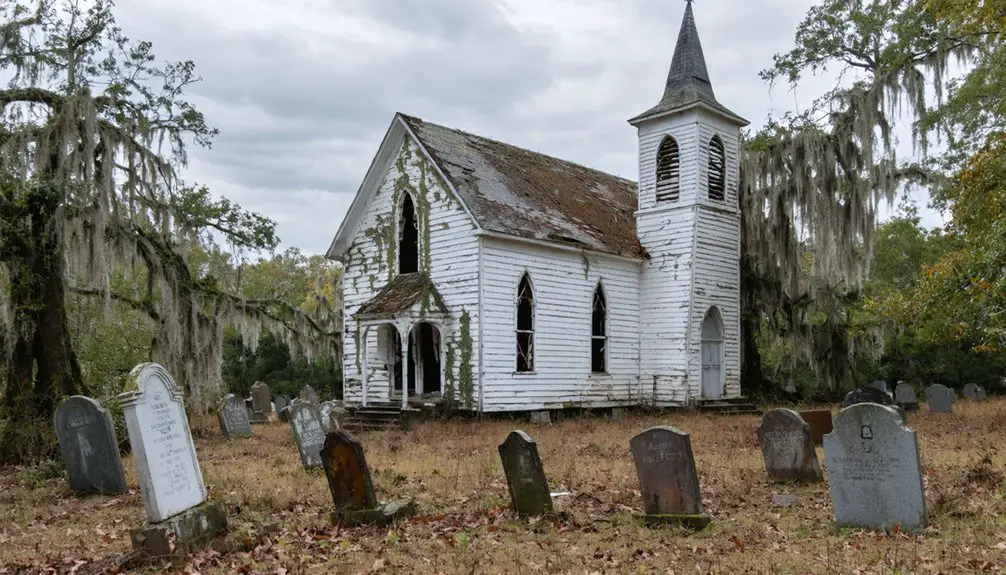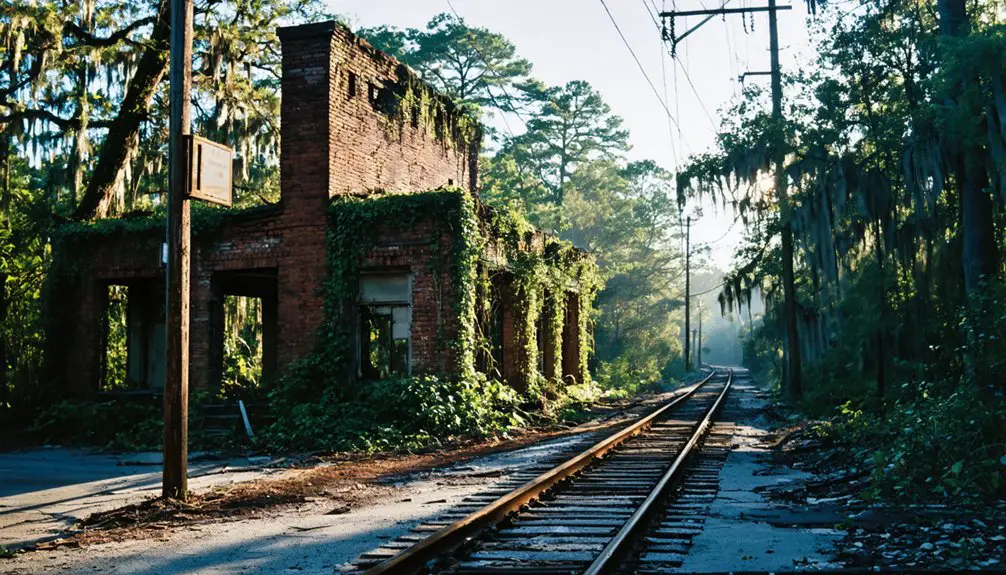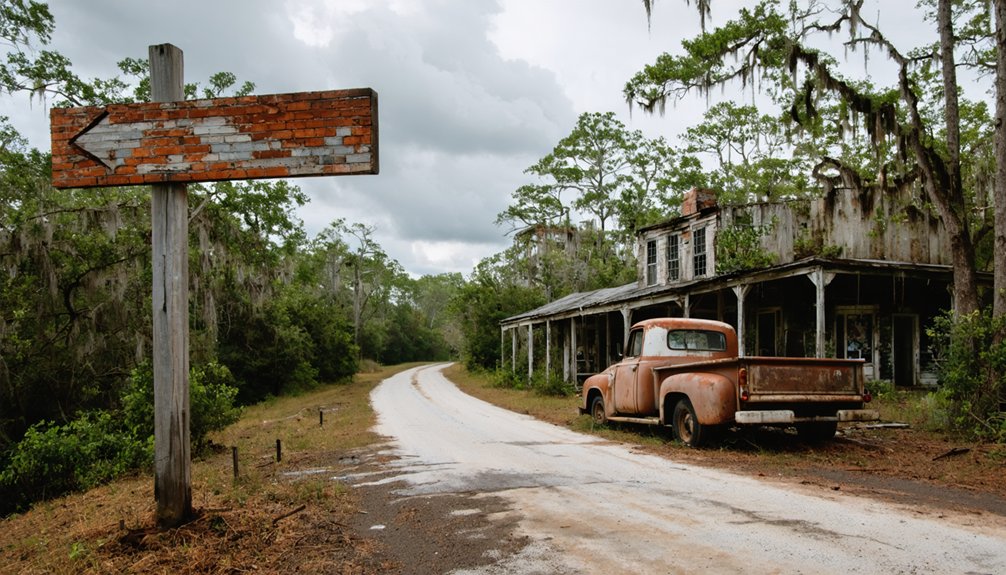
You’ll find Hamburg’s haunting remnants in Aiken County at coordinates 33°29’N 81°57’W, directly across from Augusta, Georgia. Cross the 5th Street Bridge for immediate riverfront views, then explore four primary landmarks between the bridges—including a 1950s concrete honky-tonk and overgrown structures reclaimed by nature. Pack comfortable shoes, bug spray, and water for traversing the isolated terrain. Fall offers ideal conditions with 62°F temperatures and reduced humidity, though winter’s 216 sunny days provide excellent visibility. The complete story behind this violent, fascinating history awaits your discovery.
Key Takeaways
- Hamburg’s ruins lie in Aiken County at coordinates 33°29’N 81°57’W, accessible via the 5th Street Bridge from Augusta, Georgia.
- Visit during fall for optimal 62°F temperatures and low humidity, or winter for 216 sunny days and mild weather.
- Pack walking shoes, lightweight jackets, sunscreen, wide-brimmed hats, bug spray, plus water and snacks for self-sufficiency.
- Four primary landmarks survive between 5th and 13th Street Bridges, including a 1950s concrete honky-tonk and factory remnants.
- GPS coordinates are essential as no roads or signs guide visitors to the overgrown ruins and historical markers.
The Rise and Fall of South Carolina’s Largest Inland Port
Perched on the eastern bank of the Savannah River, Hamburg emerged in 1821 as one man’s audacious challenge to Georgia’s commercial supremacy. German immigrant Henry Shultz established this settlement at the river’s fall line, creating a powerhouse that would reshape South Carolina’s economy.
One immigrant’s bold gamble transformed a riverside settlement into South Carolina’s economic powerhouse, defying an entire state’s commercial dominance.
By the 1830s, you’d witness 60,000 cotton bales worth $2,000,000 rolling through annually, cementing Hamburg’s cotton trade dominance across the region.
The town’s strategic river location attracted merchants who defied Augusta’s monopoly, shipping tobacco and cotton downriver to coastal markets. When the Charleston-Hamburg railroad—the world’s longest under single management—reached completion in 1833, Hamburg stood as South Carolina’s primary interior market.
Yet this prosperity proved fleeting. Augusta’s canal and rail developments eventually strangled Hamburg’s lifeblood, transforming the thriving port into abandoned streets.
What Remains: Exploring the Physical Ruins of Hamburg Today
Today, only scattered fragments mark where South Carolina’s once-mighty inland port thrived along the Savannah River. You’ll find four primary landmarks surviving amid nature’s reclamation. Between the 5th Street and 13th Street Bridges, concrete structures reveal their age through dangerous overgrowth—trees engulfing old toys, bathroom remnants disappearing beneath vegetation, and original light switches still clinging to crumbling walls.
The structural decay tells Hamburg’s story of abandonment following catastrophic floods that erased the town by 1929. Without GPS coordinates, you won’t locate these ruins—there’re no roads or signs guiding you. The closed bridge renovation complicates access further.
You’ll encounter a concrete honky-tonk from the 1950s, later repurposed as a mission, standing defiant against time’s erasure of this forgotten settlement.
How to Find Hamburg Ghost Town: Directions and Access Points
Finding Hamburg’s remnants requires determination, as this ghost town stubbornly resists casual discovery along the Savannah River’s South Carolina banks. You’ll locate it in Aiken County at coordinates 33°29′N 81°57′W, directly across from Augusta, Georgia. Cross the 5th Street Bridge from Augusta for immediate riverfront perspectives, or navigate Highway 1 past the historical marker. The landscape changes dramatically here—modern North Augusta sprawls across Hamburg’s footprint between the 5th and 13th Street bridges.
Railway remnants await behind private fencing: Hamburg Depot sits on restricted property, viewable only from distance. You’ll find better access exploring the old brick factory remnant at Hamburg’s south end, or entering Augusta’s city marina to observe Hamburg’s coastline. The subdivision off the former dirt road offers additional exploration opportunities with historical markers placed by Historic North Augusta.
The Hamburg Massacre of 1876: Understanding the Dark History
Blood stained Hamburg’s dusty streets on July 8, 1876, when white supremacist violence shattered this largely African American river town during South Carolina’s contested gubernatorial election. What began as a minor road dispute escalated when armed white rifle clubs surrounded black militiamen in their brick armory. After cannon fire forced their retreat, six to seven captured men were executed near the railroad bridge around 2 a.m.
The impact of the massacre reverberated far beyond Hamburg—it galvanized the “Red Shirt Movement” that ended Reconstruction through systematic voter intimidation. Though 87 white men faced indictments, none were prosecuted. The lasting effects on Hamburg’s development proved catastrophic: the violence destroyed its economic foundation and ultimately erased this once-thriving community from South Carolina’s landscape.
Best Time to Visit and What to Bring on Your Trip
When you’re planning your journey to Hamburg’s haunting riverside remnants, South Carolina’s humid subtropical climate demands careful seasonal consideration. Fall delivers prime conditions—62°F highs, reduced humidity, and drier November weather create ideal photography conditions without summer’s oppressive 105°F heat index.
Spring’s blooming landscapes and fewer crowds enhance exploration, though March’s extratropical cyclones bring tornado risks and abundant precipitation. Winter’s 216 sunny days exceed national averages, offering mild southern temperatures perfect for unhurried discovery.
Pack strategically for freedom: comfortable walking shoes handle Savannah River floodplain terrain, while lightweight jackets address variable precipitation. Sunscreen and wide-brimmed hats counter 7-8 hours of daily sunshine. Bug spray’s essential against humidity-loving insects. Carry water and snacks—Hamburg’s isolation means you’ll need self-sufficiency when exploring these abandoned streets where history whispers through river breezes.
Nearby Attractions in North Augusta and Aiken County
Your Hamburg exploration represents just the beginning of North Augusta’s historical treasures. You’ll discover the Arts & Heritage Center, where regional arts and cultural centers showcase local artists alongside driving tour maps of Historic North Augusta’s 1906 charter. The Star of Edgefield, built in 1860 with ornate New Orleans ironwork, stands as one of several nearby historic landmarks on the National Register.
Living History Park’s 7.5 acres bring colonial life to vivid reality through reenactments like Under the Crown, depicting 1780 frontier existence.
Beyond town limits, Aiken County’s Thoroughbred Country beckons with antique shops, urban forest trails, and Edisto River paddling. You’ll find Redcliffe Plantation House Tour and Beech Island Historical Tour revealing deeper Southern narratives. The riverfront’s fishing piers and multipurpose trails offer respite between discoveries.
Photography Tips for Capturing Historic Ruins
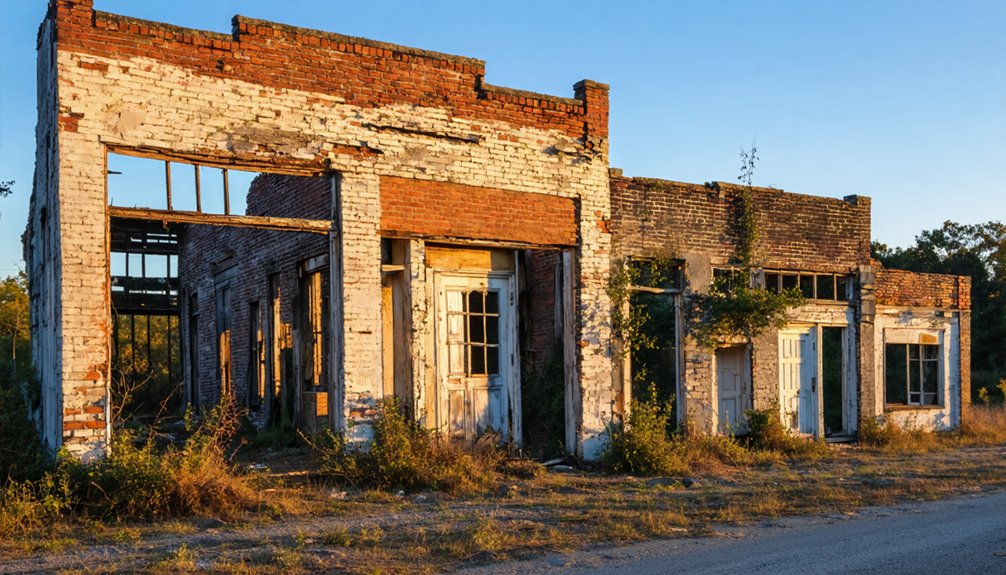
Master these fundamentals:
- Use selective focus applications to highlight compelling details like rusted door hinges or peeling wallpaper while blurring distracting backgrounds
- Employ HDR bracketing to balance harsh contrasts between sunlit openings and dark corners
- Frame compositions around architectural elements—doorways, collapsed staircases, and arched passages that emphasize abandonment’s haunting beauty
Your wide-angle lens at 24mm will exaggerate spatial depth, while carefully positioned flashlight painting reveals texture in decay’s intricate patterns.
The Old Bridge Structures and Factory Remnants Worth Seeing
You’ll find the most substantial remnants near the closed bridge spanning the Savannah River, where the crumbling Rutherford and Company Brickyard still stands defiant against encroaching vegetation.
The concrete pilings jutting from the water mark where the 1853 Hamburg-to-Augusta Rail Bridge once sealed the town’s fate, while nearby factory ruins reveal nature slowly consuming old bathroom fixtures and light switches frozen in time.
Access these sites via a small road near the deserted bridge, but exercise caution—the structures aren’t safe to walk beneath, and decades of abandonment have transformed parts of the area into an eerie outdoor museum scattered with rusted toys and industrial debris.
Abandoned Brick Factory Ruins
The crumbling brick walls of W.J. Rutherford and Company stand as Hamburg’s most tangible ghost. Established around 1895, this factory harnessed local clay deposits from the Savannah River banks, transforming raw earth into building materials through a brick manufacturing process that once sustained freedmen after the town’s post-massacre decline.
You’ll find these weathered ruins via a dirt road cutting through a riverbank subdivision, where deteriorated structures mark the former office site. The factory’s legacy reveals itself through:
- Exposed brick foundations showcasing clay-based construction techniques
- Partial wall sections rising from overgrown vegetation
- Scattered debris indicating the facility’s operational footprint
These accessible remnants within North Augusta’s limits represent Hamburg’s only identifiable above-ground structures—a defiant testimony to industry persisting long after floods erased everything else.
Closed Bridge Access Points
Where Hamburg’s grandest engineering achievements once spanned the Savannah River, only fragmentary concrete pilings now pierce the water’s surface—silent monuments to the bridges that built and buried this ghost town. You’ll spot these remnants from the 5th Street Bridge, where the 1853 Hamburg-to-Augusta rail bridge once stood.
Unfortunately, direct access remains blocked—the old bridge underwent renovation closure, and dirt roads leading to deserted structures feel genuinely unsafe underneath. What was once public heritage has transformed into restricted areas behind fancy riverbank subdivisions.
Even Hamburg Depot, honored alongside the Golden Gate Bridge as a National Historic Civil Engineering Landmark, sits abandoned on private property. These hazardous crossings and access restrictions frustrate explorers, but the visible pilings and old steel trestle near Augusta’s marina still tell Hamburg’s story.
Riverside Structural Remnants
Standing sentinel in the Savannah River’s murky waters, massive concrete pilings from the 1853 Hamburg-to-Augusta rail bridge mark the exact spot where this ghost town’s fate was sealed. These weathered columns represent Hamburg’s last physical remnants, alongside industrial debris from the Rutherford and Company Brickyard established in 1895.
You’ll discover three distinct structural remains along the riverside:
- Original wooden pilings from the elevated rail beds that once resembled a 136-mile trestle
- Concrete bridge supports that replaced Hamburg’s river-based commerce in 1853
- Brickyard foundations serving the post-Civil War community until early 20th-century floods
These crumbling structures tell Hamburg’s complete story—from cotton-shipping powerhouse moving 60,000 bales yearly to railroad casualty. The shift from water to rail transport literally stands before you in stone and timber.
Safety Considerations When Exploring Abandoned Sites
Before you set foot in Hamburg’s crumbling structures, understand that abandoned buildings pose lethal risks extending far beyond picturesque decay. Firefighters face four times higher injury rates in vacant buildings compared to occupied ones—you’re operating without their training or equipment.
These sites attract violent crime at twice the rate of secured areas, while deteriorating materials release asbestos, lead, and airborne mold into your lungs. Standing water breeds disease-carrying mosquitoes; unstable floors collapse without warning.
If you’re determined to explore, follow building inspection procedures used by professionals: identify inactive utilities, check for code violations, and assess structural integrity from outside first. Respect site security requirements—boarded windows and doors aren’t suggestions. Your freedom includes choosing calculated risks, not reckless ones.
Local Dining and Lodging Options for Your Ghost Town Adventure

- Rosalia’s Mexican Restaurant (4.3 stars) serves authentic fare when barbecue fatigue sets in
- Cravin Thai in Hamburg offers Asian noodles and soup for budget-conscious explorers
- Yamato Hibachi Steakhouse provides Japanese cuisine near your base camp
For lodging, Columbia’s California Dreaming (4.5 rating, 2,671 reviews) and Tupelo Honey offer dependable options forty miles north, while Hamburg’s chain hotels provide functional crash pads.
Frequently Asked Questions
Are There Any Guided Tours Available for Hamburg Ghost Town?
No official walking tour options exist for Hamburg’s windswept ruins. You’ll find only a self-guided experience, following coordinates through empty fields where scattered remnants whisper stories of this vanished river town’s forgotten past.
Can Visitors Access the Site at Night or During Evening Hours?
Nighttime access isn’t recommended due to safety concerns and lack of lighting infrastructure. Evening visitation hours aren’t formally established, so you’ll want to explore during daylight when unmarked pathways, deteriorated structures, and river hazards remain visible and manageable.
Is There an Admission Fee to Visit the Hamburg Historical Site?
No admission fee stands between you and Hamburg’s ruins—like freedom itself, historical preservation here remains unmonetized. You’ll find open access to this ghost town, though site maintenance relies on volunteer efforts and community support rather than ticket revenue.
Are Pets Allowed When Exploring the Hamburg Ghost Town Ruins?
Yes, you can bring pets to explore Hamburg’s ruins. While there aren’t official pet friendly facilities, the unregulated site allows leashed companions. Follow standard leash requirements for safety around unstable structures and terrain.
How Long Should Visitors Plan to Spend Exploring Hamburg Ghost Town?
You’ll need about 1-2 hours to explore Hamburg’s scattered ruins and landmarks. Afterward, visit local historical museum exhibits across the river, then consider rustic accommodations nearby if you’re continuing your freedom-filled ghost town adventure.