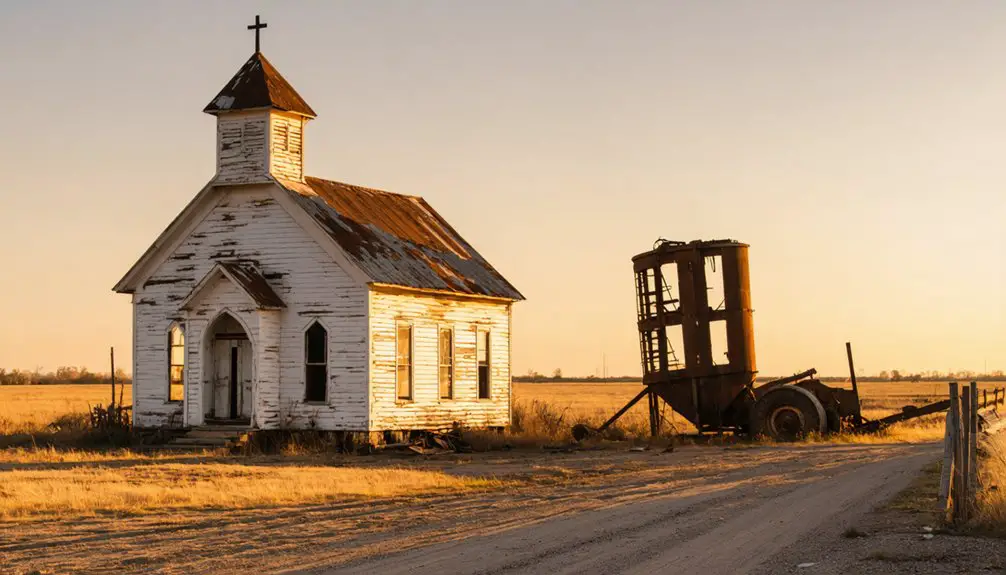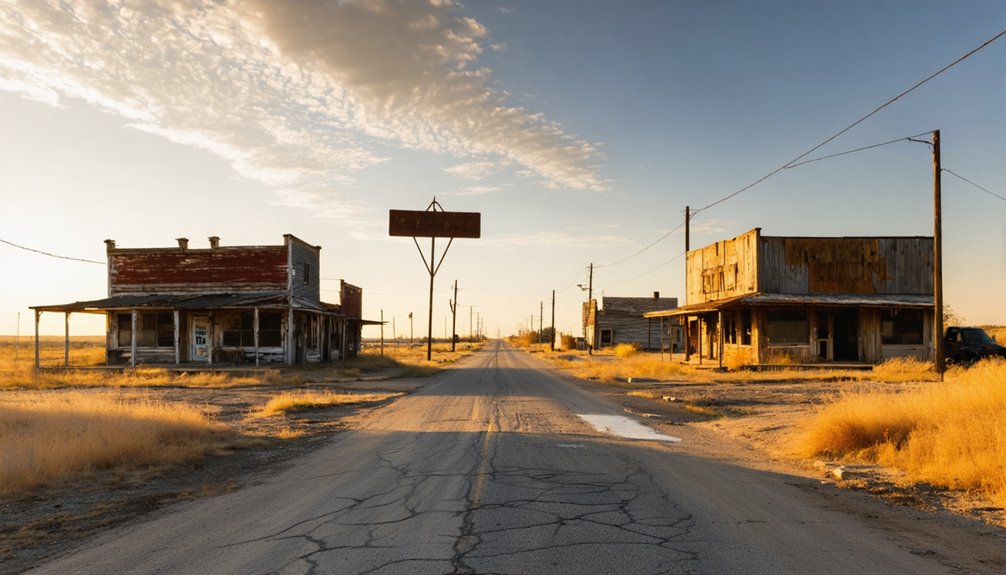
Planning a ghost town road trip to Hanson, Oklahoma means steering quiet rural roads through east-central Sequoyah County to find a town that’s more living relic than ruin. Founded in 1896, Hanson boomed on tobacco, lumber, and rail before fires and decline shrank its population from 495 to just 58. You’ll find remnants of industrial architecture, scenic Hanson Mountain, and a handful of residents still calling it home. There’s far more to this story than meets the eye.
Key Takeaways
- Hanson, Oklahoma, is a living ghost town in Sequoyah County with only 58 residents, offering a quiet glimpse into Oklahoma’s boom-and-bust history.
- The town sits on its original 50 acres, featuring remnants of tobacco factories, industrial structures, and scenic Hanson Mountain rising about 200 feet.
- Navigate rural east-central Sequoyah County roads using a detailed county map, as GPS lag and minimal highway signage can complicate directions.
- Respect private property boundaries, as Hanson remains an active small community rather than an abandoned ruins site open for unrestricted exploration.
- Plan visits with ample daylight, check seasonal road conditions beforehand, and seek dining in nearby towns since Hanson has no commercial options.
Hanson, Oklahoma: A Railroad Boomtown That Almost Disappeared
When the first train rolled into Hanson, Oklahoma, in February 1896, it arrived to little more than wilderness — yet within months, a full-fledged boomtown had taken shape. Founded on just 50 acres and named for civil engineer Henry B. Hanson, the town quickly built its identity around railroad commerce, tobacco production, and frontier enterprise.
You’ll find local legends tied to “Hanson Twist,” a tobacco brand shipped nationwide and born right here. At its peak, Hanson claimed nearly 500 residents, multiple stores, a hotel, a bank, and doctors’ offices.
But a brutal series of fires scorched the town repeatedly, causing $90,000 in damage and stripping away much of its historic architecture. Today, only a handful of residents remain — making Hanson one of Oklahoma’s most compelling partly surviving ghost towns.
How Hanson Built a Town on Tobacco, Lumber, and Rail
When the first train rolled into Hanson in February 1896, it didn’t just bring passengers — it sparked an entire economy almost overnight.
You’ll find it remarkable that within just a few years, the town supported sawmills, a grist mill, a livery firm, a blacksmith shop, and several tobacco factories all running simultaneously.
Hanson’s most famous export, “Hanson Twist,” shipped nationwide, putting this small Oklahoma railroad stop on the commercial map long before most people had heard its name.
Railroad Sparked Early Growth
Before the first train rolled into Hanson in February 1896, the surrounding land was little more than wilderness. That single railroad connection transformed 50 acres into a functioning boomtown almost overnight.
You can almost trace the town’s ambition through what local legends say sprang up along those early tracks:
- A sawmill and grist mill powered the timber and grain economy
- Livery firms and blacksmith shops served workers and travelers
- General stores, doctors’ offices, a hotel, and a bank followed quickly
- Tobacco factories emerged, eventually producing the nationally shipped “Hanson Twist” brand
Tobacco Fueled Local Economy
Though the railroad gave Hanson its backbone, tobacco gave it its identity. Several tobacco factories operated here, producing the nationally shipped “Hanson Twist” brand that put this small Oklahoma town on the map. You won’t find local cuisine inspired by that legacy today, but the history alone makes the stop worthwhile.
Beyond tobacco, early Hanson supported a sawmill, grist mill, livery firm, and blacksmith shop — a self-sufficient economy built without modern amenities or outside conveniences.
Churches rose, businesses multiplied, and an old tobacco factory even converted into a school. At its peak in 1896, Hanson claimed 495 residents.
That diversity of industry shows you how determined early settlers were to build something lasting in the eastern Oklahoma wilderness.
The Fires That Erased Hanson’s Future
Fire didn’t just slow Hanson’s growth—it systematically dismantled it. When you dig into the town’s history, you’ll find a brutal pattern of loss tied to historical architecture that never got the chance to age into local legends.
Fire didn’t just slow Hanson’s growth—it erased the architecture before history had a chance to claim it.
The fires struck repeatedly, each one cutting deeper:
- 1889 – The first recorded blaze wiped out nine houses
- Turn of the century – Five tobacco buildings and five residences burned
- Religious loss – The Hanson Christian Church was destroyed in the flames
- 1906 – Stores and courthouse buildings continued burning through the decade
Total damage reached $90,000—staggering for a small railroad town. You’re not visiting a place that faded quietly; you’re standing where ambition burned, literally, before it could fully take root.
How 495 Residents Became 58: Hanson’s Long Decline
When you consider that Hanson once housed 495 residents in 1896, its 2020 census count of just 58 people tells a striking story of collapse.
The fires didn’t just destroy buildings — they erased business confidence, scared off investors, and stripped the town of the momentum it needed to survive.
Once the railroad era wound down and commerce dried up, Hanson had little left to hold its population in place.
Fire’s Devastating Toll
What brought Hanson to its knees wasn’t a single catastrophe but a relentless string of fires that gutted the town piece by piece. Each blaze erased more historical architecture and local legends, leaving less reason for residents to stay.
Here’s what the fires consumed:
- 1889 – Nine houses vanished in the first recorded blaze
- Later fires – Five tobacco buildings and five residences burned to the ground
- Hanson Christian Church – Destroyed, taking the community’s spiritual anchor with it
- Stores and courthouse buildings – Burned repeatedly through 1906
Total damage reached $90,000 — an enormous blow for a small railroad town.
You can almost feel the weight of those losses standing there today, imagining what once stood where empty land now stretches quietly toward Hanson Mountain.
Railroad Era’s End
By 1896, Hanson had packed 495 residents into its 50 acres — a railroad boomtown humming with tobacco factories, general stores, and ambition. Then the fires came, the railroad’s economic grip loosened, and people simply left. That 495-person peak quietly collapsed into today’s 58 residents.
What remains isn’t nothing, though. You’ll find a community that local legends keep alive through stories of Hanson Twist tobacco shipments rolling out nationwide and converted industrial architecture — that old tobacco factory turned schoolhouse still anchors the town’s identity in collective memory.
Hanson never fully vanished; it just exhaled.
For freedom-seeking road-trippers, that contrast is the draw. You’re not visiting ruins — you’re standing inside a living timeline, where a railroad boomtown’s ambition shrank to something quieter but stubbornly real.
What Still Stands in Hanson Today
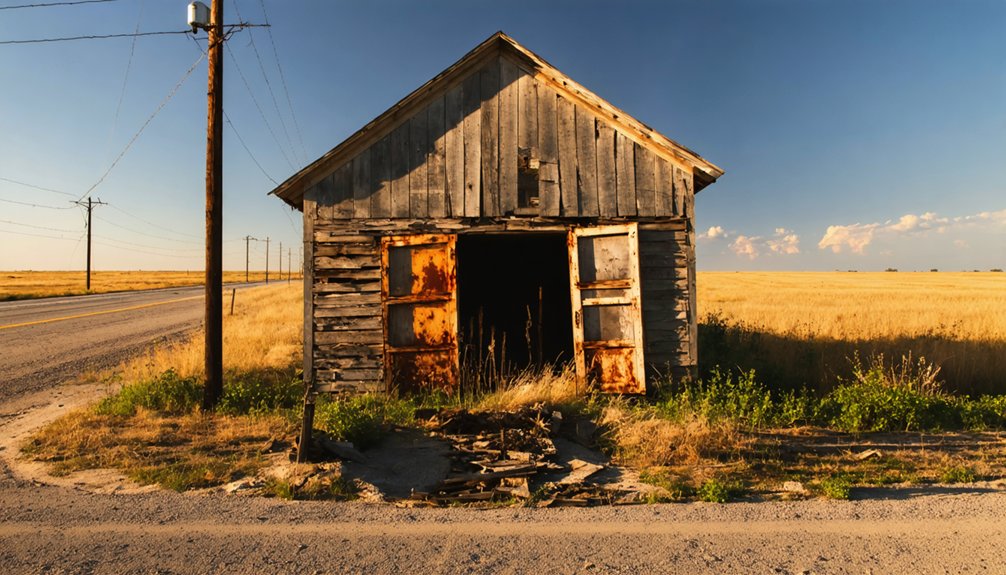
Though Hanson’s railroad boom days are long gone, the community hasn’t vanished entirely — and that’s precisely what makes it worth a detour. With 58 residents recorded in 2020, Hanson survives as a cultural remnant of Oklahoma’s railroad era, quietly holding its ground at the base of Hanson Mountain.
Local legends of tobacco factories and fire-ravaged streets still echo through the landscape.
When you roll through, expect to find:
- A handful of residences scattered across the original 50-acre townsite
- Hanson Mountain rising roughly 200 feet above the community
- A rural setting that reflects the town’s unincorporated, census-designated status
- Quiet roads that trace the former railroad corridor
It’s not a museum — it’s a living snapshot of boom-to-bust Oklahoma history waiting for you to explore.
Other Sequoyah County Ghost Towns Worth Pairing With Hanson
Sequoyah County rewards ghost-town hunters who plan ahead, because Hanson pairs naturally with several other forgotten communities scattered across the same rolling eastern Oklahoma terrain. You’ll find abandoned structures tucked along rural roads throughout the county, each carrying its own railroad-era story and local legends passed down through generations of residents.
Towns like Paw Paw and Marble City offer similarly quiet stops where settlement history lingers in crumbling foundations and overgrown lots. Mapping a single-day loop lets you cover meaningful ground without backtracking, connecting rail history, decline narratives, and surviving rural character across a compact geographic stretch.
Bring a detailed county map, respect private property boundaries, and give yourself enough daylight to explore each site before the eastern Oklahoma sunset cuts your window short.
How to Reach Hanson and What to Expect When You Arrive

Reaching Hanson means steering through the quiet rural roads of east-central Sequoyah County, where GPS signals can lag and highway signage stays minimal. You’ll find a small surviving community rather than a crumbled ruin, so reset your expectations accordingly.
GPS signals lag, signage stays minimal — Hanson rewards the determined traveler, not the casually curious.
Pack your visit with purpose using these checkpoints:
- Hanson Mountain rises roughly 200 feet above town, offering scenic overlooks worth the short climb
- Remaining residences confirm this is a living ghost town, not a fully abandoned site
- Nearby towns provide local cuisine stops since Hanson has no commercial dining
- Road conditions vary seasonally, so check rural route accessibility before heading out
You’re arriving at a place frozen between past and present — small, quiet, and honest about what it once was.
Frequently Asked Questions
Is There a Fee to Visit Hanson or Enter Sequoyah County?
You’ll pay no fee for ghost town exploration or entering Sequoyah County. Hanson history awaits you freely — you drive in, you wander around, and you soak up every remnant of this fascinating railroad-era community.
Are There Restrooms or Gas Stations Near Hanson for Road-Trippers?
Since Hanson’s a tiny ghost town, you won’t find restroom facilities or fuel availability there. Stock up in nearby Sallisaw before heading out — it’s your best bet for gas, food, and comfort stops!
What Is the Best Time of Year to Visit Hanson?
Spring and fall offer you the best visiting months for Hanson. Seasonal weather stays mild, letting you explore the mountain backdrop and historic remnants comfortably, without summer’s harsh heat or winter’s unpredictable chill slowing your adventure.
Is Hanson Safe to Visit, and Are Trespassing Laws Enforced There?
You’ll find Hanson safe to visit, but here’s the catch — trespassing laws *are* enforced. Respect private property, support local community impact, and champion historical preservation by staying on public land during your explorations.
Can Visitors Camp Overnight Near Hanson Mountain?
You’ll want to check local camping permits before settling near Hanson Mountain. Respect wildlife safety guidelines, stay aware of your surroundings, and embrace the freedom of sleeping beneath eastern Oklahoma’s star-filled skies near this historic ghost town.
References
- https://www.okhistory.org/publications/enc/entry?entry=GH002
- https://en.wikipedia.org/wiki/List_of_ghost_towns_in_Oklahoma
- https://kykinfolk.com/hopkins/towns/hanson.html
- https://en.wikipedia.org/wiki/Hanson
- https://www.travelok.com/articles/oklahomaghosttowns
- http://files.usgwarchives.net/ok/okstate/history/hghosttowns.txt
- https://worldpopulationreview.com/us-cities/oklahoma/hanson
- https://okgenweb.net/books/other/ghost.htm
- https://kids.kiddle.co/List_of_ghost_towns_in_Oklahoma
- https://texascooppower.com/old-haunts/