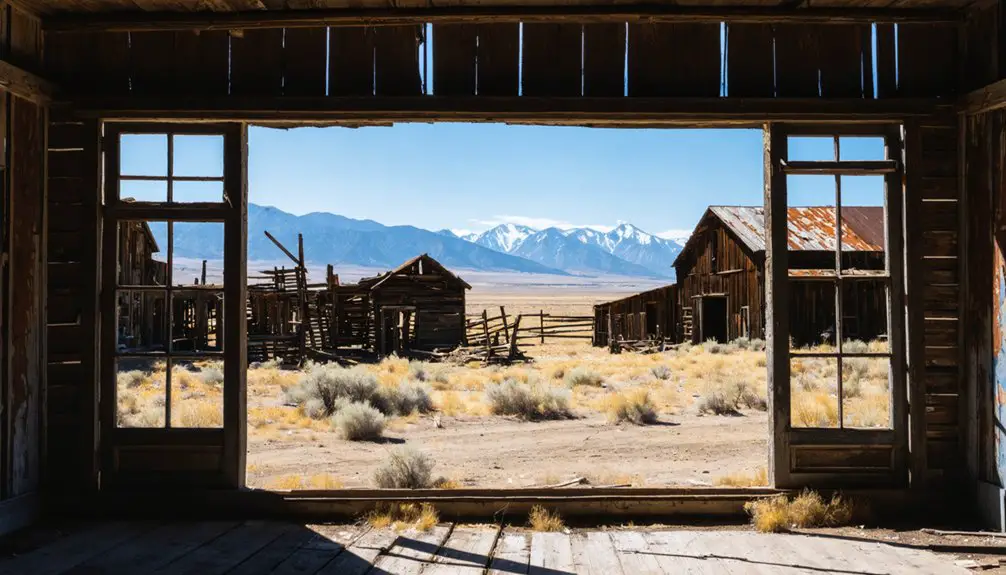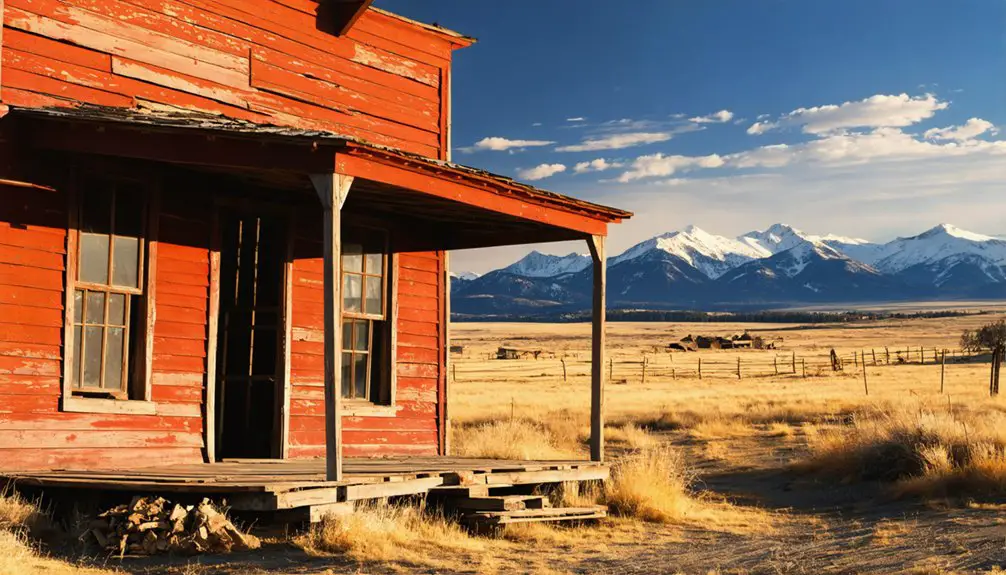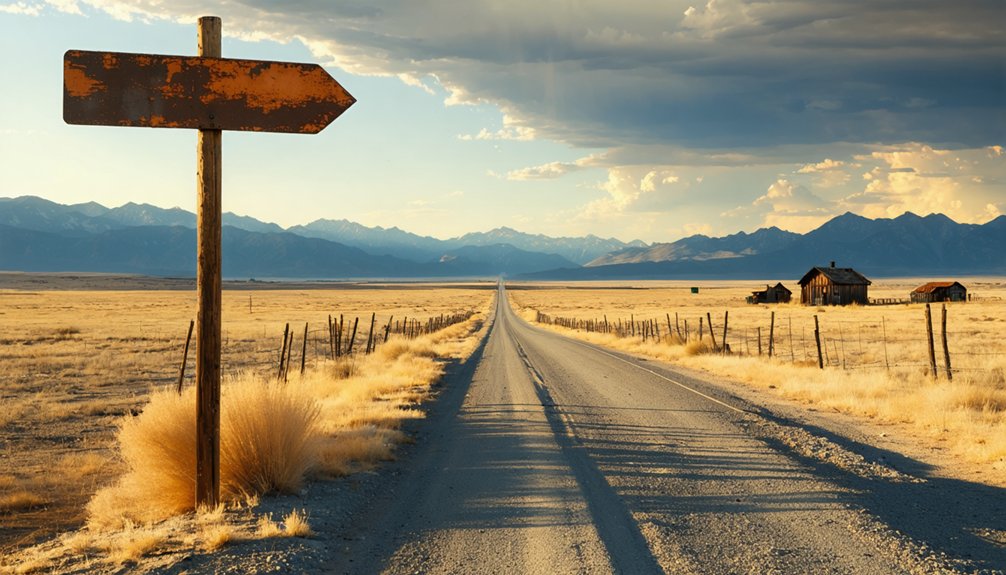
You’ll find Hecla’s haunting silver empire by taking Exit 93 off I-15 near Melrose, then following Trapper Creek Road through increasingly rugged terrain. Pack your four-wheel drive or ATV for the journey beyond Glendale, where 23 stone beehive kilns and a towering smelter stack await your exploration. The skeletal building frames and scattered mining remnants tell stories of 1,000 residents who once called this place home before silence reclaimed the mountains in 1915. Discover what lies beyond these ghostly monuments.
Key Takeaways
- Access Hecla via Trapper Creek Road off I-15 Exit 93 near Melrose; four-wheel drive or ATV required beyond Glendale.
- Visit the massive smelter stack at Glendale and 23 preserved stone beehive kilns on the National Register of Historic Places.
- Explore scattered mining remnants, skeletal building frames, and intact Hecla Company offices throughout the former community footprint.
- Cemetery on the hill requires private land access but contains graves from 1875 to 1904 reflecting multicultural mining workforce.
- Plan for rough terrain and remote conditions when visiting these ghost towns once home to over 1,000 residents.
The Rise and Fall of a Silver Mining Empire
In July 1873, prospectors struck silver in the Bryant district, and the Pioneer Mountains exploded with fortune seekers. You’d have witnessed four camps—Trapper City, Lion City, Glendale, and Hecla—spring up along ten miles of gulches as thousands chased independence through ore.
The district produced nearly $20 million in silver, lead, copper, and zinc, with Glendale’s smelter churning out a million ounces annually until flames consumed it in 1879. Mining technology advancements drove extraction deeper, while community social dynamics shifted through constant management changes. The Hecla Consolidated Mining Company formed in 1877, buying up most workings on Lion Mountain and proving itself one of the more successful operations, paying dividends to investors for over two decades.
But freedom’s price proved steep. When Congress repealed the Sherman Silver Purchase Act in 1893, silver prices collapsed. The Cleopatra mine shuttered in 1895, operations withered, and by 1915, silence reclaimed the mountains. James Toner had claimed the Hecla mine in 1885, but even this foothold couldn’t withstand the economic devastation that followed.
What to Expect When You Arrive at Hecla
When you veer off I-15 at Exit 93 near Melrose, Trapper Creek Road launches you into the raw backcountry where Hecla’s ruins wait at 8,711 feet. Your four-wheel drive or ATV will earn its keep traversing the rough terrain beyond Glendale, with Hecla lying seven miles deeper into wilderness.
Don’t expect manicured pathways or interpretive signs—you’ll find scattered remnants of mining operations, skeletal building frames, and the ghostly footprint of what once housed 2,000 souls. The former community attractions—waterworks, church, schoolhouse that educated 200 children—have surrendered to time and elements. If you’re researching before your visit, note that Hecla appears as a disambiguation page on Wikipedia, listing various places and articles sharing this historic name.
These weathered fragments of Beaverhead County’s silver empire demand respect; watch for private property boundaries as you explore. As you explore, remember to take nothing but photos and leave nothing but footprints, following the conservation principles that help preserve Montana’s historic mining sites. Pack everything you’ll need; civilization remains miles behind you.
Exploring the Historic Glendale Smelter Site
The massive smelter stack rises above scattered foundations and crumbling brick walls, marking where fortunes in silver and lead once flowed through roaring furnaces. You’ll discover the stone beehive kilns five miles away at Canyon Creek, their perfectly preserved domes standing sentinel over the landscape they helped transform.
Charles Dahler and Noah Armstrong established the original smelter and blast furnace that sparked Glendale’s transformation into a thriving mill workers’ community by 1875.
On a windswept hill overlooking the site, weathered headstones tell silent stories of miners, merchants, and families who built their lives in this remote Montana valley. The town supported over one thousand residents at its peak, making it one of the district’s primary settlements alongside neighboring Hecla.
Surviving Buildings and Foundations
Rising from the hayfields like a sentinel of industrial ambition, the prominent smelter stack at Glendale commands attention as you approach the historic site. Where 1,500 souls once labored, you’ll now discover scattered foundations whispering tales of Montana’s mineral wealth.
The intact Hecla Company offices stand defiant against time, representing irreplaceable cultural treasures from operations that yielded $22 million in ore.
Your exploration reveals remarkable engineering achievements:
- Horizontal flue systems capturing hundreds of dollars in precious metal dust daily
- Post 1881 smelter expansion integrating southwestern Montana’s mining districts
- Ore processing efficiency through dust recycling in reverberatory furnaces
- Rail connections enabling massive annual production until 1900
These weathered remains chart freedom-seekers who transformed wilderness into industrial might before nature reclaimed her territory. Just uphill, 23 beehive-shaped kilns that once fueled the smelter’s operations now stand as monuments to the charcoal production that made this enterprise possible. By 1904, the ore had been mined out and the company ceased operations, leaving Glendale as a ghost town with its compelling ruins frozen in time.
The Stone Charcoal Kilns
Beyond the towering smelter stack, twenty-three beehive-shaped stone kilns punctuate the landscape like ancient monuments to industrial hunger. Built in 1881 by designer G.M. McLain, these structures showcase remarkable architectural significance—each dome precisely engineered to transform timber into charcoal fuel.
Their historical context reveals staggering scale: Canyon Creek’s kilns devoured 11,000 acres of surrounding forest, producing 7.4 million bushels to feed Glendale’s voracious smelters. You’ll notice deteriorating interiors where extreme heat ravaged mortar and brick, evidence/proof/indication to operations that consumed up to 2,000 bushels daily.
Italian and French Canadian workers tended week-long burns here, controlling airflow through strategic vents. The kilns filled with neatly stacked pine logs burned for days with minimal oxygen, reducing the wood to almost pure carbon. The site earned recognition on the National Register of Historic Places, preserved by the Forest Service to maintain its historical integrity. Walk among these roofless shells and you’re tracing the path of Montana’s $20 million mineral rush.
Cemetery on the Hill
Perched on a low rise overlooking Glendale’s ruins, the historic cemetery commands a haunting vantage point where 1,500 to 2,000 souls once toiled in the smelter’s shadow. You’ll find this memorial landscape accessible only through private land, creating visiting challenges that limit exploration. Yet from public viewpoints, you can observe weathered markers commemorating miners who arrived after 1875.
Key Cemetery Features:
- Graves spanning Glendale’s entire operational timeline from founding through 1904’s final closure
- Diverse burials reflecting the multicultural workforce of Hecla’s mining operations
- Elevated position providing sweeping views across the former townsite below
- Irreplaceable cultural resource requiring thorough preservation strategies
This sacred ground demands additional scholarly documentation before time claims what the elements haven’t. It’s a sobering reminder that freedom’s pursuit sometimes exacted the ultimate price.
The Fascinating Canyon Creek Charcoal Kilns
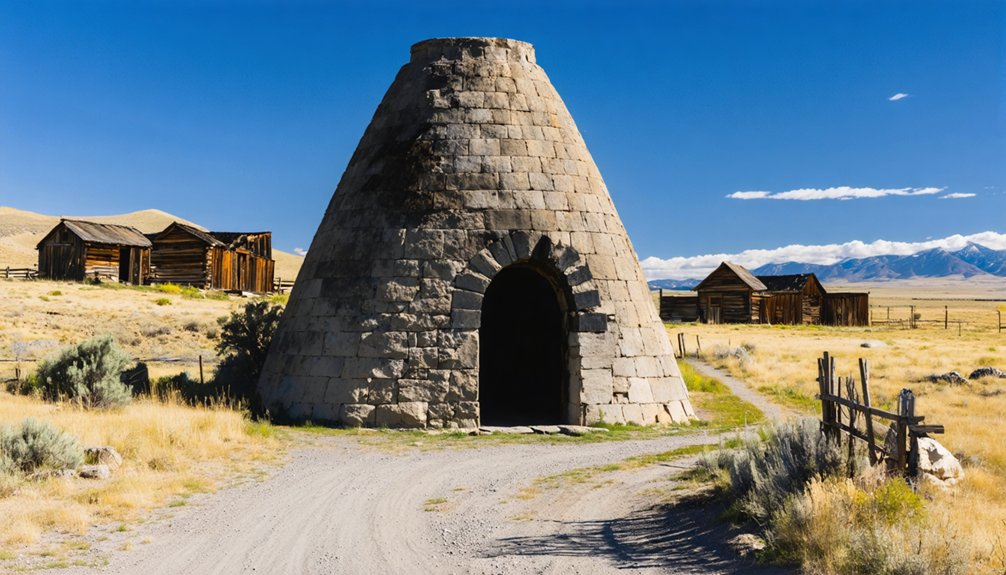
The Canyon Creek Charcoal Kilns stand like ancient sentinels in the Montana wilderness, their beehive shapes rising twenty feet into the mountain air. Built in 1881, these twenty-three brick structures fueled Glendale’s silver empire through ingenious kiln construction—their conical design resisting temperature-induced cracks while controlling burns that transformed lodgepole pine into premium charcoal.
You’ll discover the scale of their wood sourcing operation was staggering: over 11,000 acres of timber consumed, feeding an 1895 output of 1.2 million bushels. Each kiln held forty cords, monitored for eight days as smoke shifted from white to blue.
Walk the self-guided trails where French Canadian woodcutters and Italian burners once labored, their restored kilns now preserved on the National Register—monuments to industrial ambition carved into mountainside freedom.
Trapper City and Lion City: The Forgotten Settlements
Before Hecla claimed its place on Lion Mountain, two settlements rose and fell in rapid succession, their fortunes tied to the restless pursuit of silver veins threading through Trapper Creek’s drainage.
Trapper City emerged first in 1872, originally called Burnt Pine City after wildfires scorched forests three miles south. By 1874, nearly 200 fortune-seekers carved out existence along the creek, building saloons, brothels, and a general store.
Yet the economic impacts proved fleeting—richer ore lay higher up the gulch.
Lion City replaced it by 1877, swelling to 600 residents with:
- Three saloons and two brothels
- Hecla Consolidated Mines operations
- A schoolhouse amid typical mining chaos
- Environmental challenges from constant excavation
Both towns vanished by century’s end, leaving only stone furnaces and ghostly ruins.
Best Time to Visit and Weather Considerations
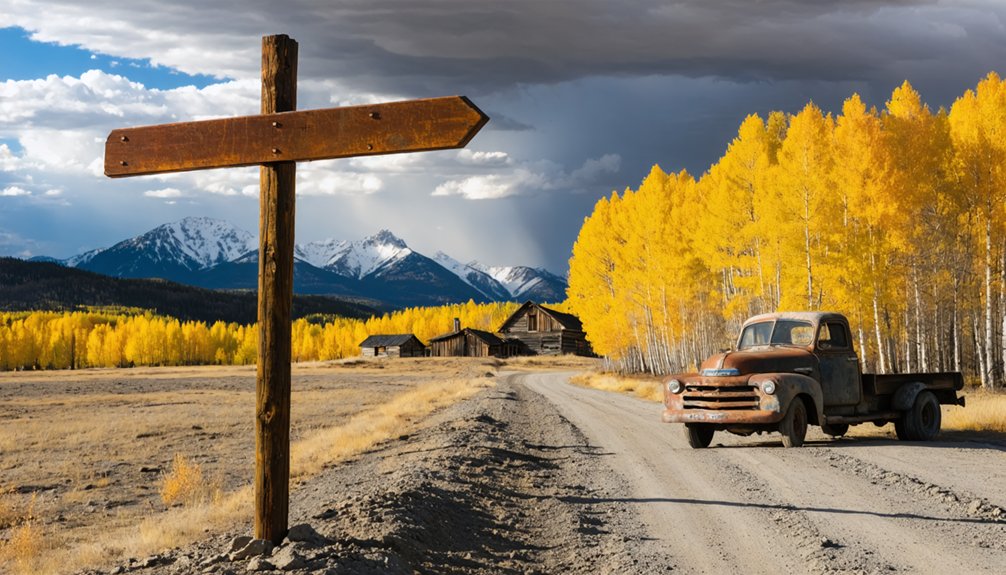
Winter snow accumulation renders Trapper Creek Road impassable without specialized equipment, while spring snowmelt creates treacherous creek crossings and washouts. Weather pattern changes arrive swiftly at elevation—northwest winds funnel through canyons, and afternoon storms materialize without warning. Seasonal accessibility restrictions lift only when summer’s dry conditions stabilize the gravel route from Melrose.
You’ll need that high-clearance vehicle and early morning departure. February through April presents variable ice and flooding risks that’ll strand even experienced backcountry travelers. October offers a final opportunity before winter reclaims this remote territory.
Getting There: Directions and Road Conditions
From I-15’s Exit 93 near Melrose, your journey into Montana’s ghost town country begins where pavement surrenders to primitive gravel. Trapper Creek Road carves westward through untamed terrain, demanding respect and preparation.
Where civilization’s edge meets wilderness, the true Montana experience awaits those willing to trade comfort for authentic discovery.
Essential Route Intelligence:
- Melrose to Glendale: 5 miles reveals smelter ruins and exposed coke ovens
- Glendale to Hecla: Additional 7 rugged miles climbing Lion Mountain’s flank
- Vehicle accessibility: High-clearance 4WD mandatory; ATVs recommended beyond Glendale
- Canyon Creek extension: 11 total miles showcases abandoned charcoal kilns
Seasonal challenges transform these routes dramatically—spring mud and winter snow amplify the primitive conditions. Ten-mile gulch’s steep alignments test both machinery and nerve. Standard vehicles won’t survive the uneven bedrock and washouts. Navigate to coordinates 45°36′20″N 112°55′53″W for Hecla’s final approach, where ghost towns reward the bold.
Photography Tips for Capturing the Ghost Town
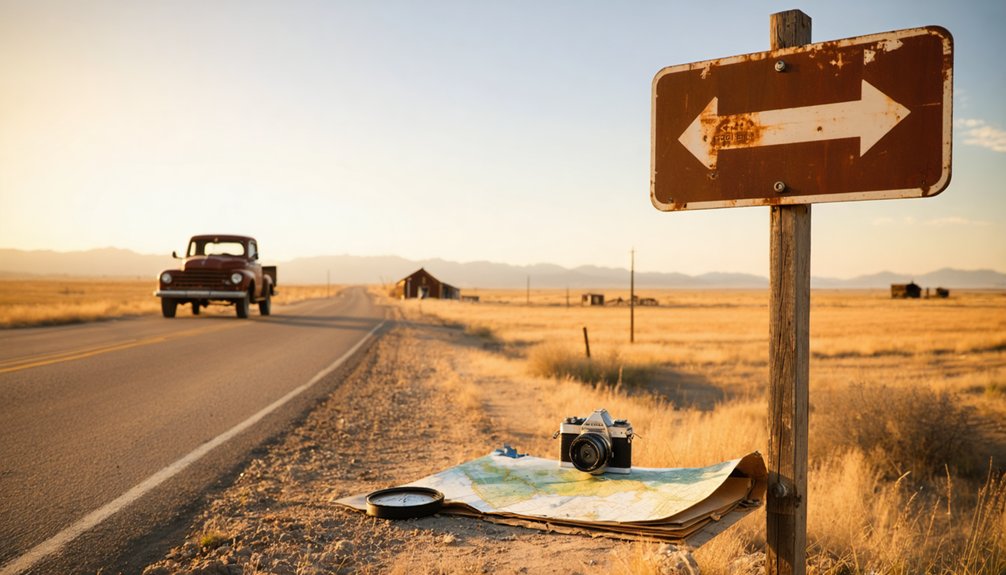
You’ll want to arrive at Hecla’s crumbling cabins and mine adits during golden hour, when dawn or dusk bathes weathered wood in amber light that transforms decay into haunting beauty.
Position your camera low to capture window reflections and foreground details that draw viewers into the frame, using wide-angle lenses to emphasize the stark isolation of structures against Montana’s vast sky.
On overcast days, diffused light eliminates harsh shadows, revealing every nail hole and splintered board in the stamp mill ruins without the contrast that can obscure the texture of a century’s worth of abandonment.
Best Times for Lighting
The towering elevation of Hecla at 9,550 feet dramatically compresses your golden hour window, transforming what would typically be leisurely two-hour shooting sessions into intense 30-45 minute sprints against the sun. Summer’s extended daylight grants you 15-16 hours to explore, but winter’s low angle winter light creates haunting shadows that define every weathered beam and collapsed wall.
The golden hour duration shrinks drastically between seasons, demanding you adapt your approach.
Optimize your lighting strategy:
- Launch predawn missions to catch sunrise golden hour illuminating Lion Mountain’s ruins
- Target September visits for soft fall light at nearby Bannack workshops
- Embrace overcast days for diffused, contrast-reducing conditions on exposed structures
- Exploit snow-covered winters when reflected light brightens cabin undersides naturally
Post-rain clear nights deliver starlit skies perfect for experimental long-exposure work.
Historic Structure Composition Techniques
Mastering light’s fleeting dance across Hecla’s weathered facades means nothing without compositional techniques that transform documentation into art. Your tripod framing techniques anchor stability while you explore doorways and windows as natural frames, drawing viewers deeper into decay’s narrative.
Position yourself to capture S-curves through collapsing hallways or Z-patterns along weathered staircases—these leading line compositions guide eyes through forgotten spaces with deliberate purpose. Shoot wide to embrace entire structures, then isolate distinctive silhouettes against Montana’s vast sky. The old saloon’s crumbling entrance, the church’s skeletal windows—each opening becomes your compositional ally.
Harness negative space around key elements, letting emptiness amplify what remains. You’re not just photographing ruins; you’re choreographing visual stories of abandonment and resilience.
Nearby Attractions and Other Ghost Towns to Explore
Beyond Hecla’s crumbling foundations, a constellation of forgotten mining camps awaits discovery across the Bryant Mining District‘s rugged terrain. You’ll find freedom exploring these interconnected sites where fortune-seekers once carved civilization from wilderness.
Adventure calls through windswept valleys where boom-towns surrendered to silence, leaving only stone foundations as monuments to ambition.
Essential stops on your ghost town circuit:
- Lion City – Fifteen weathered structures stand sentinel 12 miles west at Trapper Creek’s head, where 500-600 souls once gambled in saloons
- Glendale – Montana’s most impressive remnant, featuring a towering smelter stack and ruins from its 2,000-resident heyday
- Canyon Creek Charcoal Kilns – Beehive structures that fed Glendale’s smelter with 100,000 monthly bushels
- Trapper City – Stamp mill ruins scattered along ten miles of gulches
Local wildlife spotting opportunities abound throughout these unique geographical features, where elk and mountain goats reclaim mining territory along Lion Mountain’s 9,550-foot slopes.
Important Rules and Regulations for Visiting
When you’re exploring Hecla’s weathered ruins and abandoned structures, you’ll need to recognize which areas belong to private landowners and which paths you’re legally permitted to travel. The scattered remains of mining camps and smelter buildings tempt curious visitors, but touching, removing, or damaging these fragile historic structures violates preservation laws that protect Montana’s ghost town heritage.
Your adventure depends on treading carefully—both to avoid trespassing on marked private property and to guarantee these century-old buildings survive for future explorers to witness.
Respect Private Property Boundaries
Traversing the weathered trails to Hecla means threading through a patchwork of public and private lands where boundaries aren’t always obvious. The remains of camps like Glendale and Lion Mountain sprawl across mixed ownership, while sites like Cable and Castle sit entirely on private property.
You’ll need to respect private land ownership and preserve historical integrity by staying vigilant about where you’re allowed to roam.
Essential boundary protocols:
- Never enter areas with posted signage – private landowners legally restrict access to mining camps and structures
- Verify land status before exploring – many ghost town buildings and mines remain privately owned
- Stick to established routes – historical access disputes led to arrests for unauthorized road use
- Leave all artifacts untouched – disturbing property invites removal and legal consequences
Stay on Designated Paths
The rugged paths that lead to Hecla’s weathered remains aren’t just suggestions—they’re essential corridors through a fragile landscape still recovering from nineteenth-century devastation. When miners stripped Lion Mountain bare to fuel smelters in the 1890s, they left behind a denuded wilderness now struggling to reclaim itself.
You’ll thread through regrowth timber along tramway routes and historical roads, your wheels tracing the same passages that once connected Hecla’s cabins to the mill below. Venture off-trail and you’ll risk damaging both habitat preservation efforts and archeological conservation zones protecting twenty miles of underground tunnels and scattered mining structures.
These designated paths aren’t restrictions—they’re your gateway to exploring freely while ensuring Hecla’s ghostly remnants survive for future adventurers seeking their own discoveries.
Preserve Historical Structures
Hecla’s weathered cabins and crumbling mill structures stand as fragile monuments to 1890s ambition, and your footsteps around them carry weight beyond the physical. These historic architectural elements won’t survive careless exploration—preservation funding sources can’t restore what vandalism destroys.
Your role as a responsible explorer means:
- Never remove artifacts from buildings or grounds, even seemingly worthless items
- Avoid touching deteriorating walls that centuries of Montana weather have weakened
- Document with photography only, leaving structures exactly as you found them
- Report vandalism or damage to local preservation authorities immediately
Touch nothing but memories. These structures survived over a century through Montana’s harshest elements—don’t let your visit become their downfall. Future adventurers deserve the same discovery you’re experiencing today.
Frequently Asked Questions
Are There Any Restaurants or Gas Stations Near Hecla Ghost Town?
No restaurants or gas stations exist near Hecla’s remote ruins. You’ll need to fuel up beforehand and pack supplies, as local food options and nearby convenience stores lie 100+ miles away in towns like Emigrant, demanding careful preparation for your wilderness adventure.
Can I Camp Overnight at the Hecla or Glendale Sites?
Ironically, ghost towns can’t host living campers—overnight camping policies prohibit staying at Hecla or Glendale sites themselves. You’ll find freedom exploring nearby camping options in surrounding national forests, where designated campgrounds welcome adventurers seeking authentic Montana wilderness experiences.
For those intrigued by Montana’s history, exploring ghost towns near Bighorn Montana can provide a fascinating glimpse into the past. After a day of hiking and camping, visitors can delve into the stories behind these abandoned settlements, enriching their outdoor experience. The rugged beauty of the landscape paired with historical exploration creates a unique adventure that truly embodies the spirit of the region.
Is Cell Phone Service Available in the Ghost Town Area?
Don’t count on it. Cell tower coverage vanishes in these remote areas, and signal strength becomes nonexistent. You’ll be truly off-grid here—embrace the disconnection and experience Montana’s wilderness exactly as those early settlers did.
Are Guided Tours of Hecla and Surrounding Sites Available?
No guided tours are offered year-round at Hecla—you’ll explore independently. Unlike preserved ghost towns with guided walking tours of historical buildings, Hecla’s remote ruins await your self-directed adventure through wild, unmanaged terrain where freedom reigns supreme.
What Should I Bring for a Day Trip to Hecla?
Bring binoculars, boots, and basic hiking gear for traversing deteriorated structures at 10,000 feet. Pack water, weather-appropriate layers, and cameras to capture historical artifacts. You’ll need a four-wheel drive vehicle for primitive roads leading to freedom.
References
- https://www.legendsofamerica.com/mt-hecla/
- https://westernmininghistory.com/towns/montana/hecla/
- https://www.youtube.com/watch?v=R25NzGN_u_4
- https://montanahistoriclandscape.com/tag/hecla-smelter/
- https://www.glendalemontana.com
- https://freepages.history.rootsweb.com/~gtusa/usa/id/burke.htm
- https://kids.kiddle.co/Hecla
- https://republicofmining.com/2015/05/21/hecla-mining-company-history-1891-1998/
- https://www.hecla.com/wp-content/uploads/Hecla-company-history-HMC-125Years.pdf
- https://cdapress.com/news/2016/feb/14/hecla-mining-125-years-old-and-not-slowing-5/