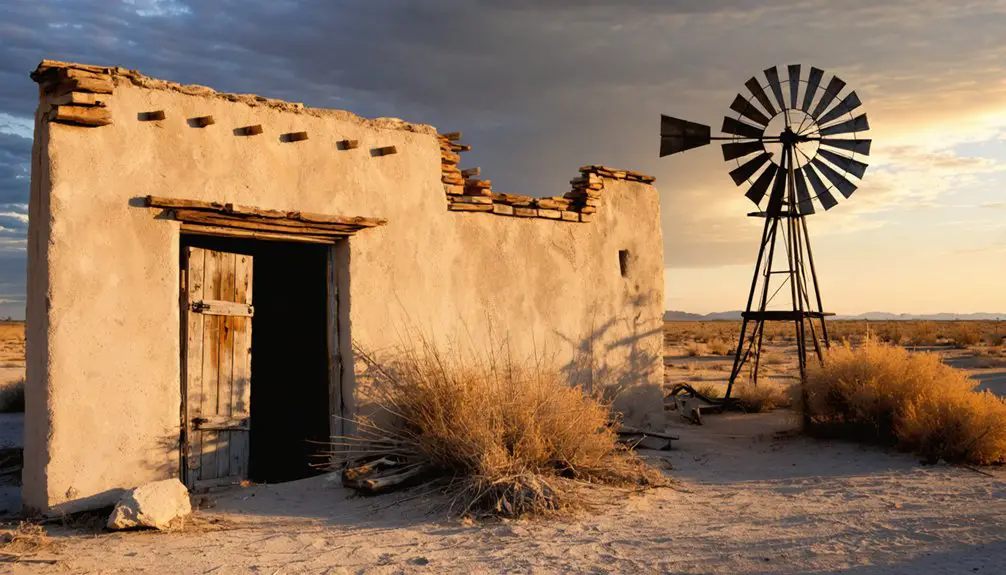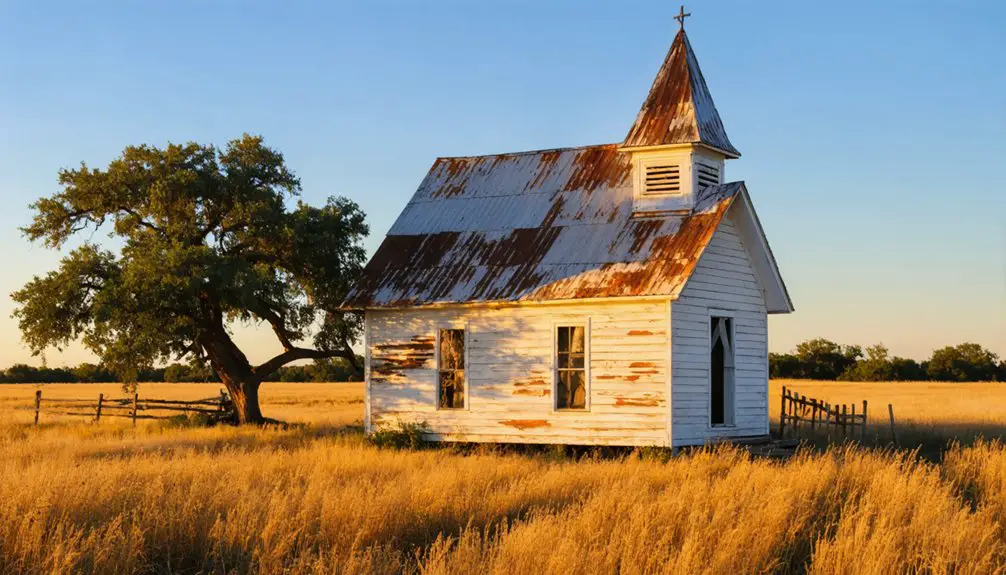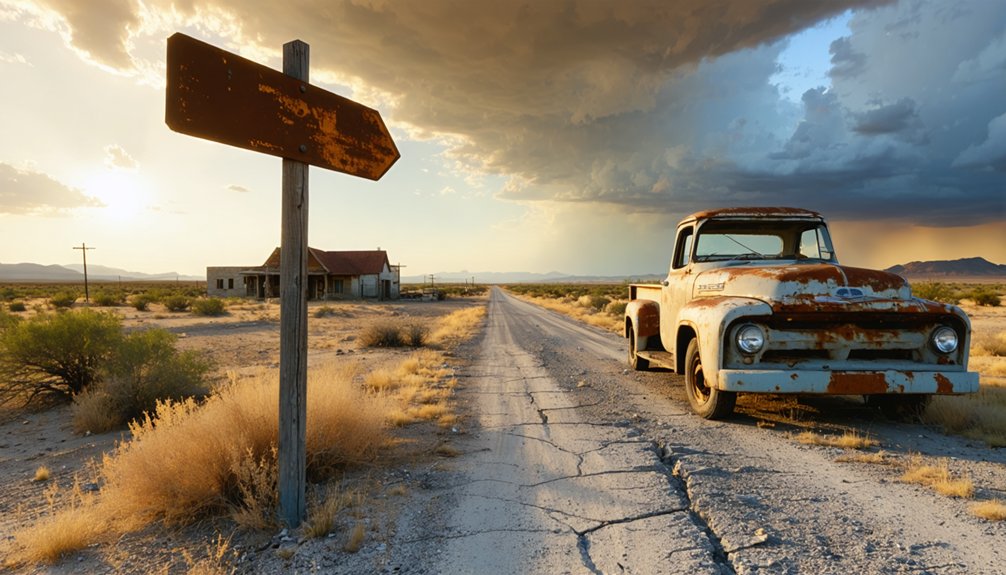
Your ghost town road trip to Hedwigs Hill starts five miles south of Art, Texas, where limestone foundations and cedar breaks mark this 1853 German settlement at 1,286 feet elevation. You’ll find minimal signage, so use coordinates N30.66574° W99.11200° to locate the weathered remains along the old Fredericksburg-Fort Mason road. Bring sturdy boots for exploring scattered homestead sites, and pack water—this remote Hill Country location offers no amenities but rewards you with authentic frontier history, including the preserved dogtrot house that survived Louis Martin’s tragic 1864 ambush story.
Key Takeaways
- Located 5 miles south of Art, Texas at coordinates N30.66574° W99.11200° with minimal signage in Mason County’s Hill Country.
- Visit weathered limestone foundations and fence posts marking the 1853 German settlement founded by Louis Martin and Christopher Voges.
- Explore sites near Loyal Valley and Cherry Spring along the historic Fredericksburg-Fort Mason road at 1,286 feet elevation.
- Learn about Louis Martin’s 1864 gold ambush tragedy and view his preserved dogtrot house at Lubbock’s National Ranching Heritage Center.
- Expect limited facilities and remote terrain with cedar breaks and limestone outcrops throughout this unincorporated ghost town area.
Getting to Hedwigs Hill: Routes and Directions
Finding Hedwigs Hill requires traversing the rolling terrain of Mason County’s Hill Country, where U.S. Highway 87 serves as your primary lifeline through open ranchland. You’ll navigate five miles south of Art, Texas, watching for minimal directional signage—ghost towns don’t advertise themselves.
At 1,286 feet elevation, the landscape shifts between cedar breaks and limestone outcrops, with regional landmarks like Loyal Valley and Cherry Spring dotting your route. Download offline maps before departing; cell service here’s unpredictable. The coordinates N30.66574° W99.11200° pinpoint this unincorporated community precisely.
You’re entering Central Texas authenticity—no tourist traps, just weathered structures and ranch gates. Keep your fuel tank full and expectations flexible. This isn’t a destination you stumble upon; it’s one you deliberately seek.
The Story Behind This 1853 German Settlement
Long before this land became a forgotten whisper on Mason County maps, two German immigrants—Louis Martin and Christopher Voges—staked their claim here in 1853, carving homesteads from Hill Country limestone and cedar. Martin named the settlement for the two Hedwigs in his life—his mother and daughter—honoring spiritual/cultural traditions that stretched across the Atlantic.
Two German pioneers carved homesteads from limestone and cedar, naming their 1853 settlement for Martin’s mother and daughter—both named Hedwig.
These Adelsverein settlers brought more than farming tools:
- Agricultural practices transforming wild Llano River bottomland into productive fields of corn and grazing pastures
- Freight-hauling operations connecting remote frontier outposts to civilization’s edge
- German community bonds that sustained families through Comanche raids and Civil War chaos
You’ll find their legacy along that old Fredericksburg-Fort Mason road, where independence-minded pioneers chose freedom over comfort.
What Remains: Ghost Town Features and Historic Sites
The limestone foundations and weathered fence posts scattered across Hedwigs Hill tell a survival story that defies typical ghost town narratives. You’ll discover the significance of homestead foundations as tangible connections to 1853 German settlers who transformed this Hill Country landscape.
The dogtrot house built by John Kline—later Louis Martin’s home—now stands preserved at the National Ranching Heritage Center, having been relocated in 1971. Architectural preservation challenges become apparent when you explore the remaining structures along Highway 87.
Original German building techniques visible in stone walls and timber framing showcase immigrant craftsmanship that’s increasingly rare. Multiple foundation sites dot the area, each marking family farms that anchored this community. Unlike abandoned ruins elsewhere, these remnants exist alongside working ranches—history breathing through an active landscape.
Louis Martin’s Legacy and the Tragic Gold Ambush
On June 16, 1864, Confederate deserters ambushed him at Eagle Pass:
- He’d hidden gold beneath bacon loads returning from Piedras Negras
- Robbers hanged him and partner Eugene Frantzen on the roadside
- His widow recovered their bodies for burial in Fredericksburg’s Der Stadt Friedhof
You’ll find his dogtrot house, moved in 1971, standing as commemoration to dreams cut short by war’s lawlessness.
The Preserved Dogtrot House at National Ranching Heritage Center
Standing proudly at Lubbock’s National Ranching Heritage Center, Louis Martin’s dogtrot house tells its story through hand-hewn logs and weathered cypress beams. Built around 1855-56, this authentic structure showcases the architectural design German settlers perfected for Texas Hill Country living—two cabins connected by an open breezeway that caught every precious breeze.
You’ll find it among 50+ historic structures along the center’s 1.5-mile trail at Texas Tech’s campus. The construction techniques reveal Martin’s resourcefulness: local timber shaped by hand, dovetailed corners holding strong after 170 years. That central breezeway wasn’t just clever ventilation—it separated cooking heat from sleeping quarters and gave families breathing room.
Visit free, 10 a.m.-5 p.m. daily. Walk through genuine frontier independence, where self-reliance met practical ingenuity.
Best Time to Visit and What to Bring
Planning your journey to Hedwigs Hill requires timing that balances Texas’s punishing desert extremes with the gear to survive them. You’ll want to aim for those sweet spring months between March and May, when wildflowers paint the Big Bend landscape and temperatures hover in the comfortable 70s and 80s—I learned this the hard way after August’s relentless 105°F heat nearly sent me back to my air-conditioned truck before exploring a single ruin.
Pack layers for the dramatic day-night temperature swings, at least three liters of water per person, and sturdy boots for traversing crumbling structures scattered across uneven terrain.
Optimal Seasons for Exploring
Timing your visit to Hedwigs Hill can mean the difference between a sweltering trudge through overgrown ruins and a perfect afternoon spent photographing century-old limestone foundations beneath cloudless skies.
Three seasons stand out for ghost town exploration:
- Spring (early March or late April) – You’ll catch prime wildflower seasons with bluebonnets framing abandoned structures, though you’ll need advance bookings to secure your basecamp.
- Fall (October-early November) – Ideal hiking conditions arrive with mild temperatures and fewer crowds. The rusted metal and weathered wood of Hedwigs Hill look stunning against autumn foliage.
- Winter (December-February) – Frosty mornings create atmospheric mist around crumbling buildings, and you’ll have the place virtually to yourself for uninterrupted exploration and stargazing.
Pack layers regardless of season—Texas weather shifts quickly.
Essential Road Trip Gear
Before you turn the ignition for Hedwigs Hill, spreading your gear across the garage floor saves you from discovering critical gaps when you’re fifty miles from the nearest hardware store.
Pack a duffle with quick-dry shirts and hiking pants—lightweight fabrics dry on your dashboard while you’re exploring crumbling foundations. Your backpack doubles as a daypack for prowling abandoned structures, while packing cubes keep trail runners separate from your headlamp and first aid kit.
Using multipurpose gear means your bandana works as a dust mask in decrepit buildings or a washcloth at camp. Don’t skip the jumper cables—cell service vanishes out here.
Toss in a road atlas, because GPS fails when you’re chasing unmarked dirt roads between mesquite thickets and forgotten homesteads.
Frequently Asked Questions
Are There Any Accommodations or Camping Options Near Hedwigs Hill?
You’ll find nearest lodging options in nearby New Braunfels, featuring riverfront cabins and vacation rentals. Local campground availability includes Guadalupe River Paradise with pools and private river access, perfect for your adventurous spirit seeking authentic Texas freedom.
Is the Llano River Accessible for Swimming or Fishing Activities?
You’ll find the Llano River laughably pristine—imagine that, actual clean water! Spring-fed sections offer excellent swimming and fishing year-round. Check seasonal flow rates and river water quality beforehand, though March through October delivers your best freedom-seeking adventure conditions.
Do I Need Permission to Explore Private Property in Hedwigs Hill?
Yes, you absolutely need private landowner consent before exploring Hedwigs Hill’s ranches. Respect property boundaries—trespassing risks fines and jail time. Connect with local historic preservation efforts through Mason County records to find willing owners who’ll share stories.
Are There Guided Tours Available for the Ghost Town Area?
No guided tours operate at Hedwigs Hill—you’re free to explore independently. Unlike Terlingua’s self-guided walking tours or historical reenactment events elsewhere, this dispersed settlement offers raw, unstructured discovery. You’ll navigate history on your own terms.
What Other Ghost Towns Can I Visit Near Hedwigs Hill?
You’ll find Loyal Valley and Hilda nearby, showcasing historical significance of local ghost towns. Their unique architectural features of abandoned buildings tell stories of Texas pioneers. Each site offers authentic exploration without restrictions—perfect for your independent adventure through Mason County’s forgotten settlements.
As you explore ghost towns in Texas, you’ll encounter remnants of a bygone era that evoke a sense of nostalgia. The eerie silence juxtaposed with the whispers of history creates an atmosphere perfect for photography and reflection. Don’t forget to bring a map—these hidden gems require a keen eye to fully appreciate their allure.