Planning a ghost town road trip to Hillsboro, New Mexico starts with Exit 83 off I-25, then 17 miles west on NM-152. Base yourself in Truth or Consequences, where you’ll find lodging, restaurants, and hot spring spas. Hillsboro’s historic core is walkable, free, and self-guided — adobe homes, Victorian buildings, and courthouse ruins tell the whole story. It’s not a true ghost town, though. Stick around, and you’ll discover why that makes it even more fascinating.
Key Takeaways
- Reach Hillsboro via Exit 83 off I-25, then drive 17 miles west on NM-152 through open desert terrain.
- Base yourself in Truth or Consequences, 17 miles east, where restaurants, motels, and hot spring spas are available.
- Explore Hillsboro’s walkable historic core, featuring adobe homes, Victorian buildings, courthouse ruins, and the Black Range Museum.
- Combine nearby ghost towns—Kingston, Chloride, Lake Valley, and Mogollon—into a one or two-day regional loop.
- Visit during Labor Day weekend for the Apple Festival, which includes local crafts, historic tours, and community celebrations.
Is Hillsboro, New Mexico Actually a Ghost Town?
Technically, Hillsboro isn’t a true ghost town — it’s still home to a small but persistent community of roughly 80 to 225 residents, depending on the source. But don’t let that stop you from making the trip.
Hillsboro isn’t a true ghost town — but with only a few hundred souls, it’s close enough to count.
The town carries the unmistakable weight of a place that once roared with ambition and then went quiet.
You’ll find historic architecture frozen somewhere between decay and preservation — adobe walls, Victorian-era buildings, and courthouse ruins that still hold stories.
Local legends tied to frontier violence, silver strikes, and old trials give the place a haunted quality that no abandoned town could manufacture.
Hillsboro isn’t dead, but it’s not exactly bustling either. That in-between state is precisely what makes it worth your time.
How Hillsboro Went From Gold Rush Camp to County Seat
The story behind that quiet, in-between atmosphere starts in April 1877, when prospectors Dan Dugan and Dave Stitzel staked gold claims near Percha Creek on the east side of the Black Range. Their early strikes, including the Opportunity and Ready Pay mines, triggered rapid settlement.
Within years, Hillsboro’s mining history transformed a tent camp into a structured frontier town. By 1880, it had four saloons, four grocery stores, and a post office.
By 1884, it became Sierra County’s seat of government.
Three milestones shaped that transformation:
- Gold discovery launched permanent settlement in 1877
- Population swelled to roughly 2,000 by the early 1890s
- The 1892 courthouse anchored architectural preservation efforts still visible today
That courthouse ruin remains one of Hillsboro’s most compelling stops.
What Happened to Hillsboro After the Boom Collapsed
Hillsboro’s boom didn’t fade quietly — it collapsed in stages. Economic decline hit hard in the early 1890s when mining production weakened and investment dried up. Then the devastating June 1914 flood swept through, wiping out infrastructure the town couldn’t easily rebuild.
Hillsboro didn’t just decline — it was dismantled, blow by blow, until almost nothing was left standing.
Population decline followed each blow, as families and workers simply moved on to better opportunities elsewhere.
World War I briefly revived activity, but the 1930s brought another downturn. The final symbolic loss came in 1938 when Sierra County relocated its seat to Hot Springs, stripping Hillsboro of its last major civic role.
What remained was a small, stubborn community — ranchers, farmers, and a few holdouts who refused to leave. That resilience is exactly what you’ll feel when you walk its quiet streets today.
What You’ll Actually See Walking Through Hillsboro Today
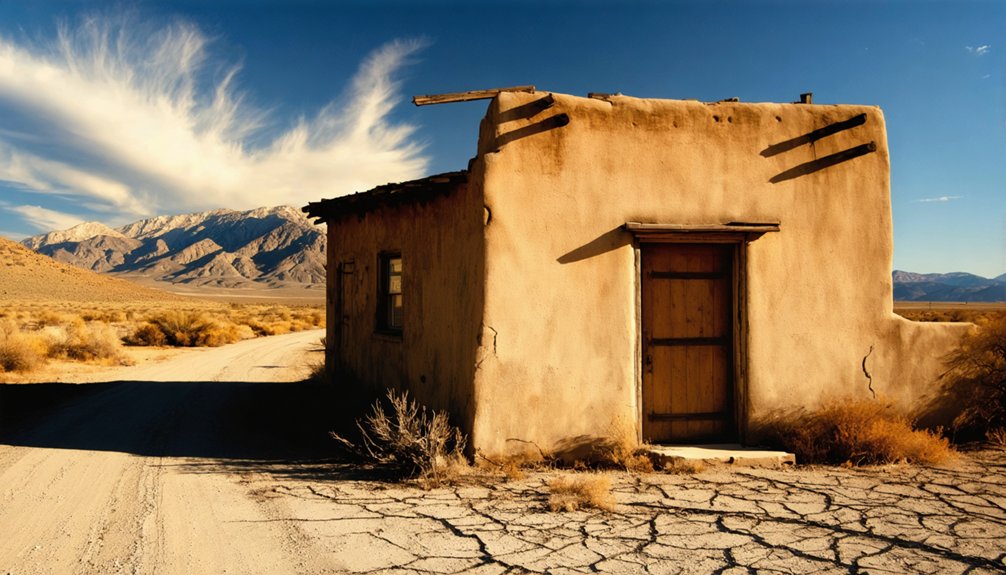
Walking through Hillsboro today, you’ll find a compact, historic core that’s easy to cover on foot — adobe homes, Victorian-era buildings, and the crumbling remnants of the 1892 courthouse that once anchored Sierra County’s legal life.
The town’s historic architecture tells the story of a community that boomed, struggled, and survived on its own terms.
Three stops anchor any good walkthrough:
- Black Range Museum — packed with mining history, artifacts, and local lore
- Courthouse ruins — a raw, atmospheric reminder of Hillsboro’s frontier legal past
- Main Street adobes — original structures that give the town its preserved Old West character
You won’t need a tour guide. Hillsboro rewards the curious traveler who simply shows up and wanders freely.
How to Get to Hillsboro From I-25
Getting to Hillsboro is straightforward: take Exit 83 off I-25 and follow NM-152 west for about 17 miles through open desert and rolling terrain before the town appears quietly at the road’s edge.
The drive itself sets the tone — wide skies, sparse traffic, and a landscape that hasn’t changed much since prospectors first pushed through here chasing gold. You won’t need a guide or a tour group. Just follow the road until the adobe architecture starts emerging between the trees.
Park anywhere along the main stretch and walk from there. The town is compact and entirely explorable on foot. Every building carries a trace of mining history, and the unhurried pace rewards travelers who prefer discovery over crowds.
No reservations required — just show up.
The Hillsboro Events Worth Planning Your Trip Around
If you time your visit right, you’ll catch one of Hillsboro’s standout community events. The Annual Apple Festival draws the biggest crowds, celebrating the region’s orchard heritage with local vendors and festivities.
You can also plan around Christmas in the Foothills for a seasonal small-town experience, or check the schedule for the town’s monthly music gatherings if you’re after something more low-key.
The Annual Apple Festival
Hillsboro’s biggest annual draw is the Apple Festival, a Labor Day weekend celebration that transforms this quiet little town into a lively gathering point for locals and visitors from across the region. You’ll find vendors, live music, and a genuine sense of community pride rooted in Hillsboro’s rugged past.
The festival also highlights the town’s commitment to architectural preservation and its rich mining history through exhibits and guided experiences.
Here’s what you can expect:
- Local artisan vendors selling handcrafted goods and fresh apple products
- Live entertainment ranging from folk to country music performances
- Historic tours showcasing adobe structures and mining-era landmarks
Plan your arrival early to secure parking and explore the town before the crowds settle in.
Christmas In The Foothills
When the holiday season arrives, Hillsboro trades its sun-baked quiet for something warmer — Christmas in the Foothills, a community celebration that fills the town’s historic adobe streets with lights, music, and seasonal cheer.
You’ll find the town’s historic architecture transformed by warm glows that highlight century-old walls once built during the height of its mining history. Local residents open their doors, vendors gather, and live music drifts through the crisp mountain air.
It’s an intimate event — nothing overproduced or corporate — just a small, proud community celebrating the season on its own terms. If you’re planning a winter road trip through southern New Mexico, timing your visit around Christmas in the Foothills gives you Hillsboro at its most welcoming.
Monthly Music Gatherings
Beyond the Apple Festival and holiday celebrations, Hillsboro keeps its calendar alive with monthly music gatherings that give you a reason to visit no matter the season. These informal events blend community spirit with the town’s commitment to historic preservation, letting you experience authentic small-town culture in a setting shaped by mining history.
When you attend, you can expect:
- Live local performances in intimate venues that reflect Hillsboro’s preserved Old West character
- Community storytelling connecting music to the town’s frontier past and mining heritage
- Open, relaxed atmospheres where locals and travelers mingle freely without pretension
These gatherings aren’t polished productions — they’re genuine.
You’ll leave with a real sense of what makes Hillsboro worth protecting, revisiting, and sharing with anyone craving an honest road trip destination.
The Closest Restaurants, Lodging, and Day Trips to Hillsboro
Though Hillsboro itself offers limited dining and overnight options, you’ll find solid choices within a short drive.
Truth or Consequences, about 17 miles east via I-25, serves as your best base. The city offers diverse restaurants, motels, bed-and-breakfasts, and hot spring spas that make it a worthy overnight stop.
For day trips, nearby Kingston sits just 8 miles west and echoes Hillsboro’s own mining history and population decline through its quiet, tree-lined streets.
Elephant Butte Lake State Park offers boating and camping just minutes from Truth or Consequences.
White Sands National Park lies roughly 90 minutes south, making it an easy addition to your southern New Mexico loop.
You’ve got real freedom to shape the route however it suits you.
Four New Mexico Ghost Towns Worth Pairing With a Hillsboro Visit
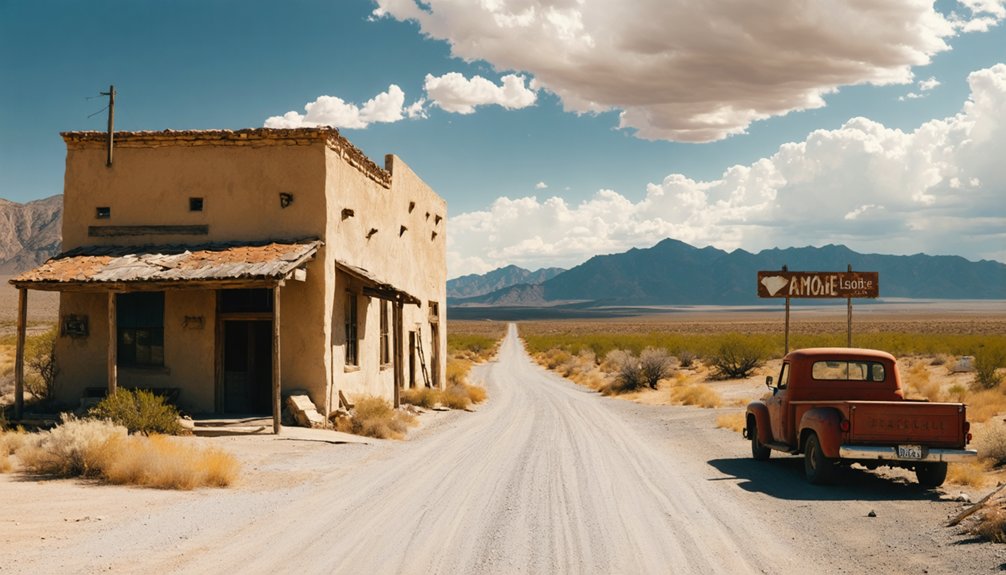
If you’re already making the drive to Hillsboro, pairing it with a few nearby ghost towns turns a single stop into a full southern New Mexico road trip. Towns like Chloride, Winston, Kingston, and Mogollon each offer their own slice of mining-era history, from crumbling storefronts to abandoned mills tucked into mountain canyons.
You can loop through several of them in a day or two, since the routes connecting these towns wind through some of the most scenic stretches of the Black Range and Gila country.
Nearby Ghost Towns Overview
Hillsboro makes a natural anchor for a wider ghost town road trip, since several abandoned or near-abandoned mining communities sit within reasonable driving distance across southern New Mexico. You can trace the region’s mining legacy through crumbling structures, forgotten streets, and historical architecture that still tells the story of boom-and-bust frontier life.
Consider pairing Hillsboro with these nearby stops:
- Chloride – A silver mining settlement with standing buildings and strong preservation efforts just north of Hillsboro.
- Kingston – Once a booming silver town, now reduced to a handful of residents and weathered remnants.
- Lake Valley – A near-deserted site featuring a restored chapel and scattered ruins tied to rich silver production.
Each destination adds depth to your southern New Mexico road trip.
What Each Town Offers
Each of these nearby towns brings something distinct to the road trip, so knowing what to expect helps you plan your time well. Chloride delivers raw mining heritage through collapsed storefronts and a small pioneer museum that actually stays open.
Kingston offers shaded canyon scenery alongside crumbling historical architecture that recalls its silver-rush heyday. Winston sits quiet and largely untouched, rewarding visitors who simply want to feel genuine isolation without crowds or entry fees.
Mogollon, perched in the Gila Wilderness, gives you dramatic mountain terrain combined with well-preserved buildings that photograph beautifully in any season.
Together, these four towns let you move at your own pace, choosing depth over quantity or covering all of them across a loose two-day loop through southern New Mexico’s high desert.
Planning Your Route
Pairing Hillsboro with a few nearby ghost towns turns a single stop into a full southern New Mexico road trip worth planning around. You’ll move through landscapes shaped by historical preservation efforts and community resilience, connecting towns that refused to disappear entirely.
Start your loop using I-25 as your spine, then branch west into the Black Range. Consider this order:
- Truth or Consequences – a logical base camp before heading into the hills
- Hillsboro – your central stop, about 17 miles off I-25
- Kingston – just 8 miles west, another Sierra County silver camp worth exploring
Keep your schedule loose. These roads reward slow driving, and the stories between stops matter just as much as the destinations themselves.
Frequently Asked Questions
Who Were the Original Prospectors That First Discovered Gold in Hillsboro?
Like pioneers chasing destiny, Dan Dugan and Dave Stitzel are the prospector legends you’ll want to know — they first struck gold near Percha Creek in 1877, using early mining techniques that sparked Hillsboro’s incredible boom.
What Were the Names of Hillsboro’s First Gold Mining Claims?
You’ll discover Hillsboro’s first gold mining claims were the Opportunity and Ready Pay mines. As you explore the ghost town architecture and mining equipment remnants, you’re walking ground where history-making wealth was first unearthed.
How Did Hillsboro, New Mexico Actually Get Its Name?
Like names drawn from a hat on a dusty frontier, Hillsboro’s identity was literally chosen by chance — someone pulled “Hillsborough” from a hat in 1877, though ghost town tours also link it to Joe Yankie’s Ohio hometown.
How Much Gold and Silver Did Hillsboro’s Mines Produce Total?
You’ll find that Hillsboro’s mines produced around $6 million in gold and silver total. Advanced mining technology drove that impressive output, and today ghost town preservation efforts keep this remarkable, freedom-inspiring legacy alive for your exploration.
What Was Hillsboro’s Population at Its Peak During the Boom Years?
At its peak, you’re looking at a town bursting at the seams — roughly 2,000 residents in the early 1890s. Today, Hillsboro’s ghost town preservation and historic architecture keep that booming spirit beautifully alive.
References
- https://epcc.libguides.com/c.php?g=754275&p=5406024
- https://cityofdust.blogspot.com/2014/08/this-is-not-ghost-town-hillsboro-nm.html
- https://www.youtube.com/watch?v=KNBpAP4pYWk
- https://mikelbclassen.com/2020/02/19/historic-hillsboro-in-new-mexico/
- https://elchuqueno.com/city-of-dust-hillsboro-new-mexico/
- https://www.newmexico.org/places-to-visit/ghost-towns/hillsboro/
- https://www.ghosttowns.com/states/nm/hillsboro.html
- https://coloradosghosttowns.com/Hillsboro NM.html
- https://www.facebook.com/groups/americansouthwest/posts/1602232500406218/
- https://npgallery.nps.gov/GetAsset/1d2d83c0-6080-429a-8bcb-bec916729401