You’ll find Holt’s ruins deep in Angelina National Forest, Jasper County, accessible via a 3-mile trail from Boykin Springs Recreation Area. Pack sturdy boots and insect repellent before heading roughly an hour east of Houston into the East Texas Piney Woods. The hike leads you through thick forest to scattered concrete foundations, the landmark Holt School building, and a haunting cemetery with weather-worn headstones. This timber town flourished during the early 1900s before economic decline reclaimed it to nature, and there’s considerably more to discover about its fascinating rise and atmospheric fall.
Key Takeaways
- Holt is located in Angelina National Forest, Jasper County, approximately one hour east of Houston via rural highways.
- Access the ghost town via a 3-mile trail starting from Boykin Springs Recreation Area within the national forest.
- Key attractions include the Texas Historic Landmark school building, Holt Cemetery with weathered headstones, and scattered industrial sawmill ruins.
- Wear sturdy boots for navigating crumbling foundations and bring insect repellent due to mosquitoes in the reclaimed forest.
- Explore nearby ghost towns like Lenorah or authentic East Texas communities such as Cherokee County’s Bulah for extended road trips.
Where to Find Holt in the East Texas Piney Woods
The ghost town of Holt lies hidden in the heart of East Texas’s Piney Woods, a vast 23,500-square-mile region where towering loblolly and shortleaf pines cast shadows over forgotten settlements. You’ll find this abandoned community nestled within Cherokee County, accessible through highways leading one hour east of Houston. The nearest towns—Lufkin, Nacogdoches, and Huntsville—serve as staging points for your exploration.
Dense forests and year-round creeks surround the site, creating an atmospheric backdrop for discovering ghost town history. Tourist information reveals the area’s rich timber heritage, though modern maps rarely acknowledge Holt’s existence. Navigate through national forests like Angelina and Davy Crockett to reach this forsaken outpost. The U.S. Forest Service maintains these forests, ensuring trails remain accessible for ghost town seekers. The rolling terrain and mixed hardwoods make locating Holt challenging yet rewarding for adventurers seeking off-grid discoveries. Loblolly pines grow 80 to 100 feet tall throughout these woodlands, forming the canopy above the abandoned structures.
The Rise and Fall of a Timber Boom Settlement
Between 1830 and 1859, hardy pioneers carved out homesteads along the Yellow and Blackwater rivers, establishing what would become Holt through sheer determination and backwoods ingenuity.
You’ll discover how Mart’s Mill transformed subsistence living into commercial prosperity during the mid-1850s, shipping timber down the Yellow River to Bagdad.
The W. T. Smith & Sons Timber Company’s 1909 arrival sparked Holt’s golden era—railroad access brought supplies, a 12-inch well secured water, and optimism ran high enough for incorporation in 1913. However, the city unincorporated in 1914 after residents found self-governance “too much trouble.”
But economic shift challenges hit hard when timber depleted. While heavy machinery like Holt’s crawler-type tractors revolutionized construction and agriculture elsewhere, Community resilience strategies emerged through pecan groves, blueberry orchards, and tung tree plantations, yet none matched lumber’s prosperity.
Mapping Your Route Through Deep East Texas
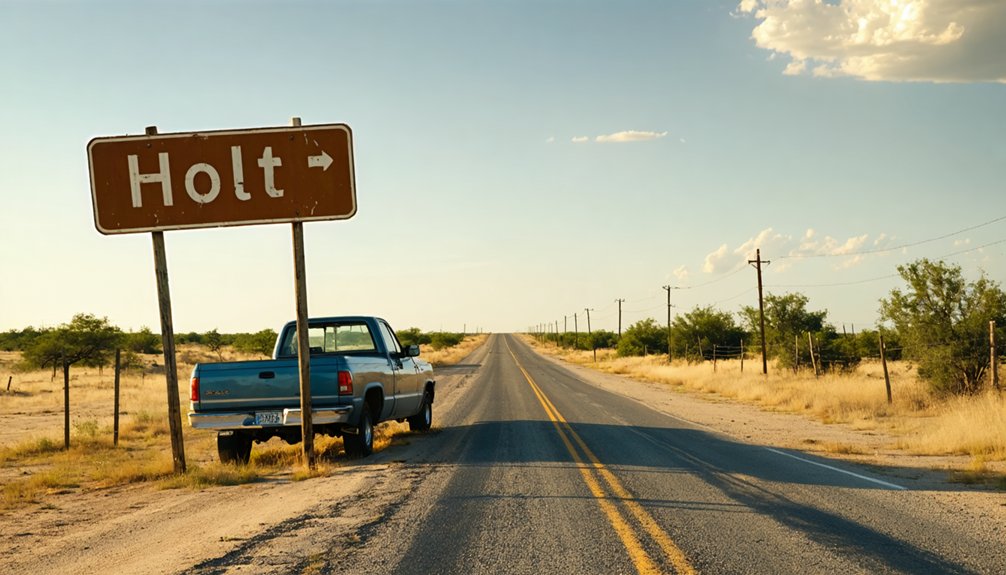
Planning your journey to Holt requires understanding a geographical puzzle: despite this article’s “Deep East Texas” framing, Holt actually sits 450 miles northwest in Hutchinson County’s windswept Panhandle plains. You’ll traverse vastly different landscapes—from Piney Woods forests along US 69 through rolling Cherokee County terrain, then northwest via US 287 into open grasslands.
This distance liberates you from crowded highways, offering rural road connections that few modern travelers experience. Hutchinson County’s preserved historical documents reveal Holt’s cemetery and markers still standing, accessible via US 67. Along your route, consider a stop at Lenorah, located at the junction of SH 176 and FM 829 in Martin County. For another dispersed rural community experience, explore Henrys Chapel in Cherokee County.
If you’re craving authentic Deep East Texas ghost towns instead, redirect to Cherokee County’s Bulah (FM 23, eight miles southwest of Rusk) or Gent’s mill remnants. Either route promises freedom from conventional tourism.
What Still Stands Among the Ruins
When you arrive at Holt, you’ll find the landscape has almost entirely surrendered to nature—thick forest now blankets where the post office, elementary school, and country store once bustled with activity.
The Holt Cemetery on the west side of Highway 147 stands as the primary evidence, witness, or proof to the community’s existence, its weathered markers offering silent stories of families who called this place home. Beyond these grave stones, the towering pines have reclaimed everything else, leaving no other structures or ruins visible among the undergrowth.
Like other Texas ghost towns such as Independence, where refusal of railroad access led to decline, or Glenrio, where the rerouting of transportation routes sealed its fate, Holt’s disappearance reflects the fragile nature of rural communities dependent on shifting economic forces. Founded in the late 1800s, this settlement in deep east Texas served as a vital hub for Shelby County before fading into obscurity.
Crumbling Structures and Foundations
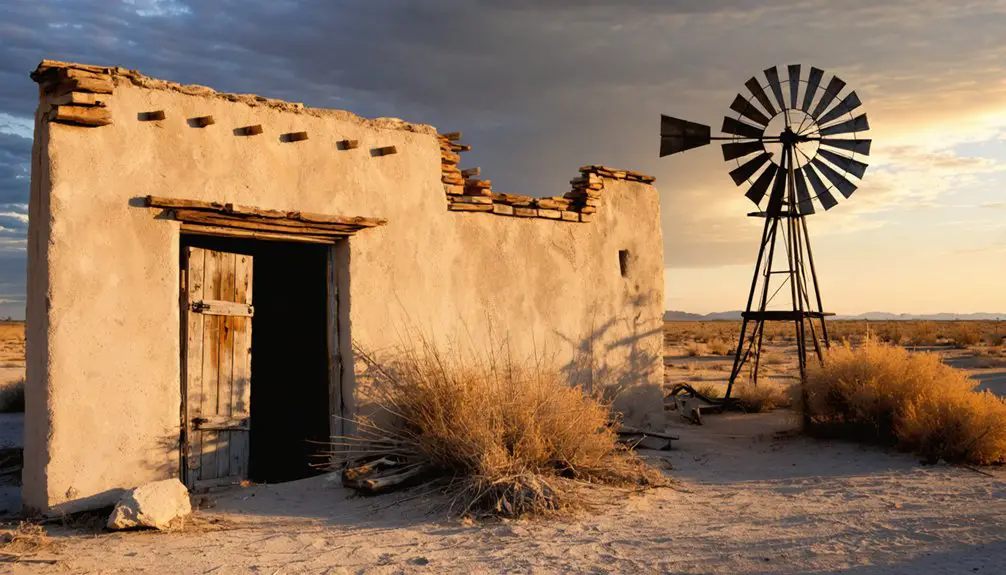
Though thick forest has swallowed most of Holt’s infrastructure, scattered remnants tell the story of a once-thriving community. You’ll discover empty concrete foundations where approximately 200 wooden buildings once stood before nature reclaimed them. Hand-poured concrete walls still mark former industrial sites, their rusted rebar jutting through crumbling surfaces like skeletal fingers. These abandoned buildings contrast sharply with the disappeared wooden structures that couldn’t withstand decades of forest encroachment.
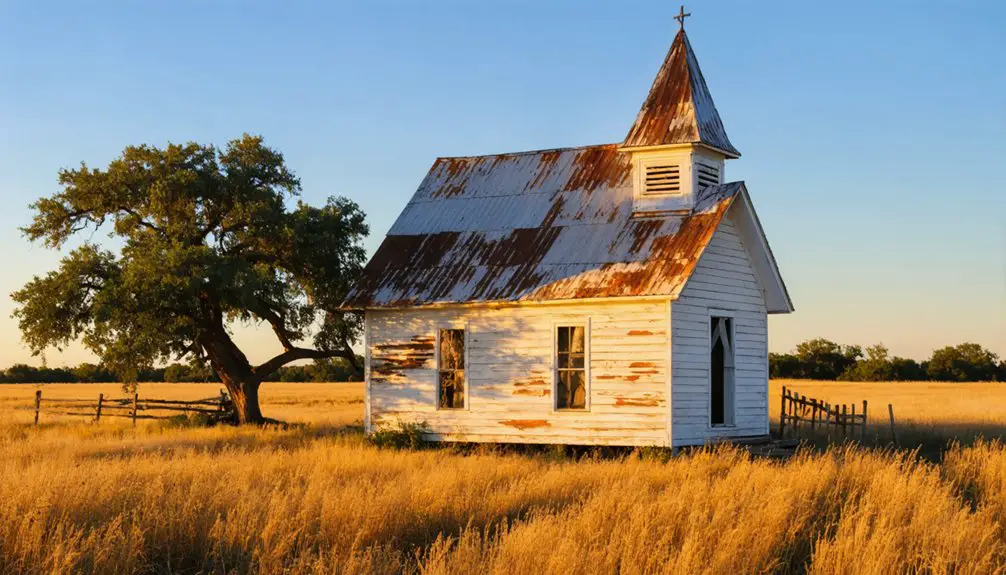
The remnant foundations serve as ghostly markers along your exploration route off Highway 147. You’ll find the old post office, elementary school, and country store sites among the undergrowth. Each concrete slab whispers tales of frontier life, standing as indestructible sentinels while wooden counterparts rotted into the east Texas soil. The Holt School building, recognized as a Texas Historic Landmark in 1989, still stands today as a testament to the community’s educational heritage. Similar to the Aldridge Sawmill where concrete walls remain after multiple fires destroyed wooden buildings, these durable structures outlasted their timber counterparts.
Historic Cemetery Markers
Among the towering pines and encroaching undergrowth, Holt Cemetery stands as the ghost town’s most enduring monument to its vanished residents. You’ll find this weathered burial ground 0.1 miles from Farm to Market Road 281 on County Highway 22, positioned on your left when traveling north.
While grave site preservation efforts remain minimal, the cemetery’s authentic decay tells its own story. You’ll discover:
- Weather-worn headstones with barely legible inscriptions marking pioneers who settled this unforgiving land
- Folk art memorial designs emerging organically as visitors leave tokens of remembrance
- Scattered foundations where wooden markers once stood before succumbing to West Texas winds
This unpretentious burial ground embodies the raw spirit of frontier life—no manicured lawns or corporate maintenance schedules, just honest earth reclaiming its own.
Logging Operation Artifacts
Beyond the cemetery’s silent testimonies, Holt’s industrial bones pierce through decades of forest reclamation. You’ll discover four concrete structures that refused to crumble—the sawmill, power plant, fuels building, and dry kiln foundations. These ruins tell the story of East Texas’s first concrete mill, built after the 1911 fire destroyed its wooden predecessor. The reinforced walls once housed steam powered machinery that churned out 125,000 board feet daily by 1918.
Walk among blasted concrete walls where salvagers extracted valuable equipment post-1923. Rusted rebar and empty foundations mark where iron wheels once turned. The fuels building operations supported this timber empire during the logging bonanza.
Access these relics via a 3-mile trail from Boykin Springs Recreation Area, deep within Angelina National Forest’s Jasper County wilderness.
Essential Supplies and Timing for Your Visit
Planning your Holt expedition means preparing for the Texas Panhandle’s brutal extremes—summer heat cresting past 100°F and winter winds that turn rural roads into ice sheets. You’ll need water reserves, sturdy boots for traversing cemetery grounds and crumbling schoolhouse foundations, plus insect repellent to fend off the mosquitoes thriving in reclaimed forest patches.
Target spring or fall weekday mornings when temperatures hover in comfortable ranges and you’ll have the ghost town’s scattered remnants virtually to yourself for a solid two to four hours of exploration.
Seasonal Weather Considerations
When you’re mapping out your ghost town adventure to Holt, Texas, understanding the region’s weather patterns can make the difference between a memorable expedition and an uncomfortable ordeal. Temperature variations swing dramatically throughout the year, from January’s chilly 39°F lows to August’s scorching 97°F peaks.
Consider these seasonal factors:
- Spring (March-May) brings ideal exploration conditions with temperatures climbing from 72°F to 89°F, though March’s 2.63 inches of precipitation means muddy roads.
- Summer delivers oppressive heat and humidity levels that’ll drain your energy quickly, with minimal 8 mph winds offering little relief.
- Fall (October) provides comfortable 81°F highs and reduced 64% humidity, perfect for wandering abandoned structures.
Winter’s mild 61-65°F days offer surprisingly pleasant exploring, though you’ll face stronger 17-19 mph winds.
Required Gear Checklist
Your survival in the desolate expanse surrounding Holt depends entirely on what you pack before leaving civilization behind. Load your four-wheel drive with a full fuel tank, spare tire, and emergency repair tools—proper off-road driving techniques won’t help if you’re stranded without basics.
Pack one gallon of water per person daily, high-energy snacks, and a first aid kit including snake bite supplies. Navigation demands both GPS and paper maps of Hutchinson County, since cell signals vanish miles before you reach the ruins.
Safe road navigation strategies require sturdy boots, long sleeves, and sun protection for when you abandon your vehicle to explore on foot. Don’t forget your camera, flashlight, and whistle—you’ll want documentation of your adventure, and hopefully won’t need the distress signals.
Time Allocation Planning
With your vehicle properly stocked and emergency gear secured, the question becomes when you’ll actually use it all. Holt rewards minimal activity planning—this abandoned settlement doesn’t operate on anyone’s schedule but yours.
The ideal time of day transforms your experience entirely:
- Dawn arrival lets you photograph weathered structures in golden light while temperatures remain bearable, giving you three uninterrupted hours before heat escalates.
- Mid-morning exploration (9-11 AM) offers optimal visibility for documenting details and traversing crumbling foundations safely.
- Late afternoon departure guarantees you’re off unpaved roads before darkness falls, when navigation becomes hazardous and wildlife emerges.
Budget four hours total: two for wandering, one for photography, one for contingencies. You’re exploring on your terms, not punching a tourist clock.
Expanding Your Journey to Other Abandoned Texas Sites
Beyond your exploration of Holt’s weathered remnants, dozens of forgotten settlements dot the Texas landscape, each offering its own haunting chapter of frontier history.
You’ll find Terlingua’s crumbling mercury mining structures near Big Bend, where desert winds whistle through abandoned stone buildings. Glenrio straddles the Texas-New Mexico border along Route 66, its skeletal motels frozen in time. Medicine Mound’s scattered foundations tell stories of failed agricultural dreams, while Indianola vanished beneath hurricane waves in 1886.
Connect with local historical societies before venturing out—they’ll share unmarked locations and access details outsiders rarely discover. Regional preservation efforts have documented these sites, creating networks of self-guided routes. You’re free to chart your own course through Texas’s forgotten corners, where history belongs to those willing to seek it.
Frequently Asked Questions
Is It Legal to Explore the Ruins at Holt?
Exploring Holt’s ruins requires landowner permission since they’re on private property. Without authorization, you’ll face trespassing risks and liability concerns. Contact ranch owners beforehand to legally discover this abandoned town’s weathered structures and fascinating history safely.
Are There Any Guided Tours Available for Holt Ghost Town?
Unfortunately, guided historical tours haven’t discovered Holt’s magic yet—you’ll find zero organized options. Instead, you’ll embrace pure self-guided exploration opportunities, traversing dusty gravel roads solo to uncover this forgotten outpost’s secrets at your own adventurous pace.
What Wildlife Dangers Should Visitors Watch for in the Area?
You’ll need to watch for aggressive rattlesnake sightings in rocky areas and potential mountain lion encounters near wooded zones. Stay alert during dawn and dusk when these predators hunt most actively in Texas’s remote wilderness territories.
Can You Camp Overnight Near the Holt Ruins?
No organized campsites exist at Holt Ruins. You’ll face private property concerns and potential trespassing issues exploring this remote site. Your nearest legal camping option sits 200 miles away in Terlingua, requiring careful trip planning for this adventure.
Are There Any Local Legends or Ghost Stories About Holt?
Documented local legends about Holt remain scarce, but you’ll find the supernatural atmosphere speaks for itself. The abandoned structures create an eerie backdrop where wanderers often report unexplained sensations and mysterious shadows among the crumbling ruins at dusk.
References
- https://www.ghostsandgetaways.com/blog-1/27-fascinating-ghost-towns-in-texas
- https://authentictexas.com/texas-ghost-towns/
- https://www.texasstandard.org/stories/best-texas-the-ghost-town-with-the-worst-reputation/
- https://en.wikipedia.org/wiki/List_of_ghost_towns_in_Texas
- https://www.youtube.com/watch?v=phjUE19A8HM
- https://texashighways.com/travel/the-quest-to-resurrect-a-ghost-town/
- https://www.ghosttowns.com/states/tx/holt.html
- https://content.govdelivery.com/accounts/TXPWD/bulletins/1dcdee4
- https://www.moontravelguides.com/travel/trip-ideas/piney-woods-the-heart-of-east-texas/
- https://homelandprop.com/east-texas-piney-woods/