Your ghost town road trip starts in Cannon County, where the real Hopewell, Tennessee waits among the rolling hills at 784 feet elevation, anchored by a Baptist church that’s stood since 1833. This isn’t a town frozen in ruins — it’s a community that quietly dissolved into what’s now Bradyville. Economic stagnation, shifting roads, and the absence of local government all played a role. Stick around and you’ll uncover exactly where Hopewell went, what survived, and how to find it yourself.
Key Takeaways
- Hopewell Baptist Church, founded in 1833, is the sole remaining landmark of the ghost town, located at GPS coordinates 35°42′50″N 86°10′20″W.
- Cross-reference Cannon County maps to distinguish Hopewell, Tennessee from other similarly named locations before beginning your trip.
- Check seasonal road conditions in advance, as rural routes leading to the site may have limited accessibility.
- Hopewell declined due to economic stagnation, shifting transportation routes, and gradual absorption into the now-thriving nearby town of Bradyville.
- Combine your visit with nearby Tennessee ghost towns like Elkmont, Loyston, and Morganton to create a fuller road trip experience.
The Real Hopewell Ghost Town Is in Cannon County, Not Bradley County
If you’re planning a ghost town road trip to Hopewell, Tennessee, you need to know which one you’re actually visiting. Two Hopewell communities exist in the state, and they couldn’t be more different.
The ghost town you’re chasing sits in Cannon County, not Bradley County. Bradley County’s Hopewell is a thriving census-designated place with over 2,000 residents — hardly a ghost town experience.
Don’t confuse the two Hopewells — the ghost town you want is in Cannon County, not Bradley County.
The Cannon County location tells a fascinating story of historical preservation and gradual community revitalization under a different name. That area is now called Bradyville, with the original Hopewell identity fading over time.
Use the coordinates 35°42′50″N 86°10′20″W to navigate precisely. Knowing this distinction saves you from driving hours toward the wrong destination and missing the authentic abandoned community you came to explore.
What Actually Happened to Hopewell, Tennessee?
Hopewell began as a small, unincorporated community in Cannon County, built around the kind of tight-knit rural life that once defined central Tennessee’s rolling landscape.
Over time, the community’s identity quietly faded as the area became known simply as Bradyville, leaving the original name behind.
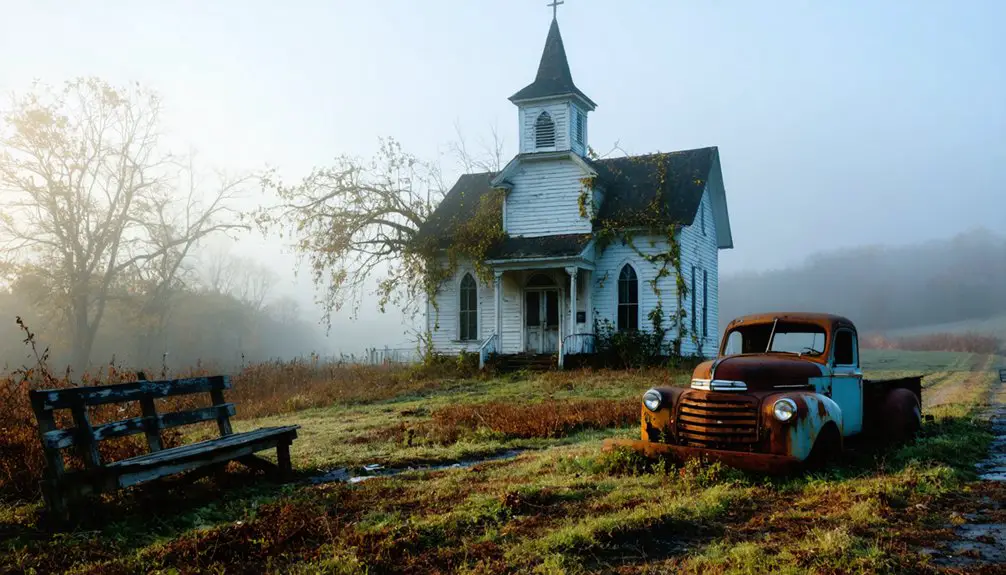
What you’ll find standing today is Hopewell Baptist Church, a remarkable landmark that’s held services since 1833 and still does, anchoring nearly 200 years of history to a place that no longer carries its original name.
Community Origins And Decline
Like many small American communities, Hopewell got its start as an unincorporated settlement in Cannon County, central Tennessee — no mayor, no town council, just a tight-knit group of residents building a life together in the rolling hills of the region.
Several factors shaped its rise and eventual fade:
- The Hopewell Baptist Church, founded in 1833, anchored community life with historical architecture still standing today
- Local legends passed through generations kept the community’s identity alive
- No single industry sustained long-term growth
- Shifting roads and transportation routes slowly redirected traffic and people elsewhere
- Over time, the area absorbed into what’s now called Bradyville
You won’t find a bustling town when you visit — but you’ll discover something rarer: authentic history rooted in a place that refused to be completely forgotten.
Identity Shift To Bradyville
What actually happened to Hopewell isn’t a dramatic story of disaster or abandonment — it’s something quieter. Over time, the community simply became known by a different name: Bradyville. No flood swallowed it, no industry collapsed overnight. The original identity just faded as the area evolved.
That kind of shift happens more often than you’d think. Communities grow, merge, or rename themselves, and the older identity slips into the background. For you as an explorer, that historical significance still matters — it’s what makes this stop worth seeking out.
The cultural preservation here lives primarily through Hopewell Baptist Church, founded in 1833 and still active today. That continuity is rare. You’re not chasing ruins — you’re tracing a quiet transformation written across nearly two centuries.
Lasting Landmark Left Behind
When a community loses its name to history, it usually leaves little more than a footnote behind — but Hopewell left something you can still walk into today.
Hopewell Baptist Church stands as the anchor of historical preservation for this vanished community. Founded in 1833, it’s been holding services for nearly 200 years.
Here’s what makes it worth your stop:
- It held its first services before the Civil War era
- It remains an active congregation, not a ruin
- It represents community nostalgia you can physically experience
- It’s the sole surviving landmark from the original settlement
- It connects you directly to Cannon County’s earliest residents
You’re not just visiting a building — you’re stepping into living history. Few ghost towns offer you something this tangible to explore.
Why Hopewell Baptist Church Is the Only Thing Left Standing
When you visit the area now known as Bradyville, you’ll find that Hopewell Baptist Church stands as the sole surviving landmark of the original community. Its roots stretching back to its first services in 1833.
As the community gradually faded without ever having formal local government to anchor it, the church held its ground while homes and other small buildings disappeared over time.
You’re looking at nearly 200 years of continuous worship in a single structure that outlasted the very town it once served.
Church’s Founding Historical Significance
Though little remains of the original Hopewell community in Cannon County, the Hopewell Baptist Church still stands as a quiet but powerful proof of the town’s early roots. Founded in 1833, it’s carried nearly 200 years of community legends within its historical architecture. When you visit, you’re stepping into something rare and real:
- It held its first services in 1833, predating most regional landmarks.
- It served as both a worship space and community gathering point.
- It survived long after the surrounding town faded completely.
- Its historical architecture reflects early Tennessee unincorporated settlement life.
- Community legends passed through generations are tied directly to its walls.
The church still holds services today, making it a living landmark rather than just a relic worth adding to your road trip.
Community’s Gradual Disappearance
Most ghost towns don’t vanish overnight — they fade slowly, piece by piece, as the forces that held them together quietly disappear. Hopewell in Cannon County followed that same quiet path. As transportation routes shifted and economic opportunities dried up, residents drifted toward towns that offered more.
Without an official government or incorporated status, nothing anchored the community in place.
Urban decay crept in gradually, erasing homes and storefronts until almost nothing remained. What you’ll find today is a landscape absorbed into what’s now called Bradyville. The original Hopewell name itself faded from common use.
Yet Hopewell Baptist Church survived. Historical preservation kept its doors open for nearly 200 years, making it the sole physical witness to a community that once gathered, thrived, and eventually disappeared into the Tennessee hills.
Church Surviving Through Time
While nearly every structure that once defined Hopewell has long since crumbled or vanished, Hopewell Baptist Church still stands — and it’s been standing since 1833. This landmark embodies both architectural preservation and community resilience in ways few buildings can claim. When you visit, you’re stepping into nearly 200 years of unbroken history.
Here’s what makes it remarkable:
- It held its first services in 1833 and never stopped
- It outlasted the entire surrounding community
- It still holds active services today
- It serves as the only physical proof Hopewell existed
- It connects visitors directly to the town’s original spirit
You won’t find a museum or marker here — just a living church that refused to disappear alongside everything else. That’s worth the drive alone.
What Still Exists in Bradyville Where Hopewell Once Stood
If you visit the area where Hopewell once stood in Cannon County, you’ll find that Bradyville has replaced the original community’s name, but one landmark has endured for nearly two centuries: the Hopewell Baptist Church. This remarkable example of historical preservation stands as the most significant remnant of what was once a thriving unincorporated community.
The church still holds services today, connecting modern visitors to a past that might otherwise be completely forgotten.
As you explore this community transformation, you’ll notice the rolling hills of central Tennessee surrounding the site at roughly 784 feet elevation. Beyond the church, little else physically remains of original Hopewell.
You’re fundamentally walking through living history when you step onto these grounds, where one determined congregation kept an entire community’s memory alive.
How to Find the Hopewell Ghost Town Site in Cannon County
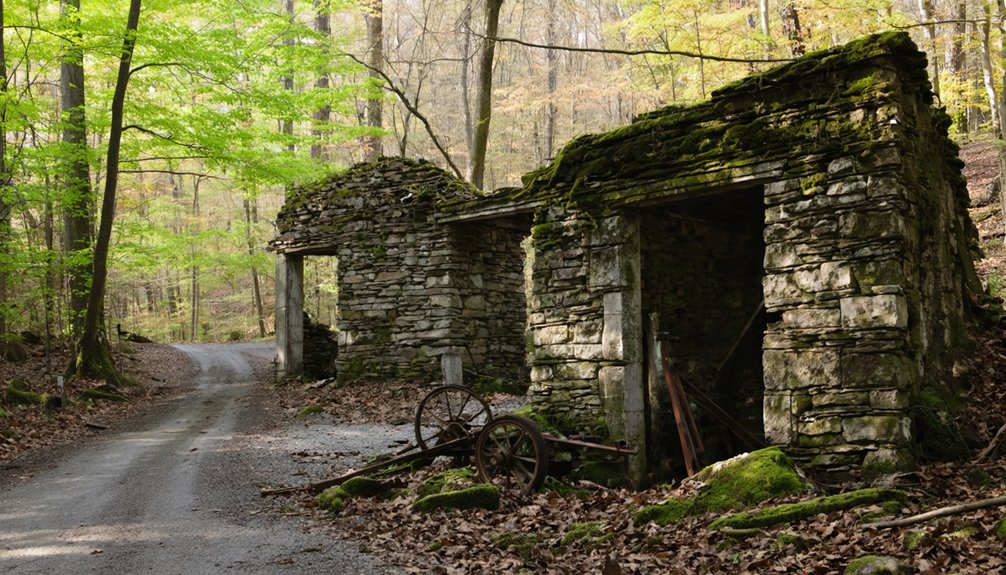
Finding the Hopewell ghost town site in Cannon County requires knowing exactly where to look, since this isn’t the Hopewell you’ll find near Cleveland in Bradley County. Today the area carries the name Bradyville, but local legends still connect the land to its original community roots.
Hopewell in Cannon County isn’t the one near Cleveland — today it’s Bradyville, but the original roots remain.
Use these navigation essentials before you go:
- Set your GPS to coordinates 35°42′50″N 86°10′20″W
- Expect rolling central Tennessee hills at roughly 784 feet elevation
- Look for Hopewell Baptist Church as your primary landmark
- Study the church’s architectural styles dating back to its 1833 origins
- Cross-reference Cannon County maps to avoid confusing the two Hopewells
Once you’re on-site, the church grounds anchor everything. That single surviving structure tells the community’s entire story without requiring a single street sign.
Other Tennessee Ghost Towns Worth Adding to Your Route
Once you’ve explored Hopewell’s quiet church grounds, Tennessee’s ghost town trail opens up with several worthwhile stops that each carry their own distinct history.
Elkmont in the Smoky Mountains draws visitors with its abandoned resort structures, where preservation efforts have kept several buildings intact for exploration. Urban legends surrounding the site add an eerie layer to its already fascinating past.
Further along your route, Loyston and Morganton offer glimpses into communities swallowed by TVA lakes, their stories preserved through local historical records.
Rhea Springs and Tharpe each carry unique narratives worth researching before you arrive.
Model rounds out a solid itinerary with its own quiet ruins. Tennessee rewards the curious traveler willing to seek out what time and progress left behind.
How to Plan a Tennessee Ghost Town Road Trip Starting at Hopewell

Planning a Tennessee ghost town road trip works best when you anchor your route to a fixed starting point, and Hopewell in Cannon County fits that role well. Use coordinates 35°42′50″N 86°10′20″W to pinpoint your arrival, then build outward toward other forgotten communities.
Anchor your Tennessee ghost town road trip in Hopewell, Cannon County — then let the forgotten communities pull you outward.
From Hopewell, structure your route around these essentials:
- Visit Hopewell Baptist Church, a landmark tied to local legends since 1833.
- Research preservation efforts before arriving so you respect remaining structures.
- Add Elkmont for its abandoned resort history deep in the Smoky Mountains.
- Include Loyston or Rhea Springs for diverse historical perspectives.
- Confirm road conditions since rural Tennessee routes shift seasonally.
You’re free to customize this itinerary however suits your pace. Let curiosity, not rigid schedules, drive your journey through Tennessee’s quietly haunting past.
What Makes Tennessee Ghost Towns Different From the Rest of the South
Tennessee ghost towns carry a character that sets them apart from abandoned places elsewhere in the South. Here, you’ll find cultural differences rooted in Appalachian heritage, logging history, and TVA-era flooding that wiped entire communities off the map.
These forces shaped ghost towns in ways that coastal or lowland Southern states simply didn’t experience. Towns like Hopewell weren’t just abandoned — they were absorbed, renamed, or submerged beneath new lakes. That history demands your attention when you’re exploring them.
Preservation challenges run deep too, since many sites sit on private land or lack formal protection. What remains — like Hopewell Baptist Church — survives through community devotion, not government funding.
That independence is exactly what makes Tennessee’s ghost towns worth your time and your miles.
Frequently Asked Questions
Is There an Admission Fee to Visit the Hopewell Baptist Church?
Free as a bird, you can visit Hopewell Baptist Church without any admission fee! Explore its historical architecture dating to 1833 and uncover fascinating local legends that’ve shaped this remarkable Tennessee community for nearly 200 years.
Are There Any Guided Ghost Town Tours Available in Cannon County?
Guided tours aren’t officially confirmed for Cannon County, but you’ll uncover historical significance through self-guided exploration. Local preservation efforts keep Hopewell Baptist Church alive, letting you freely roam and discover this enthralling ghost town’s remarkable, enduring story yourself.
What Is the Best Time of Year to Visit Tennessee Ghost Towns?
Like a well-kept secret, fall’s crisp air makes Tennessee ghost towns magical. You’ll enjoy mild seasonal weather and fewer visitor crowds, letting you freely explore Hopewell’s haunting beauty without summer’s overwhelming rush.
Are the Roads Leading to the Bradyville Area Paved and Easily Accessible?
You’ll find the roads leading to the Bradyville area generally paved and manageable, offering solid road conditions and reliable accessibility features that let you explore this historic ghost town with freedom and ease.
Can Visitors Camp Overnight Near the Hopewell Ghost Town Site?
Like a campfire flickering under open skies, freedom awaits! You’ll want to research local camping regulations before settling in, as overnight amenities near Bradyville’s Hopewell ghost town site aren’t formally established—nearby Cannon County parks may offer suitable alternatives.
References
- https://en.wikipedia.org/wiki/List_of_ghost_towns_in_Tennessee
- https://kids.kiddle.co/List_of_ghost_towns_in_Tennessee
- https://www.youtube.com/watch?v=nbn6qFkYTNI
- https://tnmuseum.org/Stories/posts/the-curious-case-of-elkmont-tennessee-the-ghost-town-of-the-smoky-mountains
- https://www.hauntedplaces.org/hopewell-tn/
- https://en.wikipedia.org/wiki/Hopewell
- https://kids.kiddle.co/Hopewell
- https://www.tnmagazine.org/tennessees-underwater-ghost-towns/