Your ghost town road trip to Hughes Springs in Cass County starts where pirate treasure legends led Tennessee settler Reece Hughes to discover iron-rich mineral springs in 1839. You’ll trace the Old Trammell Trace—an ancient Caddo path—past the site of Hughes’s four-story antebellum mansion, once Texas’s largest private residence, then explore Confederate iron furnace ruins that nearly became Charles M. Schwab’s $7 million empire. The sharecropper cabins and collapsed storefronts along this rolling blackland route reveal layers of history most travelers never discover.
Key Takeaways
- Follow Old Trammell Trace, an indigenous path turned pioneer highway, using interactive GPS tools and free downloadable maps.
- Visit the reconstructed Hughes Furnace replica with interpretive markers documenting slave labor and Confederate iron production operations.
- Explore the chalybeate mineral springs site where Reece Hughes built his first cabin in 1839, attracting early settlers.
- View remnants of the Hughes Town sharecropper community, established in 1847 near the mineral springs.
- Travel rolling blackland terrain where ghost towns sprouted and withered, their wooden storefronts now collapsed.
The Legend of Trammell’s Pirate Gold and Old Trammell Trace
Deep in the pine forests of Northeast Texas, more than 300 miles from the nearest saltwater, a pirate legend took root that would birth an entire community. You’ll find yourself tracing the story of Nicholas Trammell, allegedly one of Jean Laffite’s crew who fled inland with a strongbox of gold coins. The tale claims he buried his treasure near a Choctaw village along the trail that still bears his name—Trammell’s Trace.
These unsubstantiated burial tales drove Tennessee-born Reece Hughes to pack his gear in 1839 and search the wilderness. He never found pirate gold, but community folklore inspiration led him to settle permanently, establishing what would become Hughes Springs. Whether Trammell existed or his treasure lies waiting, the legend shaped history itself—proving sometimes myths matter more than facts.
Discovering the Chalybeate Spring and Early Settlement Sites
While hunting for phantom pirate treasure in 1839, brothers Reece and Robert Hughes stumbled upon something far more valuable than doubloons—three mineral springs bubbling with iron-rich water that locals would call “chalybeate” (ka-LIB-ee-ate).
The Hughes brothers traded their search for pirate gold to discover iron-rich mineral springs that proved far more precious.
You’ll find the historic development marked at Spring Park on 3rd Street, where:
- Reece built the area’s first cabin in 1839
- The early health resort attracted seekers who believed the iron-salt water held medicinal powers
- By 1847, families like Jacob Spear and Allen Urquhart settled near an old Choctaw village
- The site hosted large boarding schools and church camp meetings
- By 1878, the springs anchored a thriving post office and shipping point
Today, you can still visit where fortune-seekers found their own kind of gold—natural springs that built a community.
The Old Brick House: Texas’s Most Magnificent 1850s Mansion
By 1856, Reece Hughes had transformed his mineral spring fortune into something unprecedented—a four-story brick palace rising from the East Texas pines like a transplanted Southern dream. This slave built architecture stood as Texas’s largest private residence, its massive walls and parapet towers commanding the landscape.
Inside, a forty-foot dance hall gleamed with hand-planed, waxed floors where hired dancing masters led neighbors through elegant steps.
You’ll find this pre Civil War prosperity embodied in every detail—from the basement level to the towers piercing the sky above. Three miles east, Hughes’s iron furnace blazed with industrial ambition.
The mansion blazed brightest in early 1861, its rooms alive with laughter and music, before war’s shadow fell across the South and extinguished this brick monument to empire.
Mapping Your Route Through Red River County
You’ll want to trace the Old Trammell Trace, that weathered indigenous path turned pioneer highway that cuts through Red River County’s heart like a scar through memory. Starting at Blossom Prairie, the route unfolds across rolling blackland where nineteenth-century travelers once forded creeks and prayed their wagons wouldn’t mire in the mud.
The trace leads you through a landscape where ghost towns sprouted and withered, their wooden storefronts long since collapsed into the Texas earth.
Old Trammell Trace Route
Long before Nicholas Trammell carved his name into Texas history, Caddo footpaths threaded through the dense woodlands of what’s now Red River County, connecting villages across a confederation that stretched deep into east Texas.
When you trace this route today, you’re following ancient trail signs that Spanish explorers documented as early as 1542. The historical significance of trace becomes visceral when you realize these deep ruts predate American settlement entirely.
Your journey reveals:
- Blue X markers pinpointing exact Red River crossings from original land survey notes
- Centuries-old ruts still visible despite relentless erosion
- Spanish maps from 1801 showing the same crossing you’ll navigate
- Interactive GPS tools alerting you when you’re near historical waypoints
- Free downloadable maps guiding your exploration through untamed territory
This wasn’t just Trammell’s road—it was freedom’s highway.
Blossom Prairie Starting Point
Your gateway to this ghost town expedition begins at Blossom Prairie, where Farm Road 196 intersects U.S. Highway 82 in eastern Lamar County. This 1849 settlement became your jumping-off point when the Missouri Pacific Railroad transformed it into a shipping hub for lumber, livestock, and grain.
The Blossom Prairie economy thrived enough to support 1,200 residents by 1890, complete with its own newspaper. Today’s 1,402 souls maintain that frontier spirit in this 2.5-square-mile town.
From here, you’ll follow U.S. 82 northeast toward Clarksville, rolling through 20-25 miles of Red River County‘s open terrain. The Red River forms your northern boundary as you navigate past Bogata and Detroit, tracing the path early settlers carved through this unforgiving landscape toward Hughes’s forgotten streets.
Essential Stops: Iron Furnace Ruins and Historical Markers
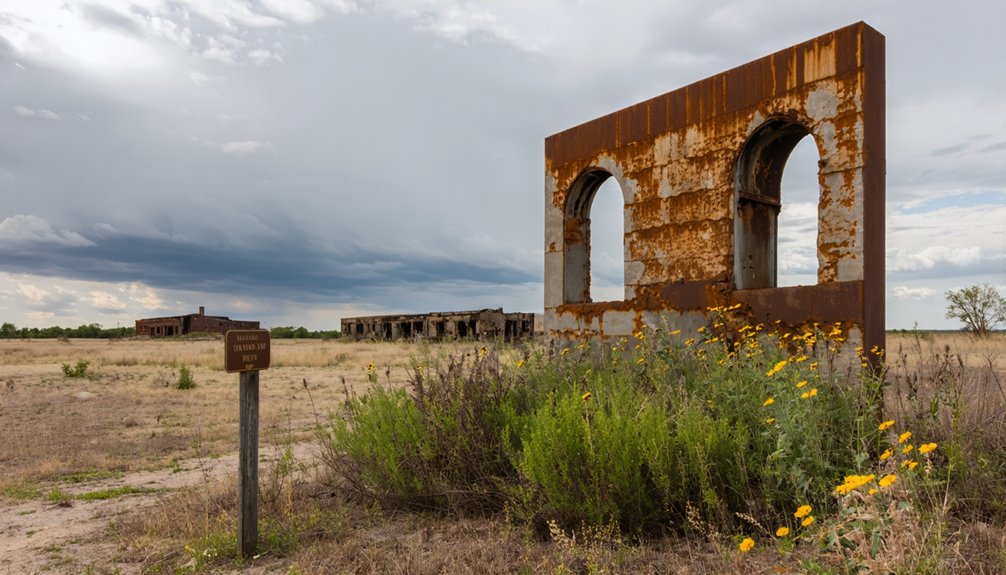
Standing sentinel in the East Texas pines, the reconstructed Hughes Furnace rises from the earth like a relic from another age. Located one mile east of Hughes Springs, this blast furnace replica marks where enslaved workers once produced Confederate iron—approximately one ton per operation during the 1860s.
The site’s historical significance speaks through weathered stone and historical markers:
- Original 1850s furnace ruins standing alongside the restored replica
- Interpretive markers documenting slave labor and Civil War production
- Evidence of 200 million tons of untapped iron ore beneath your feet
- Story of Charles M. Schwab’s rejected $7 million offer in 1912
- Connection to nearby Lone Star Steel’s World War II operations
These preservation efforts guarantee you’ll encounter authentic Texas industrial heritage—raw, unvarnished truth standing against time’s erasure.
Exploring Other Hughes Ghost Towns Across Texas
You’ll find that “Hughes” marks more than one ghostly crossroads in Texas—Irion County’s forgotten settlement shares its name with a vanished sharecropper community that once thrived under different skies. Each Hughes tells its own story of boom and abandonment, though they’re separated by miles of scrubland and decades of distinct history.
Standing among their scattered remains, you can trace how isolation, economic collapse, and the relentless Texas elements erase human ambition with the same indifferent hand, whether the town served ranchers, miners, or cotton pickers.
Hughes in Irion County
While most Texas ghost town enthusiasts flock to the better-known Hughes Springs in Cass County, the lesser-known Hughes in Irion County offers a stark contrast—a windswept monument to West Texas’s unforgiving landscape and the transient nature of rural settlements.
Named after Duwain E. Hughes, this remote outpost reveals fascinating community origins through its postal history:
- Post office served scattered ranchers until 1952
- Minimal structures remain in the barren terrain
- Private land now restricts access to former townsite
- Historical records classify it as officially abandoned
- No commercial development ever took permanent root
You’ll find freedom in exploring this desolate pocket where ambition met reality. The silence speaks volumes about settlers who challenged West Texas’s harsh conditions, leaving only their namesake and fading memories across the scrubland.
Beyond the windswept plains of Irion County lies a different Hughes—one born not from railroad ambitions but from the turbulent aftermath of emancipation. Founded in 1847 near a chalybeate spring, this East Texas settlement watched former slave cabins transform into sharecropper homes.
You’ll find echoes of four million freed people who became tenant farmers, pledging crop percentages for land access. The sharecropping economics here mirrored brutal patterns across Texas—one-fourth shares, mounting debts for supplies, and farming challenges that kept liberation just beyond reach.
Comparing Regional Ghost Towns
The name Hughes echoes across Texas landscapes where ghost towns outnumber living settlements in stunning ratios—this state claims 511 documented ghost towns according to Geotab’s mapping, part of over 3,800 abandoned communities scattered across counties from the Panhandle to the Rio Grande.
Among these desolate locations are several ghost towns near Jakes Colony, Texas, each holding unique stories of the past. Exploring these sites offers a glimpse into the lives that once thrived there, with remnants of architecture and forgotten artifacts scattered throughout. However, as nature reclaims these spaces, the history they carry becomes increasingly at risk of being lost forever.
You’ll discover diverse abandonment stories:
- Six Mile Cemetery draws thrill-seekers with urban legends about supernatural chalkboard curses and hovering lights first spotted in the 1850s
- Belle Plain College remnants stand silent in Callahan County, where industrialization dreams collapsed
- Shafter’s silver mines left Catholic churches and mill ruins near the Chinati Mountains
- Hagerman evolved from farming colony Steedman to empty prairie
- Medicine Mound preserves Comanche ceremonial sites alongside rusty gas pumps and shuttered storefronts
Each location offers distinct pathways into Texas’s untamed past.
Frequently Asked Questions
What Are the Best Accommodations Near Hughes Springs for Overnight Stays?
You’ll find exceptional overnight stays at Wildflower Inn & Restaurant or Holly Hill Homestead B&B. For adventure seekers, Hope Springs RV Campground offers pet-friendly hotels and cozy cabins with perfect lake access, letting you embrace total freedom.
Are the Ghost Town Sites Accessible Year-Round or Seasonally Closed?
You’ll find these ghost town sites accessible year-round, with no seasonal closures restricting your wandering spirit. The accessibility of sites remains open through all seasons, though seasonal operations of nearby facilities may vary by location.
What Safety Precautions Should Visitors Take When Exploring Abandoned Structures?
You’ll need proper protective equipment—sturdy boots, gloves, masks—and you must be cautious of structural integrity. Don’t enter unstable buildings, watch for exposed nails and asbestos, avoid rotting floors, and never explore alone. Your safety’s paramount.
Are There Guided Tours Available for the Hughes Springs Ghost Town?
No guided tours exist for Hughes Springs—it’s an active town, not a ghost town. You’ll find self-guided tours exploring nearby authentic ghost towns like Terlingua instead, though some group tour offerings operate in other Texas haunted locations.
What Dining Options Exist Near Hughes Springs During a Road Trip?
You’ll find fantastic local diner options like Wildflower’s home-cooked catfish and Don Juan’s authentic Tex-Mex. Seasonal food trucks occasionally appear, while Giovanni’s pizza and Granny’s Kitchen offer that small-town freedom you’re craving on your adventure.