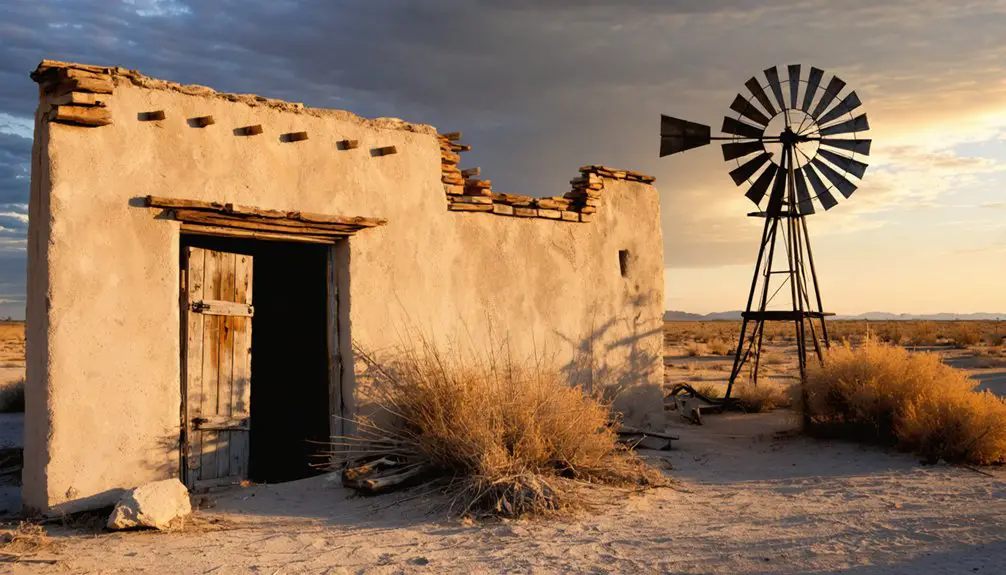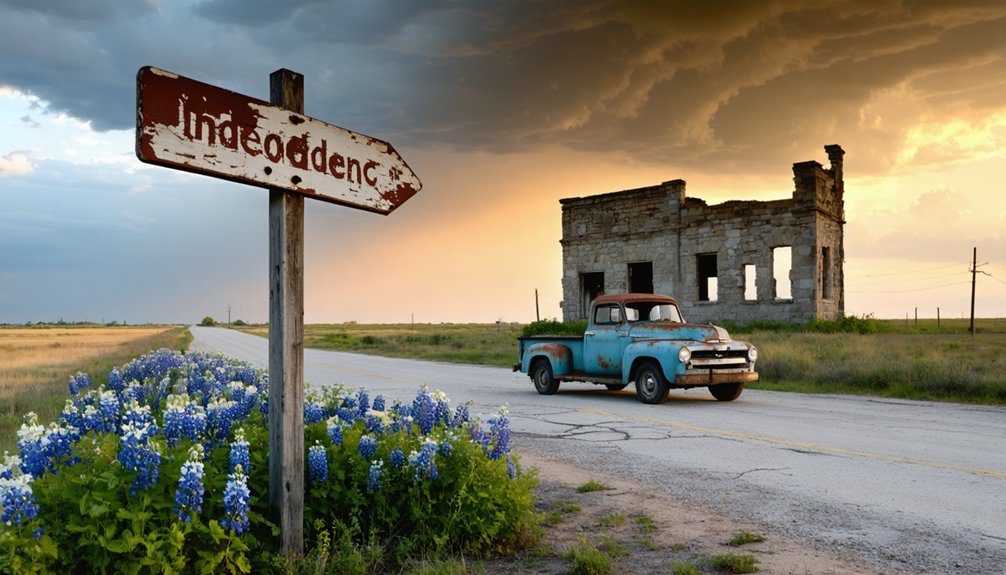
You’ll find Independence, Texas along FM 390 north of Brenham, about an hour from Houston—a remarkably preserved ghost town where Sam Houston’s carved initials still mark church pews and Baylor University’s stone ruins stand sentinel over prairie grasses. Plan your visit for spring weekends when free guided tours bring the 1840s cotton empire back to life, or explore independently among historic cemeteries and Baptist landmarks. Fuel up in Brenham since no services exist in town, and discover how this crossroads shaped Texas history.
Key Takeaways
- Visit Liberty Baptist Church where Sam Houston was baptized, featuring his carved initials and preserved 1852 pulpit furniture.
- Explore Baylor University’s original 1845 campus through stone ruins and columns marking the Female Department site.
- Tour multiple historic cemeteries including Old Independence Cemetery (1823) with symbolic grave markers of Texas founding fathers.
- Stop at the Texas Baptist Historical Center and Toalson House for information on over 30 historical points.
- Plan for springtime (March-April) free weekend tours with wildflowers or autumn visits for fewer crowds and mild weather.
The Rise and Fall of a Texas Cotton Empire
Spanish missionaries pressed cotton seeds into the sun-baked soil near San Antonio in 1745, planting the roots of what would become Texas’s most powerful crop. By 1821, Stephen F. Austin’s settlers transformed the Brazos and Colorado river valleys into cotton kingdoms, while Jared Ellison Groce imported the first gin alongside nearly 100 enslaved workers.
Production exploded from 350,628 bales in 1869 to 3.5 million by 1900, making Texas globally renowned for King Cotton.
But this empire demanded sacrifice. Cotton labor conditions remained brutal—sharecroppers and migrant families, including children as young as four, worked endless hours for minimal pay. The environmental impact of cotton farming devastated the land, while boll weevil infestations reshaped everything in the early 1900s, ultimately ending cotton’s reign over Independence.
What Remains: Historic Landmarks Worth Visiting
Five weathered landmarks stand as silent witnesses to Independence’s cotton-era glory, each offering a distinct window into the town’s dramatic rise and quiet fade into history.
You’ll find Liberty Baptist Church’s architecture and design showcasing the town’s prosperous past, its preserved walls rising against rolling hills. The Texas Baptist Historical Center anchors the 140-resident community with artifacts revealing religious heritage. At the Toalson House—known locally as the Mexican Jail—you’ll discover information on over 30 historical points from this 1835 structure built with local materials.
Preservation efforts protect two significant cemeteries: Old Independence Cemetery, where cotton barons and Civil War casualties rest, and the Houston-Lea Family Cemetery on private property, marking Sam Houston’s family graves. Each site offers unrestricted exploration of Texas’s independent spirit.
Walking in Sam Houston’s Footsteps
How does a towering figure of Texas history leave his mark on a sleepy ghost town? Sam Houston’s presence saturates Independence, where his political and military career intersected with this birthplace of Texas independence. You’ll find his family residence near where Baylor University first opened in 1846, and the church where he was baptized still stands with its 1852 pulpit furniture.
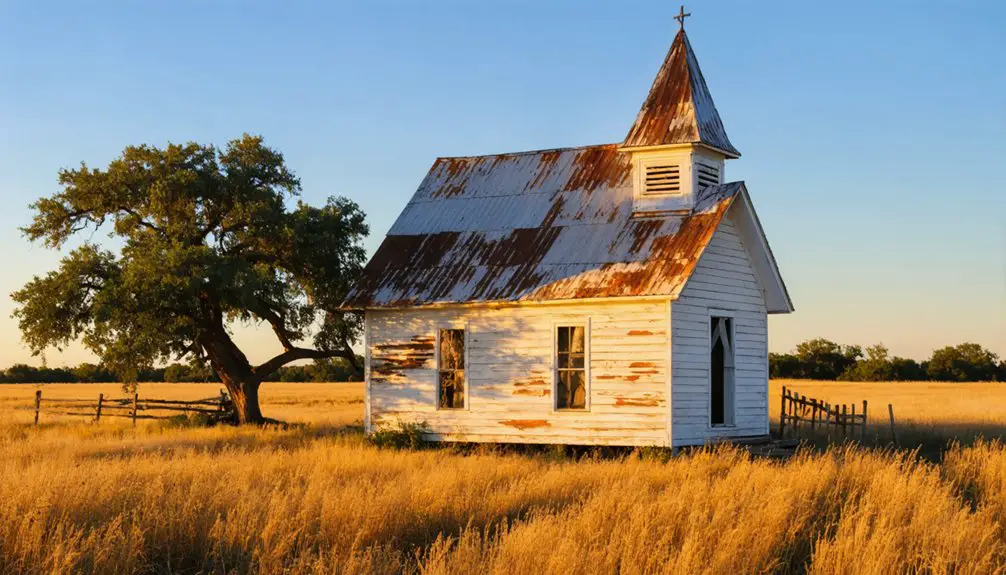
Sam Houston’s baptismal church still stands in Independence, its original 1852 pulpit furniture preserved where the Texas legend found his faith.
His carved initials remain visible in a church pew alongside his wife’s—a tangible connection to the man who shaped a nation.
Trace his path from the 1836 convention to San Jacinto’s 18-minute battle
Visit the 1847 Kellum-Noble house he knew in early Houston
Explore his 1840s Liberty law office and research center
Study Audubon paintings and personal artifacts
Walk grounds where revolution transformed into republic
Baylor University’s Original Home
Before Waco became synonymous with Baylor University, Independence cradled Texas’s oldest institution of higher learning on windswept prairie half a mile west of town. Chartered in 1845 and opening its doors in 1846, Baylor University’s impact on Independence transformed this frontier settlement into an educational beacon.
You’ll find stone ruins and columns marking where the Female Department once stood, while the male campus spread across thirteen acres to the southeast. Early Baptist influence in Texas took root here through founders Rev. William Milton Tryon and James Huckins, shaping souls alongside Sam Houston’s daughters and sons of pioneers.
Cemeteries and Final Resting Places
Weathered limestone headstones rise from Independence’s prairies like silent sentinels, their seashell decorations and false crypts marking where Texas’s earliest Anglo-American settlers found eternal rest. You’ll discover Old Independence Cemetery, founded in 1823 on land donated by Medora Coles McCrocklin. The grave marker symbolism tells stories of pioneers who built this Republic—Baylor University founders, Tacitus Thomas Clay of Clay Castle fame, and Sam Houston Jr. rest here alongside Moses Austin Bryan and other notable grave occupants.
Silent limestone sentinels guard Independence’s earliest Anglo-American pioneers, their seashell-adorned markers telling stories of the Republic’s founding fathers.
Key cemetery sites to explore:
- Houston-Lea Family Cemetery – Nancy Moffette Lea’s original vault honors Sam Houston’s mother-in-law
- Liberty Cemetery – African-American burial ground revealing the community’s complete history
- Republic of Texas leaders – Numerous founding fathers chose Independence as their final home
- Native materials – Hand-cut limestone markers demonstrate frontier resourcefulness
- Family plots – Allcorn, Dallas, and other pioneer surnames dot the landscape
Getting There: Location and Access Information
Nestled in Washington County’s gently rolling prairies, Independence sits where Farm to Market Roads 390 and 50 intersect—a crossroads that once bustled with Republic of Texas commerce now marked only by weathered historical markers and limestone ruins.
You’ll find this ghost town approximately 82 miles west of Houston—roughly an hour’s drive northwest along US 290, then north of Brenham. The Independence Visitor Center operates weekend-only hours during March and April, when guided tours bring history alive.
Plan accordingly: seasonal weather effects can transform these rural farm-to-market roads, particularly during spring storms. Parking capacity limitations mean early arrivals secure the best spots near key historical sites. You’re visiting authentic rural Texas here—no commercial infrastructure, just open roads leading to forgotten stories waiting for discovery among the ruins.
Best Things to See in Modern-Day Independence
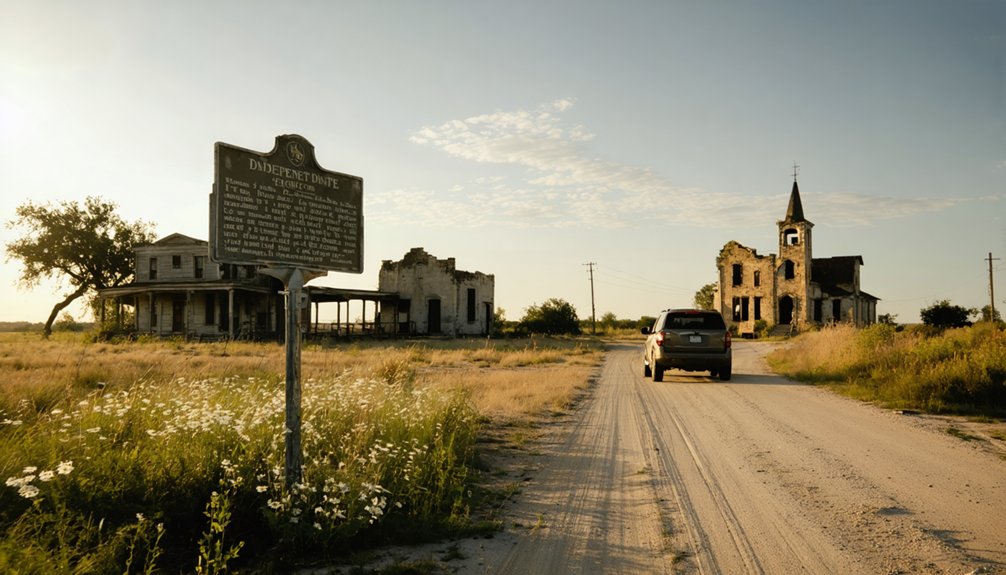
Once you arrive at Independence’s quiet crossroads, the town’s scattered historical treasures reveal themselves across pastoral landscapes where Texas history literally rises from the earth in limestone columns and crumbling foundations. Start at Old Baylor Park where massive stone pillars stand sentinel over what once was Texas’s premier educational institution.
The 8-acre Antique Rose Emporium transforms the 1855 McKnight Hairston Home grounds into living history, with antique rose exhibits complementing native Texas flora. Spring wildflower displays carpet both archaeological sites and gardens in bluebonnets and paintbrush. Independence Baptist Church, Texas’s oldest continuously active Baptist congregation since 1839, anchors the town square alongside the Historical Museum.
Essential Independence Stops:
- Old Baylor Parks at both campuses with interpretive trails
- Antique Rose Emporium gardens and historic homestead
- Independence Baptist Church and Texas Baptist Historical Museum
- Colonial-era Coles and Toalson houses
- Native limestone Blanton Block structures
Planning Your Visit: What to Expect
You’ll find Independence about 14 miles north of Brenham along US 290, where rolling hills, white fences, and cattle-dotted pastures give way to narrow shaded roads marked by faded, rusted signs.
Plan your visit for weekends in March or April when guided tours run regularly, though you can explore year-round using the downloadable Independence Walking Tour brochure and self-guided Soundwalk audio panels.
Expect the Visitor Center to be closed during most weekday visits, so grab your materials digitally beforehand or stop at Brenham’s Visitor Center first.
Getting There and Around
Finding Independence requires a scenic drive through Texas countryside, with the ghost town sitting approximately 82 miles west of Houston at the crossroads of Farm to Market Roads 390 and 50. You’ll access the community via US 290 north of Brenham—roughly an hour’s journey from Greater Houston. Transportation options remain straightforward: your personal vehicle provides the freedom to explore at your own pace. Parking availability is informal, with spaces near historic sites along the quiet roads.
As you continue your journey, make sure to explore the history of Coke, Texas, a small but intriguing location known for its unique stories and rustic charm. Interactions with locals can provide insights into the area’s past, enriching your understanding of this hidden gem. After immersing yourself in the area’s heritage, you can drive through nearby towns that showcase the diverse cultural fabric of the Texas countryside.
Essential navigation tips:
- GPS coordinates (30°19′10″N 96°20′48″W) guarantee accurate arrival
- No commercial services exist, so fuel up in Brenham beforehand
- Walking is primary once you’ve parked along the roadside
- Farm roads are two-lane with minimal traffic
- Daylight hours recommended for ideal viewing and photography
Respect private property boundaries throughout your self-guided exploration.
Best Times to Visit
Timing your Independence visit strategically transforms a simple ghost town excursion into an immersive historical experience. Spring delivers the sweet spot—free weekend tours from March through April let you explore without constraints, while wildflowers paint your journey with vibrant color.
Mild weather considerations make wandering the Baylor University ruins and church sites comfortable, with fewer crowds blocking your shots. Fall mirrors these advantages: post-Labor Day emptiness gives you atmospheric solitude along Aspen Street’s trail to Farwell Mill, though shorter days compress exploration windows.
Summer’s heat demands extra water, while winter’s harsh conditions close mountain passes entirely. Peak visitation periods hit mid-summer when historical society guides appear, but you’ll sacrifice the freedom of empty pathways for structured knowledge.
Frequently Asked Questions
Are There Any Restaurants or Places to Eat in Independence?
You’ll discover local eateries serving sizzling steaks, smoky barbecue, and spicy chili throughout Terlingua. Casual dining options like Starlight Theatre and DB’s Rustic Iron BBQ offer authentic Texan flavors where you’re free to roam and feast.
What Are the Nearest Hotels or Accommodations to Independence?
You’ll find chain hotels about 18 miles away in College Station, with room rates starting at $57 nightly. These properties offer nearby amenities like free breakfast, pools, and WiFi—perfect for your independent ghost town exploration adventure.
Is There an Admission Fee to Visit the Historic Sites?
You’ll explore Independence’s historic sites completely free—no admission fees required. While admission costs vary elsewhere, guided tours available here won’t charge you. Wander freely through Baylor’s columns, Margaret Houston House, and ghostly ruins year-round.
How Long Should I Plan to Spend Exploring Independence?
You’ll need 2-4 hours to fully experience Independence’s 30+ local attractions. Wander freely through unique architecture spanning 1820s ruins to restored buildings, historic cemeteries, and Baylor’s original campus—perfect for unhurried exploration at your own pace.
Are the Historic Sites Wheelchair Accessible?
Most historic sites offer wheelchair accessibility through ramps and ground-floor access. You’ll find accessible restrooms at visitor centers, and mobility aids are available for borrowing. However, some second-floor exhibits and gardens remain inaccessible due to historic preservation.