To plan your ghost town road trip to Industry, Kansas, base yourself in Abilene — just 13 miles south — and fuel up before heading out on rural county roads. Industry started as Lovejoy in 1873, thrived briefly, then vanished after its post office closed in 1906. There’s no preserved storefront waiting for you, just open prairie and quiet history written into the land itself. Stick around, and you’ll uncover everything you need to make this journey count.
Key Takeaways
- Industry, Kansas, once called Lovejoy, was founded in 1873 and declined after railroad-era changes, with its post office closing in 1906.
- Use Abilene as your base camp, located 13 miles south of Industry, offering supplies, fuel, and historical attractions like Eisenhower’s birthplace.
- Bring a reliable GPS app, confirm coordinates through historical society records, and prepare for rural roads in varying conditions.
- Explore nearby ghost towns like Wakefield, Milford, Chapman, and Detroit along the Republican River corridor to enrich your road trip.
- Carry sufficient water, use a paper map as backup, and embrace the open prairie landscape, as Industry has minimal physical structures remaining.
Why Industry, Kansas Still Draws Ghost Town Hunters
Even though Industry, Kansas barely registers on most maps today, ghost town hunters keep finding their way to this quiet stretch of Clay and Dickinson counties, drawn by something harder to name than a preserved courthouse or a rusted water tower.
The ghost town allure here isn’t about grand ruins. It’s about the absence itself — a post office that opened in 1873, shifted ground in 1876, and quietly closed in 1906, leaving almost nothing behind. That silence tells you something honest about how the frontier actually worked.
Historical exploration in places like Industry rewards patience over spectacle. You’re reading the land, not a museum placard. Out here, you move at your own pace, answer to no one, and let a forgotten Kansas community speak on its own terms.
How Industry, Kansas Went From Frontier Town to Ghost Town
When you trace Industry’s roots, you’ll find a frontier settlement that first took shape under the name Lovejoy in 1873, when Kansas was still raw, restless, and hungry for permanence.
By 1876, the post office had shifted to Industry itself, signaling a community actively repositioning itself along the currents of late 19th-century settlement.
But those same railroad-era forces that briefly energized small Kansas towns could just as quickly abandon them, and by 1906 the post office had gone dark, leaving Industry to quietly slip into the ghost-town landscape it now occupies.
Frontier Settlement Origins
Before the quiet descended on this stretch of central Kansas, Industry had a beginning like so many frontier settlements—ambitious, restless, and willing to uproot itself in search of something better.
It started as Lovejoy in 1873, a name planted into raw prairie soil by people chasing open land and possibility. Frontier life here wasn’t romantic—it demanded endurance through isolation, harsh seasons, and uncertain futures.
The settlement challenges were real: sparse resources, shifting populations, and the constant pressure to stay relevant in a rapidly changing landscape.
Decline After Railroad Era
The same restless energy that built Industry ultimately couldn’t save it. Railroad impact reshaped settlement patterns across central Kansas with brutal efficiency — tracks determined which towns thrived and which quietly disappeared.
When rail lines shifted or bypassed communities entirely, commerce followed the iron rails, not loyalty to a place. Merchants packed up. Families relocated. Post offices closed.
Industry’s post office shut down in 1906, and that closure tells you everything. Without postal service, a town loses its official identity, its connection to the wider world.
What once hummed with frontier ambition gradually returned to open prairie. Today, you’re chasing a memory more than a mapped destination — but that’s exactly what makes the journey worth taking. Freedom lives in roads like these.
What’s Left at the Industry, Kansas Townsite Today?
Like so many small Kansas communities that quietly slipped off the map after the post office closed in 1906, Industry leaves almost nothing behind for you to hold onto.
Current remnants are scarce — no preserved storefronts, no welcome signs, no maintained cemetery anchoring the site. What you’ll find instead is open prairie, county roads cutting through farmland, and the quiet that defines forgotten places.
Local lore fills the gaps that physical evidence can’t. Ask around in Abilene or check with the Clay County Historical Society before you go — someone always knows something.
You’re visiting a feeling as much as a place, standing where settlers once built ordinary lives, then watched them dissolve into the Kansas wind without ceremony.
How to Get to Industry, Kansas
Start your journey in Abilene, just 13 miles south of where Industry once stood, and use it as your fuel-and-food base before heading north into the quiet Clay and Dickinson county backroads.
You’ll want a reliable GPS app alongside a downloaded county road map, since unincorporated ghost-town sites rarely appear on standard navigation tools.
Confirm your exact coordinates through historical society records or Kansas ghost-town databases before you pull out of the driveway, because the roads leading to Industry reward the prepared traveler, not the improvised one.
Starting From Abilene
Thirteen miles north of Abilene, Industry waits quietly along the Clay and Dickinson county line, a name on old maps that most drivers never slow down for.
Fill your tank in Abilene before you leave, because you won’t find a gas station where you’re headed. Head north on county roads, and let the landscape do its work — flat fields, wide sky, the kind of silence that makes local legends feel entirely possible.
You’re chasing abandoned structures and forgotten lives, not tourist markers. Abilene gives you your last reliable meal, your last dependable map signal.
After that, you’re on your own, traversing the same rural grid that once funneled settlers toward a town that time quietly swallowed whole.
Navigating County Roads
Once you’ve left Abilene’s edge behind, the county road grid takes over, and it demands a different kind of attention than a highway does. These roads run straight and deliberate across Clay and Dickinson counties, cutting through wheat fields and cattle pastures like old intentions.
Road conditions vary by season — gravel turns to mud after rain, and washboard surfaces punish unprepared vehicles. Download offline maps before you leave; cell service thins quickly out here.
Navigation tips worth keeping: note your mile markers, trust your compass directions, and don’t assume every intersection is signed.
Industry sits roughly thirteen miles north of Abilene, but the journey feels longer. That’s not a complaint — it’s the point. This landscape earns your presence before it gives anything back.
Tools For Navigation
Knowing which roads to trust starts with the right tools in your hands before you ever leave the pavement.
Navigation apps like OnX Maps or Gaia GPS handle rural county roads better than standard phone maps, showing land ownership boundaries and unpaved routes that generic apps ignore.
Download offline maps before you lose cell signal, because signal drops fast once you’re deep into Clay and Dickinson counties.
Pair your digital tools with historical maps sourced from the Kansas Historical Society or the Library of Congress.
Old plat maps reveal where Industry once stood, where the post office operated, and which roads existed during its frontier years.
Together, modern navigation and historical maps give you both the practical route and the story behind every forgotten mile.
Which Ghost Towns Pair Best With Industry on the Same Route?
Because Industry sits near the Clay and Dickinson county line, it drops naturally into a broader loop through central Kansas ghost towns that once hummed with railroad commerce and frontier ambition.
Your ghost town pairings here aren’t random — they’re built on genuine historical connections that trace how settlement moved, stalled, and quietly vanished across the plains.
Consider threading Wakefield and Milford into your route along the Republican River corridor, then pushing south toward Chapman and Detroit, Kansas, where faded storefronts still whisper of busier decades.
Each stop layers onto the last, building a picture of a region that once believed it would grow forever.
You’ll leave understanding not just where these towns stood, but why they disappeared — and why that story still pulls travelers off the main road.
How to Build Your Kansas Ghost Town Road Trip Around Abilene
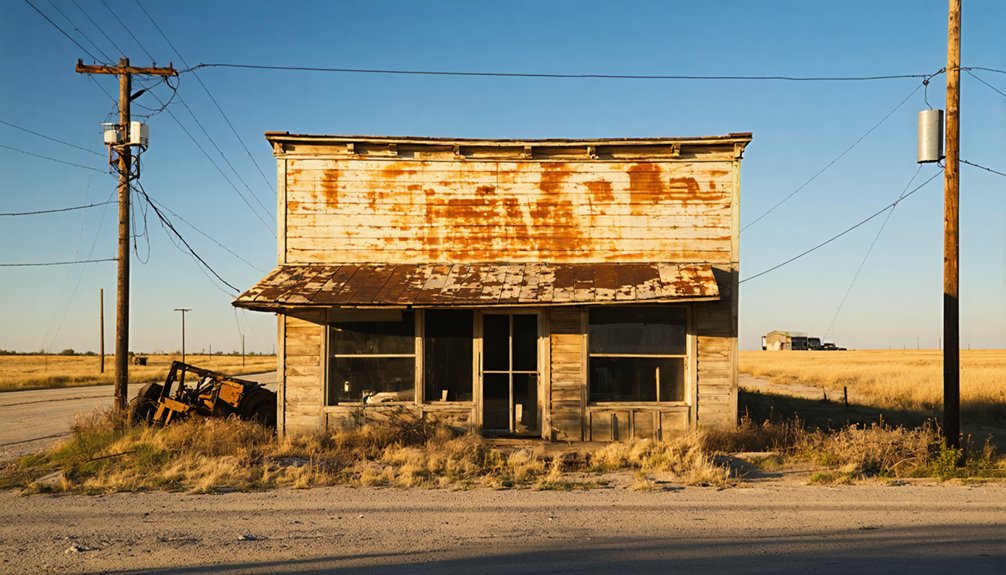
Abilene earns its place as your base camp not just because of Eisenhower’s birthplace or the old Chisholm Trail cattle pens, but because it sits within striking distance of nearly every ghost town worth chasing in this part of Kansas.
Fill your tank here, grab supplies, and let the county roads pull you outward.
- Scout abandoned structures along Clay County’s back roads before doubling south into Dickinson County
- Photograph historical markers while the morning light still cuts low across the prairie
- Return to Abilene each evening rather than scrambling for rural lodging that may not exist
You’re free to move at your own pace, looping outward each day and carrying nothing but curiosity, a paper map, and enough water to keep you honest.
Frequently Asked Questions
Is There a Fee to Access the Industry, Kansas Townsite Area?
Like pioneers chasing the frontier dream, you’ll find no formal fee here. Industry’s ghost town history and local legends await your free exploration—but always verify land access, as private property boundaries may quietly stand guard.
What Time of Year Offers the Best Weather for Visiting Industry?
Spring and fall offer you the best seasons for exploring Industry’s forgotten roads. These weather patterns bring mild breezes, golden light, and open skies — perfect for wandering freely through Kansas’s quietly haunting, wide-open historical landscapes.
Are Guided Ghost Town Tours Available in Clay or Dickinson County?
“You can’t know where you’re going until you know where you’ve been.” Guided tours aren’t formally available, but local historical societies in Clay and Dickinson counties actively preserve the historical significance of forgotten places you’ll love independently discovering.
Can Metal Detecting or Artifact Collecting Be Done at Industry Legally?
You’ll need to research local metal detecting regulations before digging into Industry’s storied past. Respect artifact preservation efforts, verify land ownership, and honor any restrictions — because true freedom means protecting history for fellow explorers chasing Kansas’s vanished frontier dreams.
What Photography Equipment Works Best for Capturing Ghost Town Sites?
For capturing time’s quiet farewell, you’ll want a wide-angle lens for landscape photography and vintage lenses to breathe soul into weathered scenes. They transform forgotten Industry, Kansas into hauntingly beautiful stories worth chasing.
References
- https://en.wikipedia.org/wiki/List_of_ghost_towns_in_Kansas
- https://legendsofkansas.com/kansas-ghost-town-list/
- http://kansasghosttowns.blogspot.com
- https://www.youtube.com/watch?v=8dtIPX7pIqI
- https://en.wikipedia.org/wiki/Industry
- https://www.youtube.com/watch?v=dF7vGl5xasI
- https://www.youtube.com/watch?v=KBXINX0xqnU
- https://www.legendsofamerica.com/ks-ghosttowns/
- https://kansasreflector.com/2023/03/26/ruined-beauty-of-kansas-ghost-towns-and-buildings-splinter-under-weight-of-time/
- https://www.facebook.com/kansasghosttownhunter/