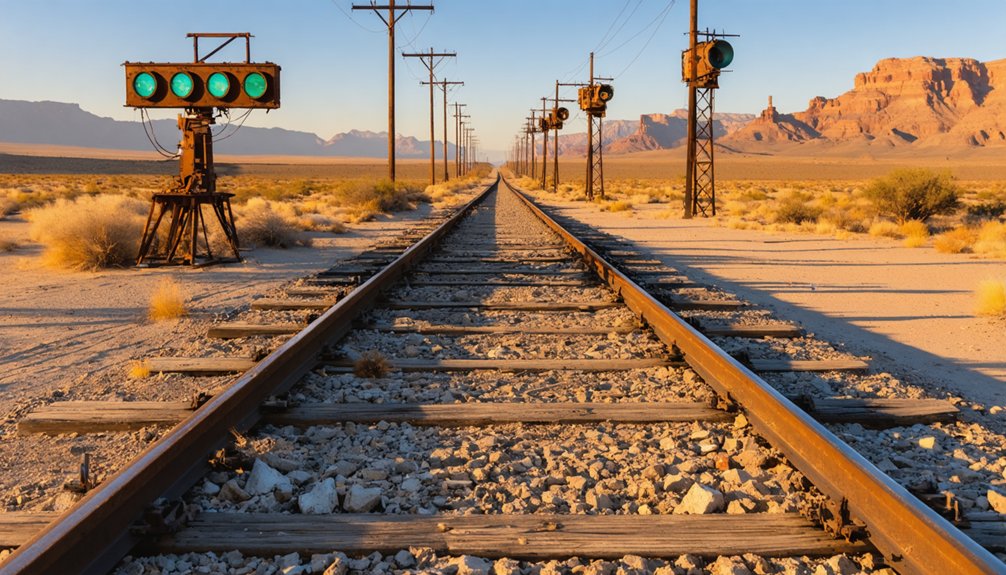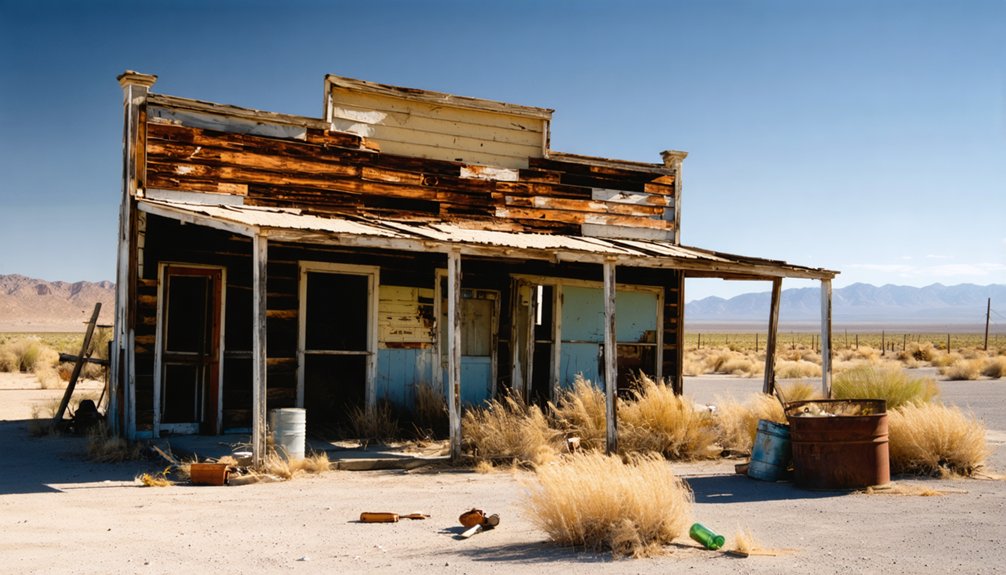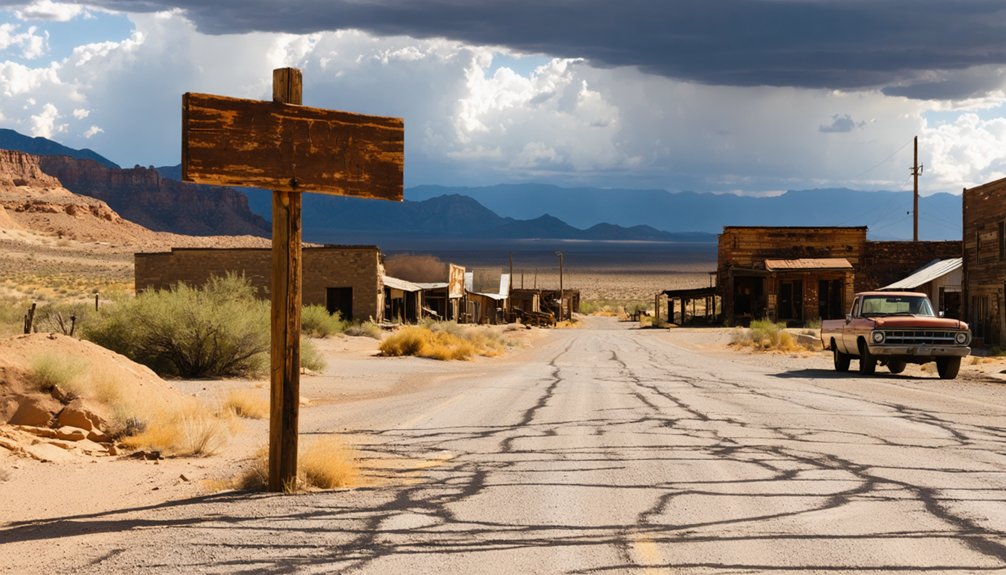
You’ll find Jerome Junction eight miles north of Jerome proper, where rusted rails and weathered foundations mark the spot where two railroad gauges once met in Arizona’s copper-rich Yavapai County. Start at Jerome’s cliffside streets, then trace Highway 89A north to where Copper Siding once buzzed with 150 residents transferring cargo between standard and narrow-gauge lines. The junction’s silent foundations now stand as a record/chronicle/account/recollection of 1917’s railroad glory, abandoned when progress rendered it obsolete by 1923. Discover what shaped this high-desert crossroads and the mining empire it served.
Key Takeaways
- Jerome Junction, originally Copper Siding, thrived until 1920 when a standard-gauge railroad connection to Clarkdale eliminated its transfer function.
- Visit nearby Jerome’s preserved mining attractions including the Sliding Jail, Audrey Headframe, and Jerome State Historic Park’s Douglas mansion.
- Explore Gold King Mine’s authentic 1,270-foot shaft, Big Bertha engine demonstrations, and functional sawmill at the former Haynes camp.
- Jerome transformed from 15,000 mining residents to an artist community after 1953, now blending creative studios with historic mining architecture.
- Plan stops at Jerome Grand Hotel and weathered ruins along Main Street to experience raw mining-era history beyond typical museums.
The Rise and Fall of Jerome’s Billion Dollar Copper Camp
Long before Jerome clung to Cleopatra Hill as Arizona’s most vertical ghost town, Native Americans ground its brilliant copper minerals into pigment for their artwork.
You’ll discover that prosperity arrived in 1888 when William A. Clark’s mining innovations transformed everything—his narrow gauge railroad with 187 curves slashed transportation costs while underground tunnels and open pit operations extracted a billion dollars in copper, silver, and gold. The population exploded to 15,000 souls representing over 30 nationalities during the boom years.
Discovering Jerome Junction: A Railroad Ghost Town
While Jerome’s mines carved fortunes from Cleopatra Hill, a quieter settlement emerged eight miles northeast where two railroads met in 1894. You’ll find Jerome Junction‘s remains where standard-gauge tracks from Prescott intersected William A. Clark’s narrow-gauge line climbing Woodchute Mountain. Originally called Copper Siding, this junction thrived on railroad operations that defined its existence—transferring ore, freight, and passengers between incompatible rail systems for twenty-five years.
At its 1917 peak, 150 residents built community life around the rhythms of arriving trains and clanging transfers. When a standard-gauge connection reached Clarkdale in 1920, Jerome Junction lost its purpose overnight. The last trains rolled through, and by 1923, silence claimed the junction.
Today you’ll discover station foundations and rusted equipment along the Chino Valley Peavine Trail—tangible reminders of a town born and abandoned by iron rails.
Exploring the Gold King Mine and Haynes Mining Camp
Eight miles from Jerome’s cliffside perch, the Gold King Mine preserves what Haynes once was—a copper-hunting camp that struck gold instead and flourished briefly before vanishing. You’ll walk through Don Robertson’s labor of love, where preservation techniques used include relocating authentic structures and crafting period replicas to capture mining life from the 1890s through 1936. The 1,270-foot shaft still marks where prospectors first descended into darkness.
For about $5, you’ll witness onsite mining demonstrations featuring Big Bertha, a massive 1930s gas engine that still roars and shoots flames. Wander through the functional sawmill, peer into the dentist’s office where extractions happened without anesthesia, and run your hands across century-old machinery. This isn’t curated museum sterility—it’s raw history.
Must-See Historic Attractions in Jerome
After descending from the Gold King Mine’s outdoor exhibits, Jerome’s compact downtown rewards exploration with structures that cling to mountainside slopes at gravity-defying angles. Start at Jerome State Historic Park, where the 1916 Douglas mansion architecture showcases mining wealth above the Little Daisy Mine. You’ll find panoramic valley views from the picnic area, plus mining equipment displays and a 3-D town model inside.
Don’t miss the Sliding Jail, which literally moved downhill due to unstable ground—it’s become one of Jerome’s most photographed oddities. The Audrey Headframe offers vertigo-inducing views down a 1,900-foot shaft through protective glass. Wander Main Street to discover the Jerome Grand Hotel (formerly United Verde Hospital), the Haunted Hamburger in the 1900s Jerome Palace, and weathered ruins that whisper mining-era stories.
Understanding Jerome’s Transformation Into an Artist Community
You’ll witness one of America’s most dramatic town resurrections when you explore how Jerome plummeted from 15,000 residents to mere dozens after the mines closed in 1953, earning its “Ghost City” moniker.
The transformation began in the 1960s when artists like Roger Holt—who’d exhibited at the Metropolitan Museum of Art—discovered creative potential in Jerome’s weathered buildings and breathtaking mountain setting.
What emerged was a fiercely dedicated artistic community that renovated crumbling structures, established galleries, and eventually secured National Historic District status, turning abandonment into Arizona’s most celebrated hillside art colony.
Decline to Artist Haven
When the last mine closed in 1953, Jerome’s population plummeted from 15,000 to fewer than 100 souls clinging to Cleopatra Hill. You’ll discover how visionaries like Roger Holt transformed abandoned buildings into studios, sparking artist driven identity shifts that reshaped this ghost town. The Verde Valley Artist group emerged, morphing into a nonprofit that featured luminaries like Paolo Soleri.
Artists didn’t just paint—they governed, filling 110 volunteer positions and drafting zoning ordinances.
But tourism’s success brought demographic displacement effects you can’t ignore. Gift shops replaced studios, vacation rentals devoured entire blocks, and housing costs exploded from 1970s pennies to hundreds of thousands. Original residents got priced out, yet Jerome’s creative spirit endures on this windswept mountaintop, where resilience defines every restored building.
1960s-1970s Cultural Rebirth
The Verde Valley Art Association planted the first seeds of Jerome’s cultural rebirth in the early 1950s, even as mining equipment still rumbled through the streets. When the mines closed in 1953, most residents fled, leaving behind a skeleton crew who established the Historical Society.
You’ll discover how the real transformation began in the 1960s and 1970s, when countercultural artists claimed abandoned buildings as their own. They renovated mining-era structures into studios, opened galleries in empty storefronts, and created spaces where cultural preservation met radical self-expression. This wasn’t gentrification—it was reclamation.
Artists, musicians, writers, craftspeople, and hermits converged to forge a community celebrating artistic diversity. Their vision transformed Jerome from ghost town into creative sanctuary, where 450 souls now thrive.
National Historic District Status
Just thirteen years after the mines fell silent, federal recognition arrived to legitimize what artists and preservationists had already understood—Jerome’s architectural bones told an irreplaceable American story. On November 13, 1966, the National Historic Landmark designation protected this mountainside mining town sprawling across one square mile of Cleopatra Hill. You’ll discover 1,500 individual retaining walls holding buildings against gravity, original 1900s storefronts, and the Douglas Mansion crowning the district.
This national historic preservation status wasn’t merely ceremonial—it channeled restoration funds and protection under the 1966 Preservation Act. The local economic impact proved transformative, attracting tourists and artists who sustain Jerome’s 450 residents today. What was dubbed “America’s largest ghost town” became Arizona’s living museum, where architectural integrity meets bohemian freedom.
Mapping Your Ghost Town Route Through Yavapai County
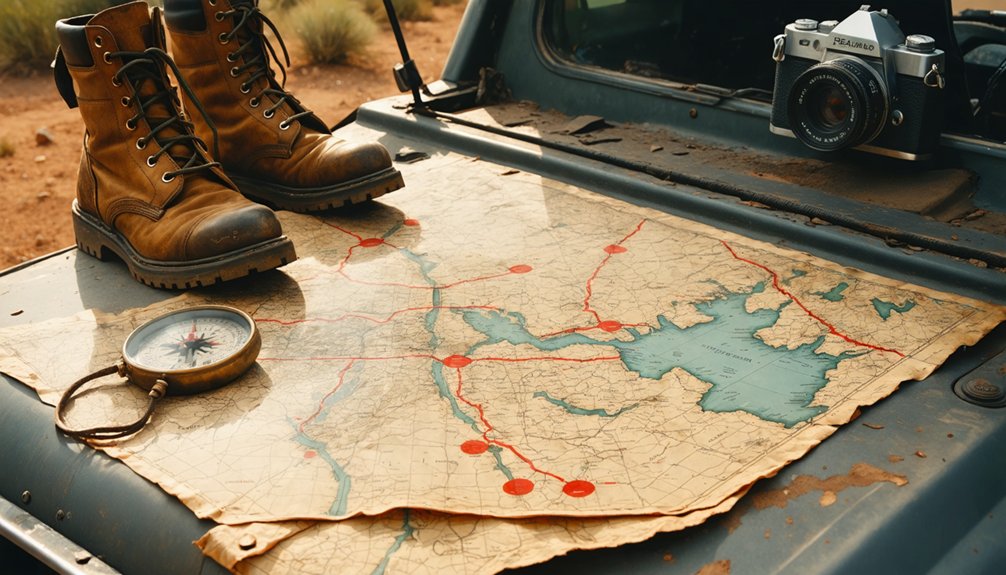
Your route through Yavapai County connects three distinct eras of mining history, starting from Jerome Junction’s vanished railroad transfer point near Chino Valley, winding through the narrow-gauge corridor along Woodchute Mountain, and culminating at Jerome perched 5,000 feet above the Verde Valley.
You’ll trace the path where standard and narrow-gauge trains once met, following modern Highway 89A as it climbs through Mingus Mountain—parallel to where William A. Clark’s precarious railway once clung to mountainsides.
This 30-mile journey links abandoned railroad beds, ghost town remnants, and still-thriving Jerome, creating a complete picture of Arizona’s copper boom heritage.
Jerome Junction Trail Access
Multiple unpaved roads and historic trails converge near Jerome Junction, creating a network that’ll transport you through Yavapai County’s high desert backcountry much like the narrow-gauge railroad once did. The Jerome to Williams route stretches 49.1 miles along the old railroad bed, where trail maintenance keeps the well-graded gravel and paved sections rideable despite narrow cuts through rock.
You’ll need high-clearance 4×4 or SUV for the unmaintained dirt sections, especially after rain creates shallow water crossings and obstacles under 12 inches. Trail signage remains minimal—Forest Road 106 sits unmarked across from Summit Picnic Area at Mingus Pass, while small signs mark essential junctions like Peavine and Iron King.
This moderate technical rating rewards adventurous riders with red rock views eastward and expansive open country stretching west.
Connecting Historic Mining Sites
Three distinct routes radiate from Jerome Junction’s weathered foundations, each one tracing copper’s journey from mountainside ore to railway depot across Yavapai County’s rumpled terrain. You’ll discover how railroads as economic drivers transformed isolated prospects into thriving communities between 1894 and 1920.
Follow the narrow-gauge path toward Cleopatra Hill, where mining technology advancements enabled United Verde’s extraction of ore from increasingly deeper shafts. The second route winds through Prescott’s commercial district, where copper wealth built Victorian storefronts. Your third option traces the standard-gauge replacement line to Clarkdale, revealing why Jerome Junction became obsolete overnight.
Pack topographic maps and plenty of water—cell service vanishes between crumbling station platforms and abandoned mining camps, leaving you genuinely disconnected from modern constraints.
Multi-Stop Railroad Heritage Route
The Santa Fe, Prescott and Phoenix Railway’s northbound departure from Prescott depot marks your entry into Arizona’s most convoluted copper supply chain, a 26-mile mechanical maze that hauled fortunes in ore while passengers clung to seats through 186 bone-jarring curves.
You’ll trace the standard-gauge route to Jerome Junction, where William A. Clark’s narrow-gauge UV&P line climbed Woodchute Mountain’s unforgiving terrain. This transfer point orchestrated both passenger transport and smelter operations until 1920, when Verde Valley’s new facilities rendered the junction obsolete.
Today’s route follows abandoned railbeds through Yavapai County’s backcountry, connecting Chino Valley to Jerome’s cliffside ruins. You’re tracking the physical evidence of engineering ambition—a railroad so crooked it earned worldwide notoriety while transforming Arizona’s mineral wealth into industrial power.
Frequently Asked Questions
What Is the Best Time of Year to Visit Jerome Junction?
You’ll hit the sweet spot visiting during spring or fall when shoulder season crowds thin out and ideal weather conditions create perfect exploration temperatures. March through May and September through October offer comfortable days for discovering Jerome’s historic mining charm.
Are There Entrance Fees for Jerome’s Historic Attractions and Museums?
You’ll find admission costs vary across Jerome’s attractions. Jerome State Historic Park charges $10 for adults, while some museums offer free entry. Historic site accessibility remains excellent, with your single fee granting access to multiple exhibits and outdoor displays throughout.
Where Can Visitors Find Lodging Accommodations Near Jerome Junction?
You’ll discover charming bed and breakfast options like Ghost City Inn right in downtown Jerome, plus vacation rental listings throughout Cottonwood. From historic inns to modern rentals, you’ll find perfect accommodations matching your independent travel style.
Is the Chino Valley Peavine Trail Suitable for Bicycles and Wheelchairs?
The trail welcomes bicycles, especially mountain and fat bikes, but wheelchair accessibility proves challenging. You’ll encounter dirt and cinder rather than paved surface conditions, making standard wheelchairs unsuitable despite the trail’s multi-use designation and level grades.
What Dining Options Are Available in Modern-Day Jerome?
You’ll discover diverse local restaurants serving American fare, BBQ, Mexican, and Italian cuisine. Family-owned eateries like The Clinkscale and Haunted Pizano offer intimate atmospheres, while spots like Bobby D’s and Vaqueros provide sweeping valley views alongside authentic flavors.