You’ll find Kent approximately 90 miles east of El Paso along Interstate 10, making it one of West Texas’s most accessible ghost towns. Take exit 0 at the Texas-New Mexico border and head south on the frontage road to explore the abandoned school, derelict Chevron station, and scattered ruins of this former cattle-shipping settlement. The historic 1894 Clairemont jailhouse sits nearby, built from red sandstone to hold frontier outlaws. Your journey through this windswept landscape reveals compelling stories of determined settlers who carved out existence in unforgiving territory.
Key Takeaways
- Kent is located in Culberson County along the Texas & Pacific Railway, accessible between the freeway and Union Pacific Railroad tracks.
- Visit the abandoned Kent Public School with two remaining classrooms and crumbling auditorium, partially demolished but still viewable.
- Explore the derelict Chevron gas station featuring skeletal signage and remnants of fuel systems from its operational past.
- Photograph the 1894 red sandstone Clairemont Jailhouse, a formidable frontier lockup that never recorded a successful escape.
- Plan early morning visits to capture the best light for photographing Kent’s haunting ruins and 22-grave cemetery.
The Rise and Fall of a West Texas Settlement
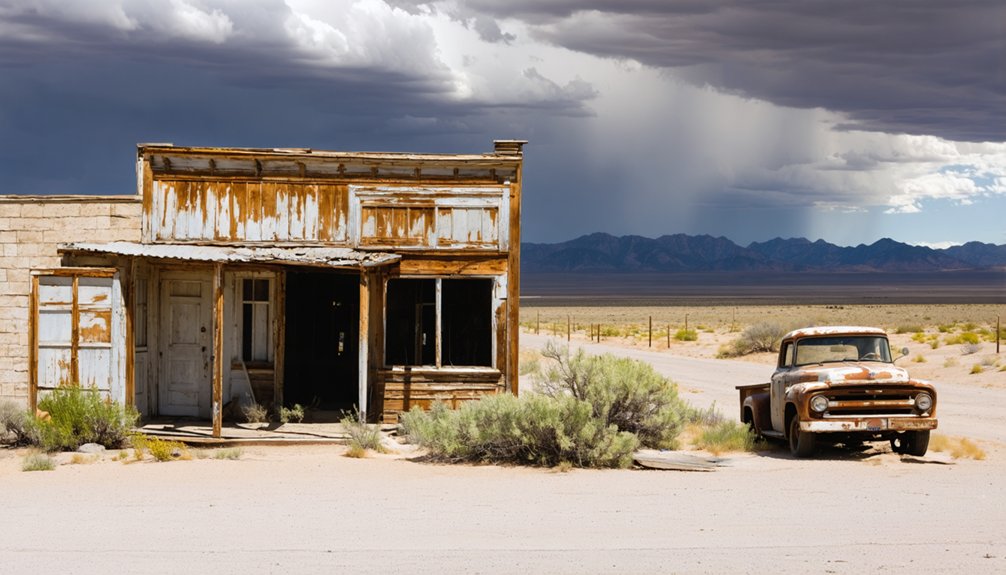
Before the tumbleweeds and silence took over, Kent, Texas began as Antelope—a name inspired by the herds that once roamed these high desert plains at 4,206 feet above sea level. The founding history traces back before 1892, when ranchers established this settlement as a cattle shipping point along the Texas & Pacific Railway. You’ll find it became part of Culberson County in 1911, peaking at just 65 souls by the late 1960s.
The economic changes that sealed Kent’s fate came swiftly—the post office shuttered in 1960, the school closed in 1961. Where six businesses once served 60 residents through 2000, zero population remains today. By 1914, the town supported 4 cattle breeders, a general store, and an estimated population of 25. Only a 22-grave cemetery marks where determined settlers carved out existence in unforgiving territory. Unlike New Birmingham, where bricks were salvaged to build structures in nearby Rusk, Kent’s remnants simply weathered away in the harsh West Texas landscape.
What Remains: Exploring Kent’s Abandoned Buildings
As you pull off the freeway and into Kent, the silence hits you first—then the buildings emerge like monuments to abandonment. The old school stands with its empty classrooms frozen since 1961, while up the road a Chevron station sits derelict beside homes where vibrant murals now fade on interior walls riddled with bullet holes.
Each structure tells a fragment of the story: Cloud Seat Boyd teaching post-war students, families pumping gas on their way through West Texas, generations painting their lives onto walls that now only the wind inhabits. These crumbling buildings and overgrown lots represent the kind of haunting beauty that photographers Morgan Page and Dustin Rice have documented across over 100 Texas communities. The most imposing remnant is the Old Kent County Jail, built in 1894 of red sandstone, where murderers and cattle thieves were once confined in cells that still remain—though the main cell has been welded shut, and it’s rumored a few inmates never left.
Kent School’s Empty Classrooms
The abandoned Kent Public School stands as a haunting cut rock ruin on the south side of Interstate 10, its weathered walls bearing witness to decades of service before closing in 1961. You’ll find what remains of two classrooms and a crumbling auditorium where generations learned their lessons from the 1890s forward.
The historic chalkboards are long gone—scavengers stripped everything but the rock walls themselves. Graffiti now covers the photogenic structure, visible right from the freeway offramp between the old highway frontage road and railroad tracks. Like other semi-abandoned Texas towns, Kent retains only scattered ruins and remnants of its once-thriving community.
Recent visits reveal the school’s been partially demolished, though enough stands to glimpse its past. Early morning light captures the ruin’s character best, making it a compelling stop for anyone seeking Texas’s vanishing frontier history.
Derelict Chevron Gas Station
Just off the I-10 offramp, Kent’s derelict Chevron station huddles between the freeway and Union Pacific Railroad tracks, its skeletal pole sign stripped of facings and its gasoline pumps gutted of their mechanisms. The fuel system remnants tell stories of cross-country travelers who once stopped here for service.
What You’ll Discover:
- Faded Chevron branding on weathered walls, marking this waystation’s corporate past
- “NO NUCLEAR WASTE AQUI” graffiti significance—painted on the wooden parapet after 2015’s controversial waste facility proposal nine miles north
- Adjacent Kent Mercantile ruins with tin roofing, part of the station’s cluster that once served 65 residents
The boarded-up structure, photographed through various stages of decay from 2010-2016, represents West Texas’s vanishing roadside culture—freedom’s landscape reclaiming abandoned commerce. Built on a 0.48-acre site, the station ceased operations and stood vacant for years before its eventual deterioration into the skeletal remains visible today. Like other Texas gas stations, this facility once provided basic needs for motorists traveling the interstate corridor connecting East and West Texas.
Murals in Abandoned Homes
Among Kent’s scattered residential ruins, one now-demolished home stood apart for its unexpected interior artwork—hand-painted murals that transformed bare walls into canvases of faded beauty. Though visible on Google Maps before its recent demolition, this abandoned house showcased creative influences from an unknown resident artist who turned living spaces into galleries.
The Boyd family’s travel mementos, pinned like museum displays from the 1990s through 2017, decorated walls alongside peeling paintings that had aged beautifully despite neglect. Urban explorers documented these murals through video footage—a vital act of historical preservation before the structure disappeared entirely.
You’ll find similar artistic remnants throughout Kent’s remaining abandoned homes, where bathroom features and exterior walls still bear traces of lives once lived with unexpected creativity. Photographing these spaces reveals colors and textures that long exposure times bring out in ways daylight never could. Like the Old Kent County Jail built in 1894, these structures stand as testaments to Kent’s architectural past, though far less intact than that notoriously escape-proof sandstone building.
The Historic Clairemont Jailhouse and County Seat
Rising from the dusty crossroads where US 380 meets TX 208, Clairemont’s 1894 jailhouse stands as one of West Texas’s most formidable frontier lockups. Built from local red sandstone (not limestone exterior), this fortress held horse thieves, murderers, and moonshiners—yet never recorded a successful escape. You’ll find it remarkably intact after 112 years.
A West Texas fortress of red sandstone that held the frontier’s worst—and never let a single soul escape.
The facility supported early county operations when Clairemont served as Kent County’s seat from 1892 until losing a bitter 1954 court battle to Jayton. The typical inmates included:
- Cattle rustlers operating across vast ranching territory
- Moonshiners defying prohibition laws
- Murderers facing frontier justice
Today, you can explore this Recorded Texas Historic Landmark alongside the preserved courthouse bottom story, now a community center in this ghost town of fifteen souls. The original courthouse and jail were completed in 1895, constructed from the same local red sandstone that defines the region’s architectural character.
Getting There: Directions and Route Planning
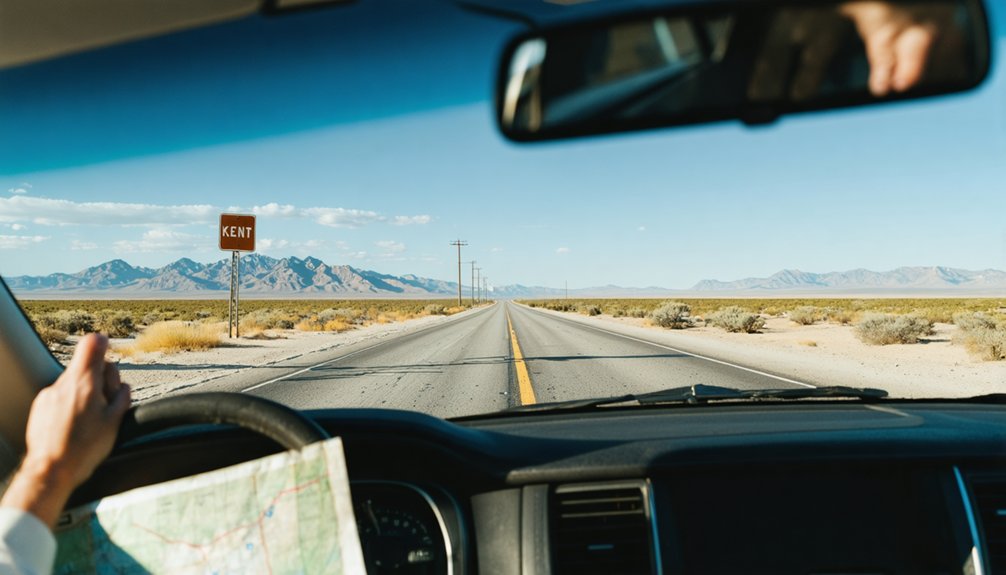
Planning your journey to Kent requires traversing the vast stretches of West Texas where Interstate 10 and Interstate 20 converge in southeastern Culberson County. You’ll find this abandoned settlement at Exit 176, positioned 36 miles east of Van Horn and 81 miles west of Fort Stockton. The transportation infrastructure connecting Kent includes Texas State Highway 118 and Farm to Market Road 2424, though geographic isolation defines this remote location at 4,206 feet elevation.
From El Paso, you’ll drive 152 miles eastward along Interstate 10. Navigate to the crossroads where the Missouri Pacific Railroad once bustled with activity. You’ll spot roofless rock ruins on a low hill south of the freeway, marking your arrival at this weathered outpost where emptiness stretches endlessly across the semiarid landscape.
The Boyd Family Legacy and Local Stories
When you explore Kent’s desolate ruins, you’re walking through landscape haunted by one of Texas’s most storied families—the Kents, whose patriarch Andrew fell defending the Alamo. His son David Boyd witnessed their farewell in Gonzales on February 27, 1836, then rushed home to scatter cattle and bury valuables before Mexican forces arrived.
Kent’s ruins echo with the legacy of Andrew Kent, Alamo defender, and his son David Boyd, who buried their homestead treasures before fleeing Mexican troops.
The family’s homesteading struggles shaped this region’s character:
- David Boyd Kent raised 11 children on their Lavaca River homestead, establishing deep community institutions
- Daughter Mary Ann built the settlement’s first dwelling on 1,107 inherited acres with freighter William Byas
- Son Bosman Kent tracked his brother’s killers into Mexico, using Texas Ranger skills before establishing New Mexico stage lines
Their descendants scattered across Texas, but this ghost town remembers their unbreakable pioneer spirit. the stories of those who lived here can still be felt in the crumbling buildings and empty streets. for those seeking a glimpse into Texas’s past, there are many ghost towns in Texas to explore, each with its own unique history and charm. these places serve as a reminder of the resilience and adventures of those who once called them home.
Visiting these ghost towns to explore in Texas can provide an enriching experience, inviting you to walk through time. Each location tells its own story, with remnants of structures that once buzzed with life and energy. By wandering these forgotten streets, you can appreciate the rich tapestry of history woven into the fabric of the Lone Star State.
Kent County’s Frontier Past: From Comanche Territory to Ranching Hub
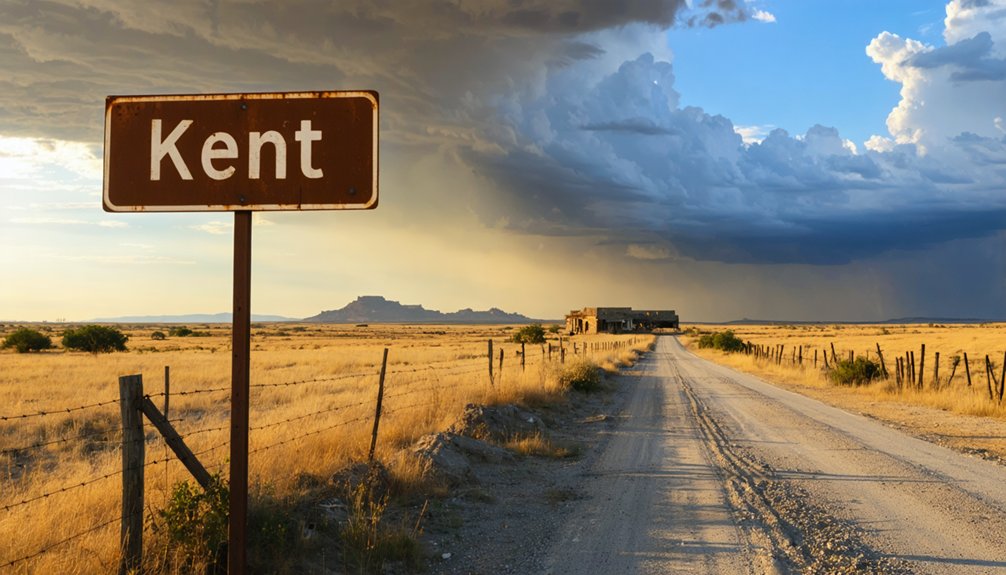
Long before the Kent family left their mark on this windswept landscape, warriors on horseback ruled these plains with absolute authority. The Comanche transformed this region into their stronghold by 1767, launching devastating raids deep into Mexico along trails that cut straight through present-day Kent County.
These Comanche raids on settlers intensified after Texas independence, with attacks stretching from San Antonio northward under the strategic light of full moons.
The U.S. Army responded in 1849 by establishing frontier military outposts across the territory. Colonel Ranald S. Mackenzie finally broke Comanche power here in 1872 at Treasure Butte. By 1876, the legislature carved Kent County from former battlegrounds, naming it for an Alamo defender. Cattlemen like R.L. Rhomberg soon arrived, transforming warrior paths into ranching trails.
Photography Tips and What to Bring
Capturing the haunting beauty of Kent’s abandoned structures demands specialized gear that matches the harsh environment and challenging lighting conditions. Your camera gear recommendations should prioritize versatility and durability for this remote West Texas location.
Essential Equipment for Kent’s Ruins:
- Wide-angle lens (16-35mm) captures the expansive decay of weathered storefronts and collapsing structures against vast prairie skies
- High-powered flashlight (600+ lumens) reveals interior details where sunlight hasn’t penetrated in decades
- Sturdy tripod stabilizes long exposures during golden hour when shadows dramatize architectural textures
For lighting equipment selection, pack backup batteries and a headlamp—cell service is nonexistent here. A fast prime lens (35mm or 50mm) handles low-light interiors while maintaining mobility through unstable structures. Bring protective gear bags; dust penetrates everything in this frontier landscape.
Frequently Asked Questions
Are There Any Services or Facilities Available for Visitors in Kent Today?
No public services available exist in Kent today. You’ll find zero operational facilities, requiring complete self-sufficiency for your visit. Respect private property concerns when exploring accessible buildings, and pack all necessities since no amenities operate within town limits.
Is It Legal to Enter the Abandoned Buildings in Kent?
No, entering abandoned buildings risks criminal trespass on private property. Before exploring, you’re checking for legal restrictions and examining potential safety concerns—owners patrol these ruins, structures show decay, and the jail’s main cell remains welded shut for good reason.
What Is the Best Time of Year to Visit Kent?
Visit Kent during fall (September-November) for ideal weather conditions with cooler 70s-80s°F temperatures and minimal crowds. You’ll avoid summer’s intense heat while enjoying nearby seasonal festivals in surrounding Hill Country towns, perfect for exploring freely.
Are There Any Camping or Overnight Accommodation Options Near Kent?
Like modern pioneers seeking untamed horizons, you’ll discover off grid lodging at Historic Route 66 Ghost Town Farm’s private property access in nearby Clarendon, plus generator-friendly RV spots at Peaceful Working Ranch Retreat in McLean.
How Long Should I Plan to Spend Exploring Kent and Clairemont?
You’ll need 1-2 hours exploring Kent’s abandoned school, derelict Chevron station, and cemetery, plus another 1-2 hours at Clairemont’s historic jail and courthouse. The ideal length of exploration totals 4-5 hours, covering all expected sights and attractions.
References
- http://www.ghosttownaz.info/kent-texas.php
- https://focusonthebackroads.com/?p=1582
- http://freepages.rootsweb.com/~gtusa/history/usa/tx/kent.htm
- https://www.youtube.com/watch?v=MlKZaOsk6T4
- https://www.youtube.com/watch?v=yJpD8WrWkoI
- https://www.tshaonline.org/handbook/entries/kent-county
- https://www.texasescapes.com/WestTexasTowns/KentTexas/KentTexas.htm
- https://www.ghosttowns.com/states/tx/kent.html
- https://blogs.baylor.edu/texascollection/category/texas-cities-and-counties/ghost-towns/
- https://en.wikipedia.org/wiki/Kent