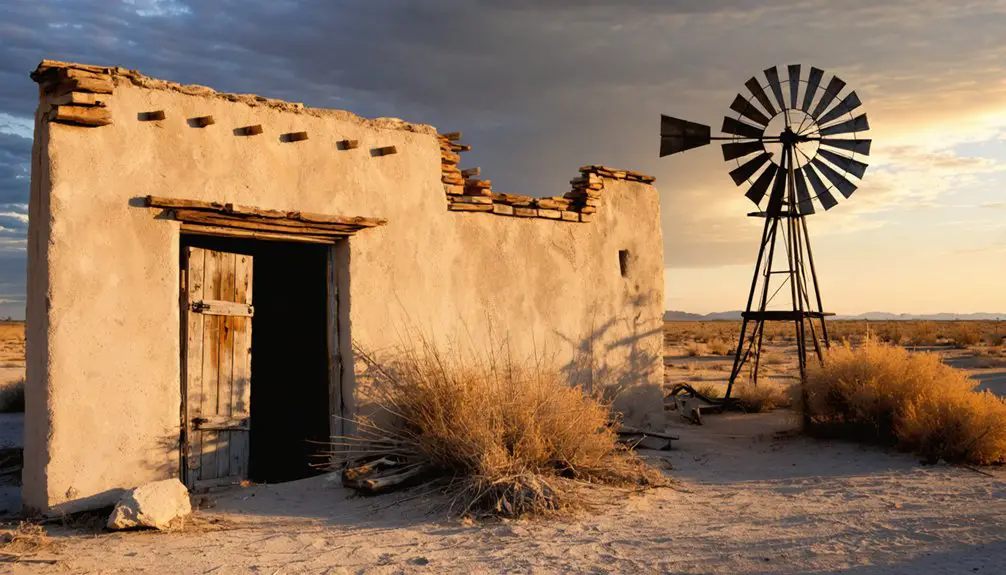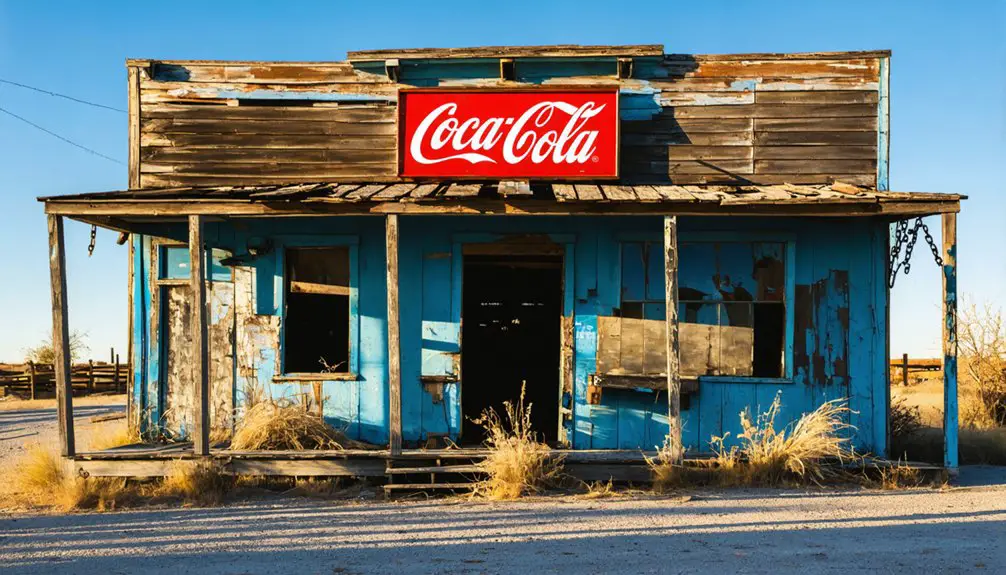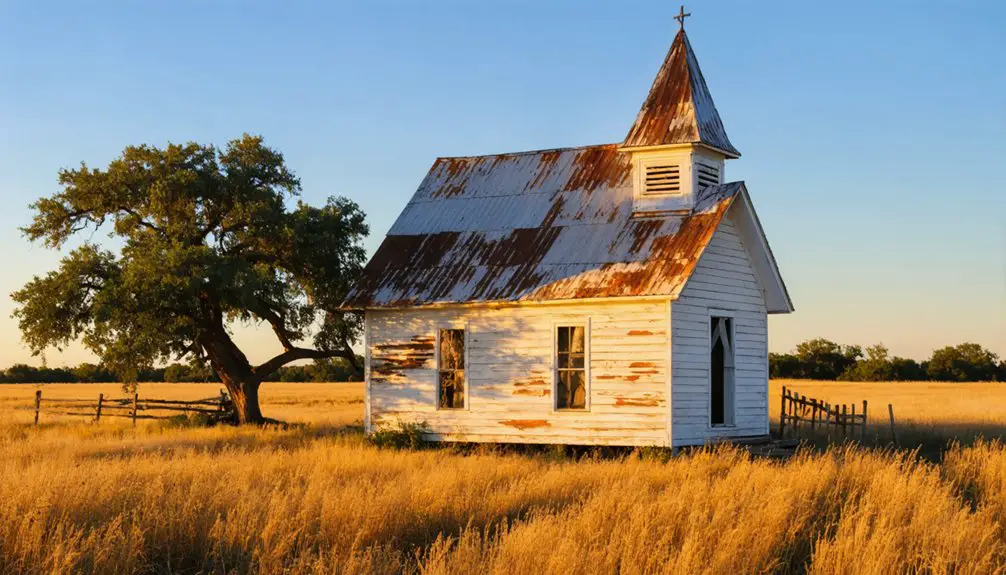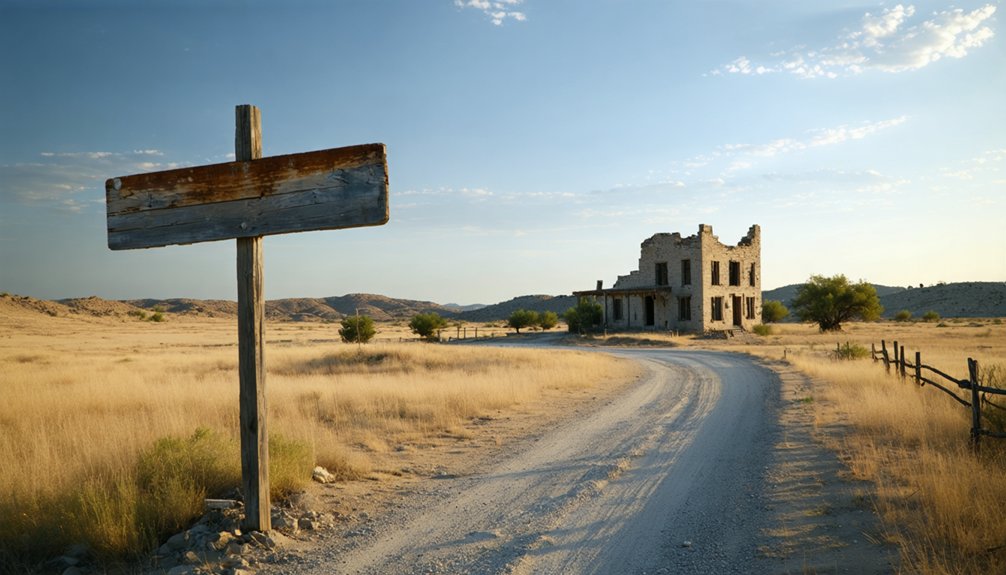
You’ll find Kirkland eight miles southeast of Childress along US Route 287, where weathered grain elevators tower over crumbling storefronts that once served 500 residents. Plan your visit for winter weekdays when you’ll have complete solitude to explore the abandoned schoolhouse ruins, two surviving churches, and the original Furr’s Groceries location. Spring and fall offer milder temperatures, though you’ll sacrifice that eerie isolation that makes ghost towns so beguiling. The route’s straightforward, but there’s strategy to maximizing your exploration.
Key Takeaways
- Kirkland is located 8 miles southeast of Childress along US Route 287 at the intersection with FM 1033.
- Visit during spring or fall for pleasant weather, or winter for complete solitude and crystal-clear skies.
- Key historic sites include grain elevators, schoolhouse ruins, two churches, and the first Furr’s Groceries store location.
- The town has authentic frontier decay with 44-100 residents, weathered structures, and abandoned storefronts—no tourist traps.
- Plan mid-week visits for private exploration and watch for icy roads during winter morning hours.
The Rise and Fall of Kirkland’s Biggest Little City
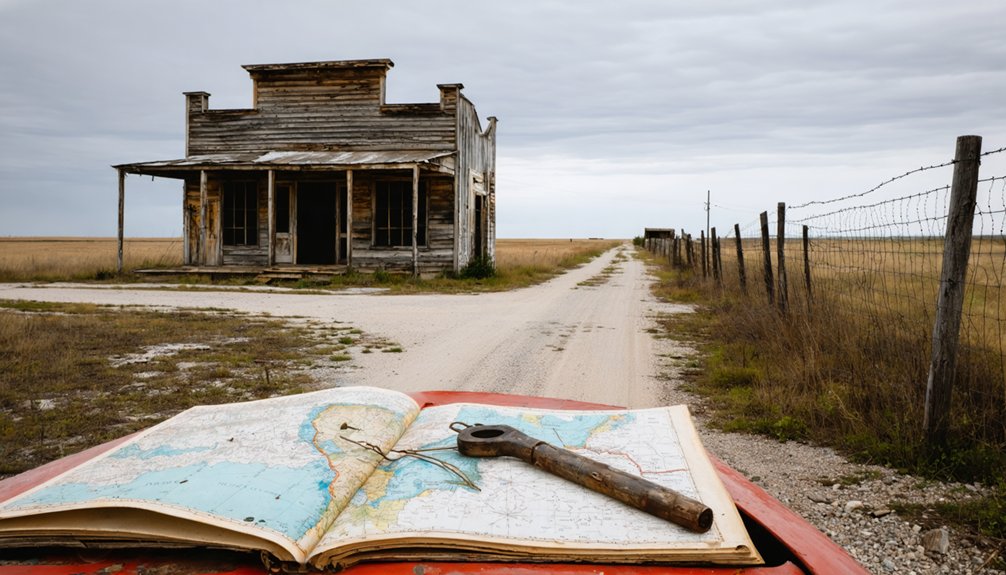
When J.C. Kirkland’s name graced this settlement in the 1880s, nobody imagined it’d become the “Biggest Little City in Texas.” You’ll find Kirkland’s story mirrors countless frontier dreams—stagecoach stations and saloons gave way to railroad prosperity when the Fort Worth and Denver City Railway arrived in 1887.
By the 1920s, five gas stations and thriving businesses served 500 residents. But economic factors influencing decline hit hard after 1940. Better roads meant folks could shop elsewhere, and mechanized farming needed fewer hands. The cultural impact on community identity proved devastating—by 1984, only 100 residents remained.
Today, you’ll discover grain elevators standing as monuments to wheat-shipping glory days, while the schoolhouse merged into Childress’s district decades ago.
What Remains of Kirkland Today
Between 44 and 100 souls still call Kirkland home—a stark contrast to the 500 who bustled through its streets before World War II. You’ll find mostly weathered structures and abandoned storefronts where three grocery stores, five filling stations, and three hardware stores once thrived. The three-room schoolhouse merged with Childress in 1951, and by the 1980s, just one general store remained operational.
Current economic conditions reflect Kirkland’s ghost town status—the mercantile that spawned Furr’s Groceries is long gone, along with the bank, barbershops, and filling stations. Local community initiatives remain scarce in this windswept hamlet, though the remaining residents maintain their independence. You’ll discover authentic Texas frontier decay here, unmarred by tourist traps or commercialization—just genuine abandonment and stubborn survivors.
Getting to Kirkland in the Texas Panhandle
You’ll find Kirkland just 8 miles southeast of Childress along US Route 287, making it an easy 15-minute drive through the flat, windswept Panhandle landscape.
The ghost town sits right at the intersection where Farm to Market Road 1033 crosses the highway—you can’t miss the lonely junction that once marked the community’s heart.
Spring and fall offer the most comfortable conditions for exploring, as summer temperatures can soar past 100°F and winter winds cut across the plains with biting force.
Highway Routes From Childress
The open stretch of US 287 cuts through the Texas Panhandle like a ribbon of asphalt through an ocean of prairie grass, and you’ll find Kirkland waiting at mile marker 438.4, roughly eight miles northwest of Childress. The Texas Panhandle infrastructure keeps this route straightforward—no confusing turns, just honest Childress County roads stretching toward the horizon.
Your route from Childress:
- Head northwest on US 287 from downtown Childress (mile marker 447.0)
- Pass FM 2638 junction at mile marker 440.2—you’re halfway there
- Watch for Kirkland at mile marker 438.4—coordinates 34°22’45″N, 100°3’41″W
You’ll roll through cattle country where the speed limit holds steady outside town limits. The Fort Worth and Denver Railway parallels your path, a reminder of when ghost towns thrived.
Distance and Drive Time
Your GPS coordinates (34.37923°N, 100.0615°W) will pinpoint the cemetery where 725 gravestones tell stories dating back to 1908.
Plan accordingly, fuel up, and enjoy the freedom of empty roads.
Best Seasonal Travel Months
When planning your ghost town expedition to Kirkland, timing makes all the difference between a memorable adventure and a miserable trek across the unforgiving Panhandle. Seasonal weather conditions here swing from blazing 91°F July highs to bitter January lows of 22°F with brutal wind chills.
Ideal travel windows for maximum comfort:
- Late Spring (May) – Temperatures hit sweet-spot highs around 79°F, perfect for exploring abandoned structures without battling extreme heat or cold
- Early Fall (September-October) – Highs drop from 90s to comfortable 70s, fewer tourists crowd the ghost town, and you’ll catch dramatic lighting for photography
- Avoid Peak Summer/Winter – July’s 97°F heat and January’s sub-freezing conditions make outdoor exploration genuinely dangerous
Target those shoulder seasons when the Panhandle shows its gentler side.
Historic Sites Worth Exploring in Kirkland
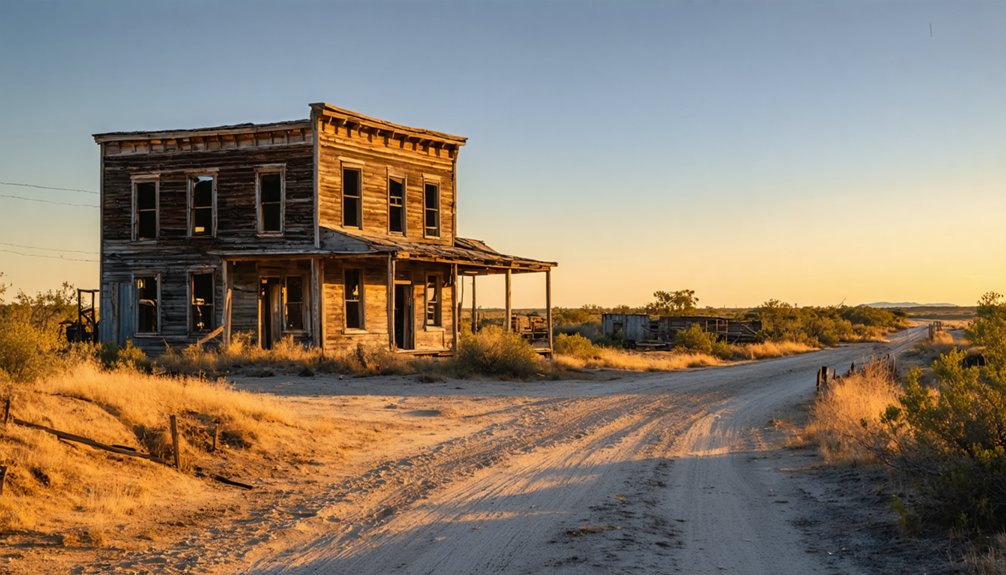
Scattered across the windswept plains of Childress County, Kirkland’s weathered structures tell the story of a frontier community that once billed itself as the “Biggest Little City in Texas.” You’ll find remnants of the original stagecoach relay station established in the early 1880s along what’s now U.S. Highway 287.
Three towering grain elevators mark Kirkland’s mercantile era, when wheat shipping dominated the local economy post-1980. Don’t miss the ruins of the three-room schoolhouse that educated children until consolidation in 1958. Two churches still stand as memorials to the community that once supported 500 residents. History buffs should seek out where Roy Crone W. Furr opened his first store in 1905—Furr’s grocery origins that eventually spawned a regional grocery and cafeteria empire.
Best Time to Visit This Childress County Ghost Town
For true off season solitude, consider December through February:
Winter months deliver absolute isolation at Kirkland—frozen mornings, empty paths, and the ghost town’s secrets reserved entirely for you.
- Zero crowds roaming these ruins
- Crystal-clear skies perfect for nighttime photography
- Unobstructed access to crumbling structures
Just watch for icy morning roads. Mid-week visits guarantee you’ll have the ghost town entirely to yourself, letting you absorb Kirkland’s haunting atmosphere without interruption—pure freedom among forgotten Texas history.
Explore the ghost town attractions in Palm Valley for a glimpse into the past and discover stories that linger among the ruins. From its dilapidated buildings to the remnants of former life, each corner holds a piece of history waiting to be uncovered. Make sure to bring your camera to capture the eerie beauty that surrounds you.
Combining Kirkland With Other Texas Panhandle Ghost Towns
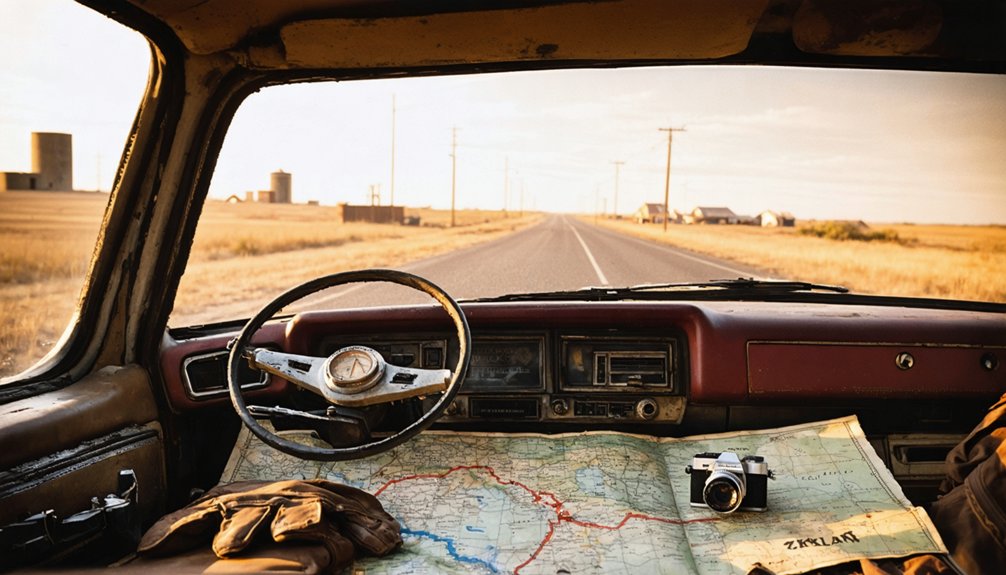
Mapping out a multi-ghost-town expedition transforms Kirkland from a solitary stop into the anchor of an unforgettable Panhandle adventure. You’ll trace US 287 north through former industries that once powered this region—oil camps like Electric City near Borger and ranching outposts scattered across windswept plains. A 250-mile loop connects Kirkland to Skellytown (90 miles via Pampa) and Electric City (100 miles total), delivering five hours of pure exploration.
Skellytown’s abandoned school reveals oil boom stories, while Electric City’s Riverview Power Plant ruins stand as monuments to 1926’s frenzied energy. Swing west toward Tascosa (200 miles) or detour to Boise’s Route 66 remnants for local cultural attractions that complement cemetery headstones and scattered foundations. You’re chasing freedom across grasslands where highways replaced railroads and ambition met isolation.
Frequently Asked Questions
Are There Any Facilities Like Restrooms or Water Available in Kirkland?
No, you won’t find portable restroom facilities or water in Kirkland—it’s completely abandoned. You’ll need to pack your own supplies and plan bathroom stops in nearby towns before venturing into this authentic ghost town.
Is It Legal to Enter the Abandoned Buildings in Kirkland?
No, you can’t legally enter without permission—ironic for freedom-seekers! Property rights still apply to abandoned buildings, and liability concerns make owners cautious. Ask locals first, respect “No Trespassing” signs, and photograph exteriors safely instead.
What Should I Bring for a Safe Ghost Town Visit?
You’ll need sturdy shoes for traversing debris, plus camera equipment to capture those haunting structures. Pack water, sunscreen, a first aid kit, and flashlight. Don’t forget gloves—those rusty nails and splintered wood won’t show mercy.
Are There Guided Tours Available in Kirkland, Texas?
No guided tours operate in Kirkland—you’ll explore this forgotten outpost solo, like a lone cowboy wandering abandoned trails. You’ll find no historical signage, just raw ruins and your imagination. Self-guided tours mean total freedom to discover at your own pace.
Can I Camp Overnight Near Kirkland Ghost Town?
Yes, you’ll find nearby camping options within miles of Kirkland ghost town. Lake Brownwood State Park sits just 1.8 miles away, while local accommodation choices like Sandy Beach RV Park offer convenient bases for exploring this abandoned settlement.