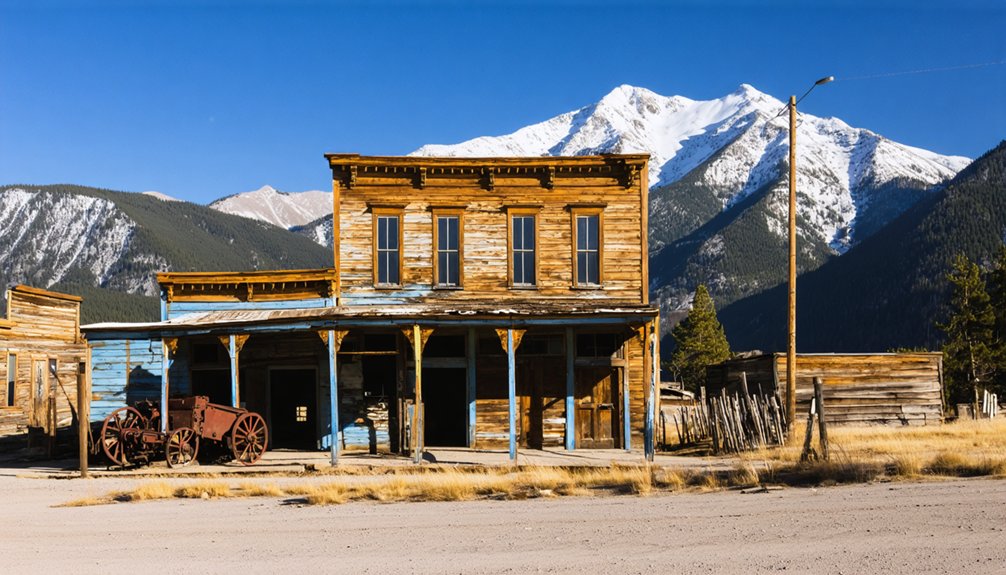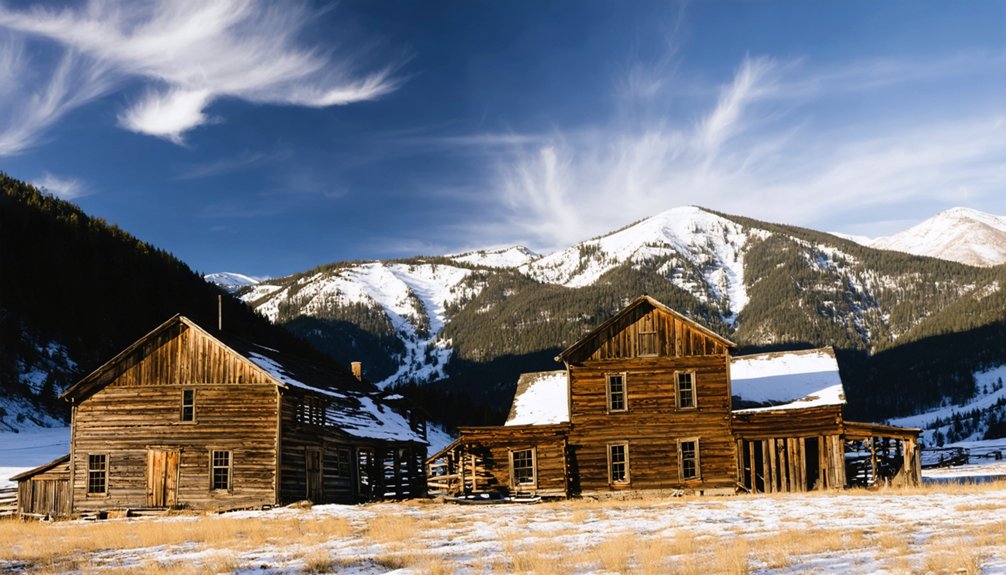
Take exit 195 from I-70 and follow State Route 91 north through Fremont Pass, where you’ll find Kokomo’s remnants buried beneath massive tailings piles at 10,618 feet. The Climax Molybdenum Mine now dominates this landscape that once held Colorado’s highest incorporated town, born from the 1878 silver boom. Look for the Masonic Lodge statue marking where wooden buildings once stood before fire devastated the settlement in 1881. Your journey to this vanished mining camp reveals layers of history hidden beneath the continental divide’s stark peaks.
Key Takeaways
- Exit I-70 at 195 and follow State Route 91 through Fremont Pass to reach Kokomo’s location near Climax.
- Look for the Masonic Lodge statue marking where Colorado’s highest incorporated town once stood before vanishing.
- Expect tailings piles covering the townsite; no original buildings remain after the 1881 fire and later mining operations.
- Visit the Tenmile Valley area where 15-20 mines once operated, including the legendary White Quail Mine.
- Plan for high elevation conditions and barren landscape dominated by the Climax Molybdenum Mine’s industrial presence.
The Silver Boom Origins of a High-Altitude Mining Town
When silver fever swept through Colorado’s high country in 1878, prospectors fanning out from Leadville’s bonanza camps turned their attention to the Tenmile Valley—and there, nestled at over 10,000 feet above sea level, Kokomo sprang to life. Named after nearby Kokomo Gulch, this settlement exploded from wilderness to boomtown within two years.
Early prospector tales tell of the Reese brothers—Andrew, Henry, and Daniel—staking claims that would transform barren mountainsides into productive ore zones. The silver strike geology proved phenomenally rich: 15 to 20 paying mines operated by 1879, with the White Quail alone yielding 40-100 ounces of silver per ton. Nearly 10,000 fortune-seekers flooded in, merchants erected storefronts, and by the 1890s, Kokomo claimed the title of Colorado’s highest incorporated town.
Finding Kokomo’s Location Along the Fremont Pass
The mountain highway known as State Route 91 carves a dramatic path through Colorado’s continental divide, cresting at Fremont Pass’s windswept summit of 11,318 feet. You’ll find Kokomo‘s remnants buried beneath tailings piles between Copper Mountain and this summit, where the Climax Molybdenum Mine now dominates the landscape.
Your access options are straightforward: take exit 195 from I-70, whether traveling eastbound or westbound, then follow CO-91’s paved route. From Leadville, head north on Harrison Avenue to East 9th Street.
This 24-mile stretch of the Top of the Rockies Scenic Byway delivers you through elevation profiles that shift dramatically between 9,000 and 11,000 feet. A Masonic Lodge statue marks where Kokomo once thrived at coordinates 39°21′59″N 106°11′12″W.
What Remains of Colorado’s Once-Highest Incorporated Town
At 10,618 feet above sea level, Kokomo claimed the distinction of Colorado’s highest incorporated town during its 1890s heyday—a title that reflected both the era’s mining ambition and the extreme conditions miners endured.
Today, you’ll find absolutely nothing of this once-thriving settlement. The mining camp’s iconic building remnants—hotels, banks, smelters, even America’s highest Masonic Lodge—vanished completely when the Climax Molybdenum Company purchased the land in the early 1970s.
Modern day land use changes transformed Kokomo’s townsite into tailings dumps, burying any trace of the community that once housed 10,000 souls. What produced over $25 million in ores through 1965 now exists only in historical markers near the obliterated site, enduring record to industry’s relentless march forward.
The Devastating Fire That Changed Everything
In 1881, flames ripped through Kokomo’s hastily-built wooden structures, reducing a thriving mining camp of 10,000 souls to ash and charred timber. The devastation forced what remained of the town to merge with neighboring Recen, two settlements so close they’d always been nearly indistinguishable.
Though residents rebuilt immediately, the timing couldn’t have been worse—local mines were already declining, and Kokomo would never again see the bustling crowds that had packed its streets before the fire.
Town’s Wooden Structure Vulnerability
Wooden structures climbed Kokomo’s slopes like matchsticks waiting for a spark, and that spark came somewhere between 1879 and 1881—accounts differ, though most historians settle on 1881.
You’ll understand the disaster when you consider the structural vulnerability factors: hastily-constructed buildings thrown up during the silver rush, timber frames dried by mountain air at 10,618 feet, and zero fire mitigation techniques in a town that exploded from 1,500 to 10,000 residents in under two years.
These mining camps prioritized speed over safety—every day spent building was a day not spent extracting silver. When flames finally raced through Kokomo’s wooden corridors, they devoured nearly everything. The town’s physical vulnerability mirrored the fragility of boom-town economics itself.
Forced Merger With Recen
The devastating fire that swept through Kokomo sometime between 1879 and 1882—most likely in 1881—didn’t just destroy buildings; it erased the town’s independent existence. When flames consumed nearly everything standing, survivors faced a stark choice: rebuild from ash or relocate. They chose the latter, moving to neighboring Recen and triggering immediate population shift impacts that would seal Kokomo’s fate.
The merger wasn’t romantic—it was survival. Recen absorbed Kokomo’s remnants, then adopted its better-known name, creating a geographical paradox you’ll notice today. The original town site emptied while its identity transferred elsewhere. This post merger decline accelerated rapidly as boundaries blurred and the community’s heart relocated. What remained was a ghost, stripped of both substance and soul by fire’s merciless efficiency.
Post-Fire Population Changes
When flames consumed Kokomo in 1881, they didn’t just destroy buildings—they incinerated a population of 10,000. You’ll find the post fire rebuilding efforts began immediately, citizens hammering together wooden structures with desperate optimism.
But the mines had already started their decline, and no amount of frontier determination could revive dying ore veins. The population decline pace accelerated relentlessly. Within years, Kokomo’s bustling streets emptied as prospectors chased richer strikes elsewhere.
The brutal winter of 1889 buried what remained under seven feet of snow, reducing food supplies to ten days’ worth. By the 1960s, when Climax mine claimed the land for tailings, you could count Kokomo’s remaining structures on one hand—a stark monument to boom-and-bust freedom.
Mining Legacy and the Dead Man Claim Story
Before the devastating fire reshaped Kokomo’s destiny, the town’s true soul belonged to the mines that carved wealth from the mountainside. The Tenmile District‘s fifteen to twenty paying operations transformed this 10,618-foot valley into one of Colorado’s richest silver camps, with production surging after those first summer 1878 discoveries.
Among the district’s most enduring tales is the Dead Man Claim—a strike allegedly found when a miner dug what he thought would be his friend’s grave, only to unearth a fortune instead of laying one to rest.
Rich Silver Strike History
Silver rushes don’t announce themselves quietly, and Kokomo’s founding in 1878–1879 proved no exception to that rule. Named after Kokomo, Indiana, this high-elevation camp exploded into existence when prospectors wielding 19th century mining technology struck paydirt in the surrounding gulches.
Within that first frenzied year, you’d have witnessed 15–20 paying mines already extracting fortunes. The district’s notable producers tell the story:
- White Quail Mine yielded extraordinary grades—40–100 ounces silver per ton, 40–60 ounces gold per ton
- Queen of the West emerged among the earliest prominent silver sources
- Wilfley-Kimberly operations revolutionized zinc processing technology
The shift in commodity focus came around 1900, when zinc surpassed silver as king. Through 1965, this district had surrendered nearly 1.8 million ounces of silver worth over $25 million—evidence of unrestrained mineral wealth.
The Dead Man Legend
Among Kokomo’s ore-stained legends, none cuts deeper than the tale of the Dead Man claim—a mining stake literally born from a prospector’s grave. When a miner buried his deceased companion during the 1878 silver rush, he marked the grave site as his claim at 10,618 feet, creating mining folklore that still echoes through these high peaks.
You’ll find this haunting origin story woven into the fabric of Kokomo’s lawless past, where 15-20 paying mines operated amid shootings and chaos. While reports of paranormal activity remain unconfirmed, the Dead Man claim symbolizes the brutal reality facing frontier prospectors—men who’d stake fortunes on their friends’ final resting places. It’s a memorial to mining’s merciless grip on those seeking independence in Colorado’s unforgiving silver country.
Tenmile District Mining Operations
The Dead Man claim represents just one thread in the vast tapestry of the Kokomo-Tenmile District, where fortunes flowed from the mountainsides for nearly a century. You’ll find this region produced over $25 million in silver, lead, zinc, copper, and gold—a record of miners who conquered tunnel engineering challenges at extreme elevations.
The district’s remarkable production tells its own story:
- Robinson ore shoot alone: $6 million extracted before 1900
- Ten Mile Tunnel: Operations at 11,001 feet elevation
- Peak activity: Champion Mine shipped ore daily throughout 1881
Logistical obstacles during operations proved formidable—supplies hauled through mountain passes, ore transported down treacherous slopes. By 1923, most mines fell silent, leaving you today’s ghost town landscape where independence-seeking prospectors once carved their destinies from solid rock.
How the Climax Molybdenum Operation Buried History
While prospectors scoured Colorado’s mountains for glimmering veins of gold and silver, a dull gray mineral on Bartlett Mountain went unnoticed for years—until Charles J. Senter discovered molybdenite in 1879.
By 1918, Max Schott’s Climax Molybdenum Company transformed this high-altitude site into the world’s largest moly mine, employing over 3,000 workers and producing three-quarters of global supply during WWI. The operation’s expansion literally consumed history—entire town structures relocated to Leadville by 1965, leaving nothing behind except active mining equipment.
Today, you’ll find no trace of the forgotten community loss, just 500 million tons of displaced earth and ongoing environmental restoration challenges. The mine that produced 2 billion pounds of molybdenum worth $4 billion erased its own story, operating sporadically since reopening in 2012.
Driving Directions to the Kokomo Historical Landmark
Reaching Colorado’s highest incorporated town site requires only a straightforward drive up State Highway 91, where modern pavement has replaced the treacherous mountain trails that once challenged prospectors in 1878. You’ll find the Kokomo Masonic Lodge marker at a scenic overlook 9.8 miles south of Interstate 70, accessible by any standard vehicle.
Your route includes:
- Exit I-70 at Copper Mountain and head south on Highway 91
- Watch for the granite marker on your right side—it’s a 4-foot engraved monument commemorating Corinthian Lodge No. 42
- Pull into the fenced overlook area at 10,618 feet elevation, where historical photographs document the lodge’s operation from 1882 to 1966
This halfway point between Copper Mountain and Leadville offers unobstructed views across the valley where Kokomo once thrived.
What to Expect When Visiting This Vanished Settlement
Unlike most Colorado ghost towns that greet visitors with weathered cabins and rusting equipment, Kokomo offers an eerie absence—you’ll stand at a roadside marker gazing across an industrial tailings pond that consumed the entire town site in 1973.
The Masonic lodge memorial marks where 10,000 souls once staked mining claims during the 1881 silver rush. You’ll find easy 2WD access off I-70 near Fremont Pass, though modern maps omit Kokomo entirely.
Local legends whisper of the catastrophic 1889 winter when 25-foot snowdrifts trapped residents with ten days’ food remaining. The highest incorporated town in 1890s Colorado now exists only in memory—a stark reminder that progress sometimes demands complete erasure.
Bring historical photos to overlay past upon present nothingness.
Frequently Asked Questions
What Facilities Are Available for Tourists Near the Kokomo Landmark Site?
The background information doesn’t specify availability of restrooms or nearby food options at Kokomo. You’ll find facilities like parking for high-clearance vehicles and trail access, but you should plan ahead and bring supplies for your adventure.
Is the Kokomo Historical Landmark Accessible During Winter Months?
You’ll find seasonal accessibility limited by weather-related closures from November through May. Heavy snowfall demands snowshoes or skis for safe passage, while summer offers unrestricted freedom to explore Kokomo’s ghost town ruins independently.
Are There Guided Tours Available for the Fremont Pass Mining District?
No formal guided tours exist—bureaucracy hasn’t packaged this adventure yet! You’ll explore the Fremont Pass mining district independently through self-guided options like “Route of the Silver Kings,” discovering authentic mining history on your own terms with available maps and brochures.
Can Visitors Hike to Any Old Mine Entrances Near Kokomo?
You’ll find views of abandoned mines from trails near Kokomo, but there’s no safe access to actual mine entrances. The possibility of trespassing dangers exists, as most sites are either buried under tailings or on restricted property.
What Other Ghost Towns Are Nearby to Visit on the Same Trip?
You won’t need to backtrack—Robinson sits right in Summit County with Kokomo. While it’s now buried under Climax Mine tailings, you’ll find better-preserved nearby ghost towns offering diverse seasonal tourism activities throughout Colorado’s historic mining districts worth exploring.