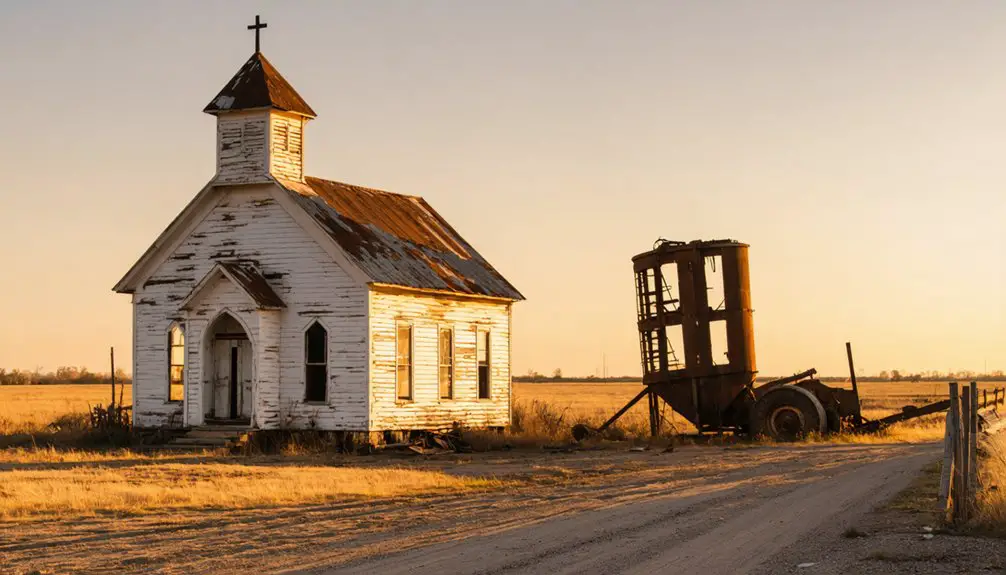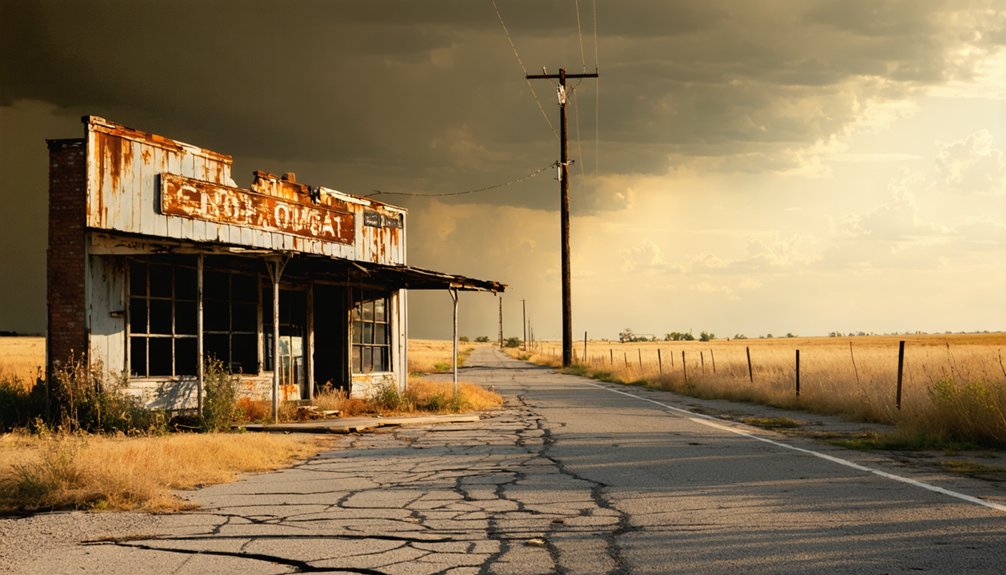
Planning a ghost town road trip to Lacey, Oklahoma means embracing open land, faint road grids, and quiet remnants where a community once stood. You’ll need reliable GPS, offline maps, and a higher-clearance vehicle for gravel stretches. Fuel up before leaving larger towns, and pack water and a paper map as backup. Pair Lacey with nearby ghost towns like Flat Rock and Ingersoll to build a rewarding northeast Oklahoma loop. There’s more to uncover than you’d expect.
Key Takeaways
- Lacey, Oklahoma is a subtle ghost town featuring foundation remnants, faint road grids, and roadside markers rather than standing structures.
- Use reliable GPS, offline maps, and multiple mapping tools to navigate Lacey’s sparse-signage backroads in Tulsa County.
- Bring a camera, paper map, and water, and use a higher-clearance vehicle for comfortable travel on gravel roads.
- Pair Lacey with nearby ghost towns like Flat Rock, Ingersoll, and Jennings to create an efficient, geographically clustered road trip loop.
- Fuel up in larger towns beforehand, monitor weather conditions, and avoid clay roads after rain for safer travel.
What’s Left of Lacey, Oklahoma Today?
Lacey, Oklahoma is the kind of place that makes you slow down and squint — not because there’s much to see, but because you’re trying to confirm you’ve actually arrived.
The ghost town remnants here are subtle. You won’t find a preserved main street or a welcome sign pointing toward history. What you’ll likely encounter is open agricultural land, a faint road grid, and perhaps a foundation or roadside marker hinting at Lacey history beneath the grass.
It’s a place where the landscape does the talking. If you keep your eyes open, those quiet details — a fence line following an old lot, a cemetery tucked off a county road — tell the story of a community that once existed and simply faded.
How Lacey Went From Rail Town to Ghost Town?
Like many small Oklahoma towns, Lacey didn’t collapse overnight — it followed a slow, familiar arc that played out across the region in the late nineteenth and early twentieth centuries.
Railroad history shaped its early identity, drawing settlers who believed rail access guaranteed a future. It didn’t. When rail lines shifted priorities and highway development redirected traffic elsewhere, communities like Lacey lost their economic footing fast.
Rural decline followed predictably — businesses closed, families relocated, and the population quietly disappeared. What you’re seeing today is the result of decades of slow erosion rather than a single dramatic event.
Businesses closed. Families left. The town didn’t die suddenly — it simply faded, one quiet loss at a time.
Understanding that pattern helps you appreciate what these vanished places represent: real communities that built something, then watched it slip away when the larger forces around them changed direction.
How to Find Lacey, Oklahoma on a Map?
Knowing the history is one thing — actually getting yourself there’s another. Finding Lacey requires reliable GPS navigation since road signs are sparse and tourist infrastructure is nonexistent.
Pull up a travel app before you leave, and search Tulsa County’s rural roads to pinpoint the general area. Local landmarks like section-line intersections and county road markers become your real guides once you’re out there.
Cross-reference multiple mapping tools, because some apps won’t recognize the name at all. Scenic routes through northeast Oklahoma’s green countryside make the drive worthwhile even if Lacey itself offers little standing structure.
Treat the journey as part of the ghost town history experience — those quiet rural roads tell the story just as much as any remaining foundation does.
What to Expect When You Arrive at Lacey?
When you pull up to what used to be Lacey, don’t expect a welcome sign or a preserved main street — you’ll find open land, quiet air, and subtle traces of a community that time gradually erased.
This is rural exploration at its most unfiltered, where hidden history lives beneath overgrown lots and faded road references rather than museum displays.
Look for these three things on arrival:
- Foundation remnants or clearings where structures once stood
- Nearby cemetery sites, which often survive long after buildings disappear
- Roadside markers or section-line intersections that confirm the original townsite
Bring a camera, a paper map as backup, and a willingness to read the landscape carefully.
Lacey rewards patience and curiosity more than convenience.
Best Ghost Towns to Pair With Lacey, Oklahoma
Lacey works best when you build it into a broader northeast Oklahoma ghost-town loop rather than treating it as a stand-alone destination.
You’ll find several small, forgotten communities scattered through Tulsa County and its neighboring counties, and grouping them together turns a brief stop into a full day of backroads exploration.
Pairing Lacey with towns that still have a standing structure, a historic marker, or a preserved depot adds contrast and gives your route a stronger sense of progression.
Nearby Ghost Towns Worth Visiting
Since Lacey’s on-site experience is brief, you’ll want to pair it with other nearby ghost towns to build a road trip worth the drive.
Northeast Oklahoma’s back roads connect several forgotten communities that reward explorers seeking authentic historic preservation and community heritage.
Consider anchoring your route around these stops:
- Flat Rock – A quiet, faded settlement where remnants hint at early rural life.
- Ingersoll – A former railroad community reflecting Oklahoma’s classic boom-and-bust cycle.
- Jennings – A small town with surviving structures that contrast nicely against fully abandoned sites.
Grouping these stops lets you cover more ground efficiently while experiencing the full spectrum of Oklahoma’s lost communities.
Keep county road maps handy, since signage stays minimal across this stretch of Green Country.
Building Your Oklahoma Route
A well-planned route turns a quick stop at Lacey into a full day of backroads exploration across northeast Oklahoma. Start by grouping Lacey with other Tulsa County ghost towns and small communities, then connect your stops along county roads and rural highways for efficient travel.
Route highlights include historic depots, overgrown townsites, and roadside markers that reveal Oklahoma’s forgotten past. You’ll also find scenic drives through rolling Green Country landscapes that make the journey as rewarding as the destinations themselves.
Balance abandoned sites with preserved historic towns featuring main streets or small museums, adding contrast to your itinerary. A well-designed loop through Tulsa and adjacent counties minimizes backtracking, keeping your day moving and your focus on discovery rather than logistics.
Pairing Stops Strategically
With your route mapped out, choosing the right companion stops makes all the difference between a scattered drive and a cohesive ghost-town experience. Northeast Oklahoma rewards rural exploration when you group destinations intentionally.
Consider anchoring your itinerary around these ghost town attractions:
- Nearby Tulsa County remnants — Small communities sharing Lacey’s rise-and-fall railroad history add historical continuity.
- Route 66 corridor towns — Preserved main streets and roadside relics contrast beautifully against abandoned sites.
- Historic depots or cemetery sites — These surviving landmarks provide tangible connection to Oklahoma’s settlement era.
Pairing strategically means you’re covering ground purposefully rather than chasing disconnected dots on a map. Each stop should reinforce the next, giving your trip a narrative that makes the whole journey feel worth every backroad mile.
How to Build a Northeast Oklahoma Ghost Town Route?

Once you’ve added Lacey to your list, you’ll want to map a logical loop through Tulsa County and its neighboring counties, connecting ghost towns by the shortest county-road paths to cut down on backtracking.
Group stops like Lacey with other nearby forgotten communities so each drive segment earns its mileage, and keep your GPS loaded since signage is sparse throughout the region.
You’ll also want to balance the abandoned sites with at least one preserved town, historic depot, or scenic byway stop to break up the desolation and give the day some variety.
Mapping Your Ghost Town Route
Planning a northeast Oklahoma ghost town route starts with one simple decision: treat Lacey as a waypoint, not a destination.
Build outward from there, connecting rural exploration stops across Tulsa County and its neighbors.
Use these three mapping steps to structure your route:
- Plot anchor towns first — identify places with preserved depots or main streets to balance ghost town history with visible landmarks.
- Cluster your stops geographically — group Lacey with other nearby abandoned communities to cut backtracking and maximize road time.
- Layer in scenic breaks — add a lake or byway segment to keep the drive from feeling monotonous.
GPS is non-negotiable here.
Signage is scarce, county roads shift without warning, and some stretches run unpaved.
Map everything before you leave the driveway.
Grouping Nearby Town Stops
Clustering your stops is what separates a scattered drive from a route that actually flows. Since Lacey offers minimal infrastructure, you’ll want to pair it with other northeast Oklahoma communities that add depth to your day.
Build your route around a loose loop through Tulsa County and neighboring counties, hitting historic landmarks like old depots, schoolhouses, or marked townsites along the way. Rural exploration works best when you’re moving efficiently between stops rather than doubling back across the same roads.
Group towns by proximity, not just interest level, and let the county road network guide your sequencing. Mixing near-ghost towns with slightly more preserved communities gives your itinerary natural contrast and keeps the drive rewarding from start to finish.
Balancing Abandoned And Active Sites
Grouping stops by proximity gets your route moving, but how you mix the sites you visit determines whether the day feels cohesive or exhausting.
Balance your abandoned landscapes with places that still have a pulse. Structure your rural exploration this way:
- Start at an active historic town with a preserved depot or main street to anchor your understanding of the era.
- Move into quieter ghost-town stops like Lacey, where the landscape speaks through silence, foundations, and open fields.
- End near a lake, scenic byway, or working small town to decompress before heading home.
This rhythm keeps the day from feeling heavy. Abandoned sites hit differently when you’ve got context before and breathing room after.
You’ll leave with a fuller picture of northeast Oklahoma’s layered history.
What to Know Before Driving to a Rural Oklahoma Ghost Town?
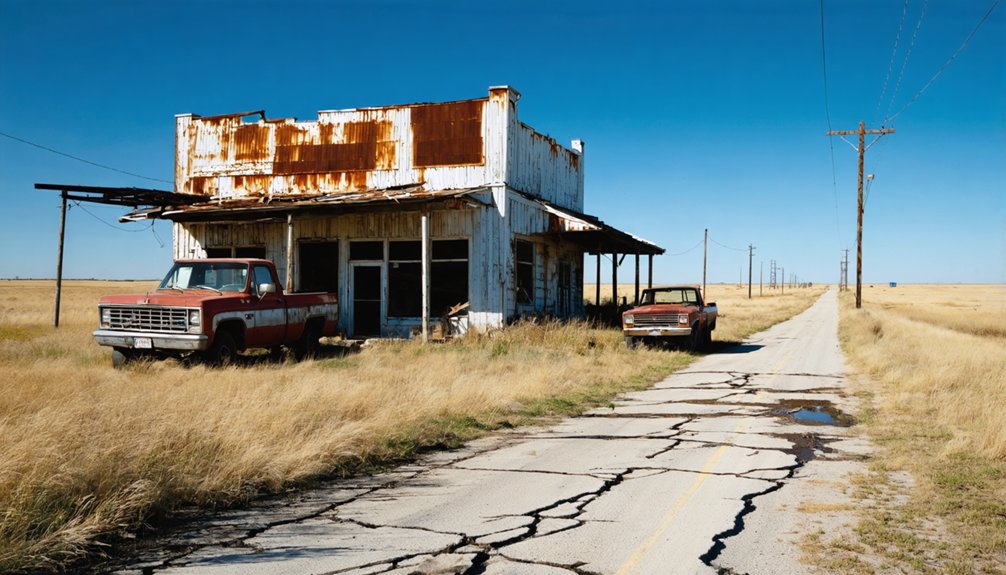
A few practical realities will shape your drive before you ever reach Lacey or any rural Oklahoma ghost town.
Signage is sparse, so download offline maps before you lose cell service on county roads. Gravel stretches are common, meaning a higher-clearance vehicle handles rural exploration far more comfortably than a low sedan.
Fuel up in a larger town beforehand, because gas stations disappear quickly once you’re deep in the backroads. Weather matters too — Oklahoma clay roads turn slick after rain, cutting off access entirely.
Carry water, a paper map as backup, and a charged phone. Ghost town history rewards patience and preparation, not spontaneity alone.
Go in ready, and you’ll spend your time discovering instead of troubleshooting.
Frequently Asked Questions
Is There an Entrance Fee or Permit Required to Visit Lacey?
You don’t need an entrance fee or permit to explore Lacey. It’s an unincorporated ghost town, so you’re free to roam, photograph, and absorb Lacey history while appreciating ghost town preservation efforts naturally woven into the rural landscape.
What Time of Year Is Best for Visiting Oklahoma Ghost Towns?
Imagine crisp October air as you explore Lacey’s forgotten foundations — fall’s your best bet. You’ll enjoy mild seasonal weather, vibrant landscapes, and a reflective mood that deepens the historical significance of every abandoned structure you discover.
Are Pets Allowed When Exploring Rural Ghost Town Sites in Oklahoma?
You’ll find most rural ghost town sites are pet-friendly since they’re open land, but keep your dog leashed. Follow rural exploration tips: bring water, watch for hazards, and respect pet-friendly policies on any private property.
Can Lacey, Oklahoma Be Visited as a Solo Traveler Safely?
You can visit Lacey solo safely by following smart solo safety tips. When exploring alone, share your itinerary, keep your phone charged, and trust your instincts maneuvering these quiet, remote backroads independently.
Are There Any Guided Ghost Town Tours Available in Northeastern Oklahoma?
Like a treasure map with no “X,” guided tours for northeastern Oklahoma ghost towns are rare — but you’ll find local history societies occasionally lead curated excursions, giving you rich context for stops like Lacey.
References
- https://www.onlyinyourstate.com/trip-ideas/oklahoma/ghost-towns-road-trip-ok
- https://www.youtube.com/watch?v=CYSGQsnt_FY
- https://www.youtube.com/watch?v=LNAm0sZuNyw
- https://www.youtube.com/watch?v=5XQUmVjjrZw
- https://www.youtube.com/watch?v=nWkVUmCTL9M
- https://www.youtube.com/watch?v=M_RK4klda70
- https://www.youtube.com/watch?v=WJF6vDJUuBI
- https://www.youtube.com/watch?v=xeX4HYw-U8A
- https://en.wikipedia.org/wiki/List_of_ghost_towns_in_Oklahoma