Planning a ghost town road trip to Lakeview, South Dakota means trading paved roads for gravel and dirt tracks through the northern Great Plains. You’ll find a still-standing Dutch immigrant church, crumbled foundations, and the quiet ruins of a once-thriving prairie community. Nearby Purewater offers two lonely structures and an even deeper silence. Visit between May and September for the best road conditions. Keep going to uncover everything you’ll need for this unforgettable off-the-beaten-path adventure.
Key Takeaways
- Lakeview, South Dakota, preserves Dutch immigrant heritage through a standing church, parsonage, and crumbled foundations of former stores and schools.
- Visit between May and September for optimal road conditions, with late summer offering the firmest dirt roads for easy navigation.
- Roads transition from paved to gravel at the Nebraska-South Dakota state line, then to dirt, requiring a reliable 2WD vehicle in dry conditions.
- Screenshot offline maps and mark waypoints before traveling, as GPS signals frequently struggle on unmarked dirt roads leading to Lakeview.
- Pack a spare tire, tow strap, extra water, paper maps, sunscreen, and sturdy boots for this remote ghost town exploration.
Why Lakeview’s Church, Ruins, and Dutch Roots Make It Worthwhile
Tucked just north of the Nebraska-South Dakota state line, Lakeview carries the quiet weight of a Dutch immigrant community that once thrived on the open plains. This ghost town‘s Dutch Heritage runs deep — Reformed Church congregations, family farms, and a self-sufficient community once defined this remote stretch of Todd County.
You’ll find the old church and parsonage still standing, offering a rare glimpse into what survival looks like across generations. Foundations mark where stores, schools, and homes once stood, letting you piece together a vanished world on your own terms.
Among South Dakota’s Ghost Towns, Lakeview rewards curious travelers willing to navigate gravel and dirt roads. It’s raw, unpolished, and completely authentic — exactly the kind of place that makes off-the-beaten-path exploration genuinely worthwhile.
The Dutch Immigrant History That Built: and Outlived: These Two Towns
When you stand among Lakeview’s crumbled foundations, you’re standing on ground that Dutch immigrant farmers carved out of the Dakota prairie in the late 19th century.
They didn’t just build homes here — they built two distinct faith communities, with Lakeview anchoring a Reformed Church in America congregation and nearby Purewater gathering a Christian Reformed one.
Those theological differences kept the towns spiritually separate for decades, yet when both communities finally merged in 1959, the combined congregation outlasted nearly every other structure the settlers ever built.
Dutch Settlers Arrive
Both Lakeview and Purewater trace their roots to Dutch immigrant farmers who pushed northward from Crookston, Nebraska, carving homesteads out of the Dakota plains just across the state line.
These settlers carried their Dutch heritage with them, planting not just crops but entire communities rooted in faith and hard work. Their pioneer spirit transformed raw prairie into functioning towns, complete with churches, schools, and local commerce.
The agricultural legacy they built still echoes across the landscape today, even as the buildings crumble back into the earth. Their cultural influences shaped everything, from how they organized their congregations to how they structured their daily lives.
You’re fundamentally walking through a living tribute to what determined immigrant farmers could accomplish with little more than grit and belief.
Faith-Driven Community Roots
Faith didn’t just shape these communities — it divided them. The Dutch settlers who homesteaded north of Crookston brought their faith-based traditions with them, but those traditions weren’t identical.
Lakeview drew members of the Reformed Church in America, while Purewater attracted Christian Reformed congregants — two distinct denominations rooted in the same Dutch heritage yet separate in practice.
Each town built its identity around its church. Lakeview grew larger, adding stores, a school, and a post office. Purewater remained smaller, quieter, defined almost entirely by its congregation.
What’s remarkable is the community resilience that outlasted both towns as functioning settlements. When the congregations finally merged in 1959, the Christian Reformed Church claimed the old Lakeview building — and still uses it today.
Merger Outlasts The Towns
The 1959 merger of Lakeview’s Reformed Church in America congregation with Purewater’s Christian Reformed congregation didn’t just unite two denominations — it quietly outlasted the towns that built them.
The merger implications stretch far beyond theology, revealing remarkable community resilience among Dutch immigrant descendants who refused to let faith dissolve with their buildings.
What survived the towns’ decline:
- The Christian Reformed Church actively worships in Lakeview’s original church building.
- The parsonage remains standing and in use.
- A small school serves the scattered farming population nearby.
- Purewater’s old church and parsonage still stand as physical witnesses.
You’re visiting places where institutions proved stronger than infrastructure.
The congregation moved forward while storefronts crumbled, schools collapsed, and dirt roads reclaimed what ambition once built.
How the 1959 Church Merger Signaled the End for Both Towns
When two separate congregations share a single church, it’s rarely a sign of growth — it’s usually a sign that both communities have run out of steam.
That’s exactly what happened in 1959 when Lakeview’s Reformed Church in America and Purewater’s Christian Reformed congregation merged into one. The church history here tells a quiet but unmistakable story: shrinking populations, aging farmers, and children leaving for cities.
The community legacy of both towns — once distinct Dutch immigrant settlements with their own identities — collapsed into a single congregation worshipping in Lakeview’s old church.
Purewater lost its purpose almost immediately, left with only a church and parsonage standing.
When you visit today, that merger doesn’t feel like survival. It feels like a graceful, final exhale.
What’s Left to See at the Lakeview Site Today
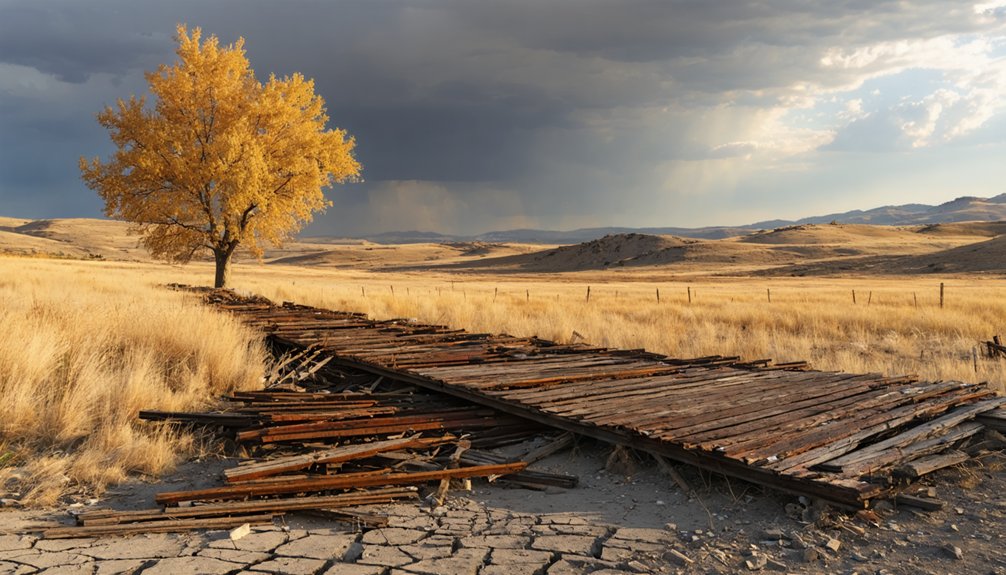
Stepping away from that merged congregation’s story, you’ll find Lakeview itself offers more rubble than romance — but it’s worth walking.
Ghost town exploration here rewards the patient traveler willing to read landscapes carefully.
Here’s what you’ll actually encounter:
- The active church and parsonage — still standing, still used
- Crumbled building foundations — where stores and homes once operated
- Old elementary school ruins — reduced to a foundation footprint
- Old high school remnants — located south of the main site
Historical preservation hasn’t protected much beyond the church complex, so manage your expectations.
You’re fundamentally reading negative space — absent walls tell Lakeview’s story louder than any remaining structure could.
What’s Still Standing at Purewater, the Smaller Ghost Town Nearby?
Just a mile or so from Lakeview’s rubble, Purewater tells an even quieter story — and it’s stripped down to two structures: an old church and its parsonage.
These Purewater landmarks are all that survive from what was once a tight-knit Christian Reformed congregation serving Dutch immigrant farmers.
Purewater history traces back to a community that intentionally kept itself separate from Lakeview’s Reformed Church in America congregation.
The two towns coexisted just miles apart until their congregations merged in 1959. After that, Purewater faded fast.
Today, you’ll find no bustling activity here — just those two aging buildings standing on open Dakota land.
It’s a raw, unfiltered stop that rewards curious travelers who appreciate honest remnants over polished historic sites.
How to Get to Lakeview From Crookston, Nebraska
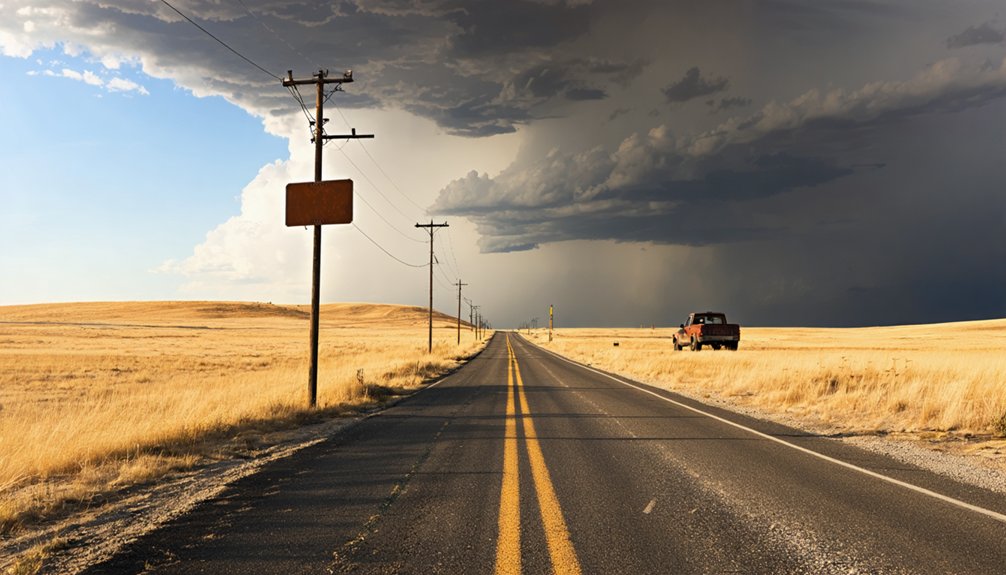
Getting to Lakeview takes you through one of the more honest shifts in rural travel — a moment where pavement simply gives up and the landscape takes over.
From Crookston, Nebraska, head 10 miles north and 1 mile east. Your ghost town road trip unfolds in stages:
From Crookston, head 10 miles north and 1 mile east — then let the road unfold in honest, unhurried stages.
- Drive north out of Crookston on the Nebraska paved road.
- Cross the Nebraska-South Dakota state line, where pavement becomes gravel.
- Change from gravel onto dirt roads leading toward Lakeview.
- Navigate carefully — grid rating 3 means route-finding takes attention.
You’ll need a reliable 2WD vehicle. Avoid winter travel entirely; snow turns those dirt roads into a trap.
Summer keeps conditions manageable and rewards your curiosity with open skies and a genuinely forgotten place worth finding.
What Road Conditions Should You Expect on the Drive In?
The road into Lakeview changes character three times before you arrive. From Crookston, Nebraska, you’ll follow a paved road heading north until it abruptly ends at the state line. That’s your first change.
South Dakota greets you with gravel, and your second change happens shortly after when the gravel surrenders to dirt.
For road safety, keep your speed down on loose gravel and watch for washboard surfaces that’ll rattle your fillings loose. These driving tips matter most in wet or winter conditions, when dirt roads turn slick and nearly impassable.
Stick to summer or dry-season visits whenever possible.
The good news? You don’t need 4WD. A standard 2WD vehicle handles the route fine when conditions are dry and you drive smart.
The Best Time of Year to Make This Trip
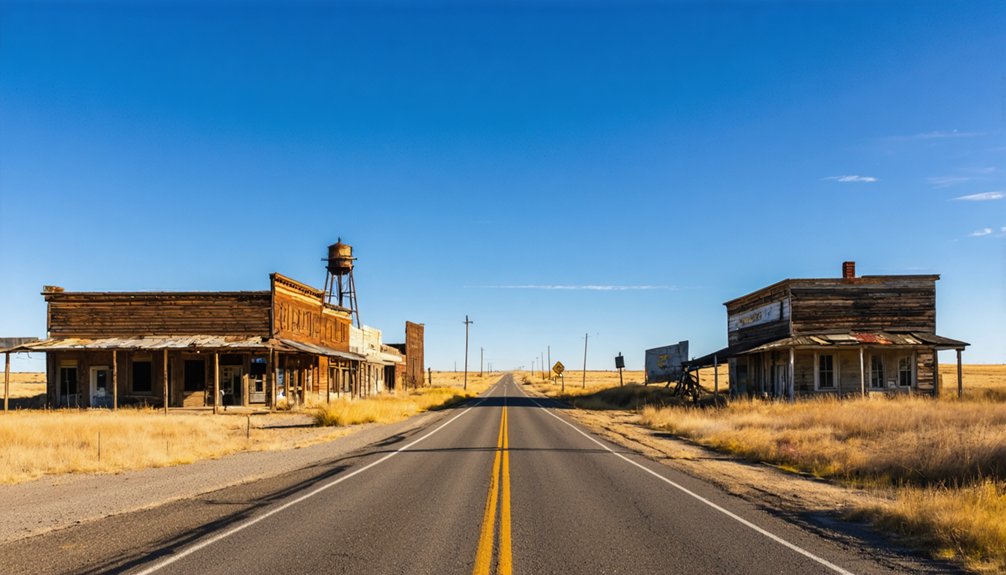
Timing your visit to Lakeview comes down to one simple principle: avoid winter. Snow and dirt roads create a brutal combination that’ll stop your road trip cold.
Instead, plan around conditions that actually work in your favor.
Best seasons for exploring Lakeview:
- Late Spring – Roads dry out after snowmelt, making dirt tracks manageable.
- Early Summer – Longer daylight hours maximize your exploration time.
- Late Summer – Hot and dry conditions firm up the dirt roads perfectly.
- Early Fall – Cooler temperatures make walking the scattered ruins comfortable.
Your best road trip window runs May through September.
South Dakota’s hot, dry summers actually help here, hardening those dirt roads into something a standard 2WD vehicle can confidently handle.
Once you leave the paved Nebraska road behind and cross into South Dakota, you’re traversing a web of unmarked dirt roads where GPS signals drop out and intersections look identical.
Train your eyes to read the terrain — tire tracks, fence lines, and grain elevator silhouettes on the horizon all serve as natural landmarks when signage doesn’t exist.
Count intersections carefully from your last known point, because one missed turn in this flat, featureless landscape can send you miles in the wrong direction.
Reading The Terrain Visually
Maneuvering the unmarked dirt roads around Lakeview demands sharp eyes and a feel for the land. You’ll rely on terrain features and visual landmarks instead of signs. Train your eyes to read what’s ahead:
- Track fence lines — they typically follow section boundaries and guide your direction across open prairie.
- Spot elevated ground — slight rises reveal where roads shift or intersect ahead.
- Watch for tree clusters — they often mark old farmsteads, cemeteries, or forgotten building sites.
- Note road surface changes — the alteration from Nebraska’s paved road to South Dakota gravel signals you’re crossing into ghost town territory.
Trust your instincts, keep your speed low, and let the landscape talk. The terrain itself becomes your map out here.
Tracking Unmarked Road Intersections
Dirt roads around Lakeview don’t announce their intersections — they just appear, often without warning and without signs. Successful road navigation here means counting every turn you make from the Nebraska paved road’s end at the state line.
The moment asphalt becomes gravel, start mentally logging each junction. Your phone’s GPS may struggle with signal, so screenshot offline maps before leaving Crookston.
During ghost town exploration, cross-reference your position against visible landmarks — a ruined foundation, the surviving church, or the old high school shell south of the main site. When two identical dirt paths split ahead, trust your pre-loaded coordinates over instinct.
Mark waypoints at every major turn. Getting confidently lost is one thing; getting genuinely stranded on unmarked Dakota roads is another entirely.
When your phone’s signal dies somewhere between Crookston and the South Dakota state line, you’ve got three reliable tools left: a printed map, a compass, and your own careful counting.
Master these rural exploration tips before you leave pavement behind.
Follow these dirt road guidance steps:
- Print detailed county maps of Todd County before departing.
- Note that Nebraska’s paved road becomes gravel exactly at the state line.
- Count intersections carefully — unmarked crossroads appear frequently.
- Track your mileage: Lakeview sits 10 miles north and 1 mile east of Crookston.
You’re navigating Grid 3 terrain, meaning intersections won’t announce themselves.
Trust your odometer over memory, keep your compass oriented north, and move deliberately through every junction.
What to Pack for Rough Roads and Remote Exploration
Maneuvering the dirt and gravel roads leading to Lakeview and Purewater demands preparation, so you’ll want to pack smart before you head out. Your road trip essentials should include a spare tire, tow strap, and basic tool kit since you’re venturing far from any repair shop.
Bring extra water and food because exploring ghost towns in South Dakota’s hot, dry summers burns energy fast. Pack sunscreen, sturdy boots, and a hat for trudging through crumbled foundations and overgrown sites.
A detailed paper map replaces unreliable GPS signals out here. Dust coats everything on dry gravel roads, so seal your gear in bags. A first aid kit and fully charged battery pack round out what you’ll need for this remote adventure.
Frequently Asked Questions
Is Camping Allowed Near the Lakeview or Purewater Ghost Town Sites?
No specific camping regulations are mentioned for Lakeview or Purewater. Both ghost towns lack ghost town amenities, so you’ll need to plan independently, respecting private farmland and ensuring you’re not trespassing on surrounding agricultural property.
Are There Any Guided Tours Available for Visiting Lakeview Ghost Town?
You won’t find guided tours for Lakeview’s ghost town history, so you’ll explore freely on your own terms. Discover local legends independently as you roam its crumbled foundations, abandoned ruins, and the still-active merged church at your own pace.
Can Visitors Legally Enter the Still-Standing Church Buildings at Lakeview?
Church access isn’t publicly confirmed, but the Lakeview church’s historical significance makes it worth inquiring locally. You’ll want to respect private property, contact the Christian Reformed congregation, and guarantee you’re exploring with proper permission before entering.
Is There Cell Phone Service or Emergency Help Available Near Lakeview?
Don’t count on cell coverage near Lakeview’s remote dirt roads. You’re deep in Todd County’s isolated plains, far from emergency resources. Always carry a satellite communicator, extra water, and tell someone your travel plans before you venture out.
Are Pets Allowed When Exploring the Lakeview and Purewater Ghost Town Sites?
No official rules restrict pets, but ghost town etiquette means you’ll keep them leashed among crumbling foundations. Since pet friendly accommodations aren’t nearby, plan ahead — you’re free to explore with your furry companion responsibly.
References
- https://www.ghosttowns.com/states/sd/lakeviewandpurewater.html
- https://en.wikipedia.org/wiki/List_of_ghost_towns_in_South_Dakota
- https://www.tripadvisor.com/Attraction_Review-g54799-d22999414-Reviews-Scenic_Ghost_Town-Scenic_South_Dakota.html
- https://www.blackhillsbadlands.com/blog/post/old-west-legends-mines-ghost-towns-route-reimagined/
- https://myxoadventures.com/the-ghost-town-of-spokane-south-dakota/
- https://www.youtube.com/watch?v=jmSADvq4Lek
- https://kids.kiddle.co/List_of_ghost_towns_in_South_Dakota