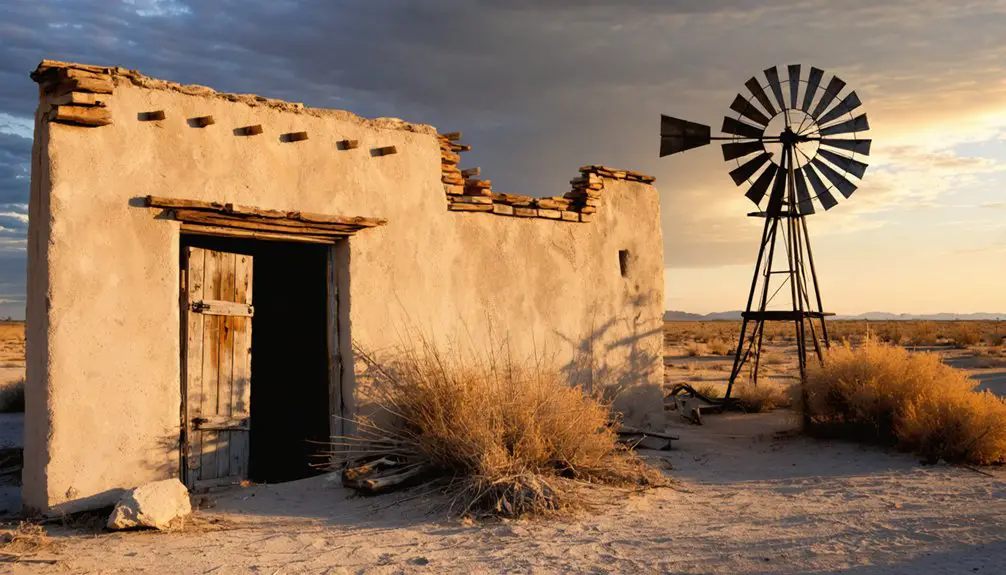
You’ll find Rancho de las Cabras 23 miles southeast of San Antonio, where massive sandstone walls form a hexagonal fortress rising from the South Texas brush. Access this World Heritage site through monthly guided tours from October to March—email saan_interpretation@nps.gov for reservations, as spots fill quickly on a first-come basis. Turn onto an unmarked dirt road five miles south of Floresville on Highway 97, where centuries-old ruins and ghostly legends await those who venture beyond the pavement.
Key Takeaways
- Located 23 miles southeast of San Antonio; turn onto unmarked dirt road 5 miles south of Floresville on Highway 97.
- Tours operate monthly October through March on first-come, first-serve basis; email saan_interpretation@nps.gov to reserve your spot.
- Explore massive hexagonal sandstone walls, defensive bastions, chapel foundations, and vaqueros’ living quarters from the 1750s era.
- View archaeological treasures spanning 60 years including ceramics, religious medals, and artifacts connecting indigenous and colonial craftsmanship.
- Experience ghost light folklore where spectral lights and mysterious sounds reportedly appear atop ancient walls during stormy nights.
The Historic Rancho De Las Cabras: a Spanish Colonial Outpost
In the 1750s, Canary Islander farmers near San Antonio grew so frustrated with mission cattle trampling their carefully tended crops that they demanded action—and the Spanish colonial authorities responded by establishing Rancho De Las Cabras thirty miles southeast of Mission San Francisco de la Espada.
You’ll discover a hexagon-shaped compound with sandstone walls that sheltered Native Texan vaqueros and their families, who managed over 1,150 cattle, 740 sheep, and 90 goats. These skilled herders provided weekly livestock allotments to the mission while defending against Lipan Apache raids.
Though Apache presence forced decline in the 1770s, the ranch later flourished under Maria del Carmen Calvillo‘s ownership through historic land grants. Her agricultural innovations expanded operations to 2,000 cattle by the 1830s, incorporating irrigation systems and crop production. Archeologists have uncovered imported ceramics, coins, and personal items that reveal the vaqueros’ acculturation to mission life and European trade networks. As one of only two known World Heritage ranch ruins in the Western Hemisphere, this site represents an irreplaceable chapter in Spanish colonial history.
Getting There: Directions to Wilson County’s Hidden Gem
You’ll find this elusive Spanish colonial treasure twenty-three miles southeast of San Antonio, accessed only through monthly guided tours from October to March.
The journey begins five miles south of Floresville on State Highway 97, where you’ll turn onto an unmarked dirt road that’s normally closed to casual visitors.
Reserve your spot well in advance by emailing saan_interpretation@nps.gov, as these two-hour expeditions into Wilson County’s thorny brush country fill quickly.
The site became part of the National Park Service holdings in 1995, after nearly two decades under Texas Parks and Wildlife Department stewardship.
Tours operate on a first come, first serve basis with limited availability each month.
Route From San Antonio
Your route markers:
- Highway 97 becomes your ribbon through ranch country
- Unmarked dirt road entrance appears five miles south of Floresville
- High ground overlooks the San Antonio River’s curves
- GPS coordinates matter more than signage here
Watch for the subtle turnoff where pavement surrenders to earth—civilization’s boundary dissolved.
Monthly Access Schedule
Finding this secluded ranch compound requires more than navigation skills—it demands patience with a calendar. You’ll need to plan your expedition between October and March, when ranger-guided tours open the gates on each month’s first Saturday (except January, which shifts to the second Saturday). These two-hour programs represent your only chance to explore the property—there’s no spontaneous wandering here.
The reservation process starts with emailing saan_interpretation@nps.gov, where you’ll provide your name, contact details, and party size. Book early; limited spots disappear quickly on this first-come basis.
Weather contingencies factor heavily into your planning—extreme conditions or rain forecasts trigger cancellations, with rescheduling handled through email. Monitor your inbox closely as your tour date approaches, ensuring your ghost town adventure doesn’t vanish before you arrive. The site sits 22 miles south of Mission Espada in Floresville, making it a considerable journey from the main mission trail. During the tour, you’ll explore the protected prairie and ruins while learning about the stories and mysteries surrounding this historic location.
What Remains: Exploring the Hexagonal Compound Ruins
When you arrive at Las Cabras, you’ll find massive sandstone walls rising from protective sand piles, forming the distinctive hexagonal shape that once enclosed the mission’s 1750s ranch headquarters. The compound’s defensive bastions still mark the northwest and southeast corners, silent sentinels that protected mission Indians and livestock from Lipan Apache raids over two centuries ago.
Though most structures remain buried beneath the sand, you can trace the chapel foundations and glimpse room outlines where vaqueros once lived during the peak years when this remote outpost managed over 1,100 cattle.
Defensive Walls and Bastions
The hexagonal compound at Las Cabras reveals itself through low mounds of sand-covered rubble, a protective blanket installed by Texas Parks and Wildlife Department to prevent further erosion of the sandstone walls beneath. You’ll discover 66-centimeter-thick perimeter walls that once defined this frontier fortress, their strategic placement creating interlocking fields of fire.
At the northwest and southeast corners, circular bastions rise from the earth—crude defensive positions built with rougher stonework than the compound’s refined perimeter blocks.
What You’ll Find at the Defensive Positions:
- Two-phase construction evident in varying stone compositions throughout the walls
- Original corner walls preserved within bastion mounds, showing defensive design evolution
- Sandstone quarrying evidence near the compound, revealing self-sufficient construction methods
- 1970s archaeological excavations that documented these strategic defensive features before protective burial
Chapel and Living Quarters
Within the hexagonal compound’s protected interior, you’ll encounter the most substantial ruin—a chapel facade wall standing 85 centimeters thick where it connects at right angles to the original perimeter. This structure replaced earlier jacals torn down to ground level during post-1772 construction phases.
Archaeological evidence reveals postholes along the south wall where thatched-roof dwellings once sheltered ranching families, their household furnishings still scattered across dirt floors when excavators arrived. You’ll notice the kiln remains used for plaster production, likely coating the chapel’s interior surfaces.
The northwest corner preserves original compound walls within later bastion modifications. Twenty-six people—herders and their families—called these quarters home, living among corrals and fenced fields that sustained mission life on this remote frontier outpost. The Center for Archaeological Research conducted two-stage archaeological investigation of this site, prompted by National Park Service plans to construct modern visitor facilities near these Spanish colonial ruins.
The Mission Connection: Understanding Espada’s Livestock Operation
Long before Las Cabras became a remote outpost in the Texas wilderness, Franciscan friars arriving from East Texas in 1731 recognized that their spiritual mission required a practical foundation: food. They established Rancho de las Cabras to support Mission San Francisco de la Espada, creating a self-sustaining operation that would feed 172 Native Americans.
By 1772, livestock production levels reached impressive numbers: 1,200 cattle, 2,700 sheep, and over 700 horses.
The demographics of workers tell a compelling story of frontier survival:
- Native American teenage vaqueros managed vast herds without constant missionary oversight
- Twenty-six people, including families, lived isolated from presidio protection
- Weekly deliveries required six cattle heads—300 annually for the mission
- Surplus livestock became valuable currency, traded throughout Spanish Texas settlements
The ranch’s prosperity continued until Mission Espada was secularized beginning in 1793, after which the lands were distributed to local residents.
Best Times to Visit and Access Information
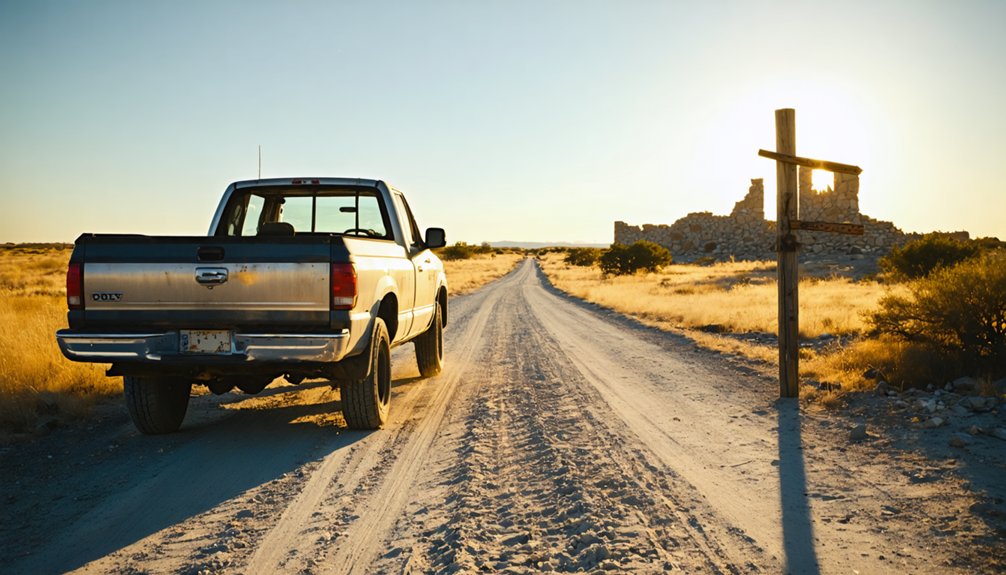
Planning your visit to Rancho de las Cabras requires more forethought than most historical sites—you can’t simply show up at the gates. This remote outpost opens only on first Saturdays from October through March, with guided tours starting at 9 a.m. You’ll need tour reservations sent via email to saan_Interpretation@nps.gov, including your name, contact details, and party size. Only twenty spots are available, awarded first-come, first-served.
Before making the 35-mile trek south to Floresville, check the park’s visitor center hours and weather alerts—extreme conditions cancel programs without notice. Admission to the missions and all ranger-led tours remain free year-round. For additional planning resources, download the NPS app to help navigate the site and access detailed park information.
Your best strategy? Reserve early in the season, verify conditions the day before, and prepare for two hours of walking Texas rangeland where Spanish colonial ranchers once drove thousands of cattle across endless horizons.
Archaeological Treasures: Artifacts From 1760-1820
When archaeologists excavated Rancho de las Cabras in 1981, they unearthed a remarkable collection spanning sixty years of Spanish colonial life—ceramics shattered in kitchen accidents, religious medals lost in the dust, gun parts discarded after repairs.
You’ll discover evidence of rancho economic activities through imported Mexican majolicas, French faience, and oriental porcelain alongside locally-made Goliad ware from colonial ceramic production. Personal treasures reveal individual stories: brass buckles, crucifixes, rings with colored glass inserts. The collection bridges two worlds—Spanish colonial sophistication and native tradition through chipped-stone tools and bone-tempered pottery.
Key artifacts that defined daily life:
- Gunparts and coins documenting frontier commerce
- Religious objects revealing spiritual devotion
- Wild game bones showing self-sufficient food procurement
- Native pottery connecting indigenous and colonial craftsmanship
Maria Del Carmen Calvillo: Pioneer Female Rancher
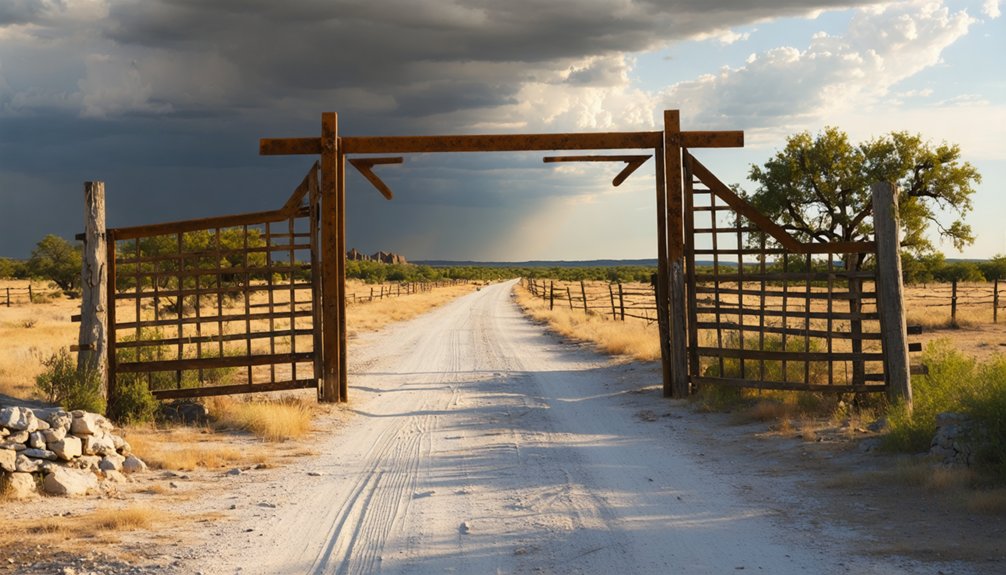
Behind these archaeological fragments lived real people who shaped the frontier, none more remarkably than María del Carmen Calvillo. Born in 1765, she inherited Rancho de las Cabras after her father’s murder in 1814, transforming it into a thriving enterprise with 2,000 cattle, irrigation systems, and a sugar mill.
Calvillo’s land management extended beyond typical ranching—she commanded crews of laborers while mastering shooting and roping alongside any vaquero. Calvillo’s entrepreneurial spirit drove her to secure additional land grants totaling three leagues by 1833. She navigated independence from an unfaithful husband, diplomatic relations with Native Americans, and three different governments ruling Texas.
Until declared incompetent at 86, she remained fiercely independent, embodying the self-reliant spirit that defined frontier life before dying in 1856.
The Legend of the Ghost Light at Las Cabras
Long after María del Carmen Calvillo’s death, the ruins of Rancho de las Cabras acquired a different reputation—one that sent shivers through anyone who visited after dark.
An 1879 account by “Pedestrian” documented what locals already knew: an old spirit mounted the crumbling walls during stormy nights, waving a light back and forth as if signaling the darkness. Historical documentation analysis reveals this legend predates modern paranormal activity theories—no cars existed to explain the phenomenon.
What you might experience at the ruins:
- A spectral light swaying atop ancient stone walls during pitch-black, stormy conditions
- The unsettling sound of chattering teeth echoing through Mission Espada’s former ranch site
- An atmosphere where nature’s warring elements seem to awaken something beyond rational explanation
- A connection to folklore spanning centuries, resistant to skeptical dismissal
Nearby Attractions in the San Antonio Missions World Heritage Site
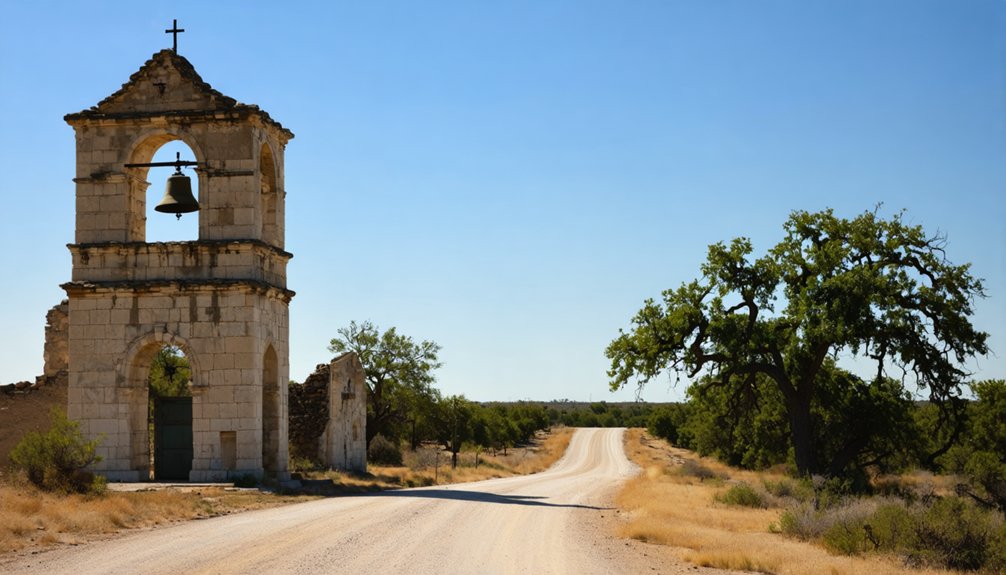
While ghost lights and ancient legends draw the curious to Las Cabras, the broader San Antonio Missions landscape offers tangible wonders that don’t require stormy nights or a tolerance for the supernatural.
You’ll discover Mission Espada’s 300-year-old aqueduct still channeling water through hand-carved channels—sustainable tourism initiatives preserve these engineering marvels while maintaining their original function.
Mission San José’s Rose Window showcases intricate Spanish Colonial craftsmanship, now part of the National Underground Railroad Network. At Mission Concepción, America’s oldest unrestored stone church stands with its flying buttresses and quatrefoil patterns intact since 1731.
Eight miles of hike-and-bike trails connect these UNESCO World Heritage sites along the Mission Reach. Local community involvement shapes interpretive programs featuring indigenous perspectives, granary workshops, and the Tree of Life installation weaving neighborhood stories into historical narratives.
Frequently Asked Questions
Are Overnight Camping or Extended Stays Permitted at the Las Cabras Site?
No overnight camping or extended stays are allowed at Las Cabras. You’ll find limited parking availability and potential wildlife encounters during monthly guided tours only. The remote site remains closed otherwise, preserving its haunting solitude for authorized visitors alone.
What Safety Precautions Should Visitors Take When Exploring the Remote Ranch Ruins?
Picture yourself wandering sun-baked ruins where danger lurks underfoot. You’ll need sturdy boots and heavy-duty gloves for debris. Bring proper clothing for extreme weather. Carry plenty of water, a respirator for mold, and stay alert for structural hazards threatening your adventure.
Can Visitors Bring Pets to the Rancho De Las Cabras Archaeological Site?
You can’t bring pets to Rancho de las Cabras—only service animals are permitted. Site accessibility restrictions prohibit non-service pets from all NPS buildings and grounds, so you’ll need pet friendly accommodations nearby during your ghost town exploration adventure.
Are Guided Tours Available or Is It Self-Guided Exploration Only?
You’ll need to join a guided tour—self-guided exploration options aren’t available at Rancho de las Cabras. The site’s only accessible through ranger-led programs on first Saturdays, preserving this remote archaeological treasure while sharing its engrossing vaquero stories with adventurous visitors.
Is There an Admission Fee to Visit the Las Cabras Ruins?
No admission fee’s required for your visit to Las Cabras ruins. You’ll find free guided tours through the National Park Service, where site preservation efforts maintain this historic ranch while parking availability’s handled at the designated meeting location.
References
- https://www.texasbeyondhistory.net/st-plains/images/he4.html
- https://sanantonioreport.org/rancho-de-la-cabras-a-forgotten-world-heritage-gem/
- https://www.wilsoncountyhistory.org/talk-rancho-de-las-cabras
- https://colfa.utsa.edu/_documents/car/asr-100/asr-143.pdf
- https://www.nps.gov/articles/000/rancho.htm
- https://npshistory.com/publications/saan/clr-rancho-del-las-cabras.pdf
- https://www.texasescapes.com/Ghosts/Ghosts-of-Wilson-County.htm
- https://scholarworks.sfasu.edu/ita/vol1998/iss1/21/
- https://colfa.utsa.edu/_documents/car/asr-100/asr-121.pdf
- https://www.tshaonline.org/handbook/entries/rancho-de-las-cabras