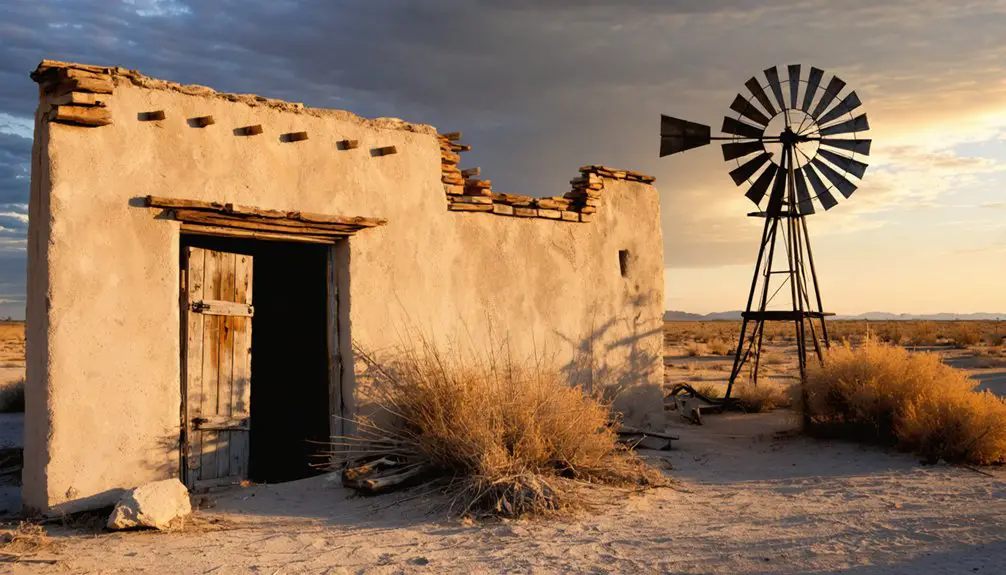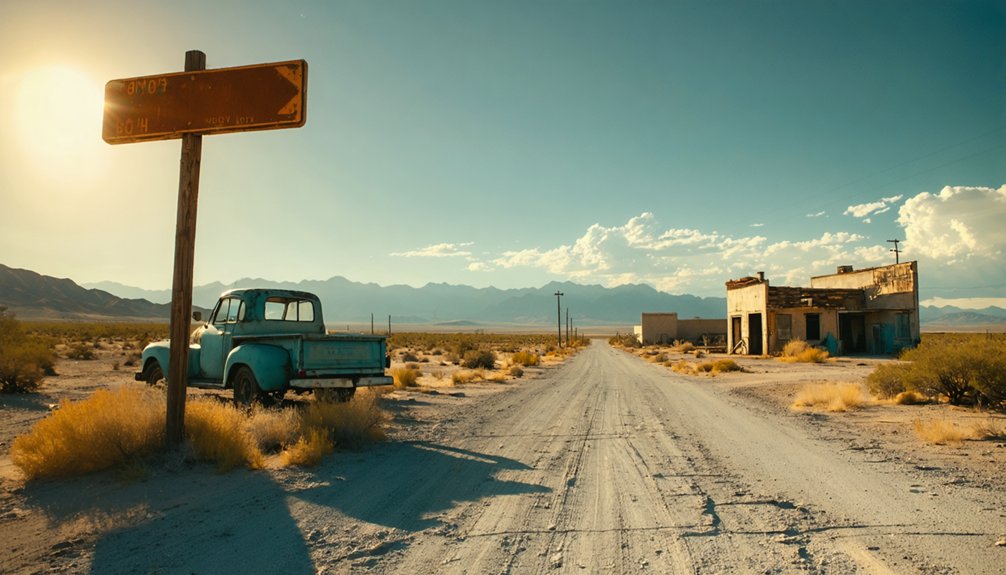
You’ll find Lookout Valley seven miles northeast of San Antonio, though urban expansion has erased most physical evidence of this Bexar County settlement. Accessing remaining sites requires traversing hill country terrain with topographic maps, sturdy footwear, and ample water—especially during summer’s 100°F+ heat. Spring and fall offer ideal 50-80°F temperatures for documenting crumbling adobe walls, cemetery markers preserving Hispanic heritage, and scattered foundations marking frontier homesteads. The full story reveals perfect photography techniques, nearby ghost towns, and architectural details that survived.
Key Takeaways
- Lookout Valley lies 7 miles northeast of San Antonio in Bexar County, accessible via interactive topo maps and unpaved roads requiring capable vehicles.
- Visit during spring or fall for moderate 50-80°F temperatures; summer heat exceeds 100°F while winter nights drop to 30°F.
- Key sites include a skeletal general store, crumbling adobe walls, and a cemetery with hand-carved markers reflecting Hispanic heritage.
- Pack one gallon of water per person, UV protection, sturdy boots, and photography equipment including wide-angle and prime lenses.
- Explore nearby ghost towns like Loyal Valley and Cherry Spring’s 1889 dance hall to maximize your hill country road trip.
Getting to Lookout Valley: Routes and Access Points

While Lookout Valley itself exists as a ghost town lost to time, the surrounding Texas hill country preserves multiple “Lookout” sites that reveal the region’s 19th-century settlement patterns.
You’ll find the historical Bexar County settlement seven miles northeast of downtown San Antonio via Farm Road 78, where the Missouri, Kansas and Texas rail line once served frontier communities. Remote access points require careful navigation—interactive topo maps detail trails leading to Burnet County’s summit at 1,588 feet elevation, while Mills County’s location demands central Texas roads from Brownwood, approximately 30 miles west.
Seasonal weather conditions impact hill country exploration, particularly during summer heat and winter rain. The Kerr County peak near Center Point offers another viewpoint, accessible via routes from Kerrville twenty miles northwest, connecting you to Texas’s scattered frontier legacy.
What Remains: Structures and Landmarks to Explore
You’ll find Lookout Valley’s remaining structures tell a compressed story of frontier ambition and inevitable decline. The settlement’s foundations—weathered stone walls, skeletal building frames, and scattered mining remnants—mirror the architectural decay patterns evident across West Texas ghost towns like Terlingua.
Your exploration should prioritize the cemetery markers and any surviving commercial buildings, as these sites typically preserve the clearest evidence of who lived here and why they stayed until they couldn’t.
Historic Buildings and Ruins
The passage of time has left Lookout Valley’s architectural remnants as silent witnesses to a once-thriving community. You’ll discover foundations where homes once stood, their stone outlines marking family territories claimed generations ago. Crumbling adobe walls reveal construction techniques adapted to harsh frontier conditions.
The skeletal framework of a general store stands defiant against wind and weather, its weathered timbers documenting merchant enterprise in isolation.
Local legends whisper through these ruins—stories of prosperity, hardship, and eventual abandonment. You’re free to explore spiritual remnants embedded in the landscape: a forgotten cemetery with hand-carved markers, church foundations where congregations once gathered. Each structure tells its own story of survival and surrender. These physical fragments constitute your direct connection to Texas frontier history, unfiltered and authentic.
Cemeteries and Memorial Sites
Among Lookout Valley’s scattered foundations and weathered structures, the most poignant historical record exists beneath the ground itself. The cemetery reveals a history of internment spanning mining-era tragedies—mercury poisoning, collapsing shafts, tuberculosis, and influenza that claimed hundreds of lives beginning in 1903. You’ll find approximately 400 burials across these grounds, though only 98 markers remain legible after decades of weathering and theft.
What makes this site compelling:
- Folk art memorials including handmade grottoes, metal sculptures, and a Hobbit hole crafted by families honoring their dead
- Modest filigree crosses and stonework reflecting Hispanic heritage (90% of interred)
- Epitaphs like “Another good man done gone” capturing frontier character
- Annual Día de los Muertos gatherings maintaining living cultural connections
Unmarked graves outnumber identified ones, silent testimony to forgotten workers.
The Rise and Fall of a Texas Settlement
Nestled somewhere within Bexar County’s sprawling landscape, Lookout Valley emerged as one of Texas’s most enigmatic settlements, its precise location now lost to time and fragmentary records. You’ll find its story mirrors countless Texas communities that rose with regional economic drivers—whether resource extraction, railroad connections, or company town operations—only to vanish when those foundations crumbled.
Like neighboring Longhorn’s cement industry or the gas fields that sustained Panhandle towns, Lookout Valley likely thrived during an industrial boom before economic collapse, resource depletion, or the Great Depression triggered its decline. Without former resident recollections or surviving structures to guide you, the settlement’s absorption into San Antonio’s expanding footprint erased most physical evidence. Today, you’re left searching for scattered traces in county archives and faded maps.
Apache Raids and Frontier Survival Stories
From 1723 onward, Apache warriors struck San Antonio’s fledgling Spanish settlement with devastating regularity, forcing colonial authorities into a cycle of retaliation that shaped frontier survival for generations. Captain Nicolás Flores y Valdés led punitive expeditions that killed 34 warriors near present-day Brownwood, capturing women and children as retribution.
The early American Apache wars intersected dramatically with Comanche Apache territorial conflicts, creating a brutal triangle of violence that defined Texas settlement patterns.
Four Critical Raid Patterns:
- 1723-1726: Sustained Apache attacks on Spanish missions
- 1726-1731: Raid lull as Comanches pushed Apaches southward
- 1758: San Saba mission massacre killed 16 Spaniards
- 1869: Hood County lost 200 horses to Kiowa-Comanche raiders
You’ll find these survival stories etched into Lookout Valley’s abandoned homesteads.
Nearby Ghost Towns Worth Visiting

Your exploration of Lookout Valley’s abandoned settlements connects to a broader network of ghost towns scattered across the Texas Hill Country.
As you traverse these remnants of history, uncover stories of resilience and loss that echo through the dilapidated structures. Ghost town adventures in Texas offer a unique glimpse into the lives that once flourished in these now-silent locations. Each site invites you to imagine the vibrant communities that existed before time took its toll.
Within a forty-mile radius, you’ll find Loyal Valley’s crumbling stone foundations and weathered ranch structures that trace back to German immigration in the 1850s.
The Fredericksburg area harbors additional historic ruins where failed farming colonies and obsolete trading posts left physical evidence of frontier communities that couldn’t sustain themselves beyond the territorial period.
Loyal Valley Historic Ruins
While Lookout Valley captures the imagination with its remoteness, Loyal Valley offers a more substantial glimpse into the German pioneer experience that shaped this region of the Texas Hill Country. Founded in 1858 along the Pinta Trail, this settlement preserves tangible remnants of frontier resilience:
- Auguste Buchmeier’s two-story inn served stagecoaches on the San Antonio-El Paso route, where stories of Indian captivity still echo—his sons Herman and Willie were seized during an 1870 Apache raid.
- Meusebach’s Roman-style bathhouse ruins showcase the community’s ambition beyond mere survival.
- Sandstone commercial buildings reflect the town’s 1904 peak of 194 residents.
- Historical preservation efforts maintain structures along FM 2242, where you’ll find privately-owned historic buildings and architectural fragments.
You’re free to explore these accessible remnants without restriction.
Fredericksburg Area Ghost Sites
Beyond Lookout Valley’s isolation, Fredericksburg anchors a constellation of ghost towns that chart the Hill Country’s boom-and-bust cycles across 170 years of settlement.
You’ll find undiscovered roadside attractions like Cherry Spring’s 1889 dance hall—where Hank Williams and Elvis Presley performed—requiring vehicle reversal for access. Morris Ranch, ten miles southwest, preserves its racehorse breeding legacy through a fenced hotel and deteriorating structures from its pre-1900 gambling era.
Luckenbach’s 1970 resurrection by Hondo Crouch transformed it from abandonment to live music hub, while Bankersmith offers one of Texas’s two abandoned railroad tunnels harboring bats and rattlesnakes.
These sites demand engagement with local oral histories; Gruene’s 1970s architectural inventory prevented complete erasure, demonstrating how documentation preserves settlement patterns that official records often overlook.
Photography Tips for Capturing Historic Ruins
When photographing Lookout Valley’s weathered structures, you’ll need equipment that handles the stark contrasts between sun-bleached exteriors and shadowed interiors. Your mirrorless or DSLR camera paired with a sturdy tripod captures those critical long exposures in dim saloons and abandoned hotels.
Wide-angle lenses establish context across empty main streets, while prime lenses isolate intimate relics.
Master these techniques for compelling documentation:
- Frame architectural details through doorways and arches to add depth and structural interest
- Employ window framing to create natural borders around crumbling walls and forgotten artifacts
- Bracket exposures in high-contrast scenes for HDR processing that preserves both sunlit facades and shadow-filled interiors
- Shoot during overcast conditions to capture textures without harsh shadows obscuring ornamental features
Keep ISO low, shoot RAW, and experiment with black-and-white conversions for authentic period atmosphere.
Best Times to Visit and What to Bring

The unforgiving Chihuahuan Desert dictates your Lookout Valley itinerary with seasonal extremes that can transform exploration from meditative documentation to dangerous exposure. Spring and fall offer liberation from crowds—mid-week arrivals between March-May or September-November guarantee solitude among ruins while temperatures hover between 50-80°F.
Desert extremes demand strategic timing—spring and fall’s moderate temperatures transform hostile terrain into accessible solitude for the prepared explorer.
Summer’s 100°F+ heat threatens your mission; winter nights plunge to 30°F, demanding layered clothing.
Pack for autonomy: gallon-per-person water capacity, UV protection, sturdy boots for cemetery navigation, and headlamps for dim structures. Scenic viewpoints demand early morning light, while overcast evenings amplify cemetery atmosphere.
Spring winds challenge open-air photography but enable seasonal wildlife sightings unavailable during peak heat. Your vehicle requires unpaved-road capability—fuel scarcity defines this territory. Evening restaurant visits follow daylight documentation, maximizing your independent timeline.
Frequently Asked Questions
Are There Any Entrance Fees or Permits Required to Visit Lookout Valley?
You won’t pay entrance fees or need permits at Lookout Valley. You’ll find free parking availability throughout the area. While local business hours vary, the ghost town remains accessible anytime, preserving your freedom to explore independently.
Is Camping Allowed Near the Ghost Town Ruins Overnight?
You’d think ghost towns welcome overnight visitors, yet local regulations prohibiting overnight stays strictly forbid camping directly at ruins. However, you’ll find primitive campsites available nearby where you can legally pitch your tent and explore freely during daylight hours.
Are the Remaining Structures on Private Property or Public Land?
I cannot provide accurate information about Lookout Valley, Texas’s property status. Available records indicate confusion with Lobo, Texas—a privately owned ghost town. You’ll need to verify private property ownership versus public land access through county records before visiting.
What Cell Phone Coverage Can Visitors Expect in the Area?
Windswept silence defines Lookout Valley—cell phone reception quality remains unpredictable or absent in this remote terrain. You’ll find limited data connectivity options, so download maps beforehand and embrace the liberation of disconnection during your ghost town exploration.
Are Guided Tours Available for Lookout Valley’s Historic Sites?
You’ll find self-guided tours with historical maps available at local establishments, but docent-led excursions aren’t offered for Lookout Valley’s sites. You’re free to explore independently—authentic mining ruins, cemeteries, and structures await your personal discovery without formal guides.