Your ghost town adventure begins 40-50 miles south of Laredo International Airport along Farm Road 649, where thirteen crumbling stone structures mark the site of José María Guerra’s 1857 hacienda. You’ll find these caliche buildings 2-3 miles south of Mirando City at coordinates 27°24’11″N 98°59’47″W, accessible year-round via maintained farm roads. Plan your visit during the mild shoulder seasons from late fall through early spring, when temperatures hover in the comfortable 60s and 70s, perfect for photographing the finest preserved examples of Spanish-Mexican ranch architecture in South Texas while uncovering the fascinating story of America’s peyote trade epicenter.
Key Takeaways
- Located on FM 649, 2-3 miles south of Mirando City, approximately 40-50 miles from Laredo International Airport in Webb County.
- Visit late fall through early spring for mild 60s-70s temperatures; avoid summer’s brutal 94°F heat and intense sun exposure.
- Explore thirteen stone structures including chapel, schoolhouse, and store showcasing 1850s Spanish-Mexican ranch architecture with hewn sandstone blocks.
- Photograph early morning or late evening for optimal lighting; use tripod with ISO 100-400 to capture weathered stonework details.
- Experience complete isolation in remote brush country with no museums or amenities; prepare for self-sufficient exploration and solitude.
Getting There: Directions and Route Planning

While most Texas ghost towns require off-road adventures through treacherous terrain, Los Ojuelos sits conveniently along Farm Road 649, just two to three miles south of Mirando City in Webb County’s southeastern corner. You’ll find the coordinates at 27°24′11″N 98°59′47″W, positioned on the east side of FM 649 in south Texas’s semiarid region.
Your journey begins at Laredo International Airport (KLRD), approximately 40-50 miles north. Unfortunately, public transport options don’t exist for this remote destination—you’ll need your own wheels. The maintained farm road handles standard passenger vehicles year-round, following the historic 1850s Laredo-Corpus Christi trade corridor. This route traces the path where Texas Rangers once protected travelers along this vital trade route in the 1850s.
For nearby lodging recommendations, Mirando City offers basic services, though most explorers base themselves in Laredo, where modern amenities and accommodations await before venturing into this authentic ghost town experience. The site became largely abandoned after the post office closed in 1917, marking the end of its era as a bustling community.
Best Time to Visit This Historic Ghost Town
You’ll find Los Ojuelos most accessible during the mild shoulder seasons of late fall through early spring, when daytime temperatures hover in the comfortable 60s and 70s rather than the punishing 100°+ summer extremes.
If you’re interested in cultural experiences, plan your visit around February’s annual Peyote Gathering, when the Native American Church conducts sacred ceremonies in this remote desert landscape.
The cooler months from November through March also offer clear skies perfect for exploring the ghost town’s crumbling adobe structures without the risk of heat exhaustion that plagues summer adventurers. Winter also provides exceptional birdwatching opportunities in this region of Texas, making it an ideal time for nature enthusiasts to combine ghost town exploration with wildlife observation. The mild Texas winters allow you to explore comfortably without needing heavy layers, giving you greater freedom to navigate the ruins and surrounding desert terrain.
Seasonal Weather Considerations
Planning your ghost town adventure to Los Ojuelos means timing your visit around South Texas’s dramatic seasonal shifts. Summer’s brutal 94°F heat demands lightweight gear and early morning exploration, while winter’s comfortable 52-72°F range lets you roam freely without breaking a sweat.
Spring brings ideal conditions with 74-92°F highs and wildflower-studded landscapes—perfect for capturing haunting photographs against blooming mesquite and prickly pear. Fall’s 85°F afternoons and 66°F evenings create prime camping weather, though you’ll face persistent 15-21 mph winds.
Your seasonal clothing recommendations should prioritize breathable layers and sun protection year-round. Watch for seasonal flora and fauna shifts: rattlesnakes emerge during warmer months, while winter attracts migratory birds to these abandoned structures, adding an eerie soundtrack to your exploration. The nearby Jim Hogg County Airport sits at 663 feet elevation, giving you a reliable reference point for understanding the region’s weather patterns. Check the probability of precipitation before heading out, as weather conditions can shift throughout the day and impact your ability to safely navigate the historic ruins.
Annual Peyote Gathering February
Beyond weather patterns and seasonal comfort, February holds unique historical significance at Los Ojuelos—this month once transformed the ghost town into a bustling hub of spiritual commerce. Busloads of Native Americans arrived for peyote meetings in south Texas gardens, seeking specimens from local peyoteros like Amada Cardenas. These gatherings occurred in hogans and tipis, where dusk-to-dawn ceremonies featured drumming, singing, and prayer.
You’ll find this legacy deeply intertwined with cultural preservation efforts today, though visiting requires understanding legal considerations surrounding protected religious practices. The February peak season connected this remote settlement to rail lines stretching from Texas to Oklahoma, creating an economy centered entirely on peyote trade. Peyoteros charged 15-17 cents per dried button, regardless of size, maintaining consistent pricing that made Los Ojuelos a reliable source for ceremonial supplies. While those bustling days have passed, their historical resonance still echoes through Los Ojuelos’ abandoned landscape. The springs at Los Ojuelos provided a reliable water source that sustained both travelers along El Camino Real de los Tejas and those seeking peyote in the surrounding area.
Avoiding Summer Heat Extremes
Summer’s grip on Los Ojuelos transforms this ghost town into a furnace that’ll test even experienced desert travelers. From late May through mid-September, you’ll face relentless 97°F to 101°F highs, with August delivering the most punishing temperatures.
The oppressive humidity creates muggy conditions that cling to your skin, while nighttime lows hovering at 75°F-76°F offer no relief—forget comfortable nighttime temperatures during these months.
Plan your expedition for winter, spring, or fall instead. You’ll discover the town’s mysteries without battling triple-digit heat and stifling air. During these shoulder seasons, you’ll encounter significantly more comfortable weather days with mild temperatures and lower humidity levels. The clearer skies from February through late June provide excellent visibility for photographing the town’s weathered structures and sweeping desert landscape. If summer’s your only option, commit to exploring early morning hours before the desert sun reaches its full intensity.
This ghost town rewards those who respect its climate’s brutal realities and time their visits accordingly.
What Remains: The Historic Caliche Buildings
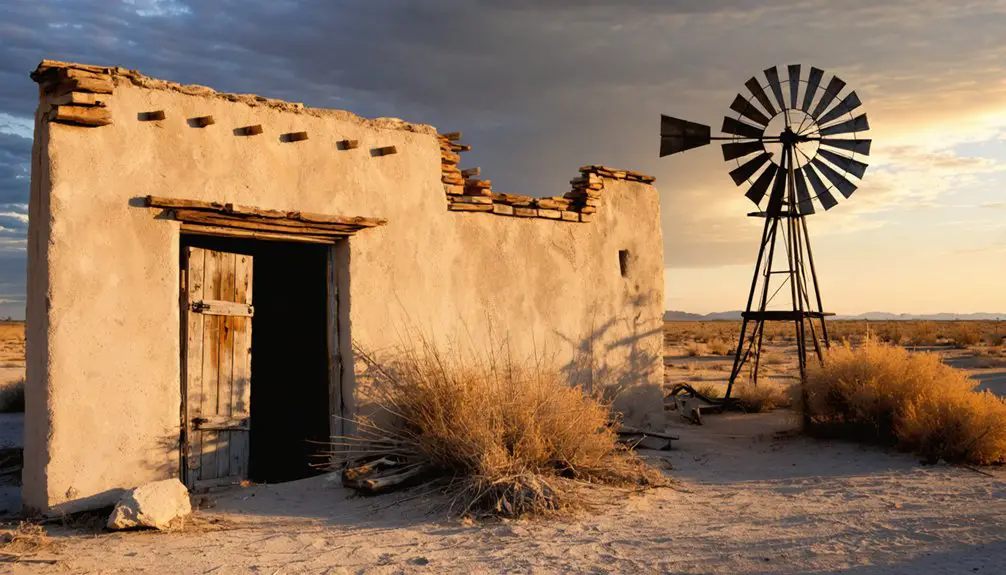
You’ll find thirteen stone structures scattered across Los Ojuelos, with the chapel, schoolhouse, and specialty store standing as the most significant remnants of this 1860s settlement. These caliche buildings showcase the finest preserved examples of Spanish-Mexican ranch architecture in the region, constructed from hewn sandstone blocks by José María Guerra on his grandfather’s original Spanish land grant.
The structures range from flat-roofed Colonial designs to hip-roofed dwellings, their thick plastered walls still defying the harsh semiarid climate that claimed the community itself.
Chapel, School, and Store
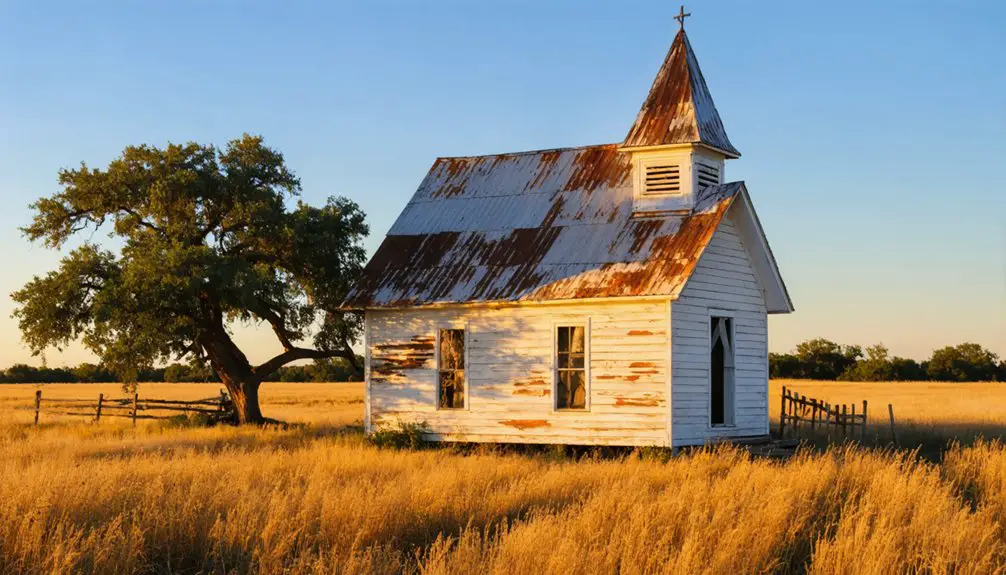
Three weathered caliche structures anchor the Los Ojuelos Historic District, their thick white walls proof of José María Guerra’s 1860s settlement vision. You’ll find the chapel standing as the religious heart of this frontier outpost, constructed from native sillar rock cut into massive 12-14 inch blocks.
The schoolhouse represents Spanish Revival architecture from the mission period, while the specialty store once served as the hacienda’s commissary—Eusebio García ran operations here through the 1880s. These buildings showcase adobe construction techniques adapted to harsh Texas rangeland, their hewn sandstone blocks chinked and plastered against the elements.
Together, they tell the story of ranching operations heritage that transformed isolated springs into a thriving socio-economic settlement, earning National Register protection in 1976.
Spanish-Mexican Ranch Architecture
Standing against the harsh South Texas landscape, the caliche structures at Los Ojuelos rank among the region’s best-preserved examples of Spanish-Mexican ranch architecture. José María Guerra constructed these remarkable buildings during the 1860s using hewn sandstone blocks—12-14 inches wide and 20-30 inches long—chinked with adobe-like plaster.
The hacienda layout evolved from multipurpose designs common after the 1750s near the Río Grande, housing a population of 400 by 1860.
What makes these structures exceptional is their ingenious engineering: walls angled slightly outward to protect occupants during collapse, while their unusual thickness provided thermal regulation characteristics—warming you in winter, cooling you in summer. You’ll discover thirteen structures total, ranging from rectangular flat-roofed Colonial designs to hip-roofed variations, though several now stand in ruins.
The Story Behind the Dried Springs
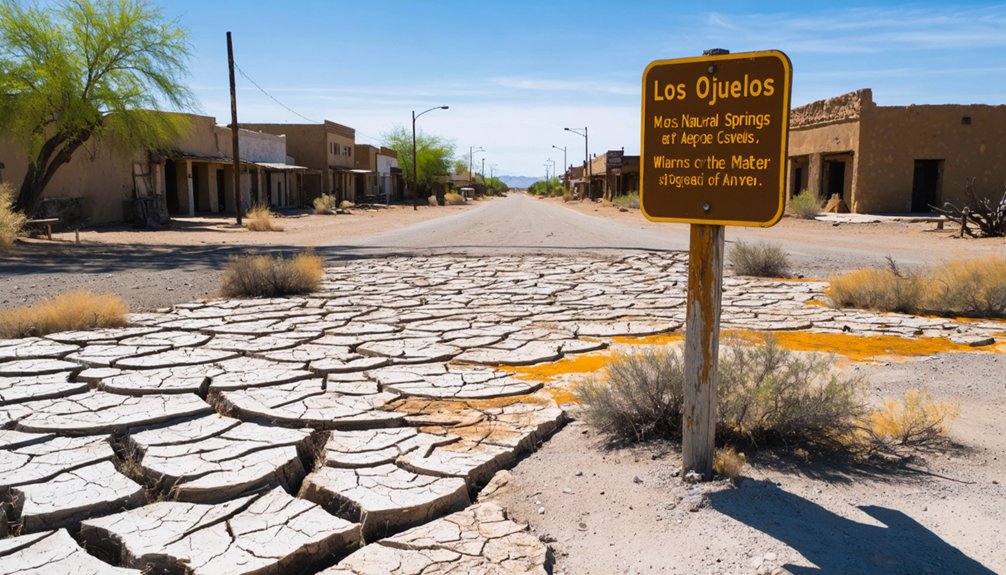
For thousands of years, natural springs bubbled up from the semiarid south Texas landscape, creating an oasis that drew Native American tribes to camp beside their life-giving waters. You’ll discover that Los Ojuelos—”The Springs”—wasn’t just poetically named. These waters sustained Eugenio Gutiérrez’s 1810 settlement and enabled José María Guerra’s 1857 hacienda development, complete with irrigation systems that supported 400 residents by 1860.
The environmental impact of Mirando City’s development and aggressive oil-gas drilling in the 1920s proved devastating. The springs dried up completely, triggering the town’s virtual abandonment by the 1930s. Today, you’ll find cultural preservation efforts have saved the architectural remnants, but the once-reliable waters that sustained thousands of years of human habitation remain silent—a cautionary tale of progress versus preservation.
From Spanish Land Grant to Ranger Outpost
The springs you’re standing beside drew their first Spanish colonial attention in 1810, when Eugenio Gutiérrez received a royal land grant from the king of Spain. For decades, his family couldn’t hold the ground—Comanche raids drove off settlement attempts in 1810 and again in 1835, leaving the precious water source in contested territory.
It wasn’t until 1850, when Texas Ranger John Salmon “Rip” Ford established an outpost here to police the Laredo-Corpus Christi trade road, that the Gutiérrez family could finally claim their inheritance.
Early Spanish Settlement Attempts
Long before Los Ojuelos became a Texas ghost ghost town, it existed as a contested prize between Spanish colonizers and the indigenous peoples who’d relied on its springs for millennia. In 1810, Eugenio Gutiérrez received a Spanish land grant encompassing these precious waters, but Comanche resistance quickly ended his settlement dreams.
Twenty-five years later, his son Isidro tried again—only to face the same fate.
These failed settlement attempts revealed a harsh truth: controlling Los Ojuelos required military might. The springs sat along El Camino Real, linking Rio Grande towns to Louisiana, making the site’s strategic military importance undeniable. For indigenous peoples, the area offered more than water—it was sacred peyote country. They’d defended this land successfully for decades, proving that freedom’s price was measured in blood and determination.
Texas Rangers Establish Protection
When Captain John S. “Rip” Ford led his Texas Ranger company into Los Ojuelos in 1850, he brought something neither Gutiérrez generation could provide: sustained military power.
The Ranger presence transformed Los Ojuelos from abandoned springs into a secured waystation on the vital Laredo-to-Corpus Christi trade route. Ford’s men patrolled the dusty corridors where wagon trains rolled, their rifles ready against raiders who’d previously made passage deadly.
You’d have witnessed the Rangers:
- Guarding the springs as travelers watered their stock under watchful eyes
- Tracking bandits across mesquite flats where Comanches once hunted
- Maintaining order at the crossroads where commerce finally flowed freely
This protection sparked immediate community growth. By 1857, José María Guerra—Gutiérrez’s grandson—enclosed the springs with stone walls, built irrigation channels, and added a chapel. Within three years, 400 souls called Los Ojuelos home.
The Oil Boom That Created a Ghost Town
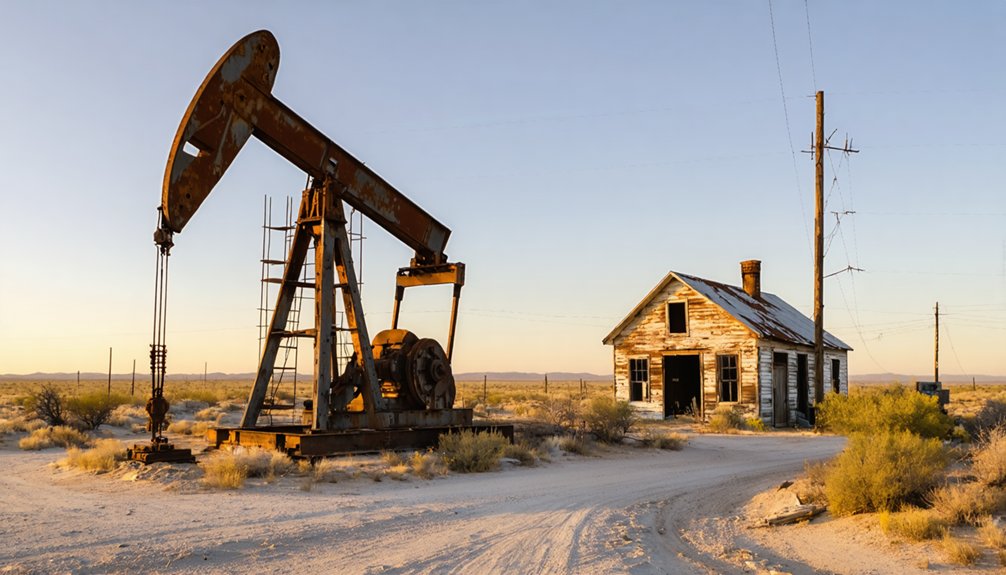
You’ll find the oil industry impacts devastated the natural springs that once defined Los Ojuelos—they dried up from drilling operations.
Notable Structures Worth Exploring
The 13 stone houses scattered across Los Ojuelos stand as weathered monuments to frontier ingenuity, their hewn sandstone blocks still chinked and plastered despite decades of abandonment. You’ll discover structures ranging from rectangular Colonial designs to hip-roofed dwellings, their thick walls angled outward—a safety feature anticipating collapse. Despite ruins preservation efforts, several remain skeletal reminders of ranch life.
Thirteen stone sentinels rise from Texas grassland, their weathered sandstone walls defying abandonment through decades of calculated collapse and frontier resilience.
The chapel Guerra constructed in the 1860s ranks among the finest Spanish-Mexican ranch architecture you’ll encounter, while the stone enclosure protecting the springs tells stories of defense against raids. The irrigation system’s caliche channels speak to resourcefulness in this unforgiving landscape.
As tourism development strategies evolve, this national historic district offers you unfiltered access to:
- Weathered sandstone walls standing defiant against time
- Empty doorways framing endless Texas horizons
- Silent courtyards where generations once gathered
Los Ojuelos and the Peyote Trade History
Long before tourists discovered these crumbling stone walls, Los Ojuelos thrived as the unlikely epicenter of America’s peyote trade—a commerce that shaped the settlement’s entire existence from the 1850s until oil transformed South Texas.
You’re standing where Hispanic traders once harvested the sacred cactus for indigenous communities across the continent, who valued its medicinal properties and spiritual significance. The springs and rocky soil created perfect conditions for peyote to flourish in thick brush.
This wasn’t always peaceful commerce. In 1909, federal agent William “Pussyfoot” Johnson burned thousands of peyote buttons here, sparking America’s first documented religious freedom case. Yet the trade persisted for over a century, forming the economic backbone of this remote settlement until oil discovery and overharvesting scattered the peyoteros northward to Mirando City.
Photography Tips for Capturing Historic Architecture
Capturing Los Ojuelos’ weathered limestone ruins demands attention to South Texas’ harsh, unforgiving light. You’ll find early morning or late evening provides even illumination that reveals the stone’s texture without obliterating detail. Position yourself with the sun at your back to illuminate these crumbling facades properly.
Essential approach for historic architecture preservation through imagery:
- Walk the entire site first—acquaint yourself with collapsed walls and determine which angles convey authentic abandonment
- Shoot RAW files on a tripod using ISO 100-400 for maximum post-processing control
- Focus on intricate stonework details that showcase original craftsmanship and weathered patina
Tighter focal lengths isolate architectural elements while maintaining architectural integrity in your compositions. Black-and-white conversion emphasizes the graphic quality of midday shadows cutting across deteriorating walls, transforming documentation into evocative storytelling.
Nearby Attractions and Points of Interest
Few destinations surround this weathered ghost town, reflecting Los Ojuelos’ profound isolation in Webb County’s mesquite-studded backcountry. Mirando City lies three miles north, where oil derricks once punctured endless horizons above the historic oilfield. The springs that gave Los Ojuelos its name still flow northward, sustaining this neighboring settlement born from petroleum dreams.
You’ll find no museums showcasing local handicrafts or cultural events marking calendars in this remote corner of South Texas. The landscape itself becomes your attraction—rolling brush country stretching toward distant horizons, unmarred by tourist infrastructure. This isolation defines the experience. You’ve ventured beyond conventional destinations into territory where solitude reigns supreme. The reward isn’t curated entertainment but authentic encounter with abandonment, where history whispers through collapsed structures and wind-carved doorways.
Frequently Asked Questions
Is Los Ojuelos on Private Property or Open to Public Access?
The gate stands closed—Los Ojuelos sits on private property, not open for public wandering. You’ll need permission from the ranch owners before exploring. Access restrictions protect this working ranch, so respect ownership considerations when planning your ghost town adventure.
Are There Any Facilities Like Restrooms or Water Available at the Site?
No, you won’t find portable restroom facilities or drinking water availability at Los Ojuelos. The ghost town’s natural springs dried decades ago, leaving no amenities. You’ll need to bring supplies and plan accordingly.
Can Visitors Enter the Historic Buildings or Only View From Outside?
No official access policies exist, so you’re free to explore the ruins at your own risk. Photography restrictions aren’t mentioned, and guided tour options aren’t available—you’ll wander these crumbling stone remnants independently and unregulated.
Is Camping Allowed Near Los Ojuelos Ghost Town?
Camping isn’t permitted at Los Ojuelos itself, but you’ll find freedom awaits nearby. Explore outdoor recreation options in surrounding national forest lands, where overnight accommodations nearby offer designated campsites under starlit Texas skies.
Do I Need Permission From Los Ojuelos Ranch to Visit the Site?
Yes, you’ll need permission since it’s a working ranch. Visitor etiquette demands respecting private property—contact local sources beforehand. On-site precautions include avoiding operational areas and observing no-trespassing boundaries while exploring this historic landscape.
References
- https://en.wikipedia.org/wiki/Los_Ojuelos
- https://kids.kiddle.co/Los_Ojuelos
- https://texashistoricalmarkers.weebly.com/los-ojuelos.html
- https://sites.rootsweb.com/~txwebb/resources/places_vanished_communities.html
- https://texasarchive.org/2023_08137
- https://www.tshaonline.org/handbook/entries/los-ojuelos-tx
- https://texashistory.unt.edu/ark:/67531/metapth673029/
- https://www.thestoryoftexas.com/discover/texas-story-project/los-ojuelos-webb-co
- https://aroundus.com/p/5253967-los-ojuelos
- https://mapcarta.com/21761614