Your ghost town road trip to Luxello begins just 25 minutes from downtown San Antonio, following an 18-mile route into forgotten Texas frontier territory. You’ll find weathered Luxello Hall and the historic Davenport House standing as silent witnesses to this 1900s railroad community’s vanished prosperity, though you’ll need to bring all supplies since no amenities exist. Be mindful that much of the site remains privately owned, with trespassing carrying serious legal consequences. Discover how to navigate safely and legally through this haunting landscape while uncovering its century-old secrets.
Key Takeaways
- Luxello is an 18-mile, 25-minute drive from downtown San Antonio with no gas stations, food, or lodging available.
- Line 17 bus connections offer public transit access, but bringing your own supplies is essential for the visit.
- Weathered Luxello Hall and the 1875 Davenport House are the main remaining structures to explore on Evans Road.
- Much of the ghost town is privately owned; trespassing risks include criminal charges, fines, and civil lawsuits.
- No signs mark the site, so advance research is required to locate structures and avoid restricted areas.
The History Behind Luxello’s Rise and Fall

In 1900, settlers carved out a new community along the banks of Cibolo Creek in northeastern Bexar County, drawn by the promise of the Missouri, Kansas and Texas rail line that snaked through the Texas brush country. They briefly called it Landa before renaming it Luxello after Charles Lux, the first postmaster.
By 1915, thirty-five residents called this place home, gathering at the general store that served as their downtown. The former inhabitants’ stories reveal a community tied to the rhythms of rail commerce and frontier independence.
But freedom came with fragility. The community’s economic shift from rail-dependent trade couldn’t sustain growth when the post office closed. By the 1920s, population dwindled. Neighboring Selma and Universal City eventually absorbed what remained, leaving only the weathered Luxello Hall standing sentinel over forgotten dreams.
Getting to Luxello From San Antonio
Anyone can reach Luxello’s windswept remains from downtown San Antonio in just 25 minutes, following an 18-mile route that threads northeast through Bexar County’s evolving landscape. You’ll trace the same path World War infantry units marched in seven grueling hours—now compressed into a brief drive where live traffic tools guide you past modern sprawl toward forgotten ground.
Pack essentials before departure; Luxello offers no gas station facilities or commercial infrastructure. The ghost town’s skeletal presence means you’ll find zero food and lodging options once you arrive. Stock your cooler, fill your tank, and grab supplies in San Antonio’s outskirts.
Whether traversing via Line 17 bus connections or driving directly, you’re chasing echoes through Texas scrubland where history dissolved into silence, leaving only foundations and stories.
What Remains of the Original Settlement
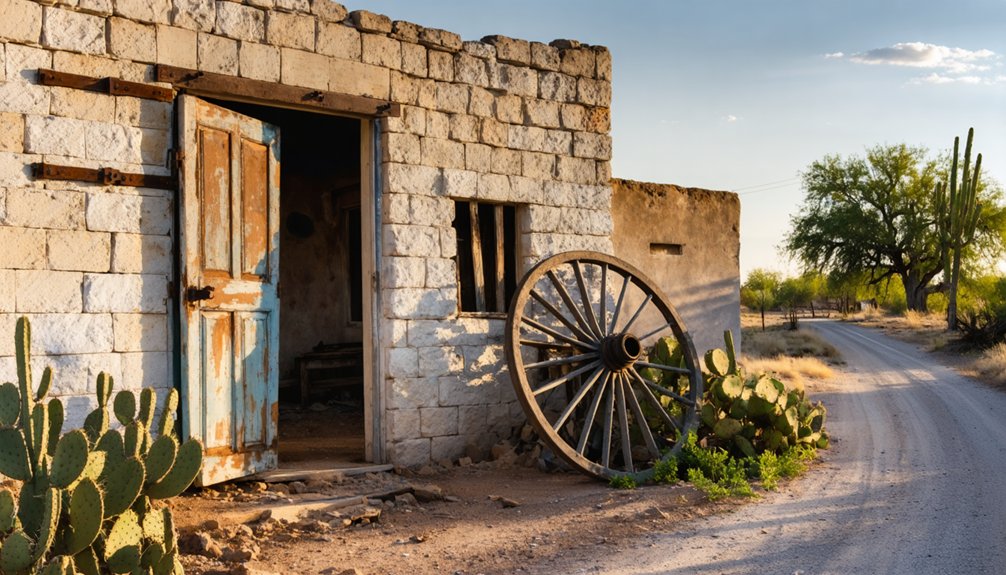
When you arrive at the heart of old Luxello, you’ll find the weathered Luxello Hall still standing after more than a century, its abandoned facade offering a glimpse into the community’s vibrant past. The structure once housed the general store where Charles Lux worked behind the counter around 1900, serving as the town’s downtown hub and social gathering place.
Next door, the historic Davenport House completes this preserved snapshot of frontier life, both buildings now silent witnesses to a settlement that’s faded into Bexar County’s ghost town legacy.
Luxello Hall Structure
The weathered Luxello Hall stands as one of the last tangible remnants of a settlement that time nearly erased. You’ll find this abandoned structure next to the century-old Davenport House, its doors hanging open like an invitation to explore forgotten history. When you visit, you’ll immediately sense the eerie atmosphere that urban explorers documented in 2015—empty rooms echoing with memories of community gatherings from decades past.
This hall once served as Luxello’s social heart alongside the general store, anchoring a “downtown” that included nearby Bracken and Selma. Its historical significance becomes clear when you realize it’s survived over 100 years while the town around it faded into obscurity. The building’s weathered facade tells stories that official records can’t capture.
General Store Site
Standing at 16589 Nacogdoches Road in San Antonio, you’re positioned eighteen miles northeast of downtown where Charles Lux’s general store once anchored the entire Luxello settlement. This spot beside Cibolo Creek served as the community’s beating heart after Lux relocated his operation from Selma around 1900.
Photographs capture the general store interior with Lux behind the counter alongside Armin Stautzenberger, revealing the intimate scale of store owners’ lives intertwined with their customers. The building stood next to Luxello Hall until its demolition, serving thirty-five residents at its 1915 peak. By the mid-1930s, only scattered houses remained around the aging store and station.
Today, nothing marks this site where frontier commerce once thrived, swallowed by Universal City’s sprawl.
Davenport House Location
Across Cibolo Creek from where Lux’s store once stood, a single structure survives from Luxello’s founding era. The Davenport House at 16589 Nacogdoches Road rises from its bluff, facing Evans Road with Folk Victorian architectural details crafted from wood, stone, and cedar. Built around 1875 after fire claimed the original homestead, it represents the last parcel of an 1847 farmstead where William Davenport’s cotton empire once flourished.
The home’s historical significance transcends its 1,334 square feet—it’s tangible proof of German and Anglo settlers who carved civilization from raw Texas prairie. Though appraisers now value the land over the structure, these weathered walls remain, anchoring memory to place.
You’ll find it standing beside Luxello Hall, both defying time while modern development encroaches.
Luxello Hall: The Town’s Most Haunting Structure
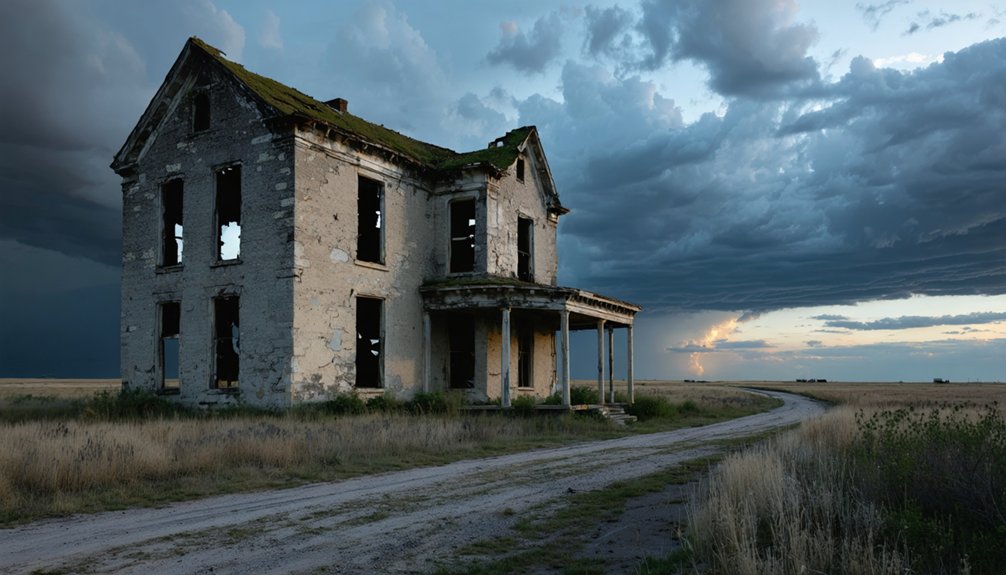
Standing beside the historic Davenport House, Luxello Hall has weathered more than a century of Texas sun and storms since its construction during the town’s early settlement days. When you approach this abandoned general store that once served as the community’s commercial heart, you’ll find the doors still unlocked—as they were in 2015—inviting you into a dusty time capsule of frontier commerce.
The two structures together form a haunting pair of landmarks, silent witnesses to Luxello’s brief thirty-five-person peak in 1915 and its subsequent fade into obscurity.
Over a Century Old
The weathered frame of Luxello Hall rises from the Texas scrub like a specter from another era, its walls bearing witness to more than a century of Hill Country history. Built in the late 1800s by pioneering German settlers, this structure anchored what locals called “downtown” Luxello.
You’ll find yourself standing before a building that served multiple lives—general store, dance hall, community gathering place—all within the same weathered planks.
The Sahm family, among the original thirty-five settlers, helped establish this 100 year old community before Charles and Hulda Laux transformed it into their vision. Photos from around 1900 show Charles behind the store counter, unaware his enterprise would outlast the town itself.
Today, those open doors and creaking timbers beckon the curious to explore what prosperity once looked like in rural Texas.
Adjacent to Davenport House
Just beyond the weathered planks of Luxello Hall, you’ll discover the Davenport House keeping silent vigil over this forgotten corner of Texas. These neighboring structures stand together on Evans Road, two survivors from Luxello’s vanished era.
Historical photographs reveal the dance hall entrance facing outward toward Cibolo Creek, where locals once gathered for Saturday night revelries. You’ll find both buildings perched on the same bluff, their proximity telling stories of a tight-knit community that once thrived here.
The general store images show Charles Lux behind the counter around 1900, while the dance hall’s faded sign speaks to wilder times. Together, they form the most tangible connection you’ll find to this ghost town’s past, resisting erasure by encroaching development.
Open Doors in 2015
On June 28, 2015, a YouTuber’s camera captured something unsettling at Luxello Hall—its doors stood wide open, inviting exploration of a structure that hadn’t welcomed visitors in decades. The eight-minute video documents what you’d find inside this forgotten landmark: weathered walls, scattered debris, and an atmosphere the explorer described as genuinely haunting.
While the open accessibility made entering straightforward, it also highlighted potential safety concerns you’ll face at abandoned sites like this. Rotting floorboards, unstable structures, and hidden hazards lurk throughout ghost towns. The footage reveals Luxello Hall’s eerie transformation from community gathering place to decaying shell.
If you’re planning your own exploration, remember that what seems like an open invitation might lead to dangerous territory—both literally and legally.
The Best Time to Visit This Ghost Town
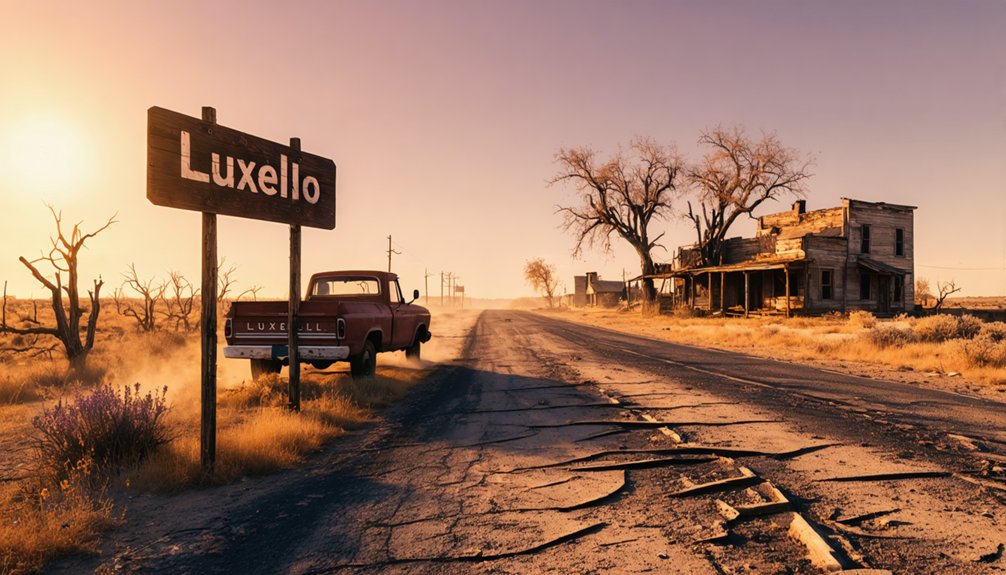
When should you venture into the faded remains of Luxello? Target October through November, when seasonal weather patterns deliver mild 60-70°F days perfect for wandering crumbling structures without summer’s brutal assault. You’ll find clear skies illuminating abandoned doorways while avoiding high temperatures that transform exploration into endurance tests exceeding 100°F.
Winter months offer equally compelling conditions—crisp mornings, comfortable afternoons, and virtually no crowds competing for your discovery. Spring tempts with wildflowers painting the northeast Bexar landscape, though May rains may flood Cibolo Creek access points.
Skip July and August entirely unless you’re chasing solitude through heat waves. Plan weekday visits regardless of season; you’ll maximize your freedom to photograph, contemplate, and lose yourself in Luxello’s quiet dissolution without suburban Selma’s weekend spillover.
Nearby Abandoned Communities Worth Exploring
Beyond Luxello’s weathered remnants, a constellation of forgotten settlements dots the northeast Bexar County landscape, each holding fragments of South Texas’s vanished frontier ambitions.
You’ll discover compelling destinations within easy driving distance:
- Selma and Bracken – Across Cibolo Creek, these communities reveal Bracken’s abandoned beginnings from the mid-1800s, now overshadowed by modern development
- Marcelina – Wilson County’s preserved church and cemetery offer tangible connections to South Texas’s settlement era
- Mahala – This Live Oak County site embodies Mahala’s desolate past with zero population and complete abandonment
- Mikeska – Another Live Oak County ghost town showcasing failed frontier dreams
Each location rewards explorers seeking authentic experiences beyond tourist trails. You’re free to chart your own course through these forgotten places where Texas history whispers through empty streets.
Photography Opportunities at the Old Landmarks

You’ll find prime golden hour opportunities along the creek, where water reflections illuminate photogenic deterioration. The cotton gin scales offer textural contrasts—rust against vine tendrils, collapsed metal embracing earth. Capture wide-angle shots of the General Store ruins beside Davenport House, documenting over a century of interconnected decay.
Bring telephoto lenses for bridge detail work and wide angles for atmospheric interior shots. The weathered textures reward patience: bracket your exposures, explore multiple angles, and let these structures reveal their haunting narratives through your lens.
Respecting Private Property and Access Rules
Before you venture down those dusty roads toward Luxello’s crumbling facades, understand that much of this ghost town remains privately owned—a patchwork of parcels passed down through generations from the original German settlers to the Sahm brothers, then scattered among the Landa and Laux families.
Legal risks of trespassing include:
- Criminal misdemeanor charges under Texas Penal Code § 30.05
- Monetary damages through civil trespass lawsuits
- Arrest by security patrols or state troopers
- Fines and prosecution from property owners
Consequences of unauthorized access aren’t worth the thrill. Posted signs, fences, and surveillance cameras guard these ruins. The historical cemetery on Sahm family land near Selma remains strictly off-limits. Respect the ownership chain—your freedom to explore shouldn’t trample others’ property rights.
Combining Your Trip With Other South Texas Attractions
Since Luxello sits just eighteen miles northeast of downtown San Antonio, you can weave this ghost town into a broader exploration of northeastern Bexar County’s forgotten settlements and historic landmarks. Day trip opportunities abound as you trace Cibolo Creek’s path through vanished communities like Bracken and Selma, where additional historic points of interest include the private cemetery holding German settler families’ remains.
Follow the old Missouri, Kansas and Texas railroad corridor to discover remnants of South Texas’s agricultural past—crumbling cotton gin foundations and weathered structures that witnessed the region’s boom-and-bust cycles. You’ll find yourself wandering beyond prescribed tourist routes, uncovering stories the mainstream overlooks. These interconnected ghost towns offer authentic encounters with Texas history, free from commercialization and crowds that sanitize genuine exploration.
As you delve deeper into the history of Denhawken, Texas, you’ll encounter local legends and unique folklore that breathe life into the region’s past. Every corner holds tales of resilience and innovation, reflecting the spirit of the communities that once thrived here. Embrace the opportunity to engage with the past, and you’ll leave with a deeper understanding of the rich tapestry that is woven into the fabric of Texas.
Frequently Asked Questions
Are There Any Guided Tours Available for Luxello Ghost Town?
No guided tours for historical preservation exist at Luxello—you’ll explore independently. Available walking tours of Luxello mean wandering freely through crumbling hall ruins and weathered cotton gin scales, discovering forgotten stories at your own pace along Cibolo Creek’s banks.
Is Camping Allowed Near the Luxello Area Overnight?
Camping isn’t permitted at Luxello itself, but you’ll find nearby campgrounds offering starlit freedom under vast Texas skies. Explore lodging accommodations in surrounding towns where you can rest between your ghost town adventures and dawn explorations.
What Safety Precautions Should Visitors Take When Exploring Abandoned Structures?
Before venturing inside, inspect structures carefully for collapse risks, hazardous materials, and unstable floors. Always avoid trespassing on private property—respect boundaries and seek permission. You’ll face real dangers: criminals, wildlife, contaminated air, and structural failures that could trap you.
Are There Restaurants or Gas Stations Near Luxello for Supplies?
Luxello itself offers no services, but you’ll find grocery stores nearby in Schertz and Selma, plus local convenience shops and gas stations. Stock up before exploring—freedom means preparing for remote adventures ahead.
Can I Bring My Drone to Photograph Luxello Hall Aerially?
Like a bird scanning open terrain, you can photograph Luxello Hall aerially if you follow drone regulations: register with FAA, maintain visual line of sight, stay below 400 feet, and respect aerial photography guidelines protecting private property rights.