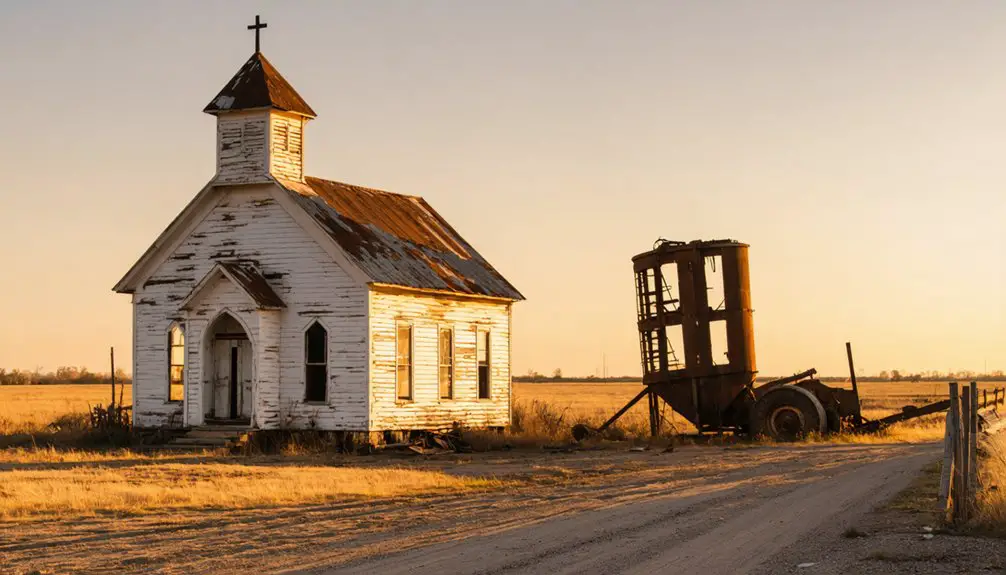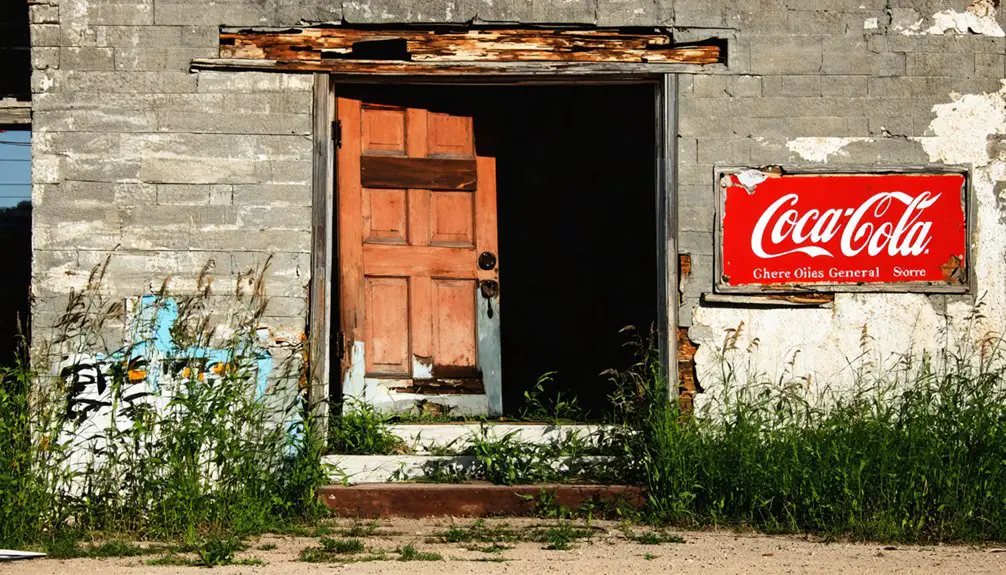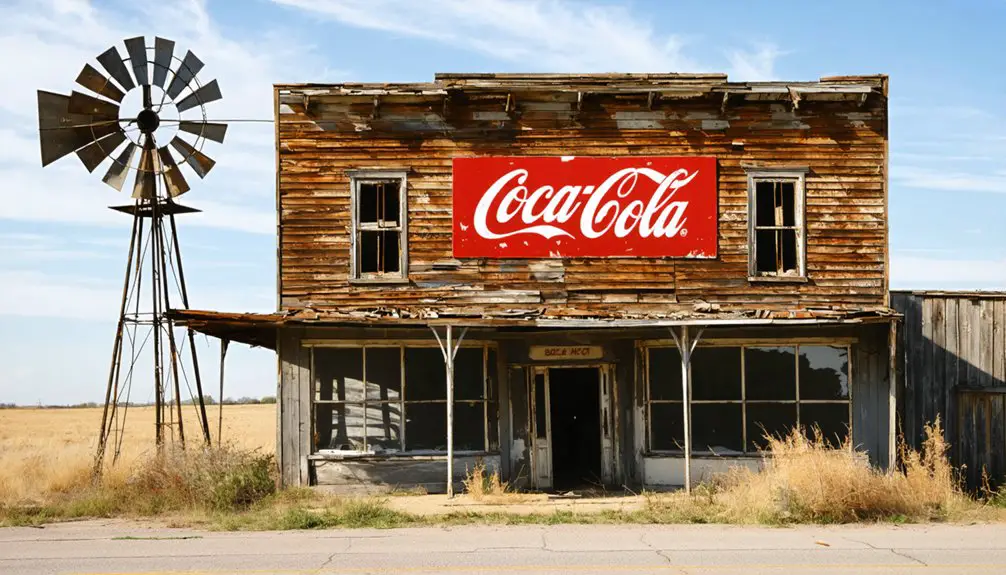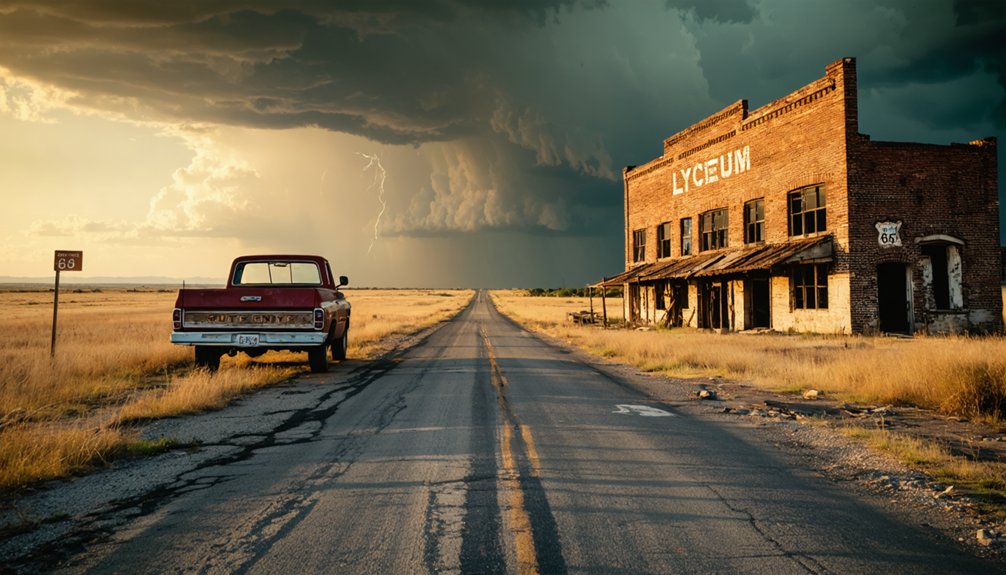
Your ghost town road trip to Lyceum in Creek County requires careful preparation since this remote settlement sits miles from main highways. You’ll navigate cracked concrete streets where weathered structures mark a vanished community, so pack sturdy boots, multiple light sources, and first-aid supplies. Tell someone your location before exploring the shadows of abandoned buildings, where floor gaps hide beneath debris. The Sapulpa Historical Museum and Drumright Oil Museum provide essential context about the boom-bust cycles that created these haunting landscapes, while the insights below reveal what awaits among Lyceum’s crumbling foundations.
Key Takeaways
- Lyceum sits in remote Creek County with only a single weathered structure marking its former post office and general store.
- Visit Sapulpa Historical Museum and Drumright Oil Museum to explore artifacts and learn about the boom-bust cycle before traveling.
- Bring sturdy boots, three independent light sources, first-aid supplies, and communication devices for safe exploration of unstable structures.
- Travel with at least two companions and tell someone your location and expected return time due to isolation risks.
- Navigate cracked concrete streets cautiously, watching for floor gaps obscured by shadow, debris, broken glass, and rusted metal.
The Rise and Fall of a Choctaw Academic Community
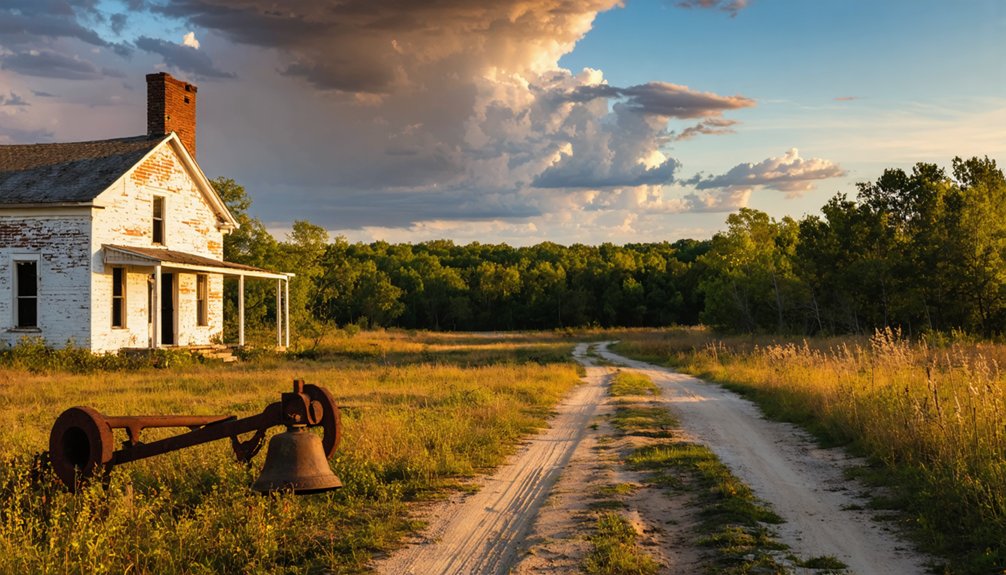
The Choctaw Nation understood what survival demanded long before forced removal scattered them westward between 1831 and 1834. Principal Chief Isaac Garvin’s cry rang clear: “educate! Educate! Or we perish!” This wasn’t rhetoric—it was strategy.
By 1842, six boarding schools anchored their educational sovereignty, while nearly every town ran local schools taught by Choctaw instructors in their native tongue. You’d find thirty-year-olds practicing spelling alongside children in weekend classes, democracy in action.
But the Curtis Act of 1898 marked the beginning of the end, bringing expansion of government control that systematically dismantled their schools. The decline of native language instruction followed swiftly. By 1930, only two academies remained standing—monuments to an autonomous educational system that once served 12,000 citizens.
What Remains at the Lyceum Site Today
When you arrive at the Lyceum site, you’ll find weathered foundations and crumbling walls scattered across the Boley landscape where lecture halls once stood. Historical markers guide you through the former campus grounds, marking where students pursued their education nearly a century ago.
The nearby cemetery holds the final resting place of faculty and community members, offering the most tangible connection to the people who built this Choctaw academic dream.
Physical Structures and Foundations
Nothing stands at Lyceum today. You’ll find open fields where the academy once educated Choctaw students before the 1925 fire triggered community evacuation. The land’s agricultural reversion erased what fire didn’t consume—no foundations mark classroom corners, no stone steps lead to phantom doorways.
Unlike ghost towns with skeletal structures still defying time, Lyceum surrendered completely to the earth. You won’t discover rubble piles or crumbling chimneys guiding your exploration. The site mirrors Oklahoma’s most barren abandoned settlements, where prairie grass and crops reclaimed territory.
Two miles west of Tuskahoma, you’re standing on memory alone. No plaques commemorate the students who walked here. No ruins anchor your imagination to 1892’s promise. The physical evidence vanished with the community itself, leaving only coordinates and old maps as proof Lyceum existed.
Historical Markers and Signs
No historical marker identifies Lyceum’s location. You’ll find no weathered sign pointing toward this vanished settlement, unlike the 700+ markers documenting Oklahoma’s past across the state. The Oklahoma Historical Society hasn’t placed bronze plaques here, and local groups haven’t sponsored commemorative posts. Without marker maintenance or community participation, Lyceum exists only in county records and fading memories.
You’re on your own traversing this ghost town. Bring GPS coordinates and old maps—there’s no roadside identification to guide you. Unlike Chisholm Trail sites with precise markers noting distances and coordinates, Lyceum remains unmarked territory. This absence actually enhances your exploration freedom. You’ll discover what few others have found, tracing the settlement’s footprint through subtle landscape changes rather than following prescribed historical narratives carved into official monuments.
Cemetery and Burial Grounds
The silence at Lyceum’s burial grounds speaks louder than any historical marker could. You’ll find weathered stones marking generations of pioneers who carved lives from Oklahoma’s raw frontier. These grounds demand respect—and action.
Recent storms across similar historic cemeteries remind us what’s at stake for cultural preservation.
When you visit, consider how you’ll contribute:
- Document crumbling markers with photos before weather erases names forever
- Connect with volunteer coordination efforts protecting Oklahoma’s burial sites
- Note GPS coordinates of unmarked graves you discover
- Share cemetery locations with preservation societies
You’re standing where frontier families mourned their dead under endless prairie skies. Their stories survive only if you refuse to let them vanish. Pack work gloves—freedom includes responsibility for what remains.
Start your journey in Tuskahoma, where the old Choctaw Council House stands as a weathered sentinel to the region’s past.
Head west on the gravel roads that slice through pine-dotted hills, watching your odometer as you cover the two-mile stretch toward where Lyceum once existed. The route demands attention—unmarked turnoffs and overgrown intersections mean you’ll rely on terrain features and distance markers rather than road signs pointing to a town that’s long since vanished.
Driving Directions From Tuskahoma
From Tuskahoma’s quiet crossroads, your journey to Lyceum ghost town demands careful preparation and a sense of adventure. U.S. Highway 271 provides all weather road access heading south, but venturing into the wilderness requires different planning. Seasonal weather impacts transform these backcountry routes dramatically.
Your route options include:
- Clayton Trail – Follow marked timber company paths cutting through dense mountain forests toward abandoned settlements
- Hurd Creek Trail – Navigate maintained routes threading through creek valleys and ridgelines
- K Trail – Traverse wilderness sections where pavement surrenders to packed earth
- Black Fork Trail – Connect remote areas where civilization once thrived
These unimproved trails demand high-clearance vehicles and current conditions knowledge. MapQuest won’t guide you here—you’ll need topographic maps and local intelligence for safe passage through Kiamichi Mountain terrain.
Historical Landmarks Along Route
Continue south and you’ll encounter Twin Mounds Cemetery, named for the distinctive earthen formations that guided settlers through unfamiliar territory. These burial grounds preserve area history influences better than any museum—names etched in stone reveal notable community figures who shaped frontier life before the Great Depression emptied these hills.
The cemetery at Pine Ridge Mission marks where Chuahla Female Seminary educated Choctaw girls from 1842 onward, representing educational ambitions that predated statehood by decades.
The Choctaw Female Academy’s Role in Lyceum’s History
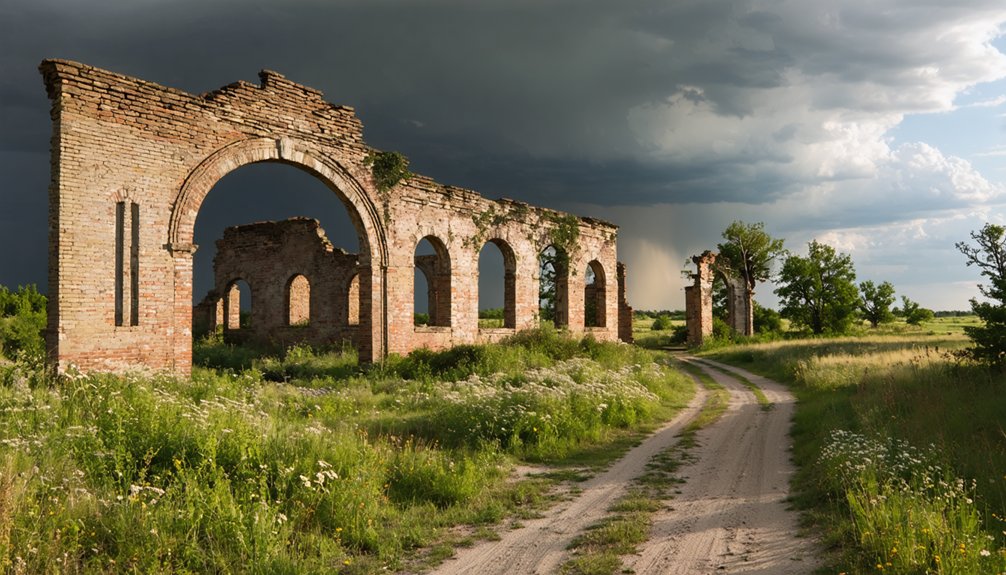
When you explore the remnants of Lyceum today, you’re standing where the Tvshka Homma Female Institute once shaped young Choctaw women’s lives. Opening in 1892, this boarding academy represented the Nation’s commitment to educational achievements through self-determination.
Miss Nellie Wakefield led the institute as both principal and postmistress, overseeing:
- Academic instruction in reading, writing, arithmetic, and classical literature
- Religious education that reinforced cultural values
- Domestic skills training for practical independence
- Boarding facilities that welcomed students from across Choctaw territory
The school’s lasting community impact extended beyond its walls—the associated Lyceum post office made this location a regional landmark. For thirty-four years, the institute stood as a commemoration to Indigenous sovereignty in education, until fire claimed the building in 1925, ending an era of autonomous Choctaw learning.
Understanding Oklahoma’s 2000 Ghost Town Phenomenon
Across Oklahoma’s windswept plains, nearly 2000 ghost towns mark the landscape like forgotten headstones—communities that either vanished entirely or shrank to mere shadows of their former selves. You’ll find these abandoned settlements everywhere, each telling stories of economic metamorphosis challenges that transformed thriving hubs into empty shells.
One of the most intriguing destinations in this eerie collection is exploring cowboy flats ghost town, where remnants of rustic buildings stand as a testament to a bygone era. Visitors are often captivated by the stories these structures whisper on the wind, offering a glimpse into the lives once lived in the harsh, yet vibrant, landscapes. As you wander through the desolation, you can almost hear the laughter of those who once called this place home, adding an emotional layer to the already haunting atmosphere.
Oil booms sparked overnight cities in the early 1900s, then left them desolate when wells dried up. Mining operations like Picher’s lead and zinc extraction created prosperity before environmental degradation impact poisoned the land and water. Railroad routing decisions sealed many towns’ fates—bypass a settlement, and it died. Power struggles between ambitious promoters destroyed others. These weren’t gradual declines; they’re dramatic collapses where populations plummeted 80% or more, leaving weathered buildings standing as monuments to impermanence.
Essential Stops Near Lyceum for History Enthusiasts
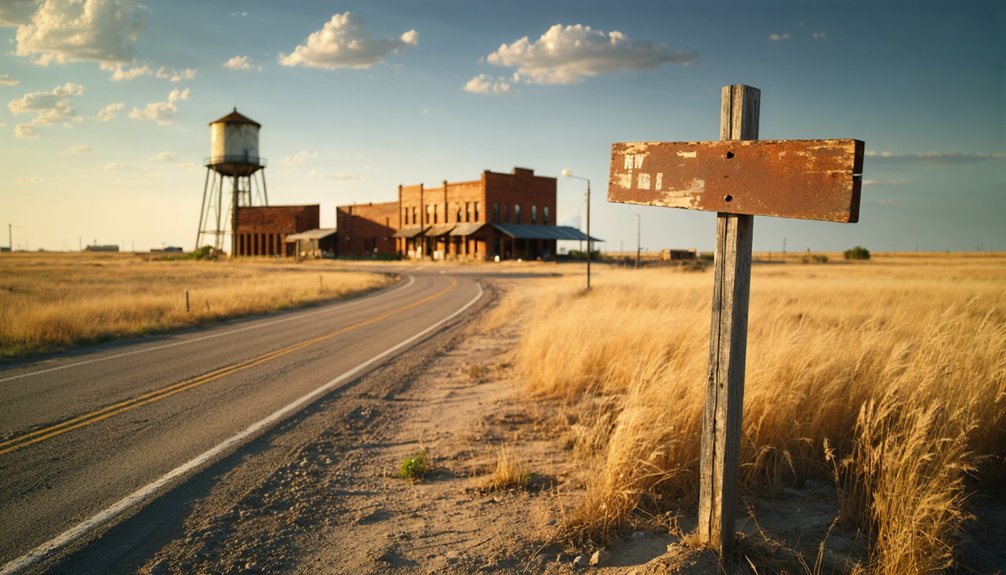
Lyceum itself sits in remote Creek County, where crumbling foundations peek through tallgrass and a single weathered structure marks what once housed a post office and general store.
You’ll find authentic connections to Oklahoma’s vanished communities through these nearby destinations:
- Sapulpa Historical Museum – Houses artifacts from abandoned Creek County settlements, including potential archaeological excavations documenting Lyceum’s 1920s peak
- Creek County Courthouse – Records room contains original land deeds and town plats you can examine independently
- Local cemeteries – Headstones reveal family stories predating the town’s collapse
- Drumright Oil Museum – Chronicles the boom-bust cycle that doomed small settlements
Visit longtime residents who maintain preservation of oral histories, sharing firsthand accounts of relatives who walked Lyceum’s streets before economic forces scattered its population.
Best Practices for Exploring Remote Abandoned Settlements
Before you step onto the cracked concrete of Lyceum’s forgotten main street, understand that abandoned settlements demand respect and preparation equal to any backcountry expedition. Following established exploratory protocols means scouting during daylight first, noting unstable structures and potential escape routes.
You’ll want sturdy boots with ankle support—broken glass and rusted metal hide beneath overgrown vegetation. Safety equipment recommendations include three independent light sources, first-aid supplies, and communication devices. Travel with at least two companions; isolation magnifies every risk.
Watch for floor gaps obscured by shadow and debris. Tell someone your location and expected return. These ghost towns offer unmatched freedom to wander history’s remnants, but that liberty comes with personal responsibility for your welfare and others’.
Frequently Asked Questions
What Permits or Permissions Are Needed to Access the Lyceum Site?
You’ll need to verify private property access before exploring, as landowners control most ghost town sites. Check local area regulations with county offices first. Respect “No Trespassing” signs—your freedom depends on respecting others’ boundaries and Oklahoma’s trespassing laws.
Are There Any Safety Concerns When Visiting Remote Ghost Town Locations?
Yes, significant dangers exist. You’ll find freedom comes with responsibility—watch out for trespassing on private land, be cautious of dilapidated structures with collapsing roofs, unstable floors, and hidden ground hazards that threaten your safety.
What Is the Best Season to Plan a Ghost Town Road Trip?
Spring and fall offer you ideal weather conditions and prime road conditions for exploring abandoned sites. You’ll avoid summer’s scorching heat and winter’s unpredictable storms while enjoying clear skies and firm, dry roads perfect for adventurous backroad exploration.
Can Visitors Take Artifacts or Souvenirs From Abandoned Ghost Town Sites?
you can’t legally take artifacts. Cultural preservation laws and ethical artifact collection practices protect these sites. Removing items destroys history and risks hefty fines. Photograph memories instead—they’ll last longer anyway.
Are There Lodging Options Available Near Lyceum and Tuskahoma?
You’ll find limited lodging directly nearby, but nearby camping facilities at Sardis Lake offer rustic freedom under the stars. Check local tourism information for cabins and RV parks scattered throughout Pushmataha County’s wooded hills and valleys.