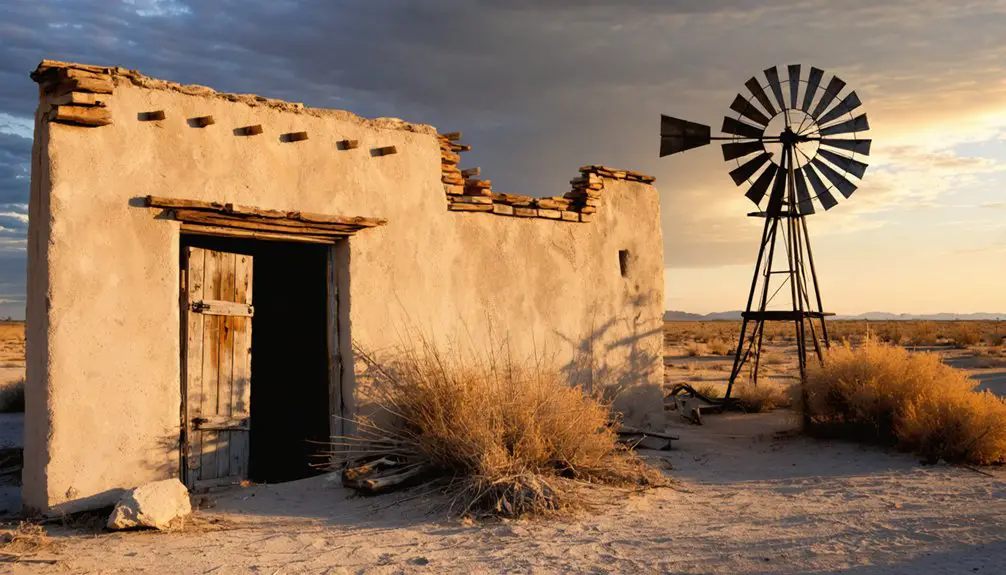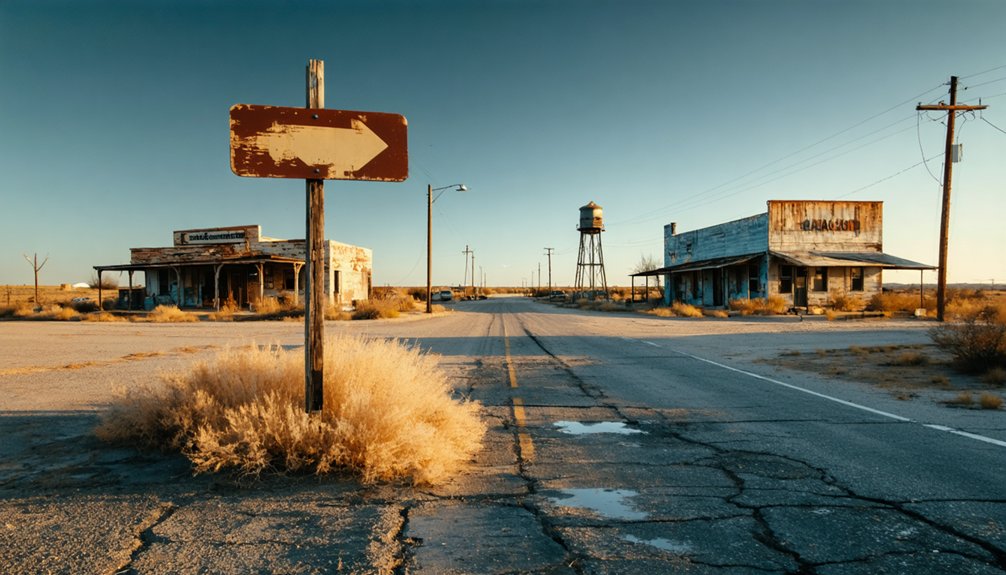
You’ll find Mangum five miles southwest of Eastland, Texas, accessible via State Highway 6 through windswept ranch land. This abandoned railroad junction once thrived with 300 residents when the Missouri-Kansas-Texas Railway and Eastland, Wichita Falls and Gulf Railroad converged here. Today, you’ll discover crumbling foundations and overgrown track beds marking where prosperity turned to dust. Stock up in nearby Ranger or Cisco before venturing off-pavement into these forgotten grasslands, where weathered remnants reveal the region’s untold stories of ambition and abandonment.
Key Takeaways
- Mangum is located five miles southwest of Eastland, Texas, accessible via State Highway 6 through ranch land at the abandoned railroad junction.
- Stock up on supplies in nearby Ranger or Cisco before exploring the unincorporated ghost town territory with minimal facilities or services.
- Visit the convergence point of two abandoned railroads: the Missouri-Kansas-Texas Railway and Eastland, Wichita Falls and Gulf Railroad corridors.
- Extend your trip to nearby ghost towns including Red Gap, Brinkman, Reed, and Russell, all within an hour’s drive.
- Prepare for boots-on-the-ground exploration with no tourist signs, discovering crumbling foundations and overgrown track beds in windswept grasslands.
The History of Mangum Ghost Town in Eastland County
In the early 1890s, settlers carved Mangum from the rugged Central Texas landscape, establishing a farming and ranching community five miles southwest of Eastland along what would become State Highway 6. You’ll discover that railroad access gave this outpost a critical advantage, fueling the development of key industries centered on agriculture and livestock.
The community thrived in Eastland County—named for William Mosby Eastland, a Texas Revolution soldier who met his fate in the infamous Black Bean executions.
When oil erupted across the region in the 1910s-1920s, social and cultural influences shifted dramatically. County population exploded from 23,421 to 58,505 as fortune-seekers flooded in. Though Mangum benefited from this energy, the boom proved fleeting. By 1950, abandonment claimed what pioneers had built.
Getting to Mangum: Location and Route Planning
Understanding Mangum’s rise and fall sharpens your appreciation for the journey ahead—now you’ll need to plot your course to this forgotten settlement.
You’ll find Mangum five miles southwest of Eastland at coordinates 32.320°N, 98.859°W in central Texas. Navigate via State Highway 6, cutting through ranch land where railroad infrastructure once dominated the landscape. The ghost town sits where two abandoned rail lines intersected—the Missouri-Kansas-Texas Railway and Eastland, Wichita Falls and Gulf Railroad—their ghost corridors still visible across the prairie.
From Eastland (population 3,960), head southwest into open country. Nearby Ranger and Cisco offer supply stops before you venture into this unincorporated territory. The small town history here whispers through windswept grasslands, beckoning explorers willing to leave pavement behind.
What Remains: Exploring the Abandoned Railroad Junction
Standing at Mangum’s junction, you’ll witness where two once-vital railroad arteries—the Missouri-Kansas-Texas Railway and the Eastland, Wichita Falls and Gulf Railroad—intersected in a cross of rusted purpose before vanishing into Texas soil.
The abandoned townsite spreads before you in whispers: crumbling foundation stones, overgrown track beds that slice through mesquite, and weathered markers that hint at the 125 souls who once called this crossroads home.
Beyond Mangum’s quiet decay, several forgotten settlements dot the surrounding Eastland County landscape, creating a circuit of ghost towns accessible within a day’s exploration.
Twin Railroad Lines Converged
Where two iron ribbons once crossed the Texas prairie, Mangum sprang to life in the late 1890s as the Missouri-Kansas-Texas Railway and the Eastland, Wichita Falls and Gulf Railroad carved their intersection into the earth. You’ll discover the railroad convergence significance transformed a barren junction into a thriving community of 300 souls by 1910.
The economic impact of junction brought prosperity—merchants, workers, and dreamers followed the rails to this remote crossroads where commerce flowed like water through intersecting streams.
Stand where those twin lines met, and you’ll witness history’s skeletal remains. The Eastland, Wichita Falls and Gulf fell silent in 1944, its tracks pulled up and sold for scrap. The Missouri-Kansas-Texas lasted until 1967 before surrendering to progress. Now only prairie grass marks their passage.
Abandoned Town Site Today
Time has reduced Mangum to whispers in the grass. You’ll find foundation stones jutting through prairie soil where 125 souls once thrived. The railroad grade beds cut straight lines across the horizon—ghost highways that carried prosperity before abandonment in 1944 and 1967. Weathered timber from 1890s structures leans against time itself, slowly surrendering to Texas wind.
Contemporary landscape features reveal themselves if you’re patient: building footprints, scattered debris marking where the junction once hummed with commerce. Despite minimal cultural preservation efforts, the site speaks volumes. U.S. Highway 283 brings you close, but there’s no interpretive center, no guided tour. Just you, the open country, and remnants of ambition. Fifteen residents still claim this territory, keeping Mangum’s name from complete extinction.
Nearby Ghost Town Routes
Two parallel paths of rust and memory converge at Mangum’s heart, marking where the Missouri-Kansas-Texas Railway and Eastland, Wichita Falls & Gulf Railroad once transformed prairie into promise. You’ll trace these abandoned corridors through historical landscape shifts that rewrote Eastland County’s destiny. The MKT’s 1967 departure severed the final artery; the EWF&G had already vanished in 1944, taking its twenty-seven miles of regional railroad connections with it.
Ten miles west, Red Gap’s crossing whispers of Texas Central Railway ambitions that never materialized. You’re standing where 125 souls once thrived in 1915, now reduced to fifteen wanderers. These ghost town routes stretch beyond Mangum—abandoned junctions dot the landscape like forgotten promises. Each rusted rail spike marks freedom from permanence, proving nothing’s truly permanent except change itself.
Nearby Ghost Towns Worth Visiting
While Mangum itself offers little beyond weathered foundations, your ghost town journey can extend northwest to Brinkman, where collapsed grain elevators stand as skeletal monuments to the community’s brief agricultural prosperity in the 1920s.
Twenty miles east, the twin settlements of Reed and Russell share a dirt road intersection—Reed’s abandoned schoolhouse still clutches tattered textbooks in its warped desks, while Russell’s lone remaining structure, a limestone general store, guards rusted farm equipment like relics in an open-air museum.
These forgotten railroad stops, each within an hour’s drive of Mangum, reveal how quickly Texas communities vanished when the trains stopped running and the cotton fields turned to dust.
Brinkman’s Agricultural Boom Era
The windswept plains surrounding Brinkman witnessed an extraordinary transformation when pioneers staked their claims across the Oklahoma panhandle in the 1890s. You’d have found Texas ranchers and sodbusters reshaping virgin prairie into productive farmland, their settlers’ demographics reflecting the rugged independence that defined frontier life.
Between 1900 and 1910, this dusty outpost swelled to several hundred souls who’d mastered the art of coaxing wheat from semi-arid soil.
Early farming innovations like dryland techniques pushed yields to 20 bushels per acre during prosperous seasons. Railroad connections carried golden grain to distant markets while blacksmiths, general stores, and churches sprouted along dirt streets.
Pre-WWI crop prices fueled an economic surge that seemed unstoppable—until nature’s brutal reckoning arrived with the 1930s Dust Bowl.
Exploring Reed and Russell
Just seven miles north of Mangum’s weathered courthouse, gravel roads branch toward forgotten settlements that once hummed with territorial ambition. You’ll find Reed first, where John Reed Graham’s 1892 post office left traces among windswept grasslands.
Russell sits nearby, its foundations surrendering to Oklahoma’s relentless prairie reclamation. These twin ghosts demand boots-on-the-ground exploration—no tourist signs guide you, just instinct and topographical maps.
Remnant preservation here means fragments: stone foundations, rusted farm equipment half-buried in red dirt. You’ll navigate by landmarks the North Fork Red River carved centuries ago. Local wildlife encounters interrupt your search—coyotesWatch from ridge lines, turkey vultures circle overhead.
The freedom lies in discovery without crowds, without commercialization. Just you, history’s whispers, and Oklahoma wind erasing what remains.
Mangum, Oklahoma: Not to Be Confused With Texas
Mangum started its life as a Texas town, pure and simple. When Henry Clay Sweet founded this settlement in 1882, he did so on Texas soil—part of the sprawling Greer County that Texas claimed as its own. You’d have called yourself a Texan here, living under the Lone Star’s authority until 1896 when everything changed. The Supreme Court handed this entire territory to Oklahoma, shifting 1.5 million acres overnight.
One day you were Texan, the next Oklahoman—a Supreme Court ruling redrew your identity across 1.5 million acres.
The conversion to statehood in 1907 brought profound shifts:
- Cowboys gave way to tenant farmers as 60 percent of land converted to agriculture
- Railway lines replaced cattle trails with Rock Island arriving in 1900
- Cotton gins supplanted ranches with seven operating by 1930
The cattle ranching decline marked the end of an era, though Mangum’s spirit remained untamed.
Best Time to Visit and What to Bring
While summer heat can turn these dusty streets into a furnace, timing your visit to Mangum right transforms an ordinary road trip into something extraordinary. The ideal visiting seasons stretch from March through May, when wildflowers erupt across abandoned lots, and September through November, when crisp air sweeps through hollow buildings.
You’ll find mild winter days perfect for exploration, with temperatures hovering in the comfortable 60s and virtually no crowds to compete with your sense of discovery.
Pack sturdy boots for rocky terrain, layers for unpredictable weather considerations, and plenty of water—there’s precious little shade among these ruins. Bring your camera, sunscreen, and snacks. This ghost town doesn’t cater to tourists; it rewards those prepared to wander freely on their own terms.
Among the fascinating sites are numerous ghost towns to explore in Texas, each with its own unique history and charm. As you stroll through the remnants of these once-thriving communities, you’ll discover stories etched into crumbling walls and faded signage. Embrace the solitude and let the haunting beauty of these locations spark your imagination.
Frequently Asked Questions
Are There Any Camping Facilities Near Mangum Ghost Town in Texas?
No dedicated camping exists at Mangum ghost town itself, but you’ll discover primitive camping sites and nearby RV campgrounds around Possum Kingdom Lake, where you can establish your base camp before exploring this abandoned frontier settlement.
Can I Legally Take Artifacts From the Abandoned Mangum Railroad Junction Site?
No, you can’t legally take artifacts from Mangum Railroad Junction. Artifact ownership laws protect historic materials on both public and private land, plus trespassing considerations apply since you’d need landowner permission to access the site.
What Wildlife Should I Watch for When Exploring Mangum Ghost Town?
You’ll encounter rattlesnake sightings among crumbling foundations, so tread carefully through prairie grasses. Bird watching opportunities abound—turkey vultures circle overhead while white-winged doves flutter past weathered buildings, creating an untamed backdrop for your exploration.
Are There Guided Tours Available for Mangum and Nearby Texas Ghost Towns?
Mangum’s silence speaks volumes—you won’t find local historical society tours or privately run guided excursions here. You’re the explorer charting your own path through weathered ruins, discovering forgotten stories at your own wild, untethered pace.
Do I Need Special Permits to Photograph the Ruins at Mangum?
You’ll need to obtain local permissions before photographing Mangum’s weathered structures. Since these crumbling remnants likely sit on private land, respect private property rights—track down owners first, preventing legal troubles while capturing your hauntingly beautiful shots.