You’ll find Maryhill’s ghost town remnants scattered across 6,000 acres of high desert overlooking the Columbia River Gorge, where Sam Hill’s 1907 agricultural utopia crumbled into failure. Today, you can explore the abandoned farmhouse foundations, visit the oldest structure—the 1888 Mary Hill Church—and marvel at the concrete Stonehenge replica that’s America’s first WWI memorial. The unexpected centerpiece is the world-class Maryhill Museum of Art, housing over 80 Rodin sculptures and Queen Marie of Romania’s treasures, transforming ambition’s ruins into cultural triumph worth discovering.
Key Takeaways
- Visit the Maryhill Museum of Art featuring over 80 Rodin sculptures, Native American artifacts, and Queen Marie of Romania’s treasures.
- Explore the concrete Stonehenge replica, America’s first World War I memorial, dedicated in 1918 to honor fallen servicemen.
- Drive the historic Maryhill Loops Road, the Northwest’s first macadam-paved highway with scenic views of the Columbia River Gorge.
- Tour the Mary Hill Church from 1888 and scattered foundations marking the failed agricultural community’s original townsite.
- Discover abandoned building foundations and employee homes throughout the area, remnants of Sam Hill’s failed utopian vision.
The Fascinating Story Behind Sam Hill’s Failed Utopia
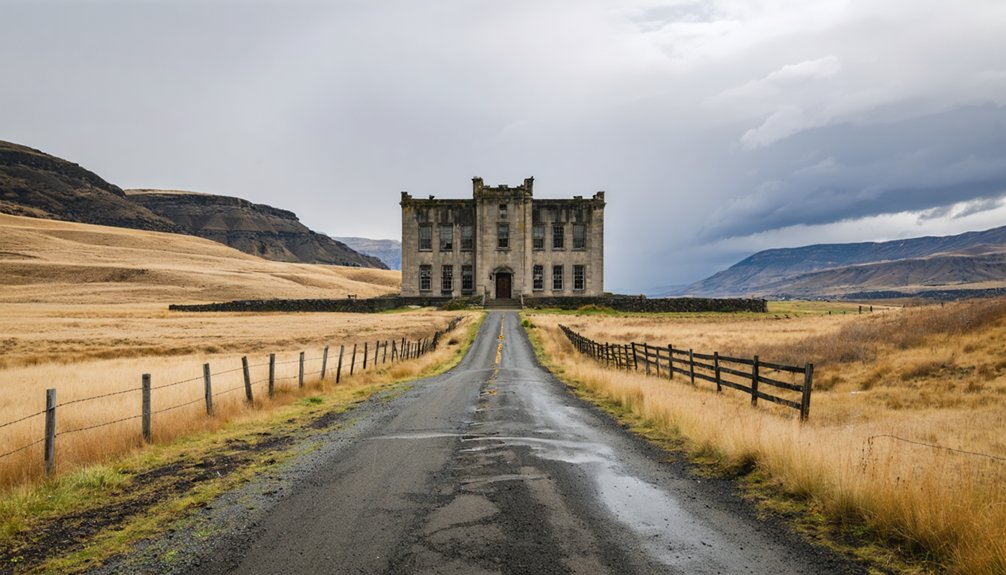
Yet failure sparked transformation. Repurposing the mansion into a museum preserved Hill’s legacy, eventually housing 80 Rodin sculptures and Queen Marie of Romania’s treasures.
What Remains of the Ghost Town Today
While Sam Hill’s utopian dreams crumbled nearly a century ago, his architectural ambitions left behind striking monuments that still dominate this windswept stretch of the Columbia River Gorge. You’ll discover Maryhill Castle—now the Museum of Art—standing as a massive Beaux Arts emblem overlooking the river’s dramatic westward bend.
The pioneering Maryhill Loops Road, the Northwest’s first macadam-paved highway, still winds through 25 curves up 850 feet of elevation. Scattered throughout are remaining building foundations, including Nathaniel Orr’s 1857 home and the historic wagon shop, silent remnants of lost industries that once promised prosperity.
The relocated Chapel at Fort Selum and weathered employee homes complete this haunting landscape where ambitious vision met harsh reality, leaving you free to explore what persists.
America’s First World War I Memorial: The Stonehenge Replica
Rising from a bluff 100 feet above the Columbia River, Sam Hill’s concrete Stonehenge commands the landscape as America’s first World War I memorial. You’ll discover a full-scale replica of England’s ancient monument, built between 1918 and 1929 to honor thirteen Klickitat County servicemen whose names mark its pillars.
The memorial’s historical significance extends beyond its dedication date of July 4, 1918. Hill built it to remind visitors of war’s “incredible folly,” drawing stark parallels between ancient human sacrifice and modern warfare’s devastating toll.
Hill’s architectural significance lies in his innovative use of concrete cast in tin-lined molds, creating stone-like textures that’ve weathered nearly a century. The altar stone aligns perfectly with summer solstice sunrise, calculated by Lick Observatory astronomers.
Exploring the Maryhill Museum of Art
Just down the hill from the Stonehenge memorial, Sam Hill’s would-be mansion stands transformed into one of America’s most unexpected art repositories. What began as a rancher’s dream in 1914 became a cultural sanctuary housing Rodin masterpieces and Queen Marie of Romania’s donated treasures.
You’ll discover:
- Over 80 Rodin sculptures including The Thinker and portions of The Gates of Hell
- 250+ American and European paintings spanning two centuries
- 900+ Native American baskets and artifacts
- Post-WWII French fashion miniatures in the Théâtre de la Mode
- Queen Marie’s coronation gown and palace memorabilia
The museum’s seasonal exhibits keep collections fresh, while the outdoor sculpture trail winds through high desert terrain with Columbia River views. TIME once called it the “world’s most isolated art museum”—perfectly fitting for adventurers seeking culture off the beaten path.
Why the Agricultural Community Never Thrived
Sam Hill’s grand vision for a thriving agricultural settlement along the Columbia River collided headlong with the harsh realities of high desert climate. You’ll discover that environmental limitations crushed his dream from the start—this spot sits 100 miles east of Portland, far beyond any viable rainfall belt. The agricultural unsuitability becomes painfully obvious when you realize the annual precipitation here could never sustain intensive farming.
Hill purchased 6,000 acres of hardscrabble land, ignoring basic climate patterns that doomed his planned utopia. By 1920, locals dubbed it “Hill’s folly on the Columbia.” The abandoned farmhouses you’ll encounter tell the story better than words—silent monuments to ambition meeting impossibility. What remains isn’t the farming community he envisioned, but rather a legendary memento to dreams outpacing environmental reality.
Historic Mary Hill Church and Early Settlement Sites
As you explore the ghost town landscape, you’ll discover the weathered Mary Hill Church standing as Maryhill’s oldest structure, built in 1888 when this place was still called Columbus.
The simple church served the Quaker settlers who arrived before Samuel Hill’s grand vision, anchoring a small frontier community that included a store, post office, and inn along the Columbia River.
Today, you can still spot the church across from the original townsite ruins, where crumbling foundations and scattered debris mark where Hill’s utopian farming colony once promised paradise.
Pre-1909 Columbus Settlement Era
Long before Samuel Hill dreamed of transforming this windswept plateau into a utopian community, the Columbus area represented the rugged edge of Klickitat County’s agricultural frontier. You’re standing where settlers first arrived in 1852, driving Durham and Shorthorn cattle across untamed grasslands.
By 1870, orchards dotted the Klickitat Valley, and prosperous farms gradually replaced open range.
The region’s early economic activities included:
- Cattle ranching supplying Idaho and British Columbia mining camps
- Apple cultivation near Hood River’s growing district
- Timber harvesting from northern forestlands
- Railway construction through the Columbia Gorge
- Fruit orchard development starting in 1870
When Hill’s Quaker settlement attempts failed in 1909—deterred by relentless gorge winds and sparse 11-inch rainfall—his grand vision crumbled, leaving behind the skeletal remains you’ll explore today.
1888 Church Architecture Details
Among the windswept ruins of Hill’s failed utopia, the Historic Mary Hill Church stands as the settlement’s most tangible architectural witness. Built in 1888 with simple wood frame structure typical of frontier Pacific Northwest design, this modest building served the Quaker farming community that Hill envisioned on 5,300 acres of Columbia River bluff.
You’ll recognize its unadorned aesthetic—the congregational layout reflects Quaker meeting house principles, where equality trumped ornamentation. The church anchored a now-vanished village that included a store, post office, and blacksmith shop. After the Maryhill Land Company failed around 1917, successive denominations occupied the building before abandonment.
Today, you can explore this National Register-listed structure alongside St. Boniface’s walled cemetery, tracing Maryhill’s evolution from ambitious agricultural dream to haunting ghost town reality.
As you delve deeper into the region, you may uncover other ghost towns near Washington state that echo similar tales of ambition and decline. Each site tells a story, inviting visitors to ponder the lives once lived there and the dreams that faded away. Exploring these remnants provides a unique insight into the historical landscape of the Pacific Northwest.
Original Townsite Ruins Today
Standing at the original townsite near Columbus, Washington, you’ll find virtually nothing of Sam Hill’s grand vision remains—the hotel, general store, and post office he erected at the turn of the 20th century burned down within years of construction, erasing the physical heart of his agricultural paradise.
These surviving infrastructure remains tell the story of ambition meeting harsh reality on these parched slopes.
What you *can* still explore of the original townsite layout includes:
- Nearly 10 miles of experimental paved roads, the first in the Pacific Northwest
- The repaved Maryhill Loops Road, with 3.6 miles maintained and accessible
- Failed dam ruins near the top of Maryhill Loops Road
- Stonehenge replica, three miles east, marking where Hill demolished his inn in 1918
- Sam Hill’s tomb, 50 yards from the memorial
Getting There: Highway Routes and Access Points
Reaching Maryhill requires a scenic journey through the Columbia River Gorge, where dramatic basalt cliffs give way to the high desert landscape of eastern Washington. From Portland, you’ll navigate I-84 east for 70 miles before crossing the Columbia’s pink bridge at The Dalles.
Accessing State Route 14 continues your adventure eastward for 20 miles along the river’s north bank.
The unincorporated community sits 103 miles upstream from Portland, where US 97 intersects your route. Here’s where freedom-seekers discover something special—just east of this junction lies the legendary Maryhill Loops Road. This engineering marvel, the Pacific Northwest’s first paved highway, climbs 850 feet through 25 curves and eight hairpin turns. The Maryhill Loops Road highlights include breathtaking viewpoints accessible to cyclists and hikers daily from 7 a.m. to 5 p.m.
Additional Attractions Along the Columbia River
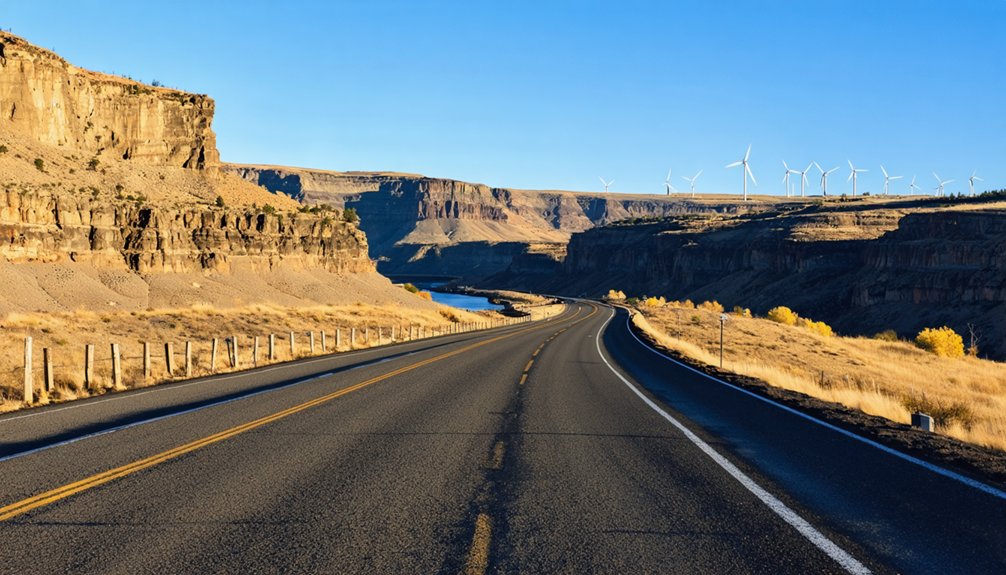
Beyond the main landmarks, you’ll find a collection of pastoral treasures that capture the region’s agricultural heritage and pioneer spirit.
The historic Mary Hill Church stands as a weathered sentinel to early settlement days, while Peach Beach RV Park offers riverside camping with direct water access.
Wineries like Maryhill and Jacob Williams dot the landscape alongside Gunkel Orchards’ fruit stand, where you can taste the sun-ripened bounty of Columbia River bottomlands.
Wineries and Fruit Orchards
Winding along the Columbia River Gorge, you’ll discover that this dramatic landscape nurtures more than ghost towns and historic landmarks—it’s home to thriving vineyards that transform the region’s volcanic soil and sun-drenched slopes into world-class wines.
Maryhill Winery stands as Washington’s crown jewel of orchards and viticulture, drawing 75,000 visitors annually to its Goldendale tasting room perched above the Columbia. The winemaking facilities and operations source over 30 grape varietals from premier Washington AVAs, crafting 50+ award-winning wines you’ll want to taste.
What awaits at Maryhill:
- 80,000 cases produced annually with 3,000+ awards since 2001
- Flagship Zinfandel, rare in Washington vineyards
- Tournament-quality bocce courts overlooking river vistas
- 4,000-seat amphitheater for sunset concerts
- Multiple tasting rooms across Washington state
Historic Mary Hill Church
Just minutes from Maryhill Winery, a weathered white chapel rises from the high desert landscape—the Historic Mary Hill Church, a 136-year-old monument to Samuel Hill’s ambitious but doomed utopian dream. Built in 1888 for the Quaker farming community that once thrived across 5,300 acres along the Columbia River, this Late Victorian Gothic Revival structure stands as record to pioneers who dared to carve paradise from sagebrush.
The community failed—too remote, no irrigation—but church restoration efforts and community preservation initiatives have kept this National Register landmark alive. You’ll find it between Gunkel Orchards and Peach Beach RV Park, surrounded by ghost remnants of Hill’s failed vision: collapsed stores, vanished post offices, dreams scattered like tumbleweeds across Oregon’s windswept Columbia River Gorge.
Peach Beach RV Park
Nestled between fragrant peach orchards and the Columbia River’s wind-whipped waters, Peach Beach RV Park offers 82 sites where adventure seekers trade suburban comfort for gorge country thrills. Pull-through sites back directly to the river, placing you mere steps from world-class windsurfing and kiteboarding conditions that draw adrenaline junkies worldwide.
The park’s recreational amenities cater to every outdoor impulse:
- Private swimming cove accessed through grassy beach terrain
- Free boat ramp access at adjacent Maryhill State Park
- Shore fishing for walleye, bass, salmon, and steelhead
- On-site dump station and WiFi keeping you connected yet untethered
- Energetic hosts maintaining pristine conditions (4.8 cleanliness rating)
Between waterfront activities, you’ll explore nearby Maryhill Winery, Goldendale Observatory, and local fruit stands—fueling yourgorge country freedom with regional flavors.
Best Times to Visit and What to Bring
Timing your Maryhill adventure right transforms a good road trip into an unforgettable one. Late April through early May offers prime wildflower bloom periods painting hillsides in vibrant colors, while temperatures warm pleasantly at lower elevations.
Spring wildflowers explode across Maryhill’s hillsides from late April through early May, creating the perfect backdrop for your adventure.
Summer’s July-August window brings reliable seasonal farm stand access at places like Gunkel Orchards, though you’ll share the roads with peak crowds. September delivers warm days without the masses—ideal for exploring petroglyphs and ghost towns at your own pace.
Pack essential rain gear for unpredictable spring weather, and always throw in layers since Columbia Gorge winds shift quickly. Load up on water and snacks before heading out, especially during holiday weekends when services get sparse.
Winter? Skip it—museums close, back roads disappear, and precipitation dominates those cold months.
Frequently Asked Questions
Are There Any Restaurants or Places to Eat Near Maryhill?
You’ll find surprisingly sophisticated nearby dining options in this remote ghost town territory. Maryhill Winery’s Bistro serves gourmet fare, while Loie’s Cafe offers museum views. For authentic local food and drink recommendations, venture to Bulldog Diner or explore Goldendale’s hidden gems.
Can You Visit Sam Hill’s Crypt at the Memorial?
Yes, you can visit Sam Hill’s crypt independently—it’s a short walk from the Stonehenge Memorial with free admission daily until dusk. No guided tours are available, giving you complete freedom to explore at your own pace.
Is There Overnight Lodging Available in Maryhill Itself?
Maryhill itself doesn’t offer overnight lodging, but you’ll find cozy bed and breakfasts and boutique hotels nearby in Hood River and Goldendale. Vacation rentals with rustic charm dot the Columbia River Gorge, giving you freedom to explore.
What Are the Maryhill Museum Admission Fees and Operating Hours?
Adult admission costs $23, with discounted admission options starting at $5 for youth and Museums for All participants. You’ll find senior rates at $21, while children under six enter free. Contact them for special event schedules and specific operating hours.
Are Pets Allowed at the Stonehenge Memorial and Museum Grounds?
You’ll find welcoming pet policies at Stonehenge Memorial, where accessibility for pets lets your four-legged companion explore the sprawling grounds freely. However, Maryhill Museum restricts animals indoors, so plan accordingly for your adventure.