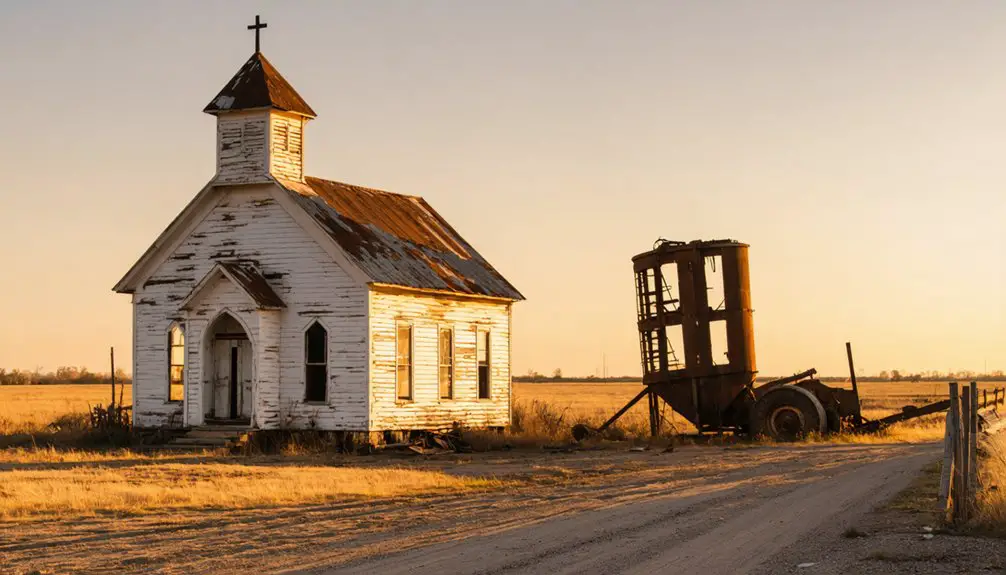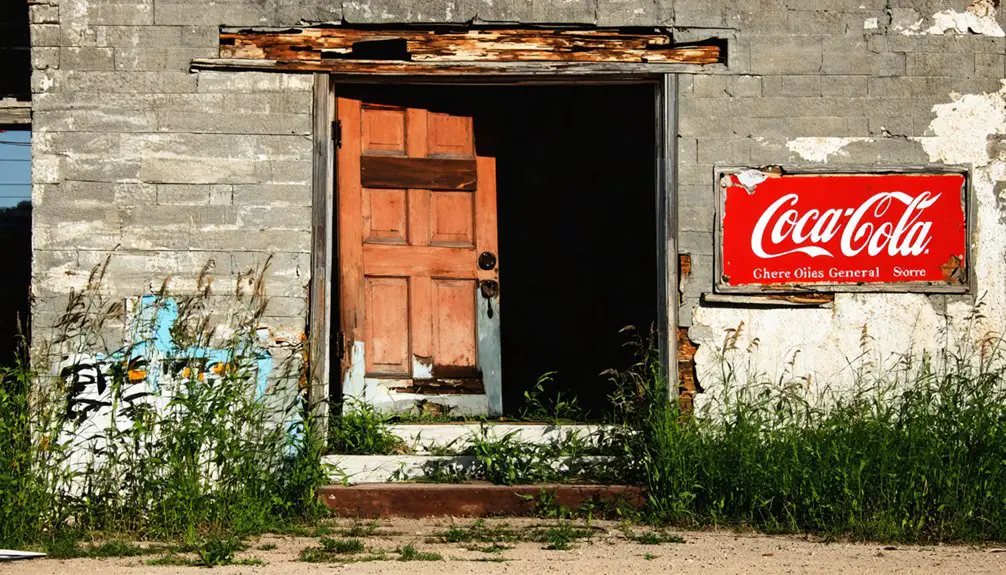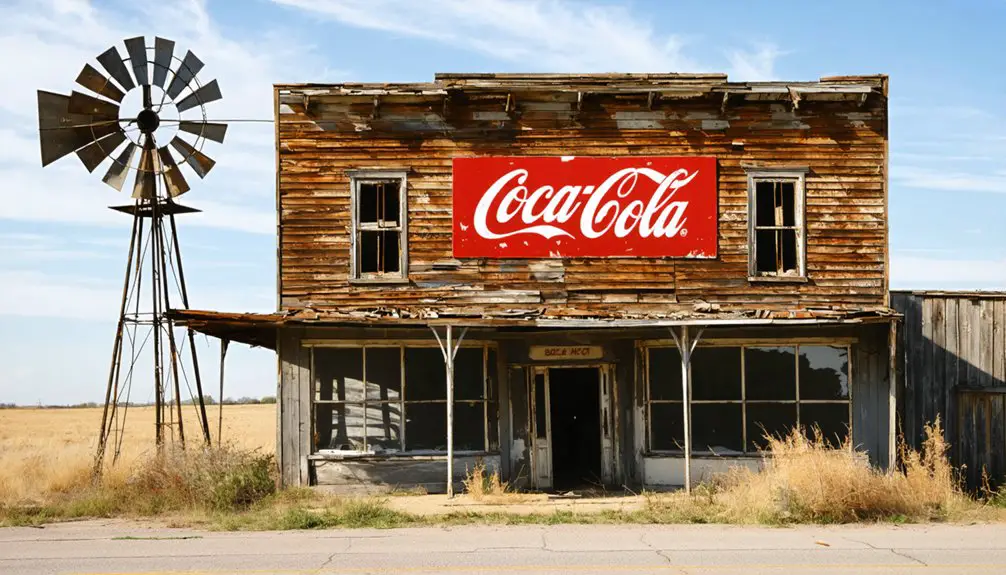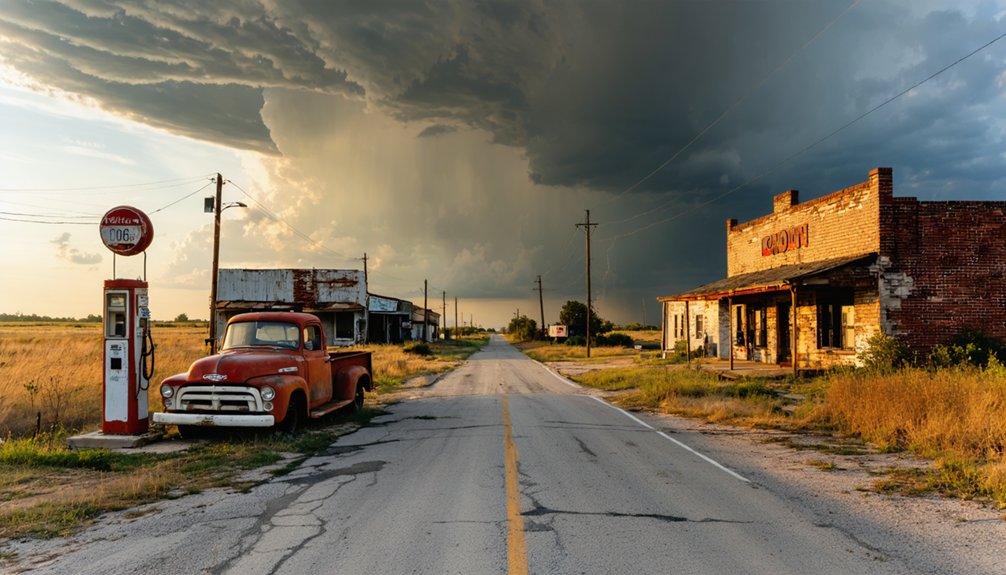
Start your ghost town adventure in Mayes County at Kenmore, then head north to Craig County’s Centralia, where crumbling foundations from 1898-1929 still dot the prairie. You’ll want to download offline maps before venturing out, since cell service gets spotty. Target surviving structures like historic markers, churches, and cemeteries as your anchors, and always respect Leave No Trace principles—photograph everything, but remove nothing. The sections below reveal specific routes, hidden architectural details, and safety tips you’ll need.
Key Takeaways
- Start with Kenmore in Mayes County, then loop through nearby Osage County sites like Barnsdall’s Persing schoolhouse and Avant’s railroad remnants.
- Use ghosttownsinoklahoma.com’s interactive map and download offline maps before venturing into areas with poor cell service.
- Target surviving structures like historic markers, community halls, churches, and cemeteries rather than empty prairie locations.
- Visit during fall for better photography conditions and expect minimal preservation with crumbling foundations at most sites.
- Respect Leave No Trace principles, avoid unstable structures and mine shafts, and photograph everything while removing nothing.
Understanding Ghost Towns in Oklahoma and Mayes County’s Haunted History
When economic winds shift across the Oklahoma plains, entire communities can vanish almost overnight—leaving behind nothing but crumbling foundations and weathered memories. You’ll find roughly two thousand ghost towns scattered across Oklahoma’s history, each telling stories of boom-and-bust cycles, railroad politics, and nature’s fury. Ghost towns meet the definition when populations plummet at least 80 percent from their peak or disappear entirely.
Mayes County holds particular location significance in this haunted landscape. Native American settlements like Alluwe, founded by Delaware Indians in 1872, relocated when Oologah Reservoir swallowed the original site by the 1950s. Nearby Bernice suffered similar fate when Grand Lake o’ the Cherokees flooded its Delaware County birthplace in 1941. These abandoned places beckon you to explore Oklahoma’s untamed past.
Exploring Ghost Towns Near Mayes County Worth Visiting
Your ghost town adventure shouldn’t stop at Mayes County’s borders—some of Oklahoma’s most compelling abandoned settlements sit just beyond, waiting within an hour’s drive. I’ve traced routes through Pawnee, Payne, and Logan counties where you’ll find everything from Ingalls’ standing structures to Skedee’s haunting cemetery and Marshall’s oil-era storefronts frozen in time.
Planning a strategic loop lets you hit four or five sites in a single day, transforming a simple outing into a full-fledged exploration of Oklahoma’s boom-and-bust legacy.
Nearby County Ghost Sites
While Mayes itself lies in Adair County rather than its namesake Mayes County, you’ll find a cluster of fascinating ghost towns scattered across the surrounding counties that make for compelling side trips. Centralia in Craig County, just six miles from the border, offers crumbling foundations from its 1898-1929 boom days. You’ll discover Markham southeast of Pryor in Mayes County proper—an accessible stop with tangible remnants of frontier life.
Over in Cherokee County, Manard (Bayou Menard) stands semi-abandoned since 1966, its schoolhouse closure marking the end of a settlement dating back to 1828. These sites showcase historical Cherokee ties that shaped the region’s identity, while their decay tells the story of regional economic shifts that transformed Oklahoma’s landscape. Each location rewards your curiosity with authentic, unpolished glimpses into territorial history.
Planning Your Route
Oklahoma’s staggering collection of roughly 2,000 ghost towns presents both opportunity and challenge—you’ll need strategy to avoid aimless wandering across hundreds of rural miles. Start with Markham, just six miles southeast of Pryor, then loop north to Alluwe near Oologah Reservoir. You’ll cover three counties in under 50 miles.
Off season visitation during fall offers crisp clarity for photography without summer’s oppressive heat. Ottawa County’s mining circuit—including Zincville—pairs perfectly with Picher if you’re chasing industrial decay. Pawnee County‘s Maramec and Blackburn sit within a 100-mile radius, ideal for ambitious day trips.
On site preservation efforts remain minimal at most locations, so expect crumbling foundations rather than polished exhibits. Document everything—these places won’t wait forever.
The Rise and Fall of Oklahoma’s Most Notable Abandoned Communities
When zinc and lead prices soared during World War I, Oklahoma’s northeastern corner transformed into one of America’s richest mining districts almost overnight. You’d have witnessed Picher’s population explode to 14,252 by 1920, with mining settlement culture creating a bustling network of 1,500 service businesses and trolley lines stretching to Missouri.
The abandoned land usage tells a stark story—over 14,000 miners carved out fortunes before subsidence swallowed Main Street in 1950. By 2010, toxic legacy forced complete evacuation, leaving America’s largest true ghost town.
Similar fates befell communities like Daet and coal-hauling settlements where daily rail shipments once defined prosperity. Highway bypasses and resource depletion sealed their abandonment, preserving authentic fragments of Oklahoma’s boom-and-bust frontier spirit.
What Caused These Once-Thriving Towns to Disappear
You’ll notice a pattern as you explore Oklahoma’s ghost towns: their deaths often came swiftly and decisively. A railroad choosing to lay tracks five miles west instead of through town center could transform a bustling county seat into scattered foundations within a decade.
Floods that swept away Main Street, coal seams that ran dry, or highways that curved around rather than through—these weren’t gradual declines but economic executions that left entire communities hollow.
Economic Boom and Bust
Like many rural Oklahoma settlements, Mayes rose and fell with forces beyond its residents’ control. You’ll find the town’s story mirrors countless communities crushed between market deregulation and commodity speculation.
When wheat prices soared in 1920, Mayes peaked at 324 souls riding that agricultural wave. But relying solely on grain shipments meant every market downturn hit harder than the last.
The North Canadian River didn’t help—flooding repeatedly demolished what residents rebuilt. World War II pulled young men away, and they discovered opportunities elsewhere. Population plummeted from 239 to 143 between 1940 and 1950.
When the high school shuttered in 1957, families left. The railway abandoned Mayes in 1972, severing its economic lifeline. Without rails to ship wheat, the town’s original purpose vanished completely.
Railroad Route Changes
Railroad companies held the power of life and death over Oklahoma settlements, and they wielded it ruthlessly. When the Missouri-Kansas-Texas Railroad bypassed Boggy Depot and North Fork Town in 1872, these once-bustling trade centers withered overnight. Railroad incentives determined survival—communities that paid for tracks lived, while those that didn’t faced extinction.
Town site selection often favored new settlements over established ones. Railroad subsidiaries platted fresh towns like Hope and Denison, profiting from both freight and land speculation. You’ll see this pattern repeated across Oklahoma: Parkersburg’s 700 residents relocated three miles east when two lines intersected at Clinton in 1904. Eschiti never stood a chance after rival promoters secured the Wichita Falls and Northwestern right-of-way elsewhere in 1907.
Natural Disaster Impact
Nature proved as merciless as any railroad executive in erasing Oklahoma settlements from the map. You’ll discover towns swallowed by forces beyond human control, where survivors simply packed up and moved on.
Three Natural Disasters That Created Ghost Towns:
- North Canadian River floods repeatedly devastated May and Burke City, forcing residents to abandon waterlogged streets and collapsed buildings
- F5 tornadoes like the 1947 Woodward twister that obliterated Glazier, leaving nothing but rubble and memories
- Flooded mine shaft issues combined with environmental contamination accelerated Picher’s evacuation, making it Oklahoma’s most infamous modern ghost town
Understanding these disasters reveals the harsh reality of frontier life—when nature strikes, you rebuild elsewhere or disappear entirely. Ghost town formation wasn’t always about economics; sometimes Mother Nature simply reclaimed her territory.
What to Look for When Exploring Ghost Town Remnants
When you first step onto the dusty streets of a ghost town, your eyes will likely dart between weathered storefronts and skeletal building frames, searching for clues about the lives once lived here. Focus on architectural details—sun-bleached window frames, lichen-covered bathtubs in dimly-lit interiors, and floating crosses still hanging in doorways. These authentic artifacts tell stories preservation tactics aim to protect.
Watch for mining equipment scattered across hillsides and period relics left exactly as residents abandoned them. Prominent brick smokestacks mark former mining hubs, while on-site signs identify workshop foundations and gun emplacements.
Always assess structural integrity concerns before approaching buildings. Stick to established paths, avoiding unstable structures and hidden mine shafts. Respect Leave No Trace principles—photograph everything, but remove nothing from these National Historic Landmarks.
Planning Your Route Through Oklahoma’s Forgotten Places

Before you load your camera gear and hit Oklahoma’s backroads, understand that mapping a ghost town route requires balancing historical significance with practical accessibility. Start with ghosttownsinoklahoma.com’s interactive Google map, then cross-reference the 1966 historic map showing post office dates to prioritize stops.
Smart ghost town hunting starts with layering digital maps over historic post office records to separate worthy destinations from empty prairie.
Essential Route-Planning Steps:
- Cluster your destinations – Focus on Mayes County’s Kenmore, then loop through nearby Osage County sites like Barnsdall’s Persing schoolhouse and Avant’s railroad remnants
- Scout for landmarks – Target surviving structures: historic markers, community halls, churches, and cemeteries that anchor your exploration
- Build backup options – Natural disasters and reservoir construction erased many sites, so identify alternative stops when map dots reveal empty fields
Download offline maps before venturing into areas where cell service vanishes along forgotten highways.
Frequently Asked Questions
What Permits or Permissions Are Needed to Explore Abandoned Ghost Town Sites?
You’ll need to obtain landowner permission before exploring, as trespassing laws still apply to abandoned sites. Most ghost towns sit on private property, so respect boundaries. However, public roads through these areas remain accessible for your adventure.
Are There Lodging Options Available Near Mayes County for Overnight Stays?
You’ll find plenty of budget hotel options in Pryor, from Hampton Inn to Days Inn starting at $70 nightly. Nearby cabin rentals offer rustic charm if you’re craving solitude. Free cancellation means you’re never locked in—pure traveling freedom.
What Safety Equipment Should I Bring When Visiting Ghost Town Locations?
Picture yourself exploring abandoned ruins safely—you’ll need personal protective equipment like helmets, gloves, and respirators. Check local safety guidelines beforehand. I’ve learned firsthand that sturdy boots, flashlights, and first-aid kits prove essential for adventure-ready explorers.
Can I Legally Take Artifacts or Souvenirs From Ghost Town Sites?
No, you can’t legally take artifacts from ghost towns. Historical artifact laws protect these sites, and artifact preservation guidelines prohibit removal from federal, state, or private lands. You’ll face serious fines and potential jail time if caught.
What Are the Best Seasons to Visit Oklahoma Ghost Towns?
Spring and fall are *absolutely perfect* for shoulder season visits to Oklahoma ghost towns. You’ll find ideal weather conditions—comfortable temps, minimal rainfall, and fewer crowds—letting you explore freely without summer’s scorching heat or winter’s icy limitations.